Recognition: unknown
Reachable-Set Decomposition for Real-Time Aggregation of Multi-Zone HVAC Fleets
Pith reviewed 2026-05-14 17:40 UTC · model grok-4.3
The pith
Reachable-set decomposition encodes future feasibility into current state constraints for multi-zone HVAC fleet aggregation.
A machine-rendered reading of the paper's core claim, the machinery that carries it, and where it could break.
Core claim
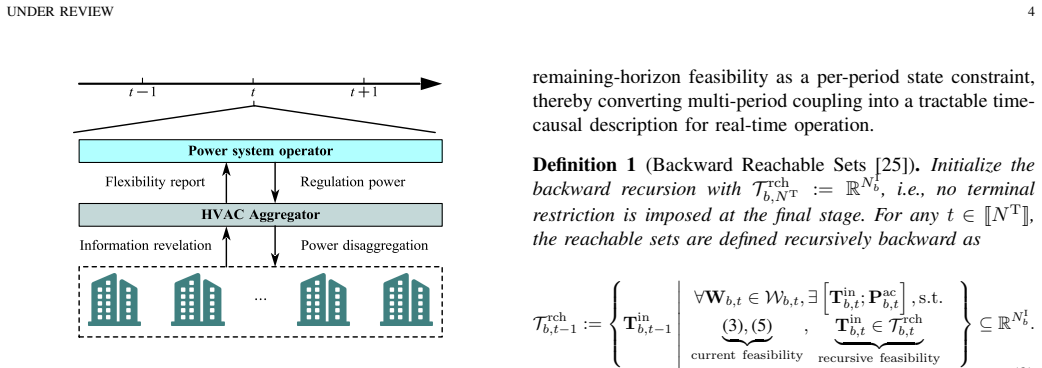
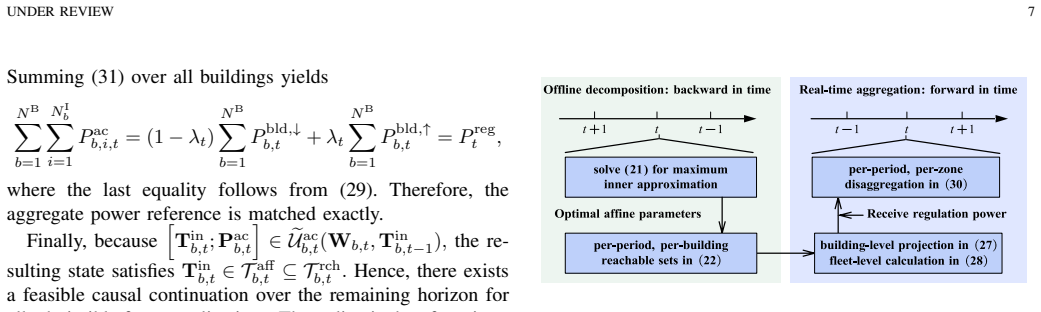
The central claim is that backward reachable sets, once computed offline and inner-approximated, convert the remaining-horizon feasibility requirement into per-period state constraints; any state inside the current reachable set therefore sustains feasible HVAC operation over the full horizon, and any regulation signal inside the flexibility interval computed from those sets admits a recursively feasible disaggregation through the real-time policy of parallel linear programs and Minkowski summation.
What carries the argument
Backward reachable sets with a tailored inner approximation that encode remaining-horizon feasibility into per-period state constraints for coupled multi-zone HVAC dynamics.
If this is right
- Aggregate flexibility intervals can be computed in real time using only parallel building-level linear programs and closed-form summation.
- Any regulation signal inside the reported interval admits a recursively feasible disaggregation over the remaining horizon.
- Strong coupling across zones and time is handled without solving a single high-dimensional optimization at each step.
- Sequential revelation of temperature states and exogenous conditions preserves feasibility using only currently realized information.
Where Pith is reading between the lines
- The same decomposition could be applied to fleets of other coupled dynamic resources such as water heaters or EV chargers that face similar multi-period feasibility requirements.
- Real-time policies derived this way could be embedded inside larger grid-level optimization layers without needing to re-solve the full building dynamics at every market clearing.
- If the inner approximation error can be bounded analytically, the method might yield provable guarantees on the gap between the reported flexibility and the true maximum flexibility.
Load-bearing premise
The tailored inner approximation of the backward reachable sets must stay tight enough for multi-zone HVAC dynamics without adding so much conservatism that usable flexibility shrinks excessively.
What would settle it
A regulation signal inside the reported flexibility interval produces an infeasible temperature trajectory when applied to the actual coupled multi-zone dynamics in a closed-loop simulation.
Figures



read the original abstract
Aggregating building heating, ventilation, and air-conditioning (HVAC) fleets provides substantial real-time flexibility to power system operations. However, real-time aggregation of multi-zone HVAC fleets faces two key challenges: (i) strong coupling across zones and time makes flexibility characterization high-dimensional and computationally demanding, and (ii) the sequential revelation of temperature states and exogenous conditions requires that decisions made at each period preserve feasibility over the remaining horizon using only currently realized information. To address these challenges, this paper proposes a reachable-set decomposition framework comprising an offline decomposition stage and a real-time policy. In the offline stage, backward reachable sets are formulated to encode remaining-horizon feasibility into per-period state constraints, so that any state within the current reachable set is guaranteed to sustain feasible operation over the entire remaining horizon. A tailored inner approximation is then developed for tractable calculation in multi-zone-coupled HVAC settings. In the real-time stage, aggregate flexibility is computed efficiently via building-level parallel linear programs followed by closed-form Minkowski summation of power intervals, and any regulation signal within the reported flexibility interval admits a recursively feasible disaggregation. Case studies demonstrate the effectiveness of the proposed framework in aggregate flexibility characterization, disaggregation feasibility, and scalable computation.
Editorial analysis
A structured set of objections, weighed in public.
Referee Report
Summary. The paper proposes a reachable-set decomposition framework for real-time aggregation of multi-zone HVAC fleets to provide power system flexibility. In the offline stage, backward reachable sets encode remaining-horizon feasibility into per-period state constraints, with a tailored inner approximation developed for tractability under zone coupling. In the real-time stage, aggregate flexibility is computed via building-level parallel linear programs followed by closed-form Minkowski summation of power intervals, with the claim that any regulation signal within the reported interval admits a recursively feasible disaggregation. Case studies are used to demonstrate effectiveness in flexibility characterization, disaggregation, and computation.
Significance. If the inner approximations are rigorously contained in the true backward reachable sets and remain sufficiently tight, the framework would provide a sound set-theoretic method for scalable, recursively feasible HVAC aggregation that avoids parameter fitting and handles sequential information revelation. This could meaningfully advance reliable demand-side flexibility services. The parallel LP structure and Minkowski summation are computationally attractive strengths, and the avoidance of empirical fitting to flexibility quantities is a methodological plus. However, the significance is currently limited by the absence of explicit inclusion proofs and quantitative tightness metrics.
major comments (3)
- [Section 3] Offline decomposition stage (Section 3): The central guarantee that any state inside the (approximated) reachable set sustains feasible operation over the remaining horizon requires an explicit proof that the tailored inner approximation is contained in the true backward reachable set for the coupled multi-zone HVAC dynamics. No such subset-inclusion argument is referenced, leaving the recursive feasibility claim unestablished.
- [Section 5] Case studies (Section 5): No quantitative metrics are reported on approximation error (e.g., Hausdorff distance or volume ratio between inner approximation and true reachable set), tightness, or comparison against full-horizon optimization. This absence makes it impossible to evaluate conservatism or the practical size of the usable flexibility intervals.
- [Section 4] Real-time policy (Section 4): The claim that any regulation signal within the Minkowski-summed interval admits a recursively feasible disaggregation inherits the same approximation risk; the disaggregation procedure and its feasibility proof under the inner approximation must be stated explicitly with conditions for recursive feasibility.
minor comments (3)
- Notation for reachable sets and Minkowski sums should be introduced with a dedicated symbol table or appendix to improve readability across sections.
- Figure captions for reachable-set visualizations should explicitly state whether plotted sets are exact, inner approximations, or projections.
- Additional references to prior work on backward reachability in constrained control and HVAC aggregation (e.g., set-theoretic methods for demand response) would strengthen the positioning.
Simulated Author's Rebuttal
We thank the referee for the constructive and detailed comments, which highlight important aspects for strengthening the rigor of the reachable-set decomposition framework. We address each major comment point by point below and will incorporate the necessary revisions to establish the claims more explicitly.
read point-by-point responses
-
Referee: [Section 3] Offline decomposition stage (Section 3): The central guarantee that any state inside the (approximated) reachable set sustains feasible operation over the remaining horizon requires an explicit proof that the tailored inner approximation is contained in the true backward reachable set for the coupled multi-zone HVAC dynamics. No such subset-inclusion argument is referenced, leaving the recursive feasibility claim unestablished.
Authors: We agree that an explicit subset-inclusion proof is required to rigorously support the recursive feasibility guarantee. The manuscript constructs the inner approximation via a tailored relaxation that preserves key invariance properties of the HVAC dynamics (specifically, the linear coupling structure and box constraints on temperatures), but the current text does not spell out the inclusion argument. In the revision we will add a formal lemma in Section 3 proving that the inner approximation is contained in the true backward reachable set, using induction on the remaining horizon and the fact that the approximation is obtained by intersecting the true set with a conservative linear outer bound derived from the zone-coupling matrix. revision: yes
-
Referee: [Section 5] Case studies (Section 5): No quantitative metrics are reported on approximation error (e.g., Hausdorff distance or volume ratio between inner approximation and true reachable set), tightness, or comparison against full-horizon optimization. This absence makes it impossible to evaluate conservatism or the practical size of the usable flexibility intervals.
Authors: We acknowledge that quantitative assessment of approximation quality is essential for evaluating conservatism. The case studies currently focus on end-to-end performance (flexibility intervals and disaggregation success), but do not report Hausdorff distances or volume ratios. In the revised manuscript we will augment Section 5 with these metrics for the single-building and multi-building instances, computed via vertex enumeration of the low-dimensional reachable sets where tractable, together with a direct comparison of the approximated flexibility intervals against those obtained from a full-horizon mixed-integer program. revision: yes
-
Referee: [Section 4] Real-time policy (Section 4): The claim that any regulation signal within the Minkowski-summed interval admits a recursively feasible disaggregation inherits the same approximation risk; the disaggregation procedure and its feasibility proof under the inner approximation must be stated explicitly with conditions for recursive feasibility.
Authors: We will revise Section 4 to present the disaggregation algorithm explicitly as a sequence of per-building linear programs whose feasible sets are defined by the inner-approximated reachable sets. We will then add a theorem stating that, provided the inner approximation is a subset of the true backward reachable set (as proved in the revised Section 3), any regulation signal inside the Minkowski-summed interval admits a recursively feasible disaggregation at every time step. The proof follows directly from the per-period feasibility encoded by the inner sets and the closed-form summation. revision: yes
Circularity Check
No significant circularity in reachable-set decomposition framework
full rationale
The paper defines backward reachable sets explicitly to encode remaining-horizon feasibility into per-period constraints, so the guarantee that states inside the set sustain feasible operation follows directly from the set-theoretic definition rather than any reduction to fitted inputs or self-referential equations. The tailored inner approximation is introduced for computational tractability while preserving inclusion, and aggregate flexibility is obtained via parallel per-building LPs followed by closed-form Minkowski summation; neither step fits parameters to the target flexibility interval nor renames a known result. No self-citations appear load-bearing, no uniqueness theorems are imported from prior author work, and no ansatz is smuggled via citation. The derivation chain remains self-contained against standard reachable-set constructions and set operations.
Axiom & Free-Parameter Ledger
axioms (2)
- domain assumption Multi-zone HVAC dynamics admit a linear state-space representation with inter-zone thermal coupling
- domain assumption Temperature and exogenous disturbances evolve such that backward reachable sets can be computed or approximated offline
Reference graph
Works this paper leans on
-
[1]
A control framework to enable a commercial building HV AC system for energy and regulation market signal tracking,
W. Wang, G. Tian, Q. Z. Sun, and H. Liu, “A control framework to enable a commercial building HV AC system for energy and regulation market signal tracking,”IEEE Transactions on Power Systems, vol. 38, no. 1, pp. 290–301, 2023
2023
-
[2]
Real-time flexibility quantification of a building HV AC system for peak demand reduction,
G. Tian, Q. Z. Sun, and W. Wang, “Real-time flexibility quantification of a building HV AC system for peak demand reduction,”IEEE Transactions on Power Systems, vol. 37, no. 5, pp. 3862–3874, 2022
2022
-
[3]
An analytical feasibility condition for the multi-stage robust scheduling of energy storage systems with application on SCUC,
J. Zhao, Q. Zhai, Y . Zhou, and X. Cao, “An analytical feasibility condition for the multi-stage robust scheduling of energy storage systems with application on SCUC,”IEEE Transactions on Power Systems, vol. 40, no. 1, pp. 435–448, 2025
2025
-
[4]
Preference-oriented aggregation of heterogeneous distributed energy resources for reserve dispatch,
J. Liu, X. Ai, S. Cui, X. Xue, S. Wang, J. Fang, W. Yao, and J. Wen, “Preference-oriented aggregation of heterogeneous distributed energy resources for reserve dispatch,”IEEE Transactions on Smart Grid, vol. 17, no. 2, pp. 1264–1279, 2026
2026
-
[5]
A geometric approach to aggregate flexibility modeling of thermostatically controlled loads,
L. Zhao, W. Zhang, H. Hao, and K. Kalsi, “A geometric approach to aggregate flexibility modeling of thermostatically controlled loads,” IEEE Transactions on Power Systems, vol. 32, no. 6, pp. 4721–4731, 2017
2017
-
[6]
Wholesale market partic- ipation of DERAs: DSO-DERA-ISO coordination,
C. Chen, S. Bose, T. D. Mount, and L. Tong, “Wholesale market partic- ipation of DERAs: DSO-DERA-ISO coordination,”IEEE Transactions on Power Systems, vol. 39, no. 5, pp. 6605–6614, 2024
2024
-
[7]
Mean-Field Learning for Storage Aggregation
J. Liu, C. Chen, X. Ai, J. Fang, J. Wang, and J. Wen, “Mean-field learning for storage aggregation,”arXiv preprint arXiv:2601.21039, 2026
work page internal anchor Pith review Pith/arXiv arXiv 2026
-
[8]
Aggregate modeling of thermostatically controlled loads for microgrid energy management systems,
S. C ´ordova, C. A. Ca ˜nizares, ´A. Lorca, and D. E. Olivares, “Aggregate modeling of thermostatically controlled loads for microgrid energy management systems,”IEEE Transactions on Smart Grid, vol. 14, no. 6, pp. 4169–4181, 2023
2023
-
[9]
An efficient method for quantifying the aggregate flexibility of plug-in electric vehicle populations,
F. Al Taha, T. Vincent, and E. Bitar, “An efficient method for quantifying the aggregate flexibility of plug-in electric vehicle populations,”IEEE Transactions on Smart Grid, vol. 16, no. 4, pp. 3142–3154, 2025
2025
-
[10]
Coupling-aware aggregation of multi-zone HV AC loads under uncertainty: A two-level framework,
J. Liu, H. Jiang, X. Ai, S. Wang, X. Xue, S. Cui, J. Hou, J. Fang, and J. Wen, “Coupling-aware aggregation of multi-zone HV AC loads under uncertainty: A two-level framework,”IEEE Transactions on Smart Grid, 2025
2025
-
[11]
Scalable building HV AC control through laxity-based reinforcement learning,
R. Liu, Y . Pan, and Y . Chen, “Scalable building HV AC control through laxity-based reinforcement learning,”IEEE Transactions on Smart Grid, 2026
2026
-
[12]
Uncertainty- aware flexibility of HV AC systems in buildings: From quantification to provision,
J. Rousseau, H. Cai, P. Heer, K. Orehounig, and G. Hug, “Uncertainty- aware flexibility of HV AC systems in buildings: From quantification to provision,”IEEE Transactions on Smart Grid, vol. 17, no. 1, pp. 269– 282, 2026
2026
-
[13]
Multistage adaptive robust optimization for the unit commitment problem,
A. Lorca, X. A. Sun, E. Litvinov, and T. Zheng, “Multistage adaptive robust optimization for the unit commitment problem,”Operations Research, vol. 64, no. 1, pp. 32–51, 2016
2016
-
[14]
Energy efficiency of commercial HV AC-based virtual batteries for load shifting,
W. Wu, S. Lei, Q. Z. Sun, and J. L. Mathieu, “Energy efficiency of commercial HV AC-based virtual batteries for load shifting,”IEEE Transactions on Power Systems, 2026
2026
-
[15]
Thermal battery modeling of inverter air conditioning for demand response,
M. Song, C. Gao, H. Yan, and J. Yang, “Thermal battery modeling of inverter air conditioning for demand response,”IEEE Transactions on Smart Grid, vol. 9, no. 6, pp. 5522–5534, 2018
2018
-
[16]
Analytical solutions of air-conditioning load flexibility,
B. Han, H. Li, and S. Wang, “Analytical solutions of air-conditioning load flexibility,”IEEE Transactions on Smart Grid, vol. 16, no. 1, pp. 441–444, 2024
2024
-
[17]
A concise, approximate representation of a collection of loads described by polytopes,
S. Barot and J. A. Taylor, “A concise, approximate representation of a collection of loads described by polytopes,”International Journal of Electrical Power & Energy Systems, vol. 84, pp. 55–63, 2017
2017
-
[18]
Distributed energy resource and energy storage investment for enhancing flexibility under a TSO-DSO coor- dination framework,
C. Gu, J. Wang, and L. Wu, “Distributed energy resource and energy storage investment for enhancing flexibility under a TSO-DSO coor- dination framework,”IEEE Transactions on Automation Science and Engineering, vol. 21, no. 3, pp. 2961–2973, 2024
2024
-
[19]
Leveraging two-stage adaptive robust optimization for power flexibility aggregation,
X. Chen and N. Li, “Leveraging two-stage adaptive robust optimization for power flexibility aggregation,”IEEE Transactions on Smart Grid, vol. 12, no. 5, pp. 3954–3965, 2021
2021
-
[20]
New insights from the Shapley-Folkman lemma on dispatchable demand in energy markets,
K. Hreinsson, A. Scaglione, M. Alizadeh, and Y . Chen, “New insights from the Shapley-Folkman lemma on dispatchable demand in energy markets,”IEEE Transactions on Power Systems, vol. 36, no. 5, pp. 4028– 4041, 2021
2021
-
[21]
Network-cognizant time-coupled aggregate flexibility of distribution systems under uncertainties,
B. Cui, A. Zamzam, and A. Bernstein, “Network-cognizant time-coupled aggregate flexibility of distribution systems under uncertainties,” in2021 American Control Conference (ACC). IEEE, 2021, pp. 4178–4183
2021
-
[22]
Aggregate flexibility of virtual power plants with temporal coupling constraints,
S. Wang and W. Wu, “Aggregate flexibility of virtual power plants with temporal coupling constraints,”IEEE Transactions on Smart Grid, vol. 12, no. 6, pp. 5043–5051, 2021
2021
-
[23]
Two-stage carbon-oriented scheduling of an active distribution network with thermostatically controlled load aggregators,
M. Zhang, Y . Xu, and Z. Yi, “Two-stage carbon-oriented scheduling of an active distribution network with thermostatically controlled load aggregators,”IEEE Transactions on Sustainable Energy, vol. 15, no. 3, pp. 1462–1474, 2024
2024
-
[24]
Reach set computation and con- trol synthesis for discrete-time dynamical systems with disturbances,
A. A. Kurzhanskiy and P. Varaiya, “Reach set computation and con- trol synthesis for discrete-time dynamical systems with disturbances,” Automatica, vol. 47, no. 7, pp. 1414–1426, 2011
2011
-
[25]
Data-driven robust backward reachable sets for set-theoretic model predictive control,
M. Attar and W. Lucia, “Data-driven robust backward reachable sets for set-theoretic model predictive control,”IEEE Control Systems Letters, vol. 7, pp. 2305–2310, 2023
2023
-
[26]
Backward reachability analysis of perturbed continuous-time linear systems using set propagation,
M. Wetzlinger and M. Althoff, “Backward reachability analysis of perturbed continuous-time linear systems using set propagation,”IEEE Transactions on Automatic Control, 2025
2025
-
[27]
Decision-oriented modeling of thermal dynamics within buildings,
X. Cui, J.-F. Toubeau, F. Vallee, and Y . Wang, “Decision-oriented modeling of thermal dynamics within buildings,”IEEE Transactions on Smart Grid, vol. 16, no. 1, pp. 369–382, 2024
2024
-
[28]
Unlocking energy flexibility from thermal inertia of buildings: A robust optimization approach,
Y . Li, N. Yorke-Smith, and T. Keviczky, “Unlocking energy flexibility from thermal inertia of buildings: A robust optimization approach,” in 2023 62nd IEEE Conference on Decision and Control (CDC). IEEE, 2023, pp. 2555–2562
2023
-
[29]
Development of RC model for thermal dynamic analysis of buildings through model structure simplification,
Z. Wang, Y . Chen, and Y . Li, “Development of RC model for thermal dynamic analysis of buildings through model structure simplification,” Energy and Buildings, vol. 195, pp. 51–67, 2019
2019
-
[30]
Finite horizon backward reachability analysis and control synthesis for uncertain nonlinear sys- tems,
H. Yin, A. Packard, M. Arcak, and P. Seiler, “Finite horizon backward reachability analysis and control synthesis for uncertain nonlinear sys- tems,” in2019 American Control Conference (ACC). IEEE, 2019, pp. 5020–5026
2019
-
[31]
Linear encodings for polytope contain- ment problems,
S. Sadraddini and R. Tedrake, “Linear encodings for polytope contain- ment problems,” in2019 IEEE 58th conference on decision and control (CDC). IEEE, 2019, pp. 4367–4372
2019
discussion (0)
Sign in with ORCID, Apple, or X to comment. Anyone can read and Pith papers without signing in.