Recognition: no theorem link
R-DMesh: Video-Guided 3D Animation via Rectified Dynamic Mesh Flow
Pith reviewed 2026-05-14 19:05 UTC · model grok-4.3
The pith
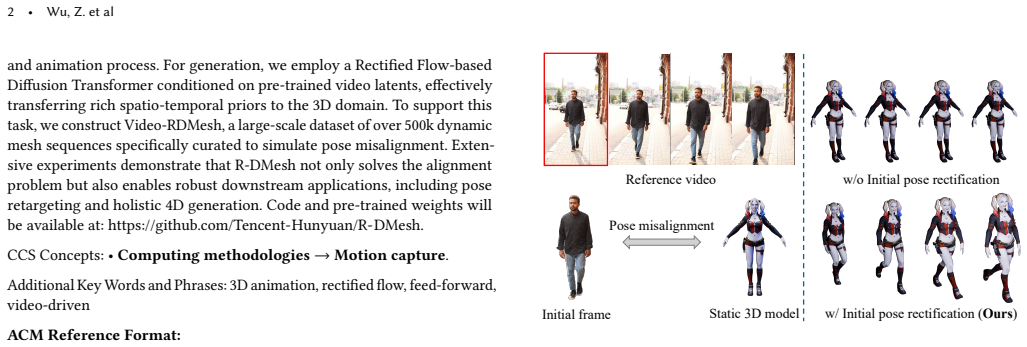
R-DMesh generates 4D meshes from video by learning a rectification offset that aligns mismatched input poses before animation.
A machine-rendered reading of the paper's core claim, the machinery that carries it, and where it could break.
Core claim
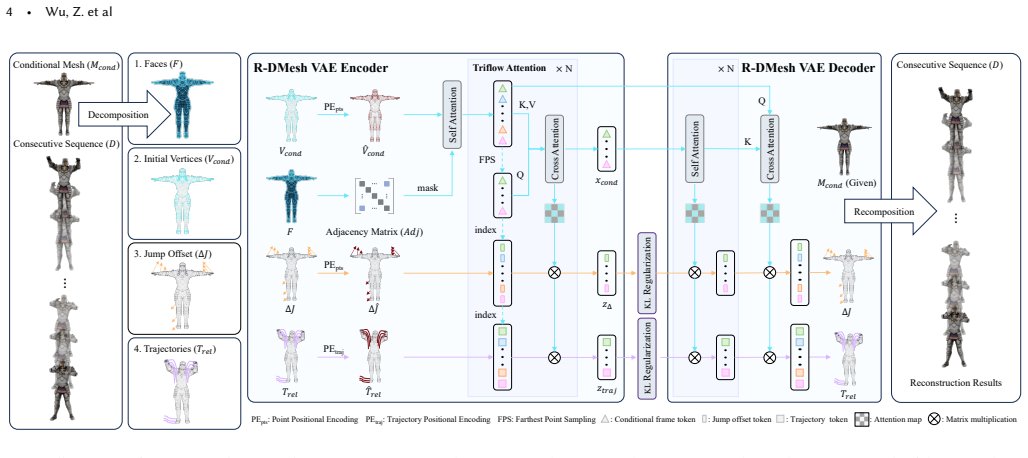
A variational autoencoder explicitly learns a rectification jump offset that transforms an arbitrary input mesh pose to match the video's initial state; this offset is then combined with relative motion trajectories and processed by Triflow Attention, which modulates three orthogonal flows with vertex-wise geometric features to maintain physical consistency and local rigidity throughout both the rectification step and subsequent animation, all inside a Rectified Flow-based Diffusion Transformer conditioned on video latents.
What carries the argument
The rectification jump offset inside the VAE, which learns to map any starting mesh pose onto the video's first frame before motion transfer begins.
If this is right
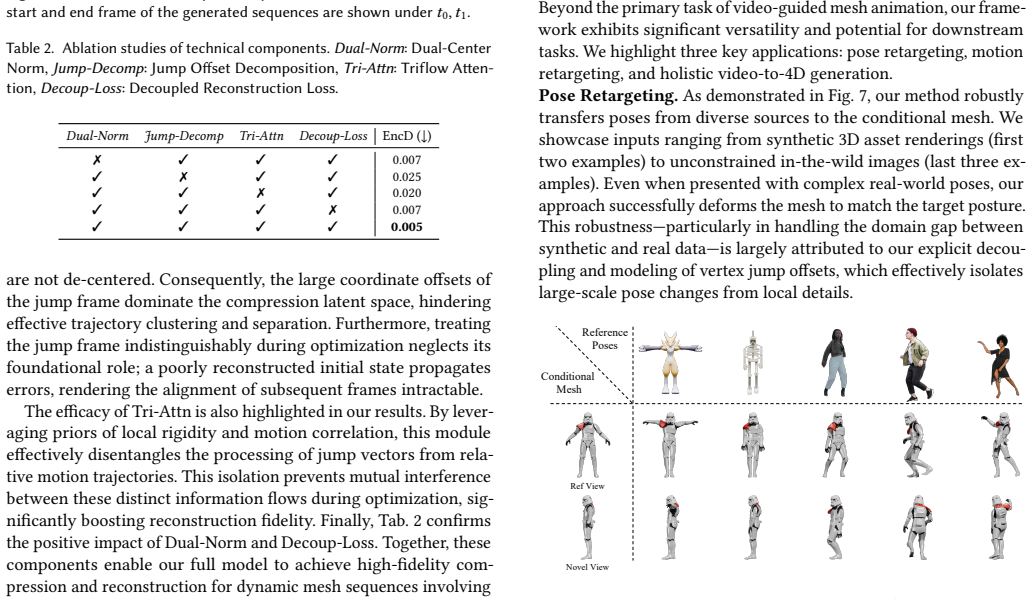
- Pose retargeting can be performed without manual pre-alignment of the source mesh.
- Holistic 4D mesh sequences can be generated from video even when the supplied mesh begins in an unrelated pose.
- Spatio-temporal priors from large video models transfer directly to the 3D domain while preserving local rigidity.
- Downstream applications such as AR content creation become feasible without per-instance pose correction.
Where Pith is reading between the lines
- The same rectification idea could be tested on non-rigid objects whose deformation modes exceed the local-rigidity assumptions of Triflow Attention.
- The Video-RDMesh dataset could serve as a public benchmark for measuring robustness to initial-pose variation in future 4D methods.
- Real-time video capture pipelines might incorporate the rectification offset to enable live 4D mesh animation from casual phone footage.
- Similar jump-offset mechanisms could be explored for audio- or text-conditioned animation where the driving signal also starts at an arbitrary temporal offset.
Load-bearing premise
The learned rectification offset can always map arbitrary input mesh poses onto the video starting frame without creating geometric distortion or violating the physical consistency later enforced by Triflow Attention.
What would settle it
Generate outputs from input meshes whose initial poses differ sharply from the video start frame and inspect the results for collapsed geometry, self-intersections, or loss of local rigidity that the rectification step was supposed to prevent.
Figures





read the original abstract
Video-guided 3D animation holds immense potential for content creation, offering intuitive and precise control over dynamic assets. However, practical deployment faces a critical yet frequently overlooked hurdle: the pose misalignment dilemma. In real-world scenarios, the initial pose of a user-provided static mesh rarely aligns with the starting frame of a reference video. Naively forcing a mesh to follow a mismatched trajectory inevitably leads to severe geometric distortion or animation failure. To address this, we present Rectified Dynamic Mesh (R-DMesh), a unified framework designed to generate high-fidelity 4D meshes that are ``rectified'' to align with video context. Unlike standard motion transfer approaches, our method introduces a novel VAE that explicitly disentangles the input into a conditional base mesh, relative motion trajectories, and a crucial rectification jump offset. This offset is learned to automatically transform the arbitrary pose of the input mesh to match the video's initial state before animation begins. We process these components via a Triflow Attention mechanism, which leverages vertex-wise geometric features to modulate the three orthogonal flows, ensuring physical consistency and local rigidity during the rectification and animation process. For generation, we employ a Rectified Flow-based Diffusion Transformer conditioned on pre-trained video latents, effectively transferring rich spatio-temporal priors to the 3D domain. To support this task, we construct Video-RDMesh, a large-scale dataset of over 500k dynamic mesh sequences specifically curated to simulate pose misalignment. Extensive experiments demonstrate that R-DMesh not only solves the alignment problem but also enables robust downstream applications, including pose retargeting and holistic 4D generation.
Editorial analysis
A structured set of objections, weighed in public.
Referee Report
Summary. The paper introduces R-DMesh, a unified framework for video-guided 3D animation that resolves pose misalignment between user-provided static meshes and reference videos. It uses a VAE to disentangle the input into a conditional base mesh, relative motion trajectories, and a rectification jump offset, which is learned to align the mesh pose with the video's initial frame. These are processed using Triflow Attention for physical consistency and a Rectified Flow-based Diffusion Transformer conditioned on video latents. A new Video-RDMesh dataset with over 500k sequences is constructed to support training and evaluation.
Significance. If the learned rectification offset and Triflow Attention successfully maintain geometric fidelity and physical consistency without distortion, the method could significantly improve practical deployment of 4D mesh animation from videos by handling arbitrary input poses, enabling applications like pose retargeting and holistic 4D generation in content creation.
major comments (2)
- [Abstract] Abstract: The rectification jump offset is described only as 'learned to automatically transform the arbitrary pose of the input mesh to match the video's initial state', with no specification of its parameterization (rigid 6-DoF vs. per-vertex displacement field), associated loss terms for rigidity/alignment, or supervision details from the Video-RDMesh data. This is load-bearing for the central claim that the offset prevents geometric distortion before Triflow Attention is applied.
- [Abstract] Abstract: The claim that 'extensive experiments demonstrate that R-DMesh not only solves the alignment problem' is unsupported by any reported quantitative metrics, ablation results, error analysis, or verification that the offset avoids introducing distortion; without these, the effectiveness of the VAE disentanglement and downstream consistency cannot be assessed.
minor comments (1)
- [Abstract] Abstract: 'Triflow Attention' is introduced without a brief inline description of how it modulates the three orthogonal flows using vertex-wise features, which would improve immediate clarity for readers.
Axiom & Free-Parameter Ledger
free parameters (1)
- rectification jump offset
axioms (1)
- domain assumption Triflow Attention on vertex-wise geometric features guarantees physical consistency and local rigidity during rectification and animation
invented entities (1)
-
rectification jump offset
no independent evidence
Reference graph
Works this paper leans on
-
[1]
Patricia S. Abril and Robert Plant. The patent holder's dilemma: Buy, sell, or troll?. Communications of the ACM. 2007. doi:10.1145/1188913.1188915
-
[2]
Deciding equivalances among conjunctive aggregate queries
Sarah Cohen and Werner Nutt and Yehoshua Sagic. Deciding equivalances among conjunctive aggregate queries. 2007. doi:10.1145/1219092.1219093
-
[3]
Special issue: Digital Libraries. 1996
work page 1996
-
[4]
Understanding Policy-Based Networking
David Kosiur. Understanding Policy-Based Networking. 2001
work page 2001
-
[7]
The title of book two. 2008. doi:10.1007/3-540-09237-4
-
[8]
Asad Z. Spector. Achieving application requirements. Distributed Systems. 1990. doi:10.1145/90417.90738
-
[9]
Douglass and David Harel and Mark B
Bruce P. Douglass and David Harel and Mark B. Trakhtenbrot. Statecarts in use: structured analysis and object-orientation. Lectures on Embedded Systems. 1998. doi:10.1007/3-540-65193-4_29
-
[10]
Donald E. Knuth. The Art of Computer Programming, Vol. 1: Fundamental Algorithms (3rd. ed.). 1997
work page 1997
-
[11]
Donald E. Knuth. The Art of Computer Programming. 1998
work page 1998
-
[12]
Structured Variational Inference Procedures and their Realizations (as incol)
Dan Geiger and Christopher Meek. Structured Variational Inference Procedures and their Realizations (as incol). Proceedings of Tenth International Workshop on Artificial Intelligence and Statistics, The Barbados
-
[13]
Stan W. Smith. An experiment in bibliographic mark-up: Parsing metadata for XML export. Proceedings of the 3rd. annual workshop on Librarians and Computers. 2010. doi:99.9999/woot07-S422
work page 2010
-
[14]
Catch me, if you can: Evading network signatures with web-based polymorphic worms
Matthew Van Gundy and Davide Balzarotti and Giovanni Vigna. Catch me, if you can: Evading network signatures with web-based polymorphic worms. Proceedings of the first USENIX workshop on Offensive Technologies. 2007
work page 2007
-
[15]
Catch me, if you can: Evading network signatures with web-based polymorphic worms
Matthew Van Gundy and Davide Balzarotti and Giovanni Vigna. Catch me, if you can: Evading network signatures with web-based polymorphic worms. Proceedings of the first USENIX workshop on Offensive Technologies. 2008
work page 2008
-
[16]
Catch me, if you can: Evading network signatures with web-based polymorphic worms
Matthew Van Gundy and Davide Balzarotti and Giovanni Vigna. Catch me, if you can: Evading network signatures with web-based polymorphic worms. Proceedings of the first USENIX workshop on Offensive Technologies. 2009
work page 2009
-
[17]
Sten Andler. Predicate Path expressions. Proceedings of the 6th. ACM SIGACT-SIGPLAN symposium on Principles of Programming Languages. 1979. doi:10.1145/567752.567774
-
[18]
LOGICS of Programs: AXIOMATICS and DESCRIPTIVE POWER
David Harel. LOGICS of Programs: AXIOMATICS and DESCRIPTIVE POWER. 1978
work page 1978
- [19]
- [20]
-
[21]
Introduction to Bayesian Statistics
Harry Thornburg. Introduction to Bayesian Statistics. 2001
work page 2001
-
[22]
CLIFFORD: a Maple 11 Package for Clifford Algebra Computations, version 11
Rafal Ablamowicz and Bertfried Fauser. CLIFFORD: a Maple 11 Package for Clifford Algebra Computations, version 11. 2007
work page 2007
- [23]
- [24]
- [25]
-
[26]
Dave Novak. Solder man. ACM SIGGRAPH 2003 Video Review on Animation theater Program: Part I - Vol. 145 (July 27--27, 2003). 2003. doi:99.9999/woot07-S422
work page 2003
-
[27]
Interview with Bill Kinder: January 13, 2005
Newton Lee. Interview with Bill Kinder: January 13, 2005. Comput. Entertain. 2005. doi:10.1145/1057270.1057278
-
[28]
The Enabling of Digital Libraries
Bernard Rous. The Enabling of Digital Libraries. Digital Libraries. 2008
work page 2008
-
[30]
(new) Finding minimum congestion spanning trees , journal =
Werneck, Renato and Setubal, Jo\. (new) Finding minimum congestion spanning trees , journal =. 2000 , issn =. doi:10.1145/351827.384253 , acmid =
-
[32]
Conti, Mauro and Di Pietro, Roberto and Mancini, Luigi V. and Mei, Alessandro , title =. Inf. Fusion , volume =. 2009 , issn =. doi:10.1016/j.inffus.2009.01.002 , acmid =
-
[33]
Li, Cheng-Lun and Buyuktur, Ayse G. and Hutchful, David K. and Sant, Natasha B. and Nainwal, Satyendra K. , title =. CHI '08 extended abstracts on Human factors in computing systems , year =. doi:10.1145/1358628.1358946 , acmid =
- [34]
-
[35]
Goossens, Michel and Rahtz, S. P. and Moore, Ross and Sutor, Robert S. , title =. 1999 , isbn =
work page 1999
-
[36]
Buss, Jonathan F. and Rosenberg, Arnold L. and Knott, Judson D. , title =. 1987 , source =
work page 1987
-
[37]
CHI '08: CHI '08 extended abstracts on Human factors in computing systems , year =
, note =. CHI '08: CHI '08 extended abstracts on Human factors in computing systems , year =
-
[38]
Algorithms for Closest-Point Problems (Computational Geometry) , year =
Clarkson, Kenneth Lee , advisor =. Algorithms for Closest-Point Problems (Computational Geometry) , year =
-
[39]
SIGCOMM Comput. Commun. Rev. , year =
-
[40]
IEEE TCSC Executive Committee , booktitle =. 2004 , isbn =. doi:http://dx.doi.org/10.1109/ICWS.2004.64 , acmid =
-
[41]
Distributed systems (2nd Ed.) , year =
- [42]
-
[43]
Donald E. Knuth. Seminumerical Algorithms. 1981
work page 1981
-
[44]
E-commerce and cultural values , year =
Kong, Wei-Chang , Title =. E-commerce and cultural values , year =
-
[45]
E-commerce and cultural values , year =
Kong, Wei-Chang , type =. E-commerce and cultural values , year =
-
[46]
Kong, Wei-Chang , editor =. Chapter 9 , booktitle =. 2002 , address =
work page 2002
-
[47]
E-commerce and cultural values , editor =
Kong, Wei-Chang , title =. E-commerce and cultural values , editor =. 2003 , isbn =
work page 2003
-
[48]
E-commerce and cultural values - (InBook-num-in-chap) , chapter =
Kong, Wei-Chang , editor =. E-commerce and cultural values - (InBook-num-in-chap) , chapter =. 2004 , address =
work page 2004
-
[49]
E-commerce and cultural values (Inbook-text-in-chap) , chapter =
Kong, Wei-Chang , editor =. E-commerce and cultural values (Inbook-text-in-chap) , chapter =. 2005 , address =
work page 2005
-
[50]
E-commerce and cultural values (Inbook-num chap) , chapter =
Kong, Wei-Chang , editor =. E-commerce and cultural values (Inbook-num chap) , chapter =. 2006 , address =
work page 2006
-
[51]
Mehdi Saeedi and Morteza Saheb Zamani and Mehdi Sedighi , title =. Microelectron. J. , volume =. 2010 , pages =
work page 2010
-
[52]
Mehdi Saeedi and Morteza Saheb Zamani and Mehdi Sedighi and Zahra Sasanian , title =. J. Emerg. Technol. Comput. Syst. , volume =
-
[53]
Kirschmer, Markus and Voight, John , title =. SIAM J. Comput. , issue_date =. 2010 , issn =. doi:https://doi.org/10.1137/080734467 , acmid =
-
[54]
Hoare, C. A. R. , title =. Structured programming (incoll) , editor =. 1972 , isbn =
work page 1972
-
[55]
History of programming languages I (incoll) , editor =
Lee, Jan , title =. History of programming languages I (incoll) , editor =. 1981 , isbn =. doi:http://doi.acm.org/10.1145/800025.1198348 , acmid =
- [56]
-
[57]
Wenzel, Elizabeth M. , title =. Multimedia interface design (incoll) , year =. doi:10.1145/146022.146089 , acmid =
- [58]
-
[59]
McCracken, Daniel D. and Golden, Donald G. , title =. 1990 , isbn =
work page 1990
-
[60]
The analysis of linear partial differential operators
H. The analysis of linear partial differential operators. 1985 , PAGES =
work page 1985
-
[61]
A. Adya and P. Bahl and J. Padhye and A.Wolman and L. Zhou , title =. Proceedings of the IEEE 1st International Conference on Broadnets Networks (BroadNets'04) , publisher = "IEEE", address = "Los Alamitos, CA", year =
-
[62]
I. F. Akyildiz and W. Su and Y. Sankarasubramaniam and E. Cayirci , title =. Comm. ACM , volume = 38, number = "4", year =
-
[63]
I. F. Akyildiz and T. Melodia and K. R. Chowdhury , title =. Computer Netw. , volume = 51, number = "4", year =
-
[64]
P. Bahl and R. Chancre and J. Dungeon , title =. Proceeding of the 10th International Conference on Mobile Computing and Networking (MobiCom'04) , publisher = "ACM", address = "New York, NY", year =
-
[65]
8 (Special Issue on Sensor Networks)
D. Culler and D. Estrin and M. Srivastava , title =. IEEE Comput. , volume = 37, number = "8 (Special Issue on Sensor Networks)", publisher = "IEEE", address = "Los Alamitos, CA", year =
-
[66]
A. Natarajan and M. Motani and B. de Silva and K. Yap and K. C. Chua , title =. Network Architectures , editor =. 960935712
- [67]
- [68]
-
[69]
Mapping Powerlists onto Hypercubes
Jacob Kornerup. Mapping Powerlists onto Hypercubes. 1994
work page 1994
-
[70]
Automatic Parallelization for Distributed-Memory Multiprocessing Systems
Michael Gerndt. Automatic Parallelization for Distributed-Memory Multiprocessing Systems
-
[71]
J. E. Archer, Jr. and R. Conway and F. B. Schneider. User recovery and reversal in interactive systems. ACM Trans. Program. Lang. Syst
-
[72]
D. D. Dunlop and V. R. Basili. Generalizing specifications for uniformly implemented loops. ACM Trans. Program. Lang. Syst
-
[73]
J. Heering and P. Klint. Towards monolingual programming environments. ACM Trans. Program. Lang. Syst
-
[74]
Donald E. Knuth. The book
-
[75]
E. Korach and D. Rotem and N. Santoro. Distributed algorithms for finding centers and medians in networks. ACM Trans. Program. Lang. Syst
- [76]
-
[77]
F. Nielson. Program transformations in a denotational setting. ACM Trans. Program. Lang. Syst
-
[78]
Brian K. Reid. A high-level approach to computer document formatting. Proceedings of the 7th Annual Symposium on Principles of Programming Languages
-
[79]
Zhou, Gang and Wu, Yafeng and Yan, Ting and He, Tian and Huang, Chengdu and Stankovic, John A. and Abdelzaher, Tarek F. , title =. ACM Trans. Embed. Comput. Syst. , issue_date =. doi:10.1145/1721695.1721705 , acmid = 1721705, publisher =
-
[80]
Institutional members of the Users Group
-
[81]
Boris Veytsman , title =
-
[82]
Bowman, Mic and Debray, Saumya K. and Peterson, Larry L. , title =. ACM Trans. Program. Lang. Syst. , volume =. 1993 , doi =
work page 1993
- [83]
-
[84]
Malcolm Clark. Post Congress Tristesse. TeX90 Conference Proceedings
discussion (0)
Sign in with ORCID, Apple, or X to comment. Anyone can read and Pith papers without signing in.