Recognition: 2 theorem links
· Lean TheoremThe Galaxy Luminosity Functions in ASTRID: Predictions for LSST
Pith reviewed 2026-05-14 17:38 UTC · model grok-4.3
The pith
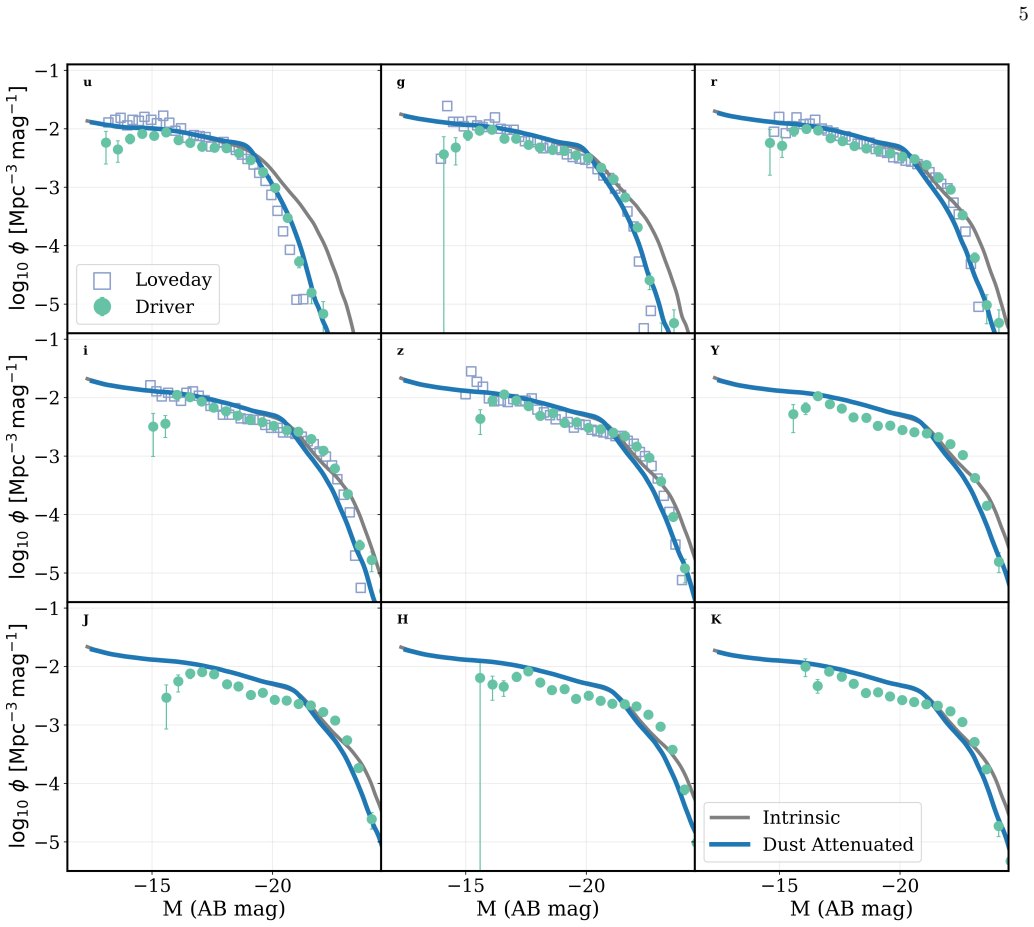
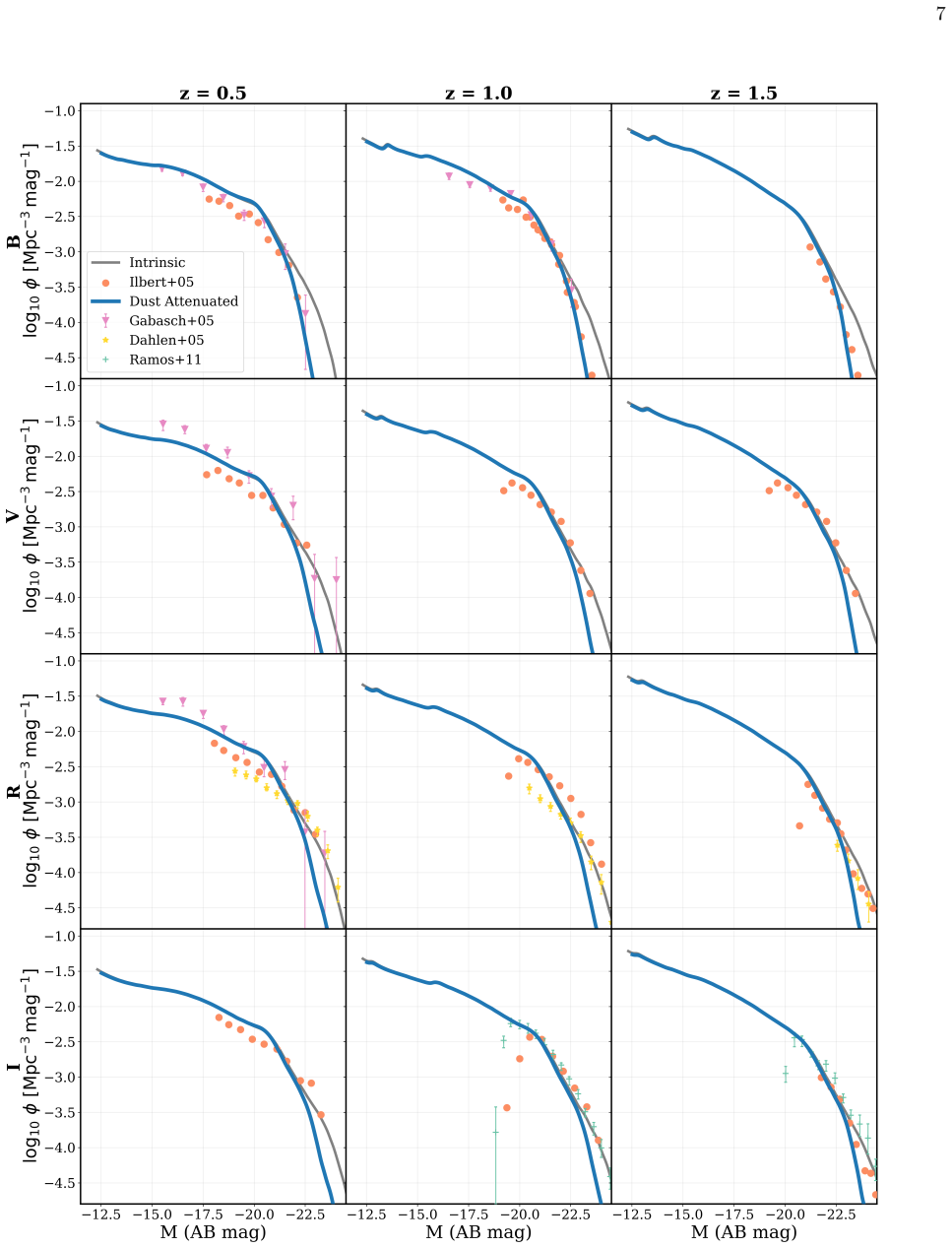
Calibrated dust attenuation in a hydrodynamical simulation reproduces observed galaxy luminosity functions from z=0 to z=1.5
A machine-rendered reading of the paper's core claim, the machinery that carries it, and where it could break.
Core claim
The central claim is that galaxy magnitudes from stellar population synthesis combined with dust attenuation scaling with metal surface density yield attenuated luminosity functions matching observed statistics across wavelengths and redshifts up to 1.5. This enables construction of LSST-ready mock photometric catalogs from z=0 to z=2 containing roughly 378 million galaxies, complete with predicted luminosity functions in ugrizy bands, Schechter fits, and number counts by depth.
What carries the argument
Dust attenuation prescription where optical depth scales with metal surface density
If this is right
- Reproduction of observed statistics in rest-frame B, V, R, and I bands at z = 0.5, 1.0, and 1.5
- Availability of apparent-magnitude luminosity functions in LSST ugrizy bands with best-fit Schechter parameters
- Computation of differential and cumulative galaxy number counts from Year 1 to Year 10 survey depths
- Mock catalogs spanning 0 ≤ z ≤ 2 with steps of Δz = 0.1 and containing ~378 million galaxies
Where Pith is reading between the lines
- Similar dust modeling could be tested against data from other current surveys to check consistency.
- Accurate predictions may help optimize survey strategies for detecting faint galaxies.
- The framework suggests that metal content is a key driver of light attenuation in galaxies across cosmic time.
Load-bearing premise
The assumption that the relationship between optical depth and metal surface density calibrated at redshift zero holds accurately for galaxies at redshifts up to 1.5 and in the LSST wavelength bands.
What would settle it
Significant mismatch between the predicted and observed galaxy luminosity functions or number counts in the LSST ugrizy filters once survey data is collected.
Figures




read the original abstract
We present validated and forward-modelled galaxy luminosity functions and photometric predictions for the Vera C. Rubin Observatory Legacy Survey of Space and Time using the ASTRID cosmological hydrodynamical simulation. Galaxy magnitudes are computed by combining stellar population synthesis modeling with a physically motivated dust attenuation prescription in which the optical depth scales with metal surface density. The dust model is calibrated at z = 0 using SDSS luminosity functions and tested at intermediate redshifts (z = 0.5, 1.0, and 1.5) in rest-frame B, V , R, and I bands. We find that the attenuated luminosity functions reproduce observed galaxy statistics across multiple wavelengths and redshifts. Using this calibrated framework, we construct LSST-ready mock photometric catalogs over 0 <= z <= 2 in steps of Delta z = 0.1, containing ~378 million galaxies. We provide predicted apparent-magnitude luminosity functions in the LSST ugrizy bands, derive best-fit Schechter parameters as a compact analytic representation, and compute differential and cumulative galaxy number counts as a function of survey depth from Year 1 to Year 10.
Editorial analysis
A structured set of objections, weighed in public.
Referee Report
Summary. The paper presents galaxy luminosity functions derived from the ASTRID cosmological hydrodynamical simulation, with galaxy magnitudes obtained via stellar population synthesis combined with a dust attenuation model in which optical depth scales with metal surface density. The dust model is calibrated at z=0 against SDSS data and tested at z=0.5, 1.0, and 1.5 in rest-frame B, V, R, and I bands; the authors report that the attenuated luminosity functions reproduce observed statistics across wavelengths and redshifts. They then generate LSST-ready mock photometric catalogs spanning 0 ≤ z ≤ 2 (Δz=0.1 steps) containing ~378 million galaxies, provide predicted apparent-magnitude luminosity functions in the ugrizy bands, derive best-fit Schechter parameters, and compute differential and cumulative number counts versus survey depth from Year 1 to Year 10.
Significance. If the dust-attenuation extrapolation holds, the work supplies a large, publicly usable set of LSST mock catalogs together with compact analytic Schechter representations and depth-dependent number counts; these are directly usable for survey planning, completeness estimates, and cosmological forecasts. The physically motivated dust prescription and the scale of the mocks (~378 million galaxies) constitute concrete strengths that would be valuable to the LSST community.
major comments (1)
- [Abstract and validation section] Abstract and the validation section: the dust attenuation model (optical depth ∝ metal surface density) is calibrated exclusively at z=0 against SDSS luminosity functions and tested only in rest-frame optical bands (BVR I) at z≤1.5. For the LSST ugrizy predictions at z=1–2 the observed bands sample rest-frame UV (e.g., u-band at z=1.5 probes ~140 nm), where the extinction curve and dust-to-metal scaling are known to differ; no quantitative validation metrics or UV-specific tests are reported, directly affecting the reliability of the faint-end slopes and cumulative counts in the mock catalogs.
minor comments (2)
- [Abstract] The abstract asserts that the attenuated LFs 'reproduce observed galaxy statistics' without supplying any quantitative goodness-of-fit metrics, error bars, or tabulated comparison values; adding these would strengthen the claim.
- [Catalog construction] The description of the mock catalog construction would benefit from explicit statements of the magnitude limits, selection criteria, and any additional observational cuts applied to the ~378 million galaxies.
Simulated Author's Rebuttal
We thank the referee for their careful and constructive review of our manuscript. We address the major comment on the scope of the dust model validation below, providing an honest assessment of the limitations while outlining how we will strengthen the presentation.
read point-by-point responses
-
Referee: [Abstract and validation section] Abstract and the validation section: the dust attenuation model (optical depth ∝ metal surface density) is calibrated exclusively at z=0 against SDSS luminosity functions and tested only in rest-frame optical bands (BVR I) at z≤1.5. For the LSST ugrizy predictions at z=1–2 the observed bands sample rest-frame UV (e.g., u-band at z=1.5 probes ~140 nm), where the extinction curve and dust-to-metal scaling are known to differ; no quantitative validation metrics or UV-specific tests are reported, directly affecting the reliability of the faint-end slopes and cumulative counts in the mock catalogs.
Authors: We agree that the calibration is performed exclusively at z=0 against SDSS and that the explicit tests are limited to rest-frame optical bands (B, V, R, I) at z ≤ 1.5. The manuscript does not report UV-specific luminosity function comparisons or quantitative attenuation metrics at rest-frame wavelengths shorter than ~400 nm. The dust prescription relies on a physically motivated scaling of optical depth with metal surface density combined with a fixed extinction curve; while this framework is applied uniformly to generate the LSST ugrizy predictions, the extrapolation to rest-UV at z=1–2 is indeed an assumption rather than a directly validated result. We will revise the validation section to state the tested wavelength range explicitly, add a dedicated paragraph discussing the implications for UV extrapolation (including possible effects on faint-end slopes), and insert appropriate caveats in the abstract, results, and mock catalog description. These changes constitute a partial revision; we cannot add new observational comparisons or re-run the dust model with UV-specific tuning without additional work beyond the scope of the current study. revision: partial
Circularity Check
No significant circularity; derivation relies on external calibration and independent validation
full rationale
The paper calibrates the dust attenuation prescription (optical depth scaling with metal surface density) exclusively against external SDSS luminosity functions at z=0, then tests the attenuated LFs against independent observations at z=0.5/1.0/1.5 in rest-frame optical bands before applying the fixed model to generate LSST ugrizy predictions. No step reduces by construction to its own inputs, no load-bearing self-citation chain is invoked, and the central claims rest on comparison to external benchmarks rather than renaming or fitting the target quantities themselves. The ASTRID simulation outputs are treated as input and validated externally, satisfying the criteria for a self-contained, non-circular derivation.
Axiom & Free-Parameter Ledger
free parameters (1)
- dust attenuation scaling parameters
axioms (1)
- domain assumption The ASTRID cosmological hydrodynamical simulation produces realistic galaxy populations and stellar metallicities.
Lean theorems connected to this paper
-
IndisputableMonolith/Cost/FunctionalEquation.leanwashburn_uniqueness_aczel uncleardust attenuation prescription in which the optical depth scales with metal surface density... calibrated at z=0 using SDSS luminosity functions... two free parameters κ_ISM and γ
-
IndisputableMonolith/Foundation/RealityFromDistinction.leanreality_from_one_distinction unclearconstruct LSST-ready mock photometric catalogs... ~378 million galaxies
Reference graph
Works this paper leans on
-
[1]
L., et al
Acero Cuellar, T., Acosta, E., Adair, C. L., et al. 2026, arXiv e-prints, arXiv
2026
-
[2]
2025, Monthly Notices of the Royal Astronomical Society, 544, 3799
Alarcon, A., Aldoroty, L., Beltz-Mohrmann, G., et al. 2025, Monthly Notices of the Royal Astronomical Society, 544, 3799
2025
-
[3]
Baldry, I. K., Balogh, M. L., Bower, R. G., et al. 2006, MNRAS, 373, 469, doi: 10.1111/j.1365-2966.2006.11081.x
-
[4]
K., Glazebrook, K., Brinkmann, J., et al
Baldry, I. K., Glazebrook, K., Brinkmann, J., et al. 2004, The Astrophysical Journal, 600, 681
2004
-
[5]
2022, MNRAS, 512, 3703, doi: 10.1093/mnras/stac648
Bird, S., Ni, Y., Di Matteo, T., et al. 2022, MNRAS, 512, 3703, doi: 10.1093/mnras/stac648
-
[6]
2020, Astronomy & Astrophysics, 642, A191
Blanchard, A., Camera, S., Carbone, C., et al. 2020, Astronomy & Astrophysics, 642, A191
2020
-
[7]
R., Hogg, D
Blanton, M. R., Hogg, D. W., Bahcall, N. A., et al. 2003, The Astrophysical Journal, 594, 186
2003
-
[8]
Bressan, A., Marigo, P., Girardi, L., et al. 2012, MNRAS, 427, 127, doi: 10.1111/j.1365-2966.2012.21948.x
-
[9]
The Dust Content and Opacity of Actively Star-Forming Galaxies
Calzetti, D., Armus, L., Bohlin, R. C., et al. 2000, ApJ, 533, 682, doi: 10.1086/308692
work page internal anchor Pith review doi:10.1086/308692 2000
-
[10]
2003, PASP, 115, 763, doi: 10.1086/376392
Chabrier, G. 2003, PASP, 115, 763, doi: 10.1086/376392
work page internal anchor Pith review doi:10.1086/376392 2003
-
[11]
2015, Monthly Notices of the Royal Astronomical Society, 454, 2736, doi: 10.1093/mnras/stv2154
Chisari, N., Codis, S., Laigle, C., et al. 2015, Monthly Notices of the Royal Astronomical Society, 454, 2736, doi: 10.1093/mnras/stv2154
-
[12]
Conroy, C., & Gunn, J. E. 2010, ApJ, 712, 833, doi: 10.1088/0004-637X/712/2/833
-
[13]
Conroy, C., Gunn, J. E., & White, M. 2009, ApJ, 699, 486, doi: 10.1088/0004-637X/699/1/486
work page internal anchor Pith review doi:10.1088/0004-637x/699/1/486 2009
-
[14]
Conselice, C. J. 2014, Annual Review of Astronomy and Astrophysics, 52, 291–337, doi: 10.1146/annurev-astro-081913-040037
-
[15]
Crenshaw, J. F., Kalmbach, J. B., Gagliano, A., et al. 2024, AJ, 168, 80, doi: 10.3847/1538-3881/ad54bf
-
[16]
S., et al
Dahlen, T., Mobasher, B., Somerville, R. S., et al. 2005, The Astrophysical Journal, 631, 126 Dav´ e, R., Angl´ es-Alc´ azar, D., Narayanan, D., et al. 2019, Monthly Notices of the Royal Astronomical Society, 486, 2827
2005
-
[17]
M., Hadzhiyska, B., Bose, S., et al
Delgado, A. M., Hadzhiyska, B., Bose, S., et al. 2023, MNRAS, 523, 5899, doi: 10.1093/mnras/stad1781
-
[18]
The Buzzard Flock: Dark Energy Survey Synthetic Sky Catalogs
DeRose, J., Wechsler, R. H., Becker, M. R., et al. 2019, arXiv preprint arXiv:1901.02401
work page internal anchor Pith review Pith/arXiv arXiv 2019
-
[19]
2019, MNRAS, 485, 4817, doi: 10.1093/mnras/stz712
Donnari, M., Pillepich, A., Nelson, D., et al. 2019, MNRAS, 485, 4817, doi: 10.1093/mnras/stz712
-
[20]
P., Robotham, A
Driver, S. P., Robotham, A. S., Kelvin, L., et al. 2012, Monthly Notices of the Royal Astronomical Society, 427, 3244
2012
-
[21]
2018, MP-Gadget/MP-Gadget: A tag for getting a DOI, FirstDOI, Zenodo, doi: 10.5281/zenodo.1451799
Pedersen, C. 2018, MP-Gadget/MP-Gadget: A tag for getting a DOI, FirstDOI, Zenodo, doi: 10.5281/zenodo.1451799
-
[22]
Fortuna, M. C., Hoekstra, H., Joachimi, B., et al. 2021, Monthly Notices of the Royal Astronomical Society, 501, 2983, doi: 10.1093/mnras/staa3802
-
[23]
2004, Astronomy & Astrophysics, 421, 41
Gabasch, A., Bender, R., Seitz, S., et al. 2004, Astronomy & Astrophysics, 421, 41
2004
-
[24]
Georgiou, C., Chisari, N. E., Bilicki, M., et al. 2025, A&A, 699, A252, doi: 10.1051/0004-6361/202554134
-
[25]
Guidi, G., Scannapieco, C., & Walcher, C. J. 2015, MNRAS, 454, 2381, doi: 10.1093/mnras/stv2050
-
[26]
Hogg, D. W., Baldry, I. K., Blanton, M. R., & Eisenstein, D. J. 2002, arXiv preprint astro-ph/0210394
work page internal anchor Pith review Pith/arXiv arXiv 2002
-
[27]
2005, Astronomy & Astrophysics, 439, 863
Ilbert, O., Tresse, L., Zucca, E., et al. 2005, Astronomy & Astrophysics, 439, 863
2005
-
[28]
LSST: from Science Drivers to Reference Design and Anticipated Data Products
Ilbert, O., McCracken, H. J., Le F` evre, O., et al. 2013, Astronomy & Astrophysics, 556, A55 Ivezi´ c,ˇZ., Kahn, S. M., Tyson, J. A., et al. 2019, ApJ, 873, 111, doi: 10.3847/1538-4357/ab042c
-
[29]
2022, Monthly Notices of the Royal Astronomical Society, 514, 1021, doi: 10.1093/mnras/stac1424
Jagvaral, Y., Singh, S., & Mandelbaum, R. 2022, Monthly Notices of the Royal Astronomical Society, 514, 1021, doi: 10.1093/mnras/stac1424
-
[30]
Joachimi, B., Semboloni, E., Bett, P. E., et al. 2013, MNRAS, 431, 477, doi: 10.1093/mnras/stt172
-
[31]
Kauffmann, G., Heckman, T. M., White, S. D. M., et al. 2003, MNRAS, 341, 33, doi: 10.1046/j.1365-8711.2003.06291.x
-
[32]
2019, The Astrophysical Journal Supplement Series, 245, 26
Korytov, D., Hearin, A., Kovacs, E., et al. 2019, The Astrophysical Journal Supplement Series, 245, 26
2019
-
[33]
Krause, E., Eifler, T., & Blazek, J. 2015, Monthly Notices of the Royal Astronomical Society, 456, 207–222, doi: 10.1093/mnras/stv2615
-
[34]
2025, The Open Journal of Astrophysics, 8, 20, doi: 10.33232/001c.129991
LaChance, P., Croft, R., Ni, Y., et al. 2025, The Open Journal of Astrophysics, 8, 20, doi: 10.33232/001c.129991
-
[35]
K., et al
Loveday, J., Norberg, P., Baldry, I. K., et al. 2012, Monthly Notices of the Royal Astronomical Society, 420, 1239
2012
-
[36]
2014, Annual Review of Astronomy and Astrophysics, 52, 415 17
Madau, P., & Dickinson, M. 2014, Annual Review of Astronomy and Astrophysics, 52, 415 17
2014
-
[37]
Dark Energy Survey Year 3: Blue Shear
McCullough, J., Amon, A., Legnani, E., et al. 2024, arXiv e-prints, arXiv:2410.22272, doi: 10.48550/arXiv.2410.22272
work page internal anchor Pith review Pith/arXiv arXiv doi:10.48550/arxiv.2410.22272 2024
-
[38]
First results from the IllustrisTNG simulations: the galaxy color bimodality
Nelson, D., Pillepich, A., Springel, V., et al. 2017, Monthly Notices of the Royal Astronomical Society, 475, 624–647, doi: 10.1093/mnras/stx3040
work page internal anchor Pith review doi:10.1093/mnras/stx3040 2017
-
[39]
2019, Computational Astrophysics and Cosmology, 6, 2
Nelson, D., Springel, V., Pillepich, A., et al. 2019, Computational Astrophysics and Cosmology, 6, 2
2019
-
[40]
2024, arXiv e-prints, arXiv:2409.10666, doi: 10.48550/arXiv.2409.10666
Ni, Y., Chen, N., Zhou, Y., et al. 2024, arXiv e-prints, arXiv:2409.10666, doi: 10.48550/arXiv.2409.10666
-
[41]
Ni, Y., Di Matteo, T., Bird, S., et al. 2022, MNRAS, 513, 670, doi: 10.1093/mnras/stac351 NSF-DOE Vera C. Rubin Observatory Team,
-
[42]
Acero-Cuellar, T., Acosta, E., et al. 2025, RTN-095: The Vera C. Rubin Observatory Data Preview 1, NSF-DOE Vera C. Rubin Observatory Technical Report, doi: 10.71929/RUBIN/2570536
-
[43]
Pan, Y., Simpson, C. M., Kravtsov, A., et al. 2023, MNRAS, 519, 4499, doi: 10.1093/mnras/stac3663
-
[44]
Pei, Y. C. 1992, ApJ, 395, 130, doi: 10.1086/171637
-
[45]
2018, Monthly Notices of the Royal Astronomical Society, 473, 4077 Planck Collaboration, Ade, P
Pillepich, A., Springel, V., Nelson, D., et al. 2018, Monthly Notices of the Royal Astronomical Society, 473, 4077 Planck Collaboration, Ade, P. A. R., Aghanim, N., et al. 2016, A&A, 594, A13, doi: 10.1051/0004-6361/201525830
-
[46]
2017, Computational Astrophysics and Cosmology, 4, 2
Potter, D., Stadel, J., & Teyssier, R. 2017, Computational Astrophysics and Cosmology, 4, 2
2017
-
[47]
2011, The Astronomical Journal, 142, 41
Ramos, B., Pellegrini, P., Benoist, C., et al. 2011, The Astronomical Journal, 142, 41
2011
-
[48]
2021, Monthly Notices of the Royal Astronomical Society, 508, 637–664, doi: 10.1093/mnras/stab2520
Samuroff, S., Mandelbaum, R., & Blazek, J. 2021, Monthly Notices of the Royal Astronomical Society, 508, 637–664, doi: 10.1093/mnras/stab2520
-
[49]
Samuroff, S., Blazek, J., Troxel, M. A., et al. 2019, Monthly Notices of the Royal Astronomical Society, 489, 5453, doi: 10.1093/mnras/stz2197 S´ anchez-Bl´ azquez, P., Peletier, R. F., Jim´ enez-Vicente, J., et al. 2006, MNRAS, 371, 703, doi: 10.1111/j.1365-2966.2006.10699.x
-
[50]
A., Bower, R
Schaye, J., Crain, R. A., Bower, R. G., et al. 2015, Monthly Notices of the Royal Astronomical Society, 446, 521
2015
-
[51]
Secco, L., Samuroff, S., Krause, E., et al. 2022, Physical Review D, 105, doi: 10.1103/physrevd.105.023515
-
[52]
, archivePrefix = "arXiv", eprint =
Somerville, R. S., & Dav´ e, R. 2015, Annual Review of Astronomy and Astrophysics, 53, 51–113, doi: 10.1146/annurev-astro-082812-140951
work page internal anchor Pith review doi:10.1146/annurev-astro-082812-140951 2015
-
[53]
R., et al
Strateva, I., Ivezi´ c,ˇZ., Knapp, G. R., et al. 2001, The Astronomical Journal, 122, 1861
2001
-
[54]
2016, Monthly Notices of the Royal Astronomical Society, 462, 2668–2680, doi: 10.1093/mnras/stw1823
Tenneti, A., Mandelbaum, R., & Di Matteo, T. 2016, Monthly Notices of the Royal Astronomical Society, 462, 2668–2680, doi: 10.1093/mnras/stw1823
-
[55]
H., et al
To, C.-H., DeRose, J., Wechsler, R. H., et al. 2024, The Astrophysical Journal, 961, 59
2024
-
[56]
Weaver, J. R., Kauffmann, O. B., Ilbert, O., et al. 2022, ApJS, 258, 11, doi: 10.3847/1538-4365/ac3078
-
[57]
M., Feng, Y., Di Matteo, T., et al
Wilkins, S. M., Feng, Y., Di Matteo, T., et al. 2017, MNRAS, 469, 2517, doi: 10.1093/mnras/stx841
-
[58]
Yoachim, P. 2025, lsst-sims/sims featureScheduler runs5.0: Initial Release, 1.0, Zenodo, doi: 10.5281/zenodo.15832326
-
[59]
2026, The Astrophysical Journal, 999, 41
Zhou, Y., Di Matteo, T., Bird, S., et al. 2026, The Astrophysical Journal, 999, 41
2026
discussion (0)
Sign in with ORCID, Apple, or X to comment. Anyone can read and Pith papers without signing in.