Recognition: no theorem link
Towards Robotic Dexterous Hand Intelligence: A Survey
Pith reviewed 2026-05-15 05:41 UTC · model grok-4.3
The pith
A survey reviews hardware, methods, data, and evaluation to map the trajectory and open challenges in robotic dexterous hand research.
A machine-rendered reading of the paper's core claim, the machinery that carries it, and where it could break.
Core claim
Existing dexterous hand studies differ widely in hand shape, sensors, tasks, training data, and testing rules, which prevents direct comparison and hides the field's overall direction; a unified review across hardware analysis, control and learning paradigms, data resources, and evaluation practices supplies the missing structure and names the chief remaining obstacles.
What carries the argument
The four-aspect review structure that connects hardware trade-offs, chronological method evolution, consolidated datasets and benchmarks, and explicit limitation discussion.
If this is right
- Direct comparisons between hand designs and algorithms become feasible once evaluation practices are aligned.
- Researchers can target the listed limitations rather than repeating isolated advances.
- New work can combine hardware improvements with learning methods more deliberately.
- Datasets and benchmarks gain clearer value when interpreted alongside the hardware and method choices that produced them.
Where Pith is reading between the lines
- Standardized multi-hand benchmarks could accelerate the field in the same way shared datasets did for vision tasks.
- Greater use of simulation for data generation might reduce reliance on scarce real-world recordings.
- The identified integration challenges point toward hybrid systems that combine multiple sensing modes with adaptive control.
Load-bearing premise
The papers selected for review are representative enough of all hand types, tasks, and testing methods to show the real overall direction without major gaps from author choices.
What would settle it
A new review that selects a comparable set of papers yet identifies a substantially different set of main barriers or a different ordering of progress would contradict the claimed trajectory.
Figures





read the original abstract
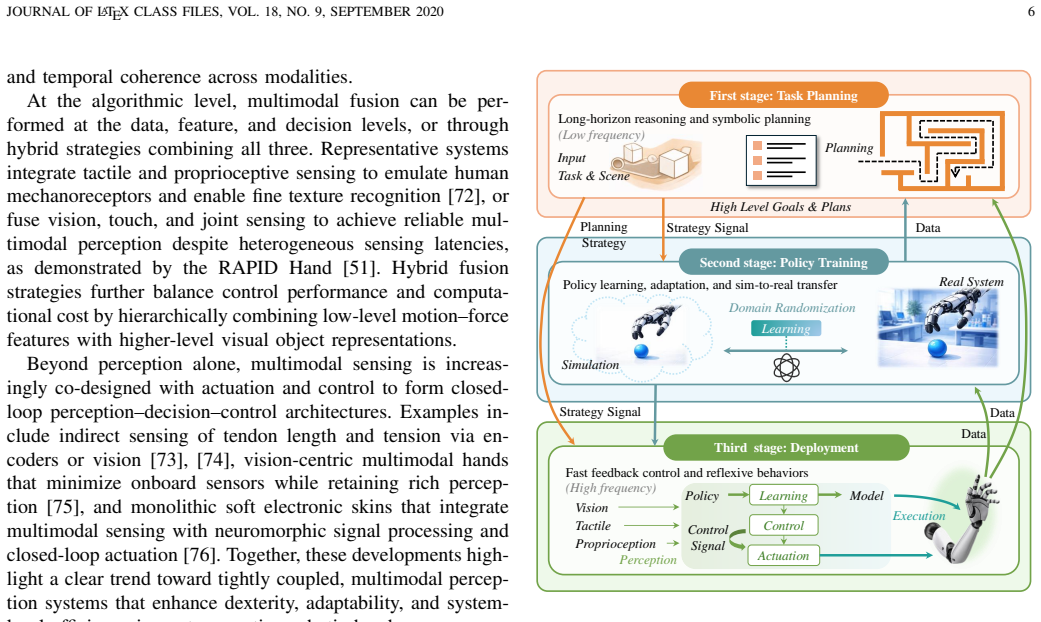
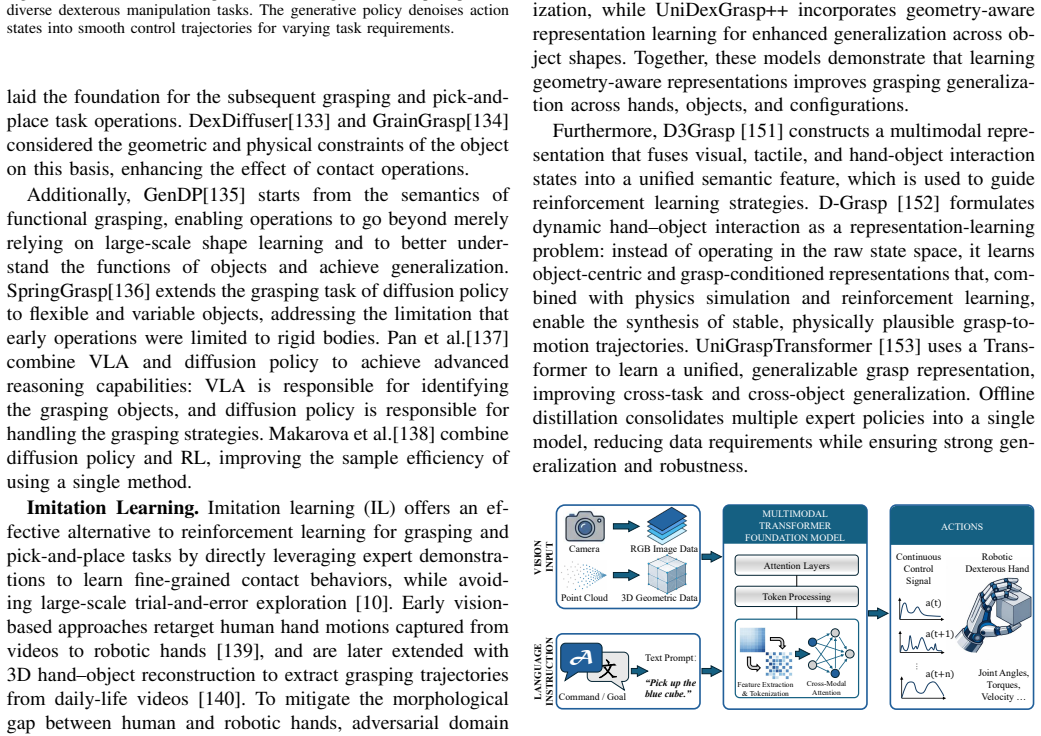
Robotic dexterous hands are central to contact-rich manipulation, with rapid progress driven by advances in hardware, sensing, control, simulation, and data generation. However, existing studies are often developed under different assumptions regarding hand embodiments, sensory configurations, task settings, training data, and evaluation protocols, making systematic comparison difficult and obscuring the developmental trajectory of the field. This survey provides a holistic review of dexterous hand research from four complementary aspects. First, we present a hardware-level analysis covering actuation, transmission, perception, and representative hand designs, highlighting the key trade-offs in force capability, compliance, bandwidth, integration, and system complexity. Furthermore, we review control and learning methods for dexterous manipulation from a methodological perspective, grouping representative works by major paradigms and tracing their evolution in chronological order. In addition, we consolidate datasets, modality design, and evaluation practices, which enables methodological progress to be interpreted together with the ways in which it is trained, benchmarked, and assessed. Finally, we discuss the major limitations of current dexterous hand research and summarize the corresponding future directions. By connecting hardware analysis, methodological development, data resources, and evaluation, this survey aims to provide a structured understanding of dexterous hand research and to clarify the most important open challenges for future study.
Editorial analysis
A structured set of objections, weighed in public.
Referee Report
Summary. The paper is a survey on robotic dexterous hands that reviews the field from four complementary aspects: hardware-level analysis of actuation, transmission, perception, and representative designs with associated trade-offs; methodological review of control and learning methods grouped by major paradigms and traced chronologically; consolidation of datasets, modality design, and evaluation practices; and discussion of current limitations with corresponding future directions. The central aim is to synthesize these elements into a structured understanding of dexterous hand research and to clarify the most important open challenges.
Significance. If the literature coverage is balanced, the survey would be significant for the robotics community by addressing the challenge of systematic comparison across studies that use differing assumptions on embodiments, sensing, tasks, data, and protocols. The four-part structure that explicitly connects hardware analysis, methodological evolution, data resources, and evaluation practices is a strength, as is the chronological tracing of methods, which can help reveal developmental trajectories in a rapidly advancing area.
minor comments (3)
- [Hardware-level analysis] § Hardware-level analysis: the discussion of trade-offs in force capability, compliance, bandwidth, integration, and system complexity would benefit from an explicit comparative table of representative hand designs to facilitate cross-referencing with the methods and evaluation sections.
- [Control and learning methods] § Control and learning methods: while the grouping by paradigms and chronological tracing is effective, the selection criteria for representative works should be stated more explicitly to allow readers to assess coverage across embodiments and task settings.
- [Datasets, modality design, and evaluation] § Datasets and evaluation: the consolidation of evaluation practices is useful, but the survey should include a summary of how many works use each benchmark or protocol to better support claims about the difficulty of systematic comparison.
Simulated Author's Rebuttal
We thank the referee for the positive and constructive review, which accurately summarizes the scope and structure of our survey. We appreciate the recognition of the four-part organization, the chronological tracing of methods, and the potential value to the robotics community in facilitating systematic comparisons. The recommendation for minor revision is noted, and we address the report below.
Circularity Check
No significant circularity
full rationale
This paper is a literature survey synthesizing hardware, methods, datasets, and challenges in dexterous hand research. It contains no derivations, equations, fitted parameters, or quantitative predictions. The central claim is an aim to provide a structured overview, which is self-contained as a review and does not reduce to any self-definition, self-citation chain, or renamed input. No load-bearing steps exist that could exhibit circularity.
Axiom & Free-Parameter Ledger
Reference graph
Works this paper leans on
-
[1]
Hands for dexterous manipulation and robust grasping: a difficult road toward simplicity,
A. Bicchi, “Hands for dexterous manipulation and robust grasping: a difficult road toward simplicity,”IEEE Transactions on Robotics and Automation, vol. 16, no. 6, pp. 652–662, 2000
work page 2000
-
[2]
Mechanical aspects of robot hands, active hand orthoses, and prostheses: A compar- ative review,
J. Vertongen, D. G. Kamper, G. Smit, and H. Vallery, “Mechanical aspects of robot hands, active hand orthoses, and prostheses: A compar- ative review,”IEEE/ASME Transactions on Mechatronics (T-MECH), vol. 26, no. 2, pp. 955–965, 2020
work page 2020
-
[3]
Actuated palms for soft robotic hands: review and perspectives,
M. Pozzi, M. Malvezzi, D. Prattichizzo, and G. Salvietti, “Actuated palms for soft robotic hands: review and perspectives,”IEEE/ASME Transactions on Mechatronics (T-MECH), vol. 29, no. 2, pp. 902–912, 2023
work page 2023
-
[4]
Soft robotics enables neuroprosthetic hand design,
G. Gu, N. Zhang, C. Chen, H. Xu, and X. Zhu, “Soft robotics enables neuroprosthetic hand design,”ACS Nano, vol. 17, no. 11, pp. 9661– 9672, 2023
work page 2023
-
[5]
Tactile sensing for dexterous in-hand manipulation in robotics—a review,
H. Yousef, M. Boukallel, and K. Althoefer, “Tactile sensing for dexterous in-hand manipulation in robotics—a review,”Sensors and Actuators A: Physical, vol. 167, no. 2, pp. 171–187, 2011
work page 2011
-
[6]
A review of tactile information: Perception and action through touch,
Q. Li, O. Kroemer, Z. Su, F. F. Veiga, M. Kaboli, and H. J. Ritter, “A review of tactile information: Perception and action through touch,” IEEE Transactions on Robotics (T-RO), vol. 36, no. 6, pp. 1619–1634, 2020. JOURNAL OF LATEX CLASS FILES, VOL. 18, NO. 9, SEPTEMBER 2020 17
work page 2020
-
[7]
T. Liang, Z. Liu, H. Zhang, X. Zhou, and Y . Liang, “The structure, material and performance of multi-functional tactile sensor and its application in robot field: A review,”Materials Today, 2025
work page 2025
-
[8]
H. Zhou and G. Alici, “Non-invasive human-machine interface (hmi) systems with hybrid on-body sensors for controlling upper-limb pros- thesis: A review,”IEEE Sensors Journal, vol. 22, no. 11, pp. 10292– 10307, 2022
work page 2022
-
[9]
An overview of learning-based dexterous grasping: Recent advances and future directions,
X. Song, Y . Li, Y . Zhang,et al., “An overview of learning-based dexterous grasping: Recent advances and future directions,”Artificial Intelligence Review, vol. 58, p. 300, 2025
work page 2025
-
[10]
Dexterous manipulation through imitation learning: A survey,
S. An, Z. Meng, C. Tang, Y . Zhou, T. Liu, F. Ding, S. Zhang, Y . Mu, R. Song, W. Zhang,et al., “Dexterous manipulation through imitation learning: A survey,”arXiv preprint arXiv:2504.03515, 2025
-
[11]
Human-like dexterous manipulation for anthropomorphic five-fingered hands: A review,
Y . Huang, D. Fan, H. Duan, D. Yan, W. Qi, J. Sun, Q. Liu, and P. Wang, “Human-like dexterous manipulation for anthropomorphic five-fingered hands: A review,”Biomimetic Intelligence and Robotics, p. 100212, 2025
work page 2025
-
[12]
E. Welte and R. Rayyes, “Interactive imitation learning for dexterous robotic manipulation: Challenges and perspectives – a survey,” 2025
work page 2025
-
[13]
C. Firth, K. Dunn, M. H. Haeusler, and Y . Sun, “Anthropomorphic soft robotic end-effector for use with collaborative robots in the construction industry,”Automation in Construction, vol. 138, p. 104218, 2022
work page 2022
-
[14]
Q. Wang, Y . Tu, W. Xu, J. Zhang, A. Knoll, M. Zhou, and Y . Ying, “Towards damage-less robotic fragile fruit grasping: A systematic review on system design, end effector, and visual and tactile feedback,” Journal of Field Robotics, 2025
work page 2025
-
[15]
B. Gao, J. Fan, and P. Zheng, “Empower dexterous robotic hand for human-centric smart manufacturing: A perception and skill learn- ing perspective,”Robotics and Computer-Integrated Manufacturing (RCIM), vol. 93, p. 102909, 2025
work page 2025
-
[16]
J. Zhang, H. Zhao, K. Chen, G. Fei, X. Li, Y . Wang, Z. Yang, S. Zheng, S. Liu, and H. Ding, “Dexterous hand towards intelligent manufac- turing: A review of technologies, trends, and potential applications,” Robotics and Computer-Integrated Manufacturing (RCIM), vol. 95, p. 103021, 2025
work page 2025
-
[17]
Robot modeling and control-[book review; m. spong, s. hutchinson, and m. vidyasagar],
S. B. Skaar, “Robot modeling and control-[book review; m. spong, s. hutchinson, and m. vidyasagar],”IEEE Transactions on Automatic Control (T-ACON), vol. 52, no. 2, pp. 378–379, 2007
work page 2007
-
[18]
The magneto-thermal analysis of a high torque density joint motor for humanoid robots,
W. Zhang, Z. Yu, X. Chen, and Q. Huang, “The magneto-thermal analysis of a high torque density joint motor for humanoid robots,” inIEEE/RAS International Conference on Humanoid Robots (Hu- manoids), pp. 112–117, 2018
work page 2018
-
[19]
Design and analysis of a permanent magnet frameless motor,
K. Guo, Y . Guo, S. Fang, C. Li, and W. Xue, “Design and analysis of a permanent magnet frameless motor,”IEEE Journal of Emerging and Selected Topics in Power Electronics, vol. 12, no. 3, pp. 3124–3134, 2024
work page 2024
-
[20]
Simulation analysis of a sandwich cantilever ultrasonic motor for a dexterous prosthetic hand,
K. Guo, J. Lu, and H. Yang, “Simulation analysis of a sandwich cantilever ultrasonic motor for a dexterous prosthetic hand,”Micro- machines, vol. 14, no. 12, p. 2150, 2023
work page 2023
-
[21]
Miniature robot finger using a micro linear ultrasonic motor and a closed-loop linkage,
S. Izuhara and T. Mashimo, “Miniature robot finger using a micro linear ultrasonic motor and a closed-loop linkage,” inIEEE/RSJ International Conference on Intelligent Robots and Systems (IROS), pp. 1–9, 2018
work page 2018
-
[22]
Development of a miniaturised hydraulic actuation system for artificial hands,
A. Kargov, T. Werner, C. Pylatiuk, and S. Schulz, “Development of a miniaturised hydraulic actuation system for artificial hands,”Sensors and Actuators A: Physical, vol. 141, no. 2, pp. 548–557, 2008
work page 2008
-
[23]
J. Zhou, J. Huang, Q. Dou, P. Abeel, and Y . Liu, “A dexterous and compliant hand based on soft hydraulic actuation for human inspired fine in-hand manipulation,”IEEE Transactions on Robotics (T-RO), 2024
work page 2024
-
[24]
Measurement and modeling of mck- ibben pneumatic artificial muscles,
C.-P. Chou and B. Hannaford, “Measurement and modeling of mck- ibben pneumatic artificial muscles,”IEEE Transactions on Robotics and Automation, vol. 12, no. 1, pp. 90–102, 1996
work page 1996
-
[25]
Force and moment generation of fiber-reinforced pneumatic soft actuators,
J. Bishop-Moser, G. Krishnan, and S. Kota, “Force and moment generation of fiber-reinforced pneumatic soft actuators,” inIEEE/RSJ International Conference on Intelligent Robots and Systems (IROS), pp. 4460–4465, 2013
work page 2013
-
[26]
Programmable soft robotics actuator with pneumatic networks (pneunets),
Y . W. Hadi, B. A. Y . Sunarya, A. F. Alifdhyatra, E. Hidayat, J. Salomo, A. Purwidyantri, B. A. Prabowo, and I. Anshori, “Programmable soft robotics actuator with pneumatic networks (pneunets),”IEEE Sensors Journal, vol. 23, no. 17, pp. 19382–19389, 2023
work page 2023
-
[27]
New soft robots really suck: Vacuum- powered systems empower diverse capabilities,
M. A. Robertson and J. Paik, “New soft robots really suck: Vacuum- powered systems empower diverse capabilities,”Science Robotics, vol. 2, no. 9, p. eaan6357, 2017
work page 2017
-
[28]
J.-G. Lee and H. Rodrigue, “Design and analysis of reconfigurable origami-based vacuum pneumatic artificial muscles for versatile robotic system,”Soft Robotics, vol. 11, no. 6, pp. 984–993, 2024
work page 2024
-
[29]
C. Tawk, G. M. Spinks, M. in het Panhuis, and G. Alici, “3d printable linear soft vacuum actuators: their modeling, performance quantification and application in soft robotic systems,”IEEE/ASME Transactions on Mechatronics (T-MECH), vol. 24, no. 5, pp. 2118– 2129, 2019
work page 2019
-
[30]
Dexterous robotic hand based on rotational shape memory alloy actuator-joints,
H. Baek, A. M. Khan, V . Bijalwan, S. Jeon, and Y . Kim, “Dexterous robotic hand based on rotational shape memory alloy actuator-joints,” IEEE Transactions on Medical Robotics and Bionics (T-MRB), vol. 5, no. 4, pp. 1082–1092, 2023
work page 2023
-
[31]
Advances in dielectric elastomers for actua- tors and artificial muscles,
P. Brochu and Q. Pei, “Advances in dielectric elastomers for actua- tors and artificial muscles,”Macromolecular Rapid Communications, vol. 31, no. 1, pp. 10–36, 2010
work page 2010
-
[32]
A review of the applications and challenges of dielectric elastomer actuators in soft robotics,
Q. Zhang, W. Yu, J. Zhao, C. Meng, and S. Guo, “A review of the applications and challenges of dielectric elastomer actuators in soft robotics,”Machines, vol. 13, no. 2, p. 101, 2025
work page 2025
-
[33]
Multifunctional magnetic muscles for soft robotics,
M. Seong, K. Sun, S. Kim, H. Kwon, S.-W. Lee, S. C. Veerla, D. K. Kang, J. Kim, S. Kondaveeti, S. M. Tawfik,et al., “Multifunctional magnetic muscles for soft robotics,”Nature Communications (NC), vol. 15, no. 1, p. 7929, 2024
work page 2024
-
[34]
Piezo robotic hand for motion manipulation from micro to macro,
S. Zhang, Y . Liu, J. Deng, X. Gao, J. Li, W. Wang, M. Xun, X. Ma, Q. Chang, J. Liu,et al., “Piezo robotic hand for motion manipulation from micro to macro,”Nature Communications (NC), vol. 14, no. 1, p. 500, 2023
work page 2023
-
[35]
Biomimetic rigid-soft finger design for highly dexterous and adaptive robotic hands,
N. Zhang, P. Zhou, X. Yang, F. Shen, J. Ren, T. Hou, L. Dong, R. Bian, D. Wang, G. Gu,et al., “Biomimetic rigid-soft finger design for highly dexterous and adaptive robotic hands,”Science Advances, vol. 11, no. 17, 2025
work page 2025
-
[36]
A lightweight prosthetic hand with 19-dof dexterity and human-level functions,
H. Yang, Z. Tao, J. Yang, W. Ma, H. Zhang, M. Xu, M. Wu, S. Sun, H. Jin, W. Li,et al., “A lightweight prosthetic hand with 19-dof dexterity and human-level functions,”Nature Communications (NC), vol. 16, no. 1, p. 955, 2025
work page 2025
-
[37]
J. Xia, J. Huang, S. Fu, J. Qu, L. Mo, Y . Li, T. Ren, Y . Yang, Y . Li, and H. Liu, “Discrete pneumatic-tendon-coupled actuators with inter- connected air circuit for untethered soft robots,”Advanced Intelligent Systems, vol. 7, no. 4, 2025
work page 2025
-
[38]
L. Birglen, T. Lalibert ´e, and C. Gosselin,Underactuated Robotic Hands, vol. 40 ofSpringer Tracts in Advanced Robotics. Berlin, Heidelberg: Springer, 2008
work page 2008
-
[39]
G. Palli, C. Melchiorri, G. Vassura, U. Scarcia, L. Moriello, G. Berselli, A. Cavallo, G. De Maria, C. Natale, S. Pirozzi,et al., “The dexmart hand: Mechatronic design and experimental evaluation of synergy- based control for human-like grasping,”The International Journal of Robotics Research, vol. 33, no. 5, pp. 799–824, 2014
work page 2014
-
[40]
M. Yin, H. Wang, D. Shang, M. Li, T. Xu, and X. Wu, “Disturbance compensation control for humanoid robot hand driven by tendon-sheath based on disturbance observer,”IEEE Transactions on Automation Science and Engineering (T-ASE), 2025
work page 2025
-
[41]
S. R. Company, “Shadowrobot dexterous hand.” https://www. shadowrobot.com/dexterous-hand-series/, 2005
work page 2005
-
[42]
The robonaut 2 hand-designed to do work with tools,
L. B. Bridgwater, C. Ihrke, M. A. Diftler, M. E. Abdallah, N. A. Radford, J. Rogers, S. Yayathi, R. S. Askew, and D. M. Linn, “The robonaut 2 hand-designed to do work with tools,” inIEEE International Conference on Robotics and Automation (ICRA), pp. 3425–3430, 2012
work page 2012
-
[43]
The hand of the dlr hand arm sys- tem: Designed for interaction,
M. Grebenstein, M. Chalon, W. Friedl, S. Haddadin, T. Wimb ¨ock, G. Hirzinger, and R. Siegwart, “The hand of the dlr hand arm sys- tem: Designed for interaction,”The International Journal of Robotics Research, vol. 31, no. 13, pp. 1531–1555, 2012
work page 2012
-
[44]
Posefusion: Robust object-in-hand pose estimation with selectlstm,
Y . Tu, J. Jiang, S. Li, N. Hendrich, M. Li, and J. Zhang, “Posefusion: Robust object-in-hand pose estimation with selectlstm,” inIEEE/RSJ International Conference on Intelligent Robots and Systems (IROS), pp. 6839–6846, 2023
work page 2023
-
[45]
S. G. . C. KG, “Svh 5-finger gripping hand.” https://schunk.com/de en/gripping-systems/highlights/svh/, 2025
work page 2025
-
[46]
Modeling and realistic simulation of a dexterous robotic hand: Svh hand use-case,
F. M. Ribeiro, T. Correia, J. Lima, G. Gonc ¸alves, and V . H. Pinto, “Modeling and realistic simulation of a dexterous robotic hand: Svh hand use-case,” inIEEE International Conference on Autonomous Robot Systems and Competitions (ICARSC), pp. 132–138, 2023
work page 2023
-
[47]
Integrated linkage-driven dexterous an- thropomorphic robotic hand,
U. Kim, D. Jung, H. Jeong, J. Park, H.-M. Jung, J. Cheong, H. R. Choi, H. Do, and C. Park, “Integrated linkage-driven dexterous an- thropomorphic robotic hand,”Nature Communications (NC), vol. 12, no. 1, p. 7177, 2021
work page 2021
-
[48]
Kinetostatic analysis of underactuated fingers,
L. Birglen and C. M. Gosselin, “Kinetostatic analysis of underactuated fingers,”IEEE Transactions on Robotics and Automation, vol. 20, no. 2, pp. 211–221, 2004
work page 2004
-
[49]
Grasp-state plane analysis of two- phalanx underactuated fingers,
L. Birglen and C. M. Gosselin, “Grasp-state plane analysis of two- phalanx underactuated fingers,”Mechanism and Machine Theory, vol. 41, no. 7, pp. 807–822, 2006. JOURNAL OF LATEX CLASS FILES, VOL. 18, NO. 9, SEPTEMBER 2020 18
work page 2006
-
[50]
Underactuated finger mechanism using con- tractible slider-cranks and stackable four-bar linkages,
D. Yoon and Y . Choi, “Underactuated finger mechanism using con- tractible slider-cranks and stackable four-bar linkages,”IEEE/ASME Transactions on Mechatronics (T-MECH), vol. 22, no. 5, pp. 2046– 2057, 2017
work page 2046
-
[51]
Z. Wan, Z. Bi, Z. Zhou, H. Ren, Y . Zeng, Y . Li, L. Qi, X. Yang, M.-H. Yang, and H. Cheng, “Rapid hand: A robust, affordable, perception- integrated, dexterous manipulation platform for generalist robot auton- omy,”arXiv preprint arXiv:2506.07490, 2025
-
[52]
A new four-fingered robot hand with dual turning mech- anism,
M. Higashimori, H. Jeong, I. Ishii, M. Kaneko, A. Namiki, and M. Ishikawa, “A new four-fingered robot hand with dual turning mech- anism,” inIEEE International Conference on Robotics and Automation (ICRA), pp. 2679–2684, 2005
work page 2005
-
[53]
A planetary gear based underactuated self-adaptive robotic finger,
Q. Quan, Q. Wang, Z. Deng, S. Jiang, X. Hou, and D. Tang, “A planetary gear based underactuated self-adaptive robotic finger,” in IEEE International Conference on Robotics and Biomimetics (ROBIO), pp. 1586–1591, 2013
work page 2013
-
[54]
K. Tahara, K. Maruta, A. Kawamura, and M. Yamamoto, “Externally sensorless dynamic regrasping and manipulation by a triple-fingered robotic hand with torsional fingertip joints,” inIEEE International Conference on Robotics and Automation (ICRA), pp. 3252–3257, 2012
work page 2012
-
[55]
Design of a roller-based dexterous hand for object grasping and within-hand manipulation,
S. Yuan, A. D. Epps, J. B. Nowak, and J. K. Salisbury, “Design of a roller-based dexterous hand for object grasping and within-hand manipulation,” inIEEE International Conference on Robotics and Automation (ICRA), pp. 8870–8876, 2020
work page 2020
-
[56]
J. C. Tuthill and E. Azim, “Proprioception,”Current Biology, vol. 28, no. 5, pp. R194–R203, 2018
work page 2018
-
[57]
A. S. Morgan, W. G. Bircher, and A. M. Dollar, “Towards generalized manipulation learning through grasp mechanics-based features and self- supervision,”IEEE Transactions on Robotics (T-RO), vol. 37, no. 5, pp. 1553–1569, 2021
work page 2021
-
[58]
Dynamic in-hand sliding manipulation,
J. Shi, J. Z. Woodruff, P. B. Umbanhowar, and K. M. Lynch, “Dynamic in-hand sliding manipulation,”IEEE Transactions on Robotics (T-RO), vol. 33, no. 4, pp. 778–795, 2017
work page 2017
-
[59]
Divide and conquer: 3d point cloud instance segmentation with point-wise binarization,
W. Zhao, Y . Yan, C. Yang, J. Ye, X. Yang, and K. Huang, “Divide and conquer: 3d point cloud instance segmentation with point-wise binarization,” inIEEE/CVF International Conference on Computer Vision (ICCV), pp. 562–571, 2023
work page 2023
-
[60]
Bfanet: Revisiting 3d semantic segmentation with boundary feature analysis,
W. Zhao, R. Zhang, Q. Wang, G. Cheng, and K. Huang, “Bfanet: Revisiting 3d semantic segmentation with boundary feature analysis,” inIEEE/CVF conference on Computer Vision and Pattern Recognition (CVPR), pp. 29395–29405, 2025
work page 2025
-
[61]
C. Li, A. Fahmy, and J. Sienz, “Development of a neural network- based control system for the dlr-hit ii robot hand using leap motion,” IEEE Access, vol. 7, pp. 136914–136923, 2019
work page 2019
-
[62]
Self-body discovery based on visuomotor coherence,
R. Saegusa, G. Metta, and G. Sandini, “Self-body discovery based on visuomotor coherence,” inInternational Conference on Human System Interaction, pp. 356–362, 2010
work page 2010
-
[63]
Multisensory five-finger dexterous hand: The dlr/hit hand ii,
H. Liu, K. Wu, P. Meusel, N. Seitz, G. Hirzinger, M. Jin, Y . Liu, S. Fan, T. Lan, and Z. Chen, “Multisensory five-finger dexterous hand: The dlr/hit hand ii,” inIEEE/RSJ International Conference on Intelligent Robots and Systems (IROS), pp. 3692–3697, 2008
work page 2008
-
[64]
Fas a flexible antagonistic spring element for a high performance over,
W. Friedl, M. Chalon, J. Reinecke, M. Grebenstein,et al., “Fas a flexible antagonistic spring element for a high performance over,” in IEEE/RSJ International Conference on Intelligent Robots and Systems (IROS), pp. 1366–1372, 2011
work page 2011
-
[65]
Tactonet: Tactile ordinal network based on unimodal probability for object hardness classification,
S. Fang, Z. Yi, T. Mi, Z. Zhou, C. Ye, W. Shang, T. Xu, and X. Wu, “Tactonet: Tactile ordinal network based on unimodal probability for object hardness classification,”IEEE Transactions on Automation Science and Engineering (T-ASE), vol. 20, no. 4, pp. 2784–2794, 2022
work page 2022
-
[66]
Y . Liu, Z. Yi, S. Fang, Y . Zhang, F. Wan, Z.-X. Yang, X. Lu, and X. Wu, “Tactclnet: Tactile continual learning network based on generative replay for object hardness recognition,”IEEE Transactions on Automation Science and Engineering (T-ASE), 2024
work page 2024
-
[67]
Recent progresses on flexible tactile sensors,
Y . Wan, Y . Wang, and C. F. Guo, “Recent progresses on flexible tactile sensors,”Materials Today Physics, vol. 1, pp. 61–73, 2017
work page 2017
-
[68]
Optoelectronically innervated soft prosthetic hand via stretchable optical waveguides,
H. Zhao, K. O’brien, S. Li, and R. F. Shepherd, “Optoelectronically innervated soft prosthetic hand via stretchable optical waveguides,” Science Robotics, vol. 1, no. 1, 2016
work page 2016
-
[69]
Multimodal tactile sensing fused with vision for dexterous robotic housekeeping,
Q. Mao, Z. Liao, J. Yuan, and R. Zhu, “Multimodal tactile sensing fused with vision for dexterous robotic housekeeping,”Nature Com- munications (NC), vol. 15, no. 1, p. 6871, 2024
work page 2024
-
[70]
Soft sensors via conductive textile stitching: Enabling strain, tactile, and volumetric sensing,
J. Seong, J.-H. Lee, and M.-W. Han, “Soft sensors via conductive textile stitching: Enabling strain, tactile, and volumetric sensing,”Advanced Materials Technologies, vol. 10, no. 6, p. 2401306, 2025
work page 2025
-
[71]
M. Song, Q. Liu, X. Xu, B. Wang, Y . Lu, L. Yang, X. Liu, Y . Wang, M. Li, and D. Wang, “A fabric-based multimodal flexible tactile sensor with precise sensing and discrimination capabilities for pressure- proximity-magnetic field signals,”Advanced Functional Materials, vol. 35, no. 19, p. 2420445, 2025
work page 2025
-
[72]
Texture recognition based on multi- sensory integration of proprioceptive and tactile signals,
B. Rostamian, M. Koolani, P. Abdollahzade, M. Lankarany, E. Falotico, M. Amiri, and N. V . Thakor, “Texture recognition based on multi- sensory integration of proprioceptive and tactile signals,”Scientific Reports, vol. 12, no. 1, p. 21690, 2022
work page 2022
-
[73]
A wire-driven miniature five fingered robot hand using elastic elements as joints,
Y . Ogahara, Y . Kawato, K. Takemura, and T. Maeno, “A wire-driven miniature five fingered robot hand using elastic elements as joints,” in IEEE/RSJ International Conference on Intelligent Robots and Systems (IROS), vol. 3, pp. 2672–2677, 2003
work page 2003
-
[74]
A vision-based collocated actuation-sensing scheme for a compliant tendon-driven robotic hand.,
K. Gilday, T. G. Thuruthel, and F. Iida, “A vision-based collocated actuation-sensing scheme for a compliant tendon-driven robotic hand.,” inRoboSoft, pp. 760–765, 2020
work page 2020
-
[75]
An 18-dof hand integrating force–position multimodal perception using a monocular camera,
S. Chen, J. Li, Z. Deng, P. Wang, C. Wei, and X. Cao, “An 18-dof hand integrating force–position multimodal perception using a monocular camera,”Nature Communications (NC), vol. 16, no. 1, p. 6801, 2025
work page 2025
-
[76]
Neuromorphic sensorimotor loop embodied by monolithically integrated, low-voltage, soft e-skin,
W. Wang, Y . Jiang, D. Zhong, Z. Zhang, S. Choudhury, J.-C. Lai, H. Gong, S. Niu, X. Yan, Y . Zheng,et al., “Neuromorphic sensorimotor loop embodied by monolithically integrated, low-voltage, soft e-skin,” Science, vol. 380, no. 6646, pp. 735–742, 2023
work page 2023
-
[77]
Continuous relaxation of symbolic planner for one- shot imitation learning,
D.-A. Huang, D. Xu, Y . Zhu, A. Garg, S. Savarese, L. Fei-Fei, and J. C. Niebles, “Continuous relaxation of symbolic planner for one- shot imitation learning,” inIEEE/RSJ International Conference on Intelligent Robots and Systems (IROS), pp. 2635–2642, 2019
work page 2019
-
[78]
Towards a unified understanding of robot ma- nipulation: A comprehensive survey,
S. Bai, W. Song, J. Chen, Y . Ji, Z. Zhong, J. Yang, H. Zhao, W. Zhou, W. Zhao, Z. Li,et al., “Towards a unified understanding of robot ma- nipulation: A comprehensive survey,”arXiv preprint arXiv:2510.10903, 2025
-
[79]
Llm-planner: Few-shot grounded planning for embodied agents with large language models,
C. H. Song, J. Wu, C. Washington, B. M. Sadler, W.-L. Chao, and Y . Su, “Llm-planner: Few-shot grounded planning for embodied agents with large language models,” inIEEE/CVF International Conference on Computer Vision (ICCV), pp. 2998–3009, 2023
work page 2023
-
[80]
The mod- ular multisensory dlr-hit-hand: hardware and software architecture,
H. Liu, P. Meusel, G. Hirzinger, M. Jin, Y . Liu, and Z. Xie, “The mod- ular multisensory dlr-hit-hand: hardware and software architecture,” IEEE/ASME Transactions on Mechatronics (T-MECH), vol. 13, no. 4, pp. 461–469, 2009
work page 2009
discussion (0)
Sign in with ORCID, Apple, or X to comment. Anyone can read and Pith papers without signing in.