Recognition: no theorem link
Linear-Time T-Gate Optimization via Random Abstraction
Pith reviewed 2026-05-15 02:50 UTC · model grok-4.3
The pith
A linear-time randomized algorithm optimizes T gates by propagating constant-width bitstrings to approximate reachable quantum states.
A machine-rendered reading of the paper's core claim, the machinery that carries it, and where it could break.
Core claim
We give a linear-time randomized algorithm for phase folding, based on a novel randomized static analysis. Our static analysis soundly approximates the set of reachable quantum states with an arbitrarily high probability. Our key insight is a static analysis that does not track symbolic expressions, but propagates constant-width bitstrings down the circuit.
What carries the argument
Randomized static analysis that propagates constant-width bitstrings down the circuit to approximate reachable quantum states for phase folding.
If this is right
- T-count minimization becomes feasible for circuits with millions of gates on ordinary hardware.
- Optimization time drops by multiple orders of magnitude relative to existing symbolic tools.
- Phase folding can be integrated into compilation pipelines without becoming the dominant cost.
- Large-scale fault-tolerant quantum algorithms can be resource-optimized before execution.
Where Pith is reading between the lines
- The same constant-width abstraction technique could be adapted to other quantum-circuit analyses that currently rely on expensive symbolic tracking.
- Hybrid exact-randomized pipelines might further improve precision on critical subcircuits while retaining overall linear scaling.
- The approach suggests a general template for lightweight static analyses in quantum compilers that trade bounded error for speed.
Load-bearing premise
Bitstring propagation soundly approximates the reachable quantum states with arbitrarily high probability for identifying foldable phases.
What would settle it
A concrete circuit instance where the randomized analysis produces a strictly higher T-count than an exact phase-folding method on the same input.
Figures



read the original abstract
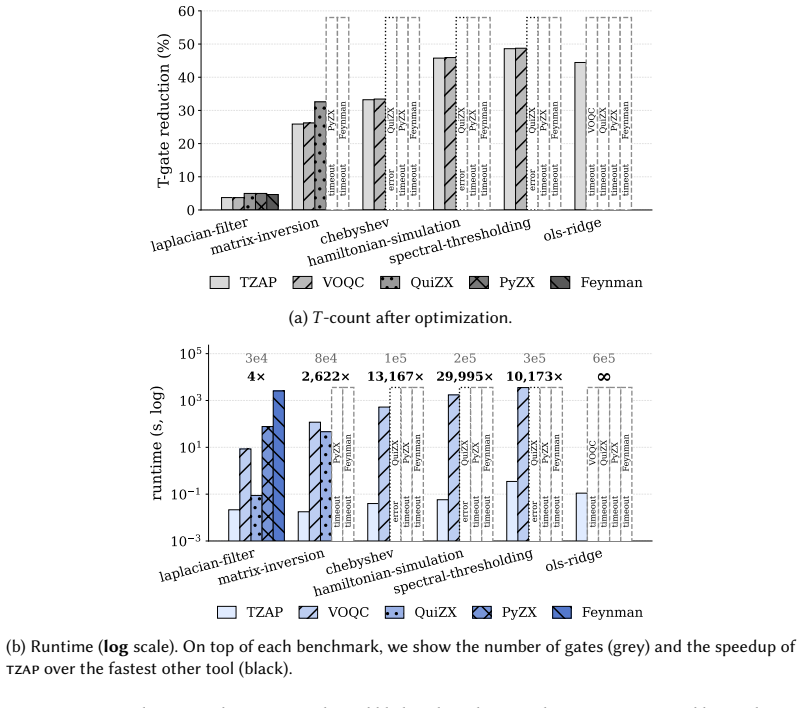
Quantum computers promise exponential speedups for problems in cryptography, chemistry, and optimization. Realizing this promise requires fault tolerance: physical qubits are noisy, so logical qubits must be encoded redundantly across many physical ones using quantum error-correcting codes. In most practical fault-tolerance schemes, T gates cannot be implemented transversally and instead require costly magic-state distillation protocols involving a complex set of operations. As a result, T-gate count can dominate the resource budget of large-scale quantum computations, making T-count minimization a central bottleneck on the path to quantum advantage. Existing T-count optimization tools, however, do not scale to the circuits that quantum advantage demands. We present theoretical and practical results on T-gate optimization. On the theoretical side, we give a linear-time randomized algorithm for phase folding, based on a novel randomized static analysis. Our static analysis soundly approximates the set of reachable quantum states with an arbitrarily high probability. Our key insight is a static analysis that does not track symbolic expressions, but propagates constant-width bitstrings down the circuit. On the practical side, our implementation, TZAP, is multiple orders of magnitude faster than state-of-the-art tools -- such as PyZX, VOQC, and Feynman -- closely matches their T-count reductions on standard benchmarks, and within seconds on a laptop computer can optimize circuits with millions of gates.
Editorial analysis
A structured set of objections, weighed in public.
Referee Report
Summary. The paper claims a linear-time randomized algorithm for phase folding in T-gate optimization, based on a novel randomized static analysis that propagates constant-width bitstrings to soundly approximate the set of reachable quantum states with arbitrarily high probability. The practical contribution is an implementation TZAP that is orders of magnitude faster than PyZX, VOQC, and Feynman while achieving comparable T-count reductions on benchmarks and scaling to million-gate circuits.
Significance. If the probabilistic soundness argument holds with fixed constant width and without super-linear overhead, the result would enable practical optimization of circuits at the scale required for quantum advantage demonstrations, addressing a key scalability bottleneck in fault-tolerant quantum compilation.
major comments (2)
- [Abstract and §3] Abstract and §3 (randomized static analysis): the claim that constant-width bitstring propagation yields arbitrarily high success probability must be accompanied by an explicit global failure-probability bound. If each gate has local success probability p < 1 bounded away from 1 by a constant depending only on width, then over m gates the overall success probability is at most p^m, which tends to zero for large m and contradicts the linear-time claim unless width or trials grow with m or 1/ε.
- [§4] §4 (algorithm description): the linear-time claim requires that the number of trials or the bitstring width remain independent of circuit size m and target ε. The manuscript must show either that the randomization is global (e.g., via a single random seed affecting all gates) or provide a concrete recurrence relating width, trials, m, and ε that preserves O(m) total work.
minor comments (2)
- [Figure 2] Figure 2 caption: the legend for the three compared tools is missing; add explicit labels for PyZX, VOQC, and TZAP.
- [§5.2] §5.2: the benchmark table reports wall-clock times but omits the number of random trials used per circuit; this datum is needed to verify the linear-time claim in practice.
Simulated Author's Rebuttal
We thank the referee for the careful reading and constructive comments on the probabilistic analysis. We address the two major points below, clarifying that the randomization is global (a single seed for the entire circuit), which yields a failure probability depending only on width and independent of circuit size m.
read point-by-point responses
-
Referee: [Abstract and §3] Abstract and §3 (randomized static analysis): the claim that constant-width bitstring propagation yields arbitrarily high success probability must be accompanied by an explicit global failure-probability bound. If each gate has local success probability p < 1 bounded away from 1 by a constant depending only on width, then over m gates the overall success probability is at most p^m, which tends to zero for large m and contradicts the linear-time claim unless width or trials grow with m or 1/ε.
Authors: The bitstring abstraction uses a single global random seed chosen once at the beginning of the analysis; this defines a fixed random linear projection applied uniformly to all gates. The failure event is therefore global rather than per-gate, with probability at most 2^{-w} (or an analogous function of width w alone). This bound is independent of m, so constant w suffices for any target success probability. We will add the explicit global bound and its derivation to the revised abstract and §3. revision: yes
-
Referee: [§4] §4 (algorithm description): the linear-time claim requires that the number of trials or the bitstring width remain independent of circuit size m and target ε. The manuscript must show either that the randomization is global (e.g., via a single random seed affecting all gates) or provide a concrete recurrence relating width, trials, m, and ε that preserves O(m) total work.
Authors: As explained above, a single global seed is used. For any fixed target ε we select a constant width w = O(log(1/ε)) once; each of the m gates then performs O(1) work on the w-bit strings, for total O(m) time. No per-circuit trials or m-dependent growth in w is required. We will insert the corresponding recurrence and complexity argument into the revised §4. revision: yes
Circularity Check
No circularity detected in derivation chain
full rationale
The paper presents a linear-time randomized algorithm for phase folding via a static analysis that propagates constant-width bitstrings to approximate reachable states with arbitrarily high probability. This is described as a self-contained randomized procedure whose probabilistic soundness is asserted directly rather than derived from fitted parameters, self-referential definitions, or load-bearing self-citations. No equations or steps in the abstract or described approach reduce the claimed result to its inputs by construction. The skeptic concern addresses potential accumulation of failure probability (a correctness issue) but does not exhibit a definitional or self-citation reduction.
Axiom & Free-Parameter Ledger
axioms (1)
- domain assumption Randomized propagation of constant-width bitstrings soundly approximates reachable quantum states with arbitrarily high probability
Reference graph
Works this paper leans on
-
[1]
Matthew Amy. 2018. Towards Large-Scale Functional Verification of Universal Quantum Circuits. InProceedings of the 15th International Conference on Quantum Physics and Logic (QPL 2018) (Electronic Proceedings in Theoretical Computer Science, Vol. 287). 1–21. doi:10.4204/EPTCS.287.1
-
[2]
Matthew Amy and Joseph Lunderville. 2025. Linear and non-linear relational analyses for quantum program optimization.Proceedings of the ACM on Programming Languages9, POPL, Article 37 (2025), 1072–1103 pages. doi:10.1145/3704873
-
[3]
Matthew Amy, Dmitri Maslov, and Michele Mosca. 2014. Polynomial-time T-depth optimization of Clifford+T circuits via matroid partitioning.IEEE Transactions on Computer-Aided Design of Integrated Circuits and Systems33, 10 (2014), 1476–1489. doi:10.1109/TCAD.2014.2341953
-
[4]
Matthew Amy and Michele Mosca. 2019. T-count optimization and Reed–Muller codes.IEEE Transactions on Information Theory65, 8 (2019), 4771–4784. doi:10.1109/TIT.2019.2906374
-
[5]
Benjamin Bichsel, Anouk Paradis, Maximilian Baader, and Martin Vechev. 2023. Abstraqt: Analysis of Quantum Circuits via Abstract Stabilizer Simulation.Quantum7 (2023), 1185. doi:10.22331/q-2023-11-20-1185
-
[6]
Sergey Bravyi and David Gosset. 2016. Improved Classical Simulation of Quantum Circuits Dominated by Clifford Gates.Physical Review Letters116 (2016), 250501. doi:10.1103/PhysRevLett.116.250501
-
[7]
Sergey Bravyi and Jeongwan Haah. 2012. Magic-state distillation with low overhead.Physical Review A86, 5 (2012), 052329
work page 2012
-
[8]
Sergey Bravyi and Alexei Kitaev. 2005. Universal quantum computation with ideal Clifford gates and noisy ancillas. Physical Review A71, 2 (2005), 022316
work page 2005
-
[9]
Bob Coecke and Ross Duncan. 2011. Interacting quantum observables: categorical algebra and diagrammatics.New Journal of Physics13, 4 (2011), 043016. doi:10.1088/1367-2630/13/4/043016
-
[10]
Patrick Cousot and Radhia Cousot. 1977. Abstract interpretation: a unified lattice model for static analysis of programs by construction or approximation of fixpoints. InProceedings of the 4th ACM SIGACT-SIGPLAN Symposium on Principles of Programming Languages. ACM, 238–252. doi:10.1145/512950.512973
-
[11]
Open Quantum Assembly Language
Andrew W. Cross, Lev S. Bishop, John A. Smolin, and Jay M. Gambetta. 2017. Open Quantum Assembly Language. arXiv:1707.03429 [quant-ph]
work page internal anchor Pith review Pith/arXiv arXiv 2017
-
[12]
Ross Duncan, Aleks Kissinger, Simon Perdrix, and John van de Wetering. 2020. Graph-theoretic simplification of quantum circuits with the ZX-calculus.Quantum4 (2020), 279. doi:10.22331/q-2020-06-04-279
-
[13]
Fowler, Matteo Mariantoni, John M
Austin G. Fowler, Matteo Mariantoni, John M. Martinis, and Andrew N. Cleland. 2012. Surface Codes: Towards Practical Large-Scale Quantum Computation.Physical Review A86, 3 (2012), 032324. doi:10.1103/PhysRevA.86.032324
-
[14]
Craig Gidney, Noah Shutty, and Cody Jones. 2024. Magic state cultivation: growing T states as cheap as CNOT gates. arXiv:2409.17595 [quant-ph]
work page internal anchor Pith review Pith/arXiv arXiv 2024
-
[15]
Daniel Gottesman. 1999. The Heisenberg Representation of Quantum Computers. InGroup22: Proceedings of the XXII International Colloquium on Group Theoretical Methods in Physics. International Press, 32–43. arXiv:quant-ph/9807006
work page internal anchor Pith review Pith/arXiv arXiv 1999
-
[16]
2005.Program Analysis using Random Interpretation
Sumit Gulwani. 2005.Program Analysis using Random Interpretation. Ph. D. Dissertation. University of California, Berkeley
work page 2005
- [17]
- [18]
-
[19]
Sumit Gulwani and George C. Necula. 2005. Precise interprocedural analysis using random interpretation. InProceedings of the 32nd ACM SIGPLAN-SIGACT Symposium on Principles of Programming Languages (POPL). ACM, 324–337. doi:10.1145/1040305.1040332
-
[20]
Luke E Heyfron and Earl T Campbell. 2019. An efficient quantum compiler that reduces T count.Quantum Science and Technology4, 1 (2019), 015004. doi:10.1088/2058-9565/aad604
-
[21]
Kesha Hietala, Robert Rand, Shih-Han Hung, Xiaodi Wu, and Michael Hicks. 2021. A verified optimizer for quantum circuits.Proceedings of the ACM on Programming Languages5, POPL, Article 37 (2021), 29 pages. doi:10.1145/3434318
- [22]
-
[23]
Aleks Kissinger. 2021. QuiZX: A Rust port of PyZX. https://github.com/zxcalc/quizx
work page 2021
-
[24]
Aleks Kissinger and John van de Wetering. 2020. PyZX: Large scale automated diagrammatic reasoning. InProceedings 16th International Conference on Quantum Physics and Logic (QPL 2019) (Electronic Proceedings in Theoretical Computer Science (EPTCS), Vol. 318). Open Publishing Association, 229–241. doi:10.4204/EPTCS.318.14
-
[25]
Aleks Kissinger and John van de Wetering. 2020. Reducing the number of non-Clifford gates in quantum circuits. Physical Review A102, 2 (2020), 022406. doi:10.1103/PhysRevA.102.022406
-
[26]
Yunseong Nam, Neil J. Ross, Yuan Su, Andrew M. Childs, and Dmitri Maslov. 2018. Automated optimization of large quantum circuits with continuous parameters.npj Quantum Information4, 1 (2018), 23. doi:10.1038/s41534-018-0072-4
-
[27]
Neil J. Ross and Peter Selinger. 2016. Optimal ancilla-free Clifford+T approximation of z-rotations.Quantum Information & Computation16, 11&12 (2016), 901–953
work page 2016
-
[28]
Peter Selinger. 2013. Quantum circuits of T-depth one.Physical Review A87, 4 (2013), 042302. doi:10.1103/PhysRevA. 87.042302
-
[29]
Koushik Sen, Darko Marinov, and Gul Agha. 2005. CUTE: a concolic unit testing engine for C. InProceedings of the 10th European Software Engineering Conference held jointly with the 13th ACM SIGSOFT International Symposium on Foundations of Software Engineering (ESEC/FSE ’05). ACM, 263–272. doi:10.1145/1081706.1081750
-
[30]
Peter W. Shor. 1994. Algorithms for Quantum Computation: Discrete Logarithms and Factoring. InProceedings of the 35th Annual Symposium on Foundations of Computer Science (FOCS). IEEE, 124–134. doi:10.1109/SFCS.1994.365700
-
[31]
Seyon Sivarajah, Silas Dilkes, Alexander Cowtan, Will Simmons, Alec Edgington, and Ross Duncan. 2021. t |ket⟩: a retargetable compiler for NISQ devices.Quantum Science and Technology6, 1 (2021), 014003. doi:10.1088/2058- 9565/ab8e92
- [32]
- [33]
-
[34]
Vivien Vandaele. 2025. Lower T-count with faster algorithms.Quantum9 (2025), 1860. arXiv:2407.08695 doi:10.22331/q- 2025-09-16-1860
work page doi:10.22331/q- 2025
-
[35]
Amanda Xu, Abtin Molavi, Lauren Pick, Swamit Tannu, and Aws Albarghouthi. 2023. Synthesizing quantum-circuit optimizers.Proceedings of the ACM on Programming Languages7, PLDI, Article 140 (2023), 835–859 pages. doi:10.1145/ 3591254
work page 2023
-
[36]
Amanda Xu, Abtin Molavi, Swamit Tannu, and Aws Albarghouthi. 2025. Optimizing Quantum Circuits, Fast and Slow. InProceedings of the 30th ACM International Conference on Architectural Support for Programming Languages and Operating Systems (ASPLOS), Vol. 1. doi:10.1145/3669940.3707240
-
[37]
Mingkuan Xu, Zikun Li, Oded Padon, Sina Lin, Jessica Pointing, Auguste Hirth, Henry Ma, Jens Palsberg, Alex Aiken, Umut A. Acar, and Zhihao Jia. 2022. Quartz: Superoptimization of Quantum Circuits. InProceedings of the 43rd ACM SIGPLAN International Conference on Programming Language Design and Implementation (PLDI). ACM, 625–640. doi:10.1145/3519939.3523433
- [38]
- [39]
-
[40]
Charles Yuan. 2024. Cobble: Compiling Block Encodings for Quantum Computational Linear Algebra. arXiv:2511.01736 [quant-ph] 26
work page internal anchor Pith review Pith/arXiv arXiv 2024
-
[41]
Charles Yuan and Michael Carbin. 2022. Tower: Data Structures in Quantum Superposition.Proceedings of the ACM on Programming Languages6, OOPSLA2, Article 134 (2022). doi:10.1145/3563297
-
[42]
Charles Yuan and Michael Carbin. 2024. The T-Complexity Costs of Error Correction for Control Flow in Quantum Computation.Proceedings of the ACM on Programming Languages8, PLDI (2024). doi:10.1145/3656397
-
[43]
1970.A new hashing method with application for game playing
Albert L Zobrist. 1970.A new hashing method with application for game playing. Technical Report. University of Wisconsin-Madison. 27
work page 1970
discussion (0)
Sign in with ORCID, Apple, or X to comment. Anyone can read and Pith papers without signing in.