Recognition: no theorem link
When galaxies burst: enhanced shot-noise for line-intensity mapping in the JWST era
Pith reviewed 2026-05-15 02:25 UTC · model grok-4.3
The pith
JWST-observed bursty star formation multiplies LIM shot-noise power by a line-dependent factor of up to 7.
A machine-rendered reading of the paper's core claim, the machinery that carries it, and where it could break.
Core claim
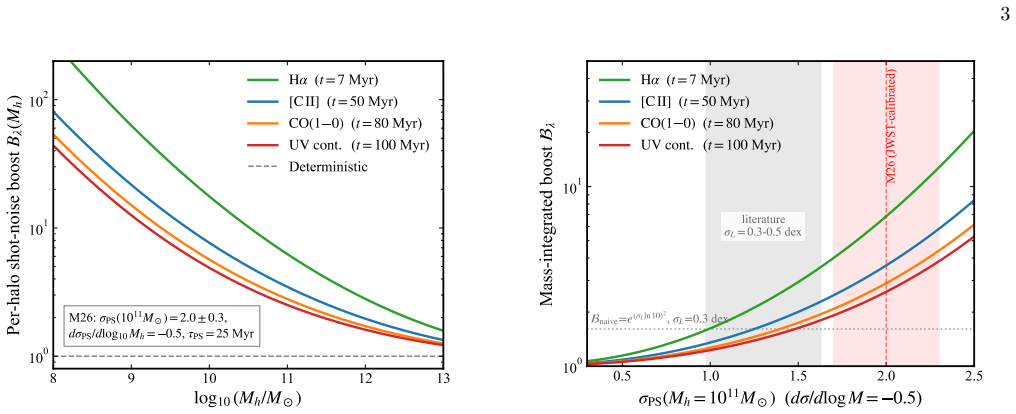
Incorporating the JWST-era burstiness yields an enhanced LIM shot-noise power spectrum equal to the deterministic shot noise multiplied by a line-dependent boost factor B_lambda, derived in closed form by convolving the SFR correlation function with the stellar-population-synthesis kernel of each line. At z approximately 6 this gives B_Halpha approximately 7 and B approximately 2.5-3.5 for longer-window tracers such as CII, CO and UV, with the factors growing toward higher redshift.
What carries the argument
The line-dependent boost factor B_lambda obtained by convolving the star-formation-rate correlation function with the stellar-population-synthesis kernel for each emission line.
If this is right
- Auto-spectrum detectability improves because the shot-noise term is larger.
- Lower-redshift interloper contamination is relatively suppressed.
- Cosmological applications such as BAO that rely on clean clustering are degraded.
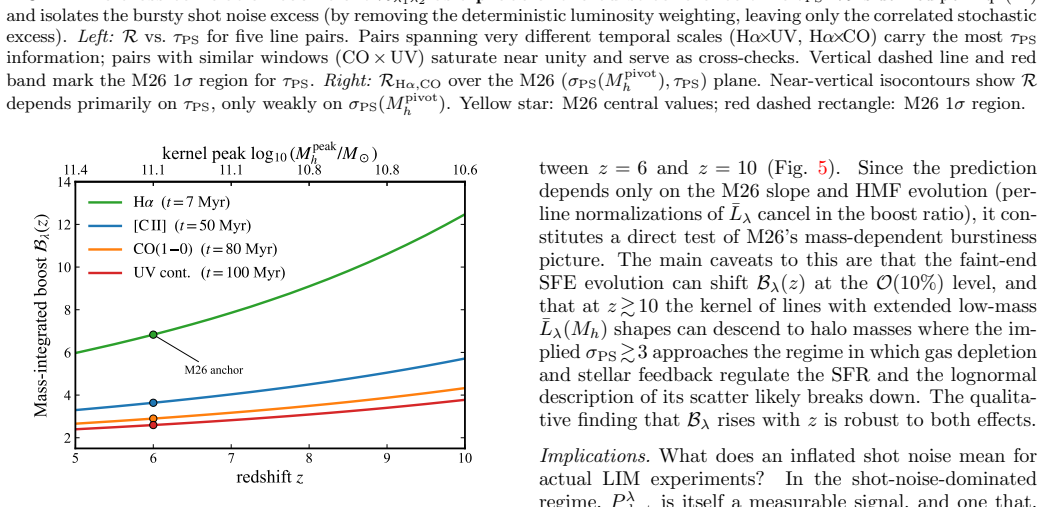
- Redshift tomography of a single line can constrain the amplitude and halo-mass dependence of the burstiness.
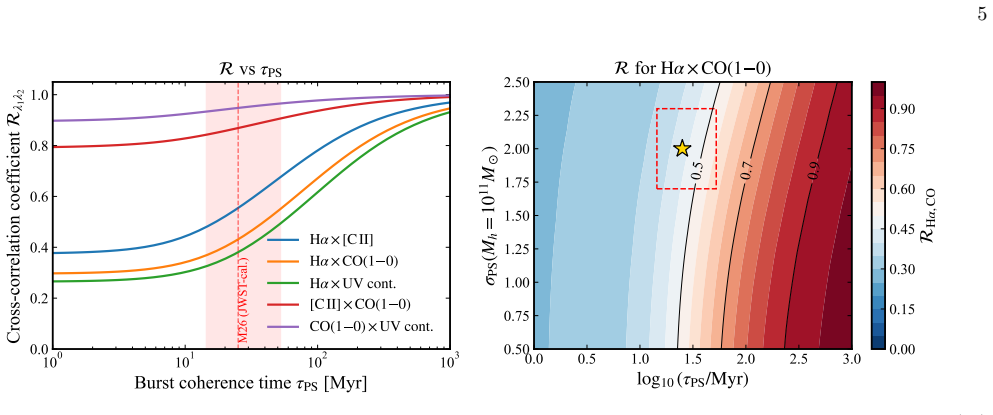
- Cross-line shot-noise correlations can measure the time coherence of the fluctuations.
Where Pith is reading between the lines
- LIM data could map the redshift evolution of burstiness amplitude using the boost factor's dependence on emission-line window length.
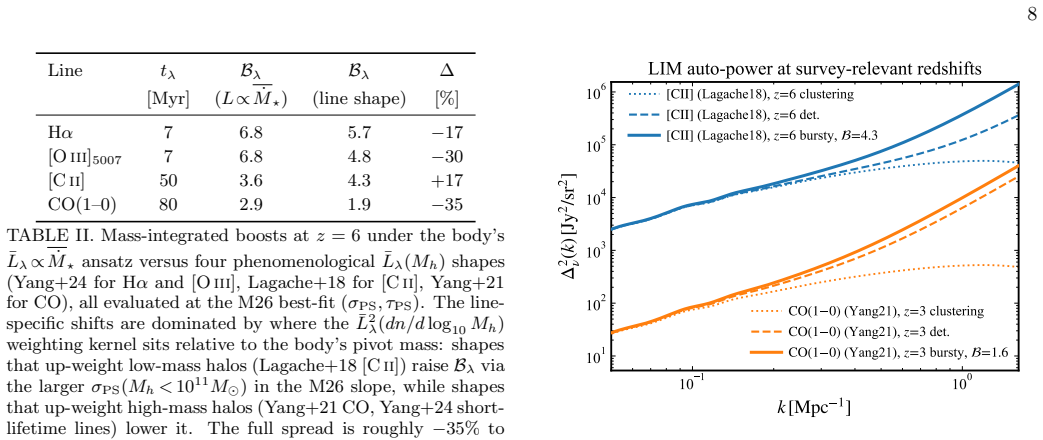
- Survey forecasts will need to replace the standard 0.3 dex scatter model with the JWST-calibrated boost to avoid biased signal-to-noise estimates.
- The time-correlation scale of 25 Myr links directly to reionization timing if the burstiness persists at still higher redshifts.
Load-bearing premise
The JWST-measured rms log-SFR scatter of 0.6 dex and 25 Myr time correlation for 10^11 solar-mass halos at z 4-6 can be inserted directly into the SFR correlation function without further astrophysical or selection corrections.
What would settle it
A measurement of the shot-noise power-spectrum amplitude for H-alpha or CII at z approximately 6 that matches the unboosted deterministic prediction while differing significantly from the boosted value.
Figures


read the original abstract
Recent JWST observations indicate that star formation at $z\!\sim\!4-6$ is more stochastic than previously assumed, with rms log-SFR scatter $\sim\!0.6$ dex at $M_h\!\sim\!10^{11}M_{\odot}$, growing toward smaller halos and time-correlated on $\sim\!25$ Myr. This is significantly higher than the typical $\sim\!0.3$ dex phenomenological lognormal scatter assumed in standard line-intensity mapping (LIM) forecasts. We propagate the JWST-era burstiness through to the LIM shot-noise power spectrum and show that the result is a simple multiplicative correction: the deterministic shot noise multiplied by a line-dependent boost factor $B_\lambda$ derived in closed form by convolving the SFR correlation function with the stellar-population-synthesis kernel of each line. At $z\!\sim\!6$, we find $B_{{\rm H}\alpha}\!\simeq\!7$ and $B\!\sim\!2.5$-$3.5$ for longer-window tracers ([CII], CO, UV) - factors of $\sim\!2$-$5$ above the standard prescription, and growing further toward higher redshift. The enhancement transforms the LIM landscape: it improves auto-spectrum detectability and suppresses lower-redshift interloper contamination, but degrades cosmological applications such as BAO that rely on a clean clustering measurement. Crucially, it also opens a new use of LIM as a diagnostic of high-redshift star-formation physics beyond the regime of individually resolved galaxies: redshift tomography of a single line constrains the amplitude and mass dependence of the burstiness, while cross-line shot-noise correlations probe its time coherence.
Editorial analysis
A structured set of objections, weighed in public.
Referee Report
Summary. The paper claims that JWST observations reveal higher stochasticity in star formation at z~4-6 (rms log-SFR scatter ~0.6 dex, time-correlated on ~25 Myr scales for M_h~10^11 M_sun) than the standard ~0.3 dex assumption in LIM models. This burstiness propagates to the LIM shot-noise power spectrum as a multiplicative boost factor B_λ per line, derived in closed form via convolution of the SFR correlation function with each line's stellar-population-synthesis kernel. At z~6 this yields B_Hα≃7 and B~2.5-3.5 for [CII], CO, and UV tracers, with implications for improved auto-spectrum detectability, reduced interloper contamination, degraded BAO measurements, and new LIM diagnostics of high-z burstiness via tomography and cross-line correlations.
Significance. If the closed-form derivation and direct insertion of JWST scatter hold, the result is significant: it revises LIM forecasts by factors of 2-5, opens a new observational window on star-formation physics beyond resolved galaxies, and alters the relative merits of auto- versus cross-spectra for cosmology. The use of externally measured JWST inputs and the parameter-free convolution structure are clear strengths that make the prediction falsifiable with upcoming LIM data.
major comments (2)
- [§3.2] §3.2 (derivation of B_λ): the closed-form convolution of the SFR correlation function with the SPS kernel is presented as parameter-free once the JWST rms scatter and 25 Myr scale are inserted, but the manuscript must explicitly show the propagation of the time-correlation function through the integral (including any damping or redshift-evolution terms) to confirm the quoted B_Hα≃7 is not sensitive to the assumed functional form of the correlation.
- [§4.1] §4.1 and Table 1: the numerical boost factors rest on directly adopting the JWST-measured 0.6 dex scatter and 25 Myr correlation at z~4-6 for M_h~10^11 M_sun without additional astrophysical corrections; the paper should quantify how selection effects, halo-mass dependence, or redshift extrapolation alter B_λ before claiming factors of ~2-5 enhancement over standard prescriptions.
minor comments (2)
- [Figure 2] Figure 2: the plotted boost-factor curves versus redshift would benefit from an additional panel showing the sensitivity to the exact value of the 25 Myr correlation time.
- [Abstract] The abstract states the result is a 'simple multiplicative correction,' but the main text should include a one-line reminder that this holds only for the shot-noise term and does not affect the clustering component.
Simulated Author's Rebuttal
We thank the referee for their positive evaluation of the manuscript and for the constructive comments, which have helped clarify the presentation of our results. We respond to each major comment below and indicate the revisions we will make.
read point-by-point responses
-
Referee: [§3.2] §3.2 (derivation of B_λ): the closed-form convolution of the SFR correlation function with the SPS kernel is presented as parameter-free once the JWST rms scatter and 25 Myr scale are inserted, but the manuscript must explicitly show the propagation of the time-correlation function through the integral (including any damping or redshift-evolution terms) to confirm the quoted B_Hα≃7 is not sensitive to the assumed functional form of the correlation.
Authors: We agree that an explicit walkthrough of the integral will improve transparency. In the revised manuscript we will expand §3.2 (and add a short appendix) to show the full propagation of the SFR time-correlation function ξ_SFR(Δt) through the convolution integral, including the damping from the finite correlation timescale and any redshift-evolution factors. We will also test alternative functional forms (exponential decay and Gaussian) and demonstrate that B_Hα remains within 15% of 7, confirming the result is robust to the precise shape of the correlation. revision: yes
-
Referee: [§4.1] §4.1 and Table 1: the numerical boost factors rest on directly adopting the JWST-measured 0.6 dex scatter and 25 Myr correlation at z~4-6 for M_h~10^11 M_sun without additional astrophysical corrections; the paper should quantify how selection effects, halo-mass dependence, or redshift extrapolation alter B_λ before claiming factors of ~2-5 enhancement over standard prescriptions.
Authors: We partially agree. The manuscript adopts the JWST values directly for the mass and redshift range where they are measured, which is appropriate because LIM integrates over the full halo population. In revision we will add to §4.1 a quantitative discussion of the three effects: (i) halo-mass dependence—scatter increases toward lower masses, raising the mass-function-weighted B_λ; (ii) selection effects—we note that the JWST sample traces the star-forming galaxies that dominate the LIM signal; (iii) redshift extrapolation—we provide a simple scaling showing B_λ grows with z. These additions will be included as new text and an updated table entry while retaining the direct adoption for the quoted z~6 results. revision: partial
Circularity Check
No significant circularity; derivation applies external JWST inputs via standard convolution
full rationale
The central claim derives the line-dependent boost factor B_λ by convolving an SFR correlation function (populated directly from JWST-measured rms log-SFR scatter of ~0.6 dex and ~25 Myr coherence time) with standard stellar-population-synthesis kernels. These inputs are external observational constraints, not outputs of the paper's own equations or prior self-citations. The resulting multiplicative correction to deterministic shot noise is a new application to LIM power spectra and does not reduce by construction to a fit or self-referential loop. No load-bearing step matches any of the enumerated circularity patterns.
Axiom & Free-Parameter Ledger
free parameters (2)
- rms log-SFR scatter =
0.6 dex
- SFR time-correlation scale =
~25 Myr
axioms (2)
- domain assumption The SFR correlation function can be convolved with the stellar-population-synthesis kernel of each line to produce a closed-form multiplicative boost factor for shot noise.
- domain assumption The deterministic (non-bursty) shot-noise model remains the correct baseline that is simply rescaled by B_λ.
Reference graph
Works this paper leans on
-
[1]
The brightest galaxies at cosmic dawn
C. A. Mason, M. Trenti, T. Treu, “The brightest galaxies at cosmic dawn”, MNRAS521, 497 (2023)
work page 2023
-
[2]
Y. Harikaneet al., “A Comprehensive Study of Galaxies at z∼9−16 Found in the Early JWST Data: Ultraviolet Lu- minosity Functions and Cosmic Star Formation History at the Pre-reionization Epoch”, Astrophys. J.265, 5 (2023)
work page 2023
-
[3]
The Complete CEERS Early Uni- verse Galaxy Sample
S. L. Finkelsteinet al., “The Complete CEERS Early Uni- verse Galaxy Sample”, Astrophys. J. Lett.969, L2 (2024)
work page 2024
-
[4]
C. T. Donnanet al., “JWST PRIMER: a new multifield determination of the evolving galaxy UV luminosity func- tion at redshiftsz≃9−15”, MNRAS533, 3222 (2024)
work page 2024
-
[5]
B. E. Robertsonet al., “Earliest Galaxies in the JADES Origins Field: Luminosity Function and Cosmic Star For- mation Rate Density 300 Myr after the Big Bang”, Astro- phys. J.970, 31 (2024)
work page 2024
-
[6]
R. Endsleyet al., “The star-forming and ionizing prop- erties of dwarfz∼6−9 galaxies in JADES: insights on bursty star formation and ionized bubble growth”, MN- RAS533, 1111 (2024)
work page 2024
-
[7]
J. B. Mu˜ noz, J. Chisholm, G. Sun, J. Samuel, J. Mirocha, E. Bregou, A. Venditti, M. Qezlou, C. Simmonds and R. Endsley, “Relatively Fast and Reasonably Furious: Ev- idence for Increased Burstiness in Smaller Halos at Cosmic Dawn,” [arXiv:2601.07912]
work page internal anchor Pith review Pith/arXiv arXiv
-
[8]
Bursty Star Formation Naturally Explains the Abundance of Bright Galaxies at Cosmic Dawn,
G. Sun, C. A. Faucher-Gigu` ere, C. C. Hayward, X. Shen, A. Wetzel and R. K. Cochrane, “Bursty Star Formation Naturally Explains the Abundance of Bright Galaxies at Cosmic Dawn,” Astrophys. J. Lett.955, no.2, L35 (2023)
work page 2023
-
[9]
The impact of mass- dependent stochasticity at cosmic dawn
V. Gelli, C. Mason, C. C. Hayward, “The impact of mass- dependent stochasticity at cosmic dawn”, ApJ975, 192 (2024)
work page 2024
-
[10]
Stochastic star formation in early galaxies: JWST implications
A. Pallottini and A. Ferrara, “Stochastic star formation in early galaxies: JWST implications”, Astron. Astrophys. 677, L4 (2023)
work page 2023
-
[11]
I. Mitsuhashiet al., “UNCOVER/MegaScience Finds Uni- form and Highly Bursty Star Formation at 3< z <9, con- sistent with the High-Redshift UV Luminosity Function”, [arXiv:2601.16284]
-
[12]
L. Clarke, A. E. Shapley, R. L. Sanders, M. W. Topping, G. B. Brammer, T. Bento, N. A. Reddyet al., “The Star- Forming Main Sequence in JADES and CEERS atz >1.4: Investigating the Burstiness of Star Formation”, Astro- phys. J.977, 133 (2024)
work page 2024
-
[13]
Galaxies on FIRE (Feedback In Realistic Environments)
P. F. Hopkins, D. Kereˇ s, J. O˜ norbe, C.-A. Faucher- Gigu` ere, E. Quataert, N. Murray, J. S. Bullock, “Galaxies on FIRE (Feedback In Realistic Environments)”, MNRAS 445, 581 (2014)
work page 2014
-
[14]
Obser- vational signatures of bursty star formation in galaxies
M. Sparre, C. C. Hayward, R. Feldmann, C.-A. Faucher- Gigu` ere, A. L. Muratov, D. Kereˇ s, P. F. Hopkins, “Obser- vational signatures of bursty star formation in galaxies”, MNRAS466, 88 (2017)
work page 2017
-
[15]
K. El-Badry, A. Wetzel, M. Geha, P. F. Hopkins, D. Kereˇ s, T. K. Chan, C.-A. Faucher-Gigu` ere, “Breathing FIRE: How Stellar Feedback Drives Radial Migration, Rapid Size Fluctuations, and Population Gradients in Low-Mass Galaxies”, Astrophys. J.820, 131 (2016)
work page 2016
-
[16]
A model for the origin of bursty star formation in galaxies
C.-A. Faucher-Gigu` ere, “A model for the origin of bursty star formation in galaxies”, MNRAS473, 3717 (2018)
work page 2018
-
[17]
Stochastic mod- eling of star-formation histories II
S. Tacchella, J. C. Forbes, N. Caplar, “Stochastic mod- eling of star-formation histories II”, MNRAS497, 698 (2020)
work page 2020
-
[18]
Bursty star formation during the Cosmic Dawn driven by delayed stellar feed- back
S. R. Furlanetto and J. Mirocha, “Bursty star formation during the Cosmic Dawn driven by delayed stellar feed- back”, MNRAS511, 3895 (2022)
work page 2022
-
[19]
Break- ing degeneracies in the first galaxies with clustering
J. B. Mu˜ noz, J. Mirocha, S. Furlanetto, N. Sabti, “Break- ing degeneracies in the first galaxies with clustering”, MN- RAS Letters526, L47 (2023)
work page 2023
-
[20]
G. Sun, J. B. Mu˜ noz, J. Mirocha, C.-A. Faucher- Gigu` ere, “Constraining bursty star formation histories with galaxy UV and Hαluminosity functions and clus- tering”, [arXiv:2410.21409]
-
[21]
Line-Intensity Mapping: Theory Review
J. L. Bernal and E. D. Kovetz, “Line-Intensity Mapping: Theory Review”, Astron. Astrophys. Rev.30, 5 (2022)
work page 2022
-
[22]
Line-Intensity Mapping: 2017 Status Report
E. D. Kovetzet al., “Line-Intensity Mapping: 2017 Status Report”, [arXiv:1709.09066]
work page internal anchor Pith review Pith/arXiv arXiv 2017
-
[23]
Astrophysics & cosmology from LIM vs galaxy surveys
E. Schaan and M. White, “Astrophysics & cosmology from LIM vs galaxy surveys”, JCAP2021, 067 (2021)
work page 2021
-
[24]
Intensity Mapping with Carbon Monoxide Emission Lines and the Redshifted 21 cm Line
A. Lidz, S. R. Furlanetto, S. P. Oh, J. Aguirre, T.-C. Chang, O. Dor´ e, J. R. Pritchard, “Intensity Mapping with Carbon Monoxide Emission Lines and the Redshifted 21 cm Line” Astrophys. J.741, 70 (2011)
work page 2011
-
[25]
Intensity Mapping across Cosmic Times with the LyαLine’
A. R. Pullen, O. Dor´ e, J. Bock, “Intensity Mapping across Cosmic Times with the LyαLine’”, ApJ786, 111 (2014)
work page 2014
-
[26]
The high redshift star-formation history from carbon- monoxide intensity maps,
P. C. Breysse, E. D. Kovetz and M. Kamionkowski, “The high redshift star-formation history from carbon- monoxide intensity maps,” MNRAS457, L127 (2016)
work page 2016
-
[27]
Carbon monoxide intensity mapping at moderate redshifts
P. C. Breysse, E. D. Kovetz, M. Kamionkowski, “Carbon monoxide intensity mapping at moderate redshifts”, MN- RAS443, 3506 (2014)
work page 2014
-
[28]
Intensity mapping of [C ii] emission from early galaxies
B. Yue, A. Ferrara, A. Pallottini, S. Gallerani, L. Vallini, “Intensity mapping of [C ii] emission from early galaxies”, MNRAS450, 3829 (2015)
work page 2015
-
[29]
Probing Cosmic Reionization and Molecu- lar Gas Growth with TIME
G. Sunet al., “Probing Cosmic Reionization and Molecu- lar Gas Growth with TIME”, ApJ915, 33 (2021)
work page 2021
-
[30]
Evidence for [CII] diffuse line emission at redshiftz∼2.6
S. Yang, A. R. Pullen, E. R. Switzer, “Evidence for [CII] diffuse line emission at redshiftz∼2.6”, MNRAS489, L53 (2019)
work page 2019
-
[31]
The diversity and variability of star formation histories in models of galaxy evolution
K. G. Iyer, S. Tacchella, S. Genelet al., “The diversity and variability of star formation histories in models of galaxy evolution”, Mon. Not. Roy. Astron. Soc.498, 430 (2020)
work page 2020
-
[32]
LIMFAST. I. A Seminumerical Tool for Line 11 Intensity Mapping
L. Mas-Ribas, G. Sun, T.-C. Chang, M. O. Gonzalez, R. H. Mebane, “LIMFAST. I. A Seminumerical Tool for Line 11 Intensity Mapping”, Astrophys. J.950, 39 (2023)
work page 2023
-
[33]
LIMFAST. II. Line Intensity Mapping as a Probe of High-redshift Galaxy Formation
G. Sun, L. Mas-Ribas, T.-C. Chang, S. R. Furlanetto, R. H. Mebane, M. O. Gonzalez, J. Parsons, A. C. Trapp, “LIMFAST. II. Line Intensity Mapping as a Probe of High-redshift Galaxy Formation”, ApJ950, 40 (2023)
work page 2023
-
[34]
An Effective Model for the Cosmic-Dawn 21-cm Signal
J. B. Mu˜ noz, “An Effective Model for the Cosmic-Dawn 21-cm Signal”, MNRAS523, 2587 (2023)
work page 2023
-
[35]
Effective model for LIM: Auto- and cross-power spectra in the cosmic dawn and reionization
S. Libanore, J. B. Mu˜ noz, E. D. Kovetz, “Effective model for LIM: Auto- and cross-power spectra in the cosmic dawn and reionization”, PRD112, 083552 (2025)
work page 2025
-
[36]
On the Theory of the Brownian Motion,
G. E. Uhlenbeck and L. S. Ornstein, “On the Theory of the Brownian Motion,” Phys. Rev.36, 823 (1930)
work page 1930
-
[37]
Stellar population synthesis at the resolution of 2003
G. Bruzual and S. Charlot, “Stellar population synthesis at the resolution of 2003”, MNRAS344, 1000 (2003)
work page 2003
-
[38]
Improving log- normal models for cosmological fields
H. S. Xavier, F. B. Abdalla, B. Joachimi, “Improving log- normal models for cosmological fields”, MNRAS459, 3693 (2016)
work page 2016
-
[39]
Stochastic modeling of star- formation histories I: the scatter of the star-forming main sequence
N. Caplar and S. Tacchella, “Stochastic modeling of star- formation histories I: the scatter of the star-forming main sequence”, MNRAS487, 3845 (2019)
work page 2019
-
[40]
Full disc [C II] mapping of nearby star-forming galaxies
G. Lagache, M. Cousin, M. Chatzikos, “Full disc [C II] mapping of nearby star-forming galaxies”, Astron. Astro- phys.609, A130 (2018)
work page 2018
-
[41]
Star Formation in Galaxies Along the Hubble Sequence
R. C. Kennicutt, “Star Formation in Galaxies Along the Hubble Sequence”, Annu. Rev. Astron. Astrophys.36, 189 (1998)
work page 1998
-
[42]
T. Y. Li, R. H. Wechsler, K. Devaraj, S. E. Church, “Con- necting CO Intensity Mapping to Molecular Gas and Star Formation in the Epoch of Galaxy Assembly”, Astrophys. J.817, 169 (2016)
work page 2016
-
[43]
Large-scale bias and the peak background split
R. K. Sheth and G. Tormen, “Large-scale bias and the peak background split”, MNRAS308, 119 (1999)
work page 1999
-
[44]
The Cosmic Linear Anisotropy Solving System (CLASS) I: Overview
J. Lesgourgues, “The Cosmic Linear Anisotropy Solving System (CLASS) I: Overview”, arXiv:1104.2932 (2011)
work page internal anchor Pith review Pith/arXiv arXiv 2011
-
[45]
Studying high-z galaxies with [CII] intensity mapping,
B. Yue and A. Ferrara, “Studying high-z galaxies with [CII] intensity mapping,” MNRAS490, 1928 (2019),
work page 1928
-
[46]
COMAP Early Science. I. Overview
K. A. Clearyet al.“COMAP Early Science. I. Overview”, (COMAP Collab.), Astrophys. J.933, 182 (2022)
work page 2022
-
[47]
Cosmology with the SPHEREX All-Sky Spectral Survey
O. Dor´ eet al., “Cosmology with the SPHEREX All-Sky Spectral Survey”, [arXiv:1412.4872]
work page internal anchor Pith review Pith/arXiv arXiv
-
[48]
Overview and status of EXCLAIM, the experiment for cryogenic large-aperture intensity map- ping
G. Cataldoet al., “Overview and status of EXCLAIM, the experiment for cryogenic large-aperture intensity map- ping”, JATIS7, 011007 (2021)
work page 2021
-
[49]
CCAT-Prime Collab., M. Aravenaet al., “CCAT-prime Collaboration: Science Goals and Forecasts with Prime- Cam on the Fred Young Submillimeter Telescope”, Astro- phys. J. Suppl.264, 7 (2023)
work page 2023
-
[50]
[CII] line intensity mapping the epoch of reionization with the Prime-Cam on FYST
C. Karoumpis, B. Magnelli, E. Romano-D´ ıaz, M. Haslbauer, F. Bertoldi, “[CII] line intensity mapping the epoch of reionization with the Prime-Cam on FYST”, As- tron. Astrophys.659, A12 (2022)
work page 2022
-
[51]
COMAP Early Science: VII. Prospects for CO Intensity Mapping at Reionization
P. C. Breysseet al., “COMAP Early Science: VII. Prospects for CO Intensity Mapping at Reionization”, As- trophys. J.933, 188 (2022)
work page 2022
-
[52]
COMAP Early Science: V. Constraints and Forecasts atz∼3
D. T. Chunget al.(COMAP Collab.), “COMAP Early Science: V. Constraints and Forecasts atz∼3”, Astro- phys. J.933, 186 (2022)
work page 2022
-
[53]
COMAP Pathfinder – Season 2 results II. Updated constraints on the CO(1–0) power spectrum
N.-O. Stutzeret al.(COMAP Collab.), “COMAP Pathfinder – Season 2 results II. Updated constraints on the CO(1–0) power spectrum”, Astron. Astrophys.691, A337 (2024) [arXiv:2406.07511]
-
[54]
Insights from probability distribution functions of intensity maps,
P. C. Breysse, E. D. Kovetz, P. S. Behroozi, L. Dai, and M. Kamionkowski, “Insights from probability distribution functions of intensity maps,” MNRAS467, 2996 (2017),
work page 2017
-
[55]
Line inten- sity mapping with [C II] and CO(1-0) as probes of primor- dial non-Gaussianity,
A. Moradinezhad Dizgah and G. K. Keating, “Line inten- sity mapping with [C II] and CO(1-0) as probes of primor- dial non-Gaussianity,” Astrophys. J.872, 126 (2019),
work page 2019
-
[56]
Intensity Mapping of Lyman-alpha Emission During the Epoch of Reionization
M. B. Silva, M. G. Santos, Y. Gong, A. Cooray, J. Bock, “Intensity Mapping of Lyman-alpha Emission During the Epoch of Reionization”, Astrophys. J.763, 132 (2013)
work page 2013
-
[57]
C. Heneka and A. Cooray, “Optimal survey parameters: Lyαand Hαintensity mapping for synergy with the 21- cm signal during reionization,” Mon. Not. Roy. Astron. Soc.506, no.2, 1573-1584 (2021)
work page 2021
-
[58]
Cosmic Expansion History from Line-Intensity Mapping,
J. L. Bernal, P. C. Breysse and E. D. Kovetz, “Cosmic Expansion History from Line-Intensity Mapping,” Phys. Rev. Lett.123, 251301 (2019)
work page 2019
-
[59]
User’s guide to extracting cosmological information from line-intensity maps,
J. L. Bernal, P. C. Breysse, H. Gil-Mar´ ın and E. D. Kovetz, “User’s guide to extracting cosmological information from line-intensity maps,” Phys. Rev. D100, 123522 (2019)
work page 2019
- [60]
- [61]
-
[62]
The TIME-Pilot intensity mapping experiment
A. T. Criteset al., “The TIME-Pilot intensity mapping experiment”, Proc. SPIE9153, 91531W (2014)
work page 2014
-
[63]
E. Visbal and A. Loeb, “Measuring the 3D clustering of undetected galaxies through cross correlation of their cu- mulative flux fluctuations from multiple spectral lines”, JCAP11, 016 (2010)
work page 2010
discussion (0)
Sign in with ORCID, Apple, or X to comment. Anyone can read and Pith papers without signing in.