Memory Forensics Techniques for Automated Detection and Analysis of Go Malware
Pith reviewed 2026-05-15 05:30 UTC · model grok-4.3
The pith
A memory forensics framework parses Go runtime structures to recover execution state and artifacts from malware binaries.
A machine-rendered reading of the paper's core claim, the machinery that carries it, and where it could break.
Core claim
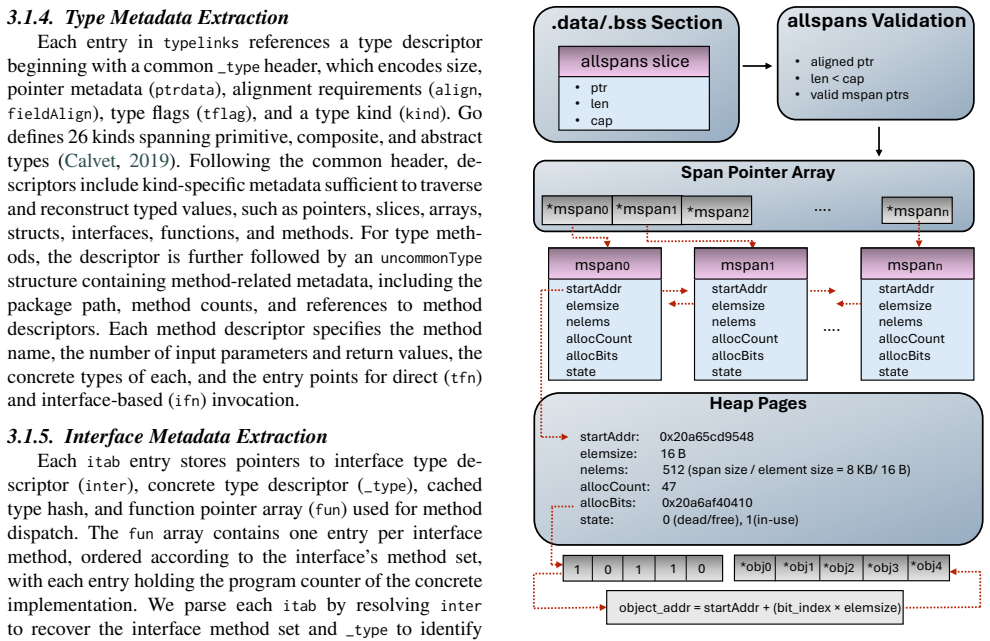
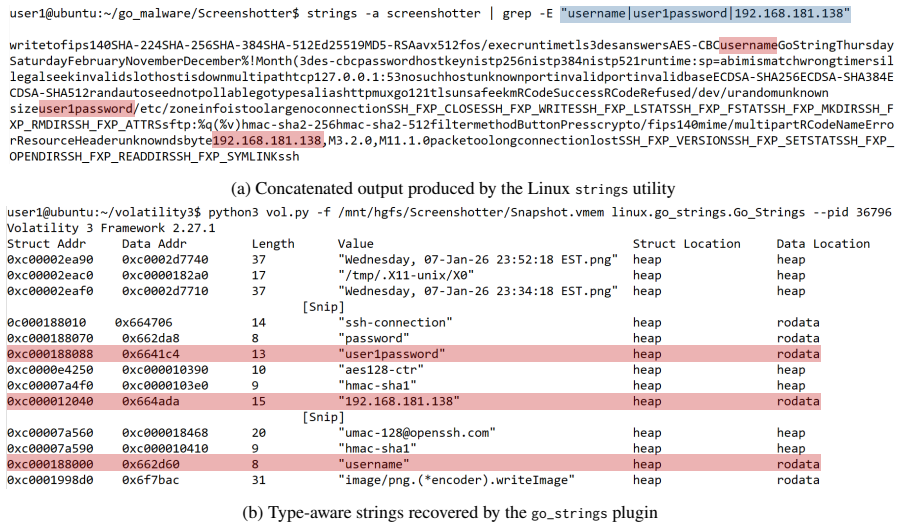
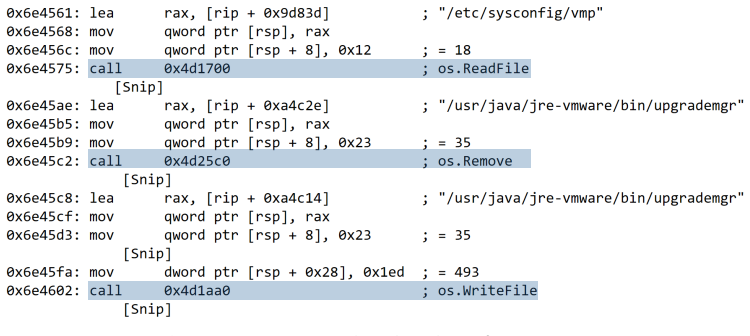
We present the first memory forensics framework for runtime analysis of Go binaries. By parsing Go's internal structures, our framework reconstructs type and function metadata, recovers heap-allocated and static strings, and distinguishes application-level functions. Through ABI-aware backward analysis, it derives execution paths and argument values from call sites. To capture runtime state beyond what static analysis reveals, it analyzes goroutine stacks to identify actively executing functions and recover their runtime argument values. We implemented all capabilities as Volatility 3 plugins and evaluated them against malware seen in recent incidents, successfully recovering C2 endpoints, 0
What carries the argument
Volatility 3 plugins that parse Go runtime structures (type metadata, pointer-length string representations, goroutine stacks, and ABI) to reconstruct metadata and derive execution paths from memory.
If this is right
- Recovers C2 endpoints and persistence mechanisms directly from infected system memory.
- Extracts encryption keys and ransom notes that exist only in runtime state.
- Identifies actively executing functions and their argument values from goroutine stacks.
- Supplies runtime artifacts missing from static analysis and published threat reports.
- Supports automated analysis of Go malware samples through existing Volatility workflows.
Where Pith is reading between the lines
- The same parsing approach could apply to other languages that embed substantial runtime metadata if their structures become documented.
- Memory forensics tools may need periodic updates as compilers change internal layouts in languages like Go.
- Integration into incident response could reduce reliance on reverse engineering for concurrent malware.
Load-bearing premise
Go's internal runtime structures including type metadata, string representations, and goroutine stacks remain stable enough to parse reliably across the malware samples and compiler versions tested.
What would settle it
A memory dump from Go malware compiled with a newer version that alters the runtime ABI or string representation would cause the plugins to fail to recover the expected C2 endpoints and argument values.
Figures




read the original abstract
The Go programming language has become increasingly popular among malware developers due to its ability to produce statically linked, cross-platform executables that challenge traditional analysis techniques. These binaries embed a substantial runtime and compiler-generated metadata and are compiled with aggressive optimizations that discard type information for function parameters and local variables. Go's design further complicates analysis by representing strings as pointer-length pairs rather than null-terminated sequences, employing a caller-allocated stack model that obscures argument boundaries, and fragmenting program state across concurrent goroutines. Although existing static analysis and reverse engineering tools provide Go-specific support, they remain limited to compile-time artifacts and cannot recover runtime execution state and artifacts that persist solely in memory. To address this gap, we present the first memory forensics framework for runtime analysis of Go binaries. By parsing Go's internal structures, our framework reconstructs type and function metadata, recovers heap-allocated and static strings, and distinguishes application-level functions. Through ABI-aware backward analysis, it derives execution paths and argument values from call sites. To capture runtime state beyond what static analysis reveals, it analyzes goroutine stacks to identify actively executing functions and recover their runtime argument values. We implemented all capabilities as Volatility 3 plugins and evaluated them against malware seen in recent incidents, such as the BRICKSTORM backdoor, Obscura ransomware, and Pantegana RAT, as well as open-source samples for reproducibility. The framework successfully recovered C2 endpoints, persistence mechanisms, encryption keys, ransom notes, and execution state, including critical runtime artifacts that were absent from published threat intelligence.
Editorial analysis
A structured set of objections, weighed in public.
Referee Report
Summary. The paper presents the first memory forensics framework for runtime analysis of Go binaries, implemented as Volatility 3 plugins. It parses Go runtime structures (type metadata, string headers as pointer+length, goroutine stacks, ABI-derived arguments) to reconstruct function metadata, recover heap/static strings, identify executing functions, and derive argument values. Evaluation on real malware (BRICKSTORM backdoor, Obscura ransomware, Pantegana RAT) and open-source samples claims successful recovery of C2 endpoints, persistence mechanisms, encryption keys, ransom notes, and execution state absent from static analysis or published threat intelligence.
Significance. If reliable, the framework would address a clear gap in analyzing increasingly common Go malware whose static linking and runtime optimizations defeat traditional tools. Strengths include concrete Volatility 3 plugin implementations, ABI-aware backward analysis, goroutine stack examination for runtime state, and evaluation on both real incident samples and open-source binaries for reproducibility.
major comments (2)
- [Evaluation] Evaluation section: claims of successful artifact recovery on BRICKSTORM, Obscura, and Pantegana rest on qualitative statements without quantitative metrics (success rates, error rates, number of samples tested, or version-specific failure modes), undermining assessment of the framework's practical reliability.
- [Framework description and Evaluation] Framework description and Evaluation: the parsing of Go runtime layouts (string representation, type metadata, caller-allocated stacks, goroutine structures) assumes cross-version stability but provides no version-detection logic, no enumeration of tested Go releases (e.g., 1.18–1.22), and no discussion of handling compiler optimizations known to alter stack frames and string headers; this is load-bearing for claims that recovered C2 endpoints and keys are trustworthy outside the evaluated binaries.
minor comments (1)
- [Abstract and Evaluation] Abstract and Evaluation: references to 'open-source samples for reproducibility' do not name the specific binaries or provide repository links, reducing the ability to verify results.
Simulated Author's Rebuttal
We thank the referee for their constructive comments, which highlight important aspects of evaluation rigor and framework robustness. We address each major comment below, indicating where revisions will be made to strengthen the manuscript.
read point-by-point responses
-
Referee: [Evaluation] Evaluation section: claims of successful artifact recovery on BRICKSTORM, Obscura, and Pantegana rest on qualitative statements without quantitative metrics (success rates, error rates, number of samples tested, or version-specific failure modes), undermining assessment of the framework's practical reliability.
Authors: We acknowledge that the evaluation is presented through qualitative case studies on three real incident samples (BRICKSTORM backdoor, Obscura ransomware, Pantegana RAT) plus open-source binaries, demonstrating recovery of specific runtime artifacts such as C2 endpoints, encryption keys, and execution state that static analysis could not provide. Establishing quantitative metrics like success rates or error rates is inherently difficult in this domain because ground-truth runtime state for live malware is rarely available in public reports. We will revise the evaluation section to explicitly state the total number of samples tested, list the specific artifacts recovered per sample, and add a brief discussion of observed failure modes tied to Go version differences. This will improve transparency without overstating the results as a broad benchmark. revision: partial
-
Referee: [Framework description and Evaluation] Framework description and Evaluation: the parsing of Go runtime layouts (string representation, type metadata, caller-allocated stacks, goroutine structures) assumes cross-version stability but provides no version-detection logic, no enumeration of tested Go releases (e.g., 1.18–1.22), and no discussion of handling compiler optimizations known to alter stack frames and string headers; this is load-bearing for claims that recovered C2 endpoints and keys are trustworthy outside the evaluated binaries.
Authors: We agree that an explicit treatment of version compatibility is needed. Our plugins were developed and validated against Go releases 1.18 through 1.22, which encompass the compiler versions present in the evaluated malware. Core data structures (pointer-length string headers, goroutine metadata, and caller-allocated stack layout) have remained stable across this range; variations arise mainly from compiler optimizations that affect argument placement and inlining. Our ABI-aware backward analysis already accounts for these by walking call sites rather than relying on fixed offsets. We will add a dedicated subsection enumerating the tested releases, describing the stability assumptions, and outlining how the analysis handles optimization-induced changes to stack frames. No automatic version-detection logic will be added, as it is not required for the targeted range and would increase plugin complexity without improving reliability for the evaluated samples. revision: yes
Circularity Check
No circularity: engineering framework directly parses documented Go runtime layouts
full rationale
The paper describes an engineering implementation of memory parsing for Go binaries using known runtime structures such as string headers, type metadata, and goroutine stacks. No mathematical derivations, predictions, or first-principles results are claimed that could reduce to fitted inputs or self-referential definitions. All capabilities are presented as direct applications of publicly documented Go ABI and runtime layouts, with evaluation against specific malware samples serving as validation rather than circular confirmation. The work contains no self-citation load-bearing steps, ansatz smuggling, or renaming of known results as novel derivations.
Axiom & Free-Parameter Ledger
axioms (1)
- domain assumption Go runtime internal structures (type metadata, string headers, goroutine stacks, ABI calling conventions) are stable enough to parse from memory across the compiler versions used by the target malware
Reference graph
Works this paper leans on
-
[1]
Leveraging memory forensics to investigate and detect illegal 3d printing activities
Ali, H., Case, A., Ahmed, I., 2025a. Leveraging memory forensics to investigate and detect illegal 3d printing activities. Forensic Science International: Digital Investigation 53, 301925. doi:10.1016/j.fsidi.20 25.301925. Ali,H.,Case,A.,Ahmed,I.,2025b.Memoryanalysisofthepythonruntime environment. Forensic Science International: Digital Investigation 53, ...
-
[2]
{DroidScraper}: A tool for android{In-Memory}object recovery and reconstruction, in: 22nd International Symposium on Research in At- tacks, Intrusions and Defenses (RAID 2019), pp. 547–559. Ali-Gombe,A.,Tambaoan,A.,Gurfolino,A.,RichardIII,G.G.,2020.App- agnostic post-execution semantic analysis of android in-memory foren- sics artifacts, in: Proceedings o...
work page 2019
-
[3]
Analyzing Golang Executables.https://www.pnfsoftwar e.com/blog/analyzing-golang-executables/. Accessed: 2026-01-16. Capstone Engine Team,
work page 2026
-
[4]
Capstone: The ultimate disassembly frame- work.https://github.com/capstone- engine/capstone. Accessed: 2026-01-16. Carvey, H., O’Donnell-Welch, L., Schmidt, A., Pham, A.,
work page 2026
-
[5]
Obscura, an obscure new ransomware variant.https://www.huntress.com/blog/ob scura-ransomware-variant. Accessed: 2026-01-16. Case, A., Richard III, G.G.,
work page 2026
-
[6]
Obscura ransomware: A case study in ran- somware data loss.https://www.coveware.com/blog/2025/11/18/obscura -ransomware-data-loss-validation. Accessed: 2026-01-16. Cybersecurity and Infrastructure Security Agency (CISA), National Secu- rityAgency(NSA),CanadianCentreforCyberSecurity,2025. BRICK- STORM Backdoor: Malware Analysis Report AR25-338A.https: //ww...
work page 2025
-
[7]
AlphaGolang: A Step-by-Step Go Malware Reversing Methodology for IDA Pro.https://www.sentinelone.com/la bs/alphagolang-a-step-by-step-go-malware-reversing-methodology-f or-ida-pro/. Accessed: 2026-01-15. Hex-Rays,
work page 2026
-
[8]
Stop guessing and start going: Cleaner golang decompi- lation in ida 9.2.https://hex-rays.com/blog/stop-guessing-and-start -going. Accessed: 2026-01-16. Hunt.io, 2025a. Gh0st and pantegana: Two rats that refuse to fade away. https://hunt.io/blog/gh0st- and- pantegana- two- rats- that- refuse- t o-fade-away. Accessed: 2026-01-16. Hunt.io, 2025b. Pantegana ...
work page 2026
-
[9]
Rust and go malware: Cross-platform threats evading traditional defenses.https://medium.com/@instatunnel/rust -and-go-malware-cross-platform-threats-evading-traditional-defen ses-d7fddf127d32. Accessed: 2026-01-15. Mandiant, 2025a. Another brickstorm: Stealthy backdoor enabling espi- onage into tech and legal sectors.https://cloud.google.com/blog/to pics/...
work page 2026
-
[10]
Goresym: Go symbol recovery tool.https://github.com /mandiant/GoReSym. Accessed: 2026-01-16. Manna, M., Case, A., Ali-Gombe, A., Richard III, G.G.,
work page 2026
-
[11]
Garble: Changelog (v0.15.0).https://github.com/burro wers/garble/blob/6dab979/CHANGELOG.md. Accessed: 2026-01-16. Maurya,A.,2021. Golangmalwareismorethanafad:Financialmotivation drives adoption.https://www.crowdstrike.com/en-us/blog/financial-m otivation-drives-golang-malware-adoption/. Accessed: 2026-01-15. Meskauskas, T.,
work page 2026
-
[12]
https://www.pcrisk.com/removal- guides/33788- obscura- ransomware
How to remove obscura (.obscura) ransomware. https://www.pcrisk.com/removal- guides/33788- obscura- ransomware. Accessed: 2026-01-16. omaidf,
work page 2026
-
[13]
Go-malware: Golang malware examples.https://github.c om/omaidf/go-malware/tree/master. Accessed: 2026-01-16. Raimbaud, K., Rascagneres, P.,
work page 2026
-
[14]
GoResolver: Using Control-flow GraphSimilaritytoDeobfuscateGolangBinaries,Automatically.https: //www.volexity.com/blog/2025/04/01/goresolver- using- control- flo w-graph-similarity-to-deobfuscate-golang-binaries-automatically/. Accessed: 2026-01-15. First Author et al.:Preprint submitted to ElsevierPage 11 of 12 Smmarwar,S.K.,Gupta,G.P.,Kumar,S.,2024. And...
work page 2025
-
[15]
BitSight Threat Intelligence Briefing: Key Malware Trends Shaping Cyber Risk in 2025.https://www.bitsight.com/blo g/current-malware-trends-2025. Accessed: 2026-01-15. Sylve, J., Case, A., Marziale, L., Richard, G.G.,
work page 2025
-
[16]
https://go.dev/src/cmd/compile/abi-internal
Go Internal ABI Specification (ABIInternal). https://go.dev/src/cmd/compile/abi-internal. Accessed: 2026-01-18. Trellix,
work page 2026
-
[17]
Feeding gophers to ghidra.https://www.trellix.com/blogs/ research/feeding-gophers-to-ghidra/. Accessed: 2026-01-16. Volatility Foundation,
work page 2026
-
[18]
Volatility 3: The volatile memory extraction framework.https://github.com/volatilityfoundation/volatility3. Accessed: 2026-01-16. Volexity,2025. Goresolver:Context-awarerecoveryofgomalwareseman- tics.https://github.com/volexity/GoResolver. Accessed: 2026-01-16. Wang,E.,Zurowski,S.,Duffy,O.,Thomas,T.,Baggili,I.,2022. Juicingv8: Aprimaryaccountforthememoryf...
work page 2026
-
[19]
url = https://unit42.paloaltonetworks.com/bookworm- stately-taurus-attribution-framework/
Bookworm to stately taurus using the unit 42 attribu- tion framework. url = https://unit42.paloaltonetworks.com/bookworm- stately-taurus-attribution-framework/. Accessed: 2026-01-21. First Author et al.:Preprint submitted to ElsevierPage 12 of 12
work page 2026
discussion (0)
Sign in with ORCID, Apple, or X to comment. Anyone can read and Pith papers without signing in.