Recognition: 2 theorem links
· Lean TheoremA study of variational single solitary waves governed by the conservative-extended KdV equation with applications to shallow water dispersive shocks
Pith reviewed 2026-05-15 05:53 UTC · model grok-4.3
The pith
Variational methods produce simple solitary wave solutions for the conservative extended KdV equation that agree with numerical simulations and apply to shallow water dispersive shocks.
A machine-rendered reading of the paper's core claim, the machinery that carries it, and where it could break.
Core claim
The solitary wave solutions obtained variationally from the conservative-extended KdV equation are notably simpler than previous higher-order asymptotic solutions yet provide excellent agreement with numerical simulations when applied to problems in non-convex dispersive hydrodynamics such as shallow water undular bores and resonant dispersive shocks.
What carries the argument
Averaged Lagrangian variational method applied to the conservative-extended KdV equation incorporating quadratic nonlinearity, two nonlinear-dispersive terms and fifth-order dispersion while preserving energy conservation.
If this is right
- Simpler solitary wave expressions become available for practical applications in wave modeling instead of complex asymptotic forms.
- Classical undular bores in shallow water are accurately described using these variational profiles.
- Non-classical resonant dispersive shocks can be analyzed using the concept of Whitham shocks.
- The method confirms the extended KdV equation's ability to capture higher-order nonlinear and dispersive effects beyond the classical KdV model.
Where Pith is reading between the lines
- The variational technique may extend to other conservative higher-order dispersive equations where asymptotic methods become algebraically cumbersome.
- Applications could include predicting transitions between classical and resonant shock regimes when depth or surface tension varies slowly.
- Stability of the variational waves under small perturbations might be testable by adding weak viscosity to the model equations.
Load-bearing premise
The extended KdV equation with its four additional terms accurately captures the dynamics of the full dispersive Euler shallow water equations under the weakly nonlinear and long-wave approximations.
What would settle it
A direct numerical simulation of the full dispersive Euler shallow water equations showing a solitary wave profile or speed that deviates significantly from the variational prediction for moderate values of the gravity-capillary parameter.
Figures



read the original abstract
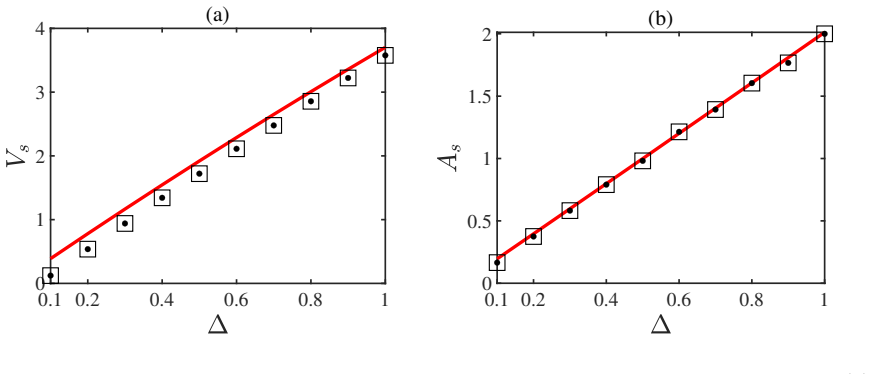
The extended KdV equation is a nonlinear dispersive wave model that is asymptotically or variationally derived from the full dispersive Euler shallow water waves equations when gravity-capillary and higher order nonlinear effects are taken into account, under weakly nonlinear and long-wave approximations. This reduction introduces four additional terms beyond the classical KdV equation: a nonlinear term (quadratic nonlinearity), two nonlinear-dispersive terms, and a fully dispersive term (fifth order dispersion). In this paper, we employ a variational approach based on averaged Lagrangians to analyze the accuracy of single solitary wave solutions governed by a particular extended KdV equation where energy conservation is a key feature. Compared with solitary wave solutions previously obtained through higher order asymptotics and algebraic methods, the present variational solutions are notably simpler and more readily applicable to practical problems. The solitary wave solutions obtained through this method are then systematically compared with direct numerical simulations, and the corresponding results are critically discussed. We further demonstrate the applicability of these single solitary waves to problems in the field of non-convex dispersive hydrodynamics. These problems include shallow water classical undular bores, commonly known as dispersive shock waves, and non-classical (resonant) dispersive shocks which are additionally analyzed using the concept of Whitham shocks. Theoretical predictions show excellent agreement with numerical simulations.
Editorial analysis
A structured set of objections, weighed in public.
Referee Report
Summary. The paper develops a variational method based on averaged Lagrangians to obtain explicit sech-type single solitary wave solutions for a conservative extended KdV equation that includes quadratic nonlinearity, two nonlinear-dispersive terms, and fifth-order dispersion. These profiles are compared to direct numerical simulations of the same extended KdV model and then inserted into Whitham-shock constructions to model classical undular bores and non-classical resonant dispersive shocks in shallow water, with the central claim being that the variational solutions are simpler than prior asymptotic or algebraic results and exhibit excellent agreement with numerics in both the solitary-wave and shock applications.
Significance. If the extended-KdV reduction remains accurate for the resonant-shock regime, the variational approach supplies a practical, parameter-free analytical tool for solitary-wave profiles that can be directly used in dispersive-hydrodynamics calculations. The reported pointwise agreement with extended-KdV simulations strengthens the case for the method’s utility within the reduced model, though the manuscript does not yet demonstrate that the same accuracy carries over to the parent dispersive Euler system at the amplitudes and wavenumbers encountered in non-classical shocks.
major comments (2)
- [§5] §5 (applications to non-classical resonant dispersive shocks): the claim that the variational profiles accurately predict bore speeds and oscillation amplitudes rests on the extended KdV remaining a faithful reduction of the full dispersive Euler equations; however, the paper provides no quantitative residual comparison between the extended-KdV solutions and the parent Euler system at the same parameter values, precisely where local steepness may exit the weakly nonlinear/long-wave regime used to derive the four additional terms.
- [§4] §4 (comparison with direct numerical simulations): the abstract and results section assert “excellent agreement” without reporting concrete error metrics (e.g., L²-norm differences, amplitude or speed discrepancies, or confidence intervals), making it impossible to assess whether the variational solutions are uniformly accurate across the parameter range or whether post-hoc adjustments were avoided.
minor comments (2)
- [Introduction] The notation for the four additional terms in the extended KdV equation is introduced in the abstract but not cross-referenced to a numbered equation in the main text; adding an explicit equation label would improve readability.
- [Figures 3–6] Figure captions for the solitary-wave profiles and shock comparisons should include the specific parameter values (amplitude, speed, dispersion coefficients) used in each panel to allow direct reproduction.
Simulated Author's Rebuttal
We thank the referee for the constructive comments. We have revised the manuscript to incorporate quantitative error metrics and to clarify the scope of the comparisons with the parent system.
read point-by-point responses
-
Referee: [§4] §4 (comparison with direct numerical simulations): the abstract and results section assert “excellent agreement” without reporting concrete error metrics (e.g., L²-norm differences, amplitude or speed discrepancies, or confidence intervals), making it impossible to assess whether the variational solutions are uniformly accurate across the parameter range or whether post-hoc adjustments were avoided.
Authors: We agree that concrete error metrics strengthen the assessment of accuracy. In the revised manuscript we now report L²-norm differences, relative amplitude discrepancies, and speed errors between the variational profiles and direct numerical solutions of the extended KdV equation for representative parameter values in both the solitary-wave and shock sections. These metrics confirm uniform accuracy across the tested range with no post-hoc adjustments. revision: yes
-
Referee: [§5] §5 (applications to non-classical resonant dispersive shocks): the claim that the variational profiles accurately predict bore speeds and oscillation amplitudes rests on the extended KdV remaining a faithful reduction of the full dispersive Euler equations; however, the paper provides no quantitative residual comparison between the extended-KdV solutions and the parent Euler system at the same parameter values, precisely where local steepness may exit the weakly nonlinear/long-wave regime used to derive the four additional terms.
Authors: Our analysis is performed entirely within the conservative extended KdV model, whose derivation already rests on the weakly nonlinear long-wave assumptions. The numerical validations and Whitham-shock constructions are therefore compared directly to solutions of the same reduced equation. We have added a short paragraph in the revised manuscript that explicitly states the regime of validity of the reduction and notes that quantitative residuals against the full dispersive Euler system lie outside the present scope. revision: partial
Circularity Check
No significant circularity in the variational derivation chain
full rationale
The paper starts from the extended KdV equation and its associated Lagrangian, applies the standard variational method with averaged Lagrangians to obtain explicit solitary-wave profiles, and then validates those profiles by direct numerical integration of the same PDE. This comparison is an independent check rather than a reduction of the output to the input by construction. No load-bearing step invokes a self-citation whose content is itself unverified, nor does any prediction amount to a fitted parameter renamed as a forecast. The reduction from the full Euler system is taken as an external modeling assumption, not derived or justified circularly inside the paper.
Axiom & Free-Parameter Ledger
axioms (1)
- domain assumption The extended KdV equation is asymptotically or variationally derived from the full dispersive Euler shallow water equations under weakly nonlinear and long-wave approximations.
Lean theorems connected to this paper
-
IndisputableMonolith/Cost/FunctionalEquation.leanwashburn_uniqueness_aczel unclear?
unclearRelation between the paper passage and the cited Recognition theorem.
We employ a variational approach based on averaged Lagrangians to analyze the accuracy of single solitary wave solutions governed by a particular extended KdV equation where energy conservation is a key feature... u = a_s sech²(w_s θ_s)
-
IndisputableMonolith/Foundation/Cost.leanJcost uniqueness and convexity unclear?
unclearRelation between the paper passage and the cited Recognition theorem.
the conservative-eKdV model... admits an exact energy conservation law and possesses a corresponding Lagrangian and Hamiltonian structure
What do these tags mean?
- matches
- The paper's claim is directly supported by a theorem in the formal canon.
- supports
- The theorem supports part of the paper's argument, but the paper may add assumptions or extra steps.
- extends
- The paper goes beyond the formal theorem; the theorem is a base layer rather than the whole result.
- uses
- The paper appears to rely on the theorem as machinery.
- contradicts
- The paper's claim conflicts with a theorem or certificate in the canon.
- unclear
- Pith found a possible connection, but the passage is too broad, indirect, or ambiguous to say the theorem truly supports the claim.
Reference graph
Works this paper leans on
-
[1]
Whitham, Linear and Nonlinear Waves, J
G.B. Whitham, Linear and Nonlinear Waves, J. Wiley and Sons, New York (1974)
work page 1974
-
[2]
A.M. Kamchatnov, Nonlinear periodic waves and their modulations: an introdu ctory course, World Scientific, Singapore (2000)
work page 2000
-
[3]
Shallow water waves–exten ded Korteweg-de Vries equa- tions,
A. Karczewska and P. Rozmej, “Shallow water waves–exten ded Korteweg-de Vries equa- tions,”University of Zielona G´ ora Press, Poland (2018)
work page 2018
-
[4]
I.M. Gelfand and S.V. Fomin, Calculus of variations , Revised and translated by R. A. Silverman, Dover Publications, New York (2000)
work page 2000
-
[5]
Trefethen, Spectral methods in MATLAB
L. Trefethen, Spectral methods in MATLAB . SIAM, Philadelphia (2000)
work page 2000
-
[6]
Nonstationary stru cture of a collisionless shock wave,
A.V. Gurevich and L.P. Pitaevskii, “Nonstationary stru cture of a collisionless shock wave,” Sov. Phys. JETP, 38, 291 (1974)
work page 1974
-
[7]
Multiphase av eraging and the inverse spec- tral solution of the Korteweg de Vries equation,
H. Flaschka, M. Forest and D. McLaughlin. “Multiphase av eraging and the inverse spec- tral solution of the Korteweg de Vries equation,” Commun. Pure Appl. Math., 33, 739 (1980). 20
work page 1980
-
[8]
Small-amplitude defocusing nematicons ,
T.P. Horikis, “Small-amplitude defocusing nematicons ,” J. Phys. A, 48, 02FT01 (2015)
work page 2015
-
[9]
A Korteweg–de Vries descri ption of dark solitons in polariton superfluids,
R. Carretero-Gonz´ alez, J. Cuevas-Maraver, D.J. Frant zeskakis, T.P. Horikis, P.G. Kevrekidis and A.S. Rodrigues, “A Korteweg–de Vries descri ption of dark solitons in polariton superfluids,” Phys. Lett. A, 381, 3805-3811 (2017)
work page 2017
-
[10]
Fission of a lon gitudinal strain solitary wave in a delaminated bar,
K.R. Khusnutdinova and A.M. Samsonov, “Fission of a lon gitudinal strain solitary wave in a delaminated bar,” Phys. Rev. E, 77, 066603 (2008)
work page 2008
-
[11]
A Generalised Korteweg–de Vries model of internal tide transformation in the coastal zone,
P.E. Holloway, E. Pelinovsky, T.Talipova, B. Barnes, “ A Generalised Korteweg–de Vries model of internal tide transformation in the coastal zone,” J. Geophys. Res., 104, 18333—18350 (1999)
work page 1999
-
[12]
Shallow-wat er soliton dynamics beyond the Korteweg–de Vries equation,
A. Karczewska, P. Rozmej and Eryk Infeld, “Shallow-wat er soliton dynamics beyond the Korteweg–de Vries equation,” Phys. Rev. E., 90, 012907 (2014)
work page 2014
-
[13]
Undular bores gener- ated by fracture,
C.G. Hooper, P.D. Ruiz and J.M. Huntley, K.R. Khusnutdi nova, “Undular bores gener- ated by fracture,” Phys. Rev. E 104, 044207 (2021)
work page 2021
-
[14]
K.R. Khusnutdinova, Y.A. Stepanyants and MR Tranter, “ Soliton solutions to the fifth- order Korteweg–de Vries equation and their applications to surface and internal water waves,” Phys. Fluids, 20, 022104 (2018)
work page 2018
-
[15]
N. Sidorovas, D. Tseluiko, W. Choi and K. Khusnutdinova , “Soliton solutions to the fifth-order Korteweg–de Vries equation and their applicati ons to surface and internal water waves,” Phys. D, 134723 (2025)
work page 2025
-
[16]
On the dissipation at a shock wave in an elastic bar,
P.K. Purohit and R. Abeyaratne, “On the dissipation at a shock wave in an elastic bar,” Int. J. Solids Struct. 257, 111371 (2022)
work page 2022
-
[17]
Shock waves in dispersive hydrodynamics with nonconvex dispersion,
P. Sprenger and M.A. Hoefer, “Shock waves in dispersive hydrodynamics with nonconvex dispersion,” SIAM J. Appl. Math., 77, 26 (2017)
work page 2017
-
[18]
Traveling W ave Solutions of the Kawahara Equation Joining Distinct Periodic Waves,
P. Sprenger, T.J. Bridges, and M. Shearer, “Traveling W ave Solutions of the Kawahara Equation Joining Distinct Periodic Waves,” J. Nonl. Sci., 33, 79 (2023)
work page 2023
-
[19]
M.A. Hoefer, N.F. Smyth, and P. Sprenger, “Modulation t heory solution for nonlinearly resonant, fifth-order Korteweg-de Vries, nonclassical, tr aveling dispersive shock waves,” Stud. Appl. Math., 142, 219 (2019)
work page 2019
-
[20]
Hydrodynamics of a Discrete Conservation Law,
P. Sprenger, C. Chong, E. Okyere, M. Herrmann, P.G. Kevr ekidis and M.A. Hoefer, “Hydrodynamics of a Discrete Conservation Law,” Stud. Appl. Math., 153, , 12767 (2024)
work page 2024
-
[21]
Dispersive shock waves and mod ulation theory,
G.A. El and M.A. Hoefer, “Dispersive shock waves and mod ulation theory,” Physica D , 333, 11 (2016)
work page 2016
-
[22]
P. Sprenger and M.A. Hoefer, “Discontinuous shock solu tions of the Whitham modu- lation equations and traveling wave solutions of higher ord er dispersive nonlinear wave equations,” Nonlinearity, 33, 3268 (2020)
work page 2020
-
[23]
Dispersive shock waves in viscously deformable media,
N.K. Lowman and M.A. Hoefer, “Dispersive shock waves in viscously deformable media,” J. Fluid Mech. 718, 524-557 (2013). 21
work page 2013
-
[24]
Approximate techniques for dispersive shock waves in nonlinear media,
T.R. Marchant and N.F. Smyth, “Approximate techniques for dispersive shock waves in nonlinear media,” J. Nonlin. Opt. Phys. and Materials, 21, 1250035 (2012)
work page 2012
-
[25]
Asymptotic solitons of the extended Ko rteweg–de Vries equation,
T.R. Marchant, “Asymptotic solitons of the extended Ko rteweg–de Vries equation,” Phys. Rev. E , 59, 3745 (1999)
work page 1999
-
[26]
Ext ended shallow water wave equa- tions, Wave Motion,
T.P. Horikis, D.J. Frantzeskakis, and N.F. Smyth, “Ext ended shallow water wave equa- tions, Wave Motion,” 112, 102934 (2022)
work page 2022
-
[27]
Optical dispersiv e shock waves in defocusing colloidal media,
X. An, T.R. Marchant and N.F. Smyth, “Optical dispersiv e shock waves in defocusing colloidal media,” Physi. D, 342, 45—56 (2017)
work page 2017
-
[28]
Higher-dimensional extended shallow water equations and resonant soliton radi ation,
T.P. Horikis, D.J. Frantzeskakis, T.R. Marchant and N. F. Smyth, “Higher-dimensional extended shallow water equations and resonant soliton radi ation,” Phys. Rev. Fluids , 6, 104401 (2021)
work page 2021
-
[29]
Radiating dispersive shock wav es in non-local optical media,
G.A. El and N.F. Smyth, “Radiating dispersive shock wav es in non-local optical media,” Proc. Roy. Soc. Lond. A, 472, 20150633 (2016)
work page 2016
-
[30]
Modulation theory and resonan t regimes for dispersive shock waves in nematic liquid crystals
S. Baqer and N.F. Smyth, “Modulation theory and resonan t regimes for dispersive shock waves in nematic liquid crystals”, Phys. D, 403, 132334 (2020)
work page 2020
-
[31]
Nematic dispersive shock waves from nonlocal to loc al,
S. Baqer, D.J. Frantzeskakis, T.P. Horikis, C. Houdevi lle, T.R. Marchant, and N.F. Smyth, “Nematic dispersive shock waves from nonlocal to loc al,” Appl. Sci. 11, 4736 (2021)
work page 2021
-
[32]
The extended Korteweg-d e Vries equation and the resonant flow of a fluid over topography,
T.R. Marchant and N.F. Smyth, “The extended Korteweg-d e Vries equation and the resonant flow of a fluid over topography,” J. Fluid Mech., 221, 263 (1990)
work page 1990
-
[33]
Soliton interaction for th e extended Korteweg-de Vries equation,
T.R. Marchant, N.F. Smyth, “Soliton interaction for th e extended Korteweg-de Vries equation,” IMA J. Appl. Math, 56, 157—176 (1996)
work page 1996
-
[34]
S. Baqer and N.F. Smyth, “Whitham shocks and resonant di spersive shock waves gov- erned by the higher order Korteweg–de Vries equation,” Proc. R. Soc. A, 479, 20220580 (2023)
work page 2023
-
[35]
On shal low water non-convex dispersive hydrodynamics: the extended KdV model,
S. Baqer, T.P. Horikis and D.J. Frantzeskakis, “On shal low water non-convex dispersive hydrodynamics: the extended KdV model,” Water Waves, 7, 225–262 (2025)
work page 2025
-
[36]
Lagrange solution for three wavelength solitary wave clusters in nem atic liquid crystals,
G. Assanto, C. Garc ´ ıa-Reimbert, A.A. Minzoni, N.F. Smyth and A.L. Worthy, “Lagrange solution for three wavelength solitary wave clusters in nem atic liquid crystals,” Phys. D, 240, 1213–1219 (2011)
work page 2011
-
[37]
Dynamics of dark-brigh t vector solitons in Bose- Einstein condensates,
M.O.D. Alotaibi and L.D. Carr, “Dynamics of dark-brigh t vector solitons in Bose- Einstein condensates,” Phys. Rev. A, 96, 013601 (2017)
work page 2017
-
[38]
Resolution of a shock in hyperbolic systems mo dified by weak dispersion,
G.A. El, “Resolution of a shock in hyperbolic systems mo dified by weak dispersion,” Chaos, 15, 037103 (2005)
work page 2005
-
[39]
G.A. El, E.G. Khamis and A. Tovbis, “Dam break problem fo r the focusing nonlinear Schr¨ odinger equation and the generation of rogue waves,” Nonlinearity, 29, 2798 (2016). 22
work page 2016
-
[40]
Optical solitons from fibers to photonic crystals,
Y. Kivshar and G. Agrawal, “Optical solitons from fibers to photonic crystals,” Academic Press, San Diego (2003)
work page 2003
-
[41]
Assanto, Nematicons: Spatial optical solitons in nematic liquid cry stals, J
G. Assanto, Nematicons: Spatial optical solitons in nematic liquid cry stals, J. Wiley and Sons, New York (2012)
work page 2012
-
[42]
solitary waves in the atm osphere,
J.W. Rottman and R. Grimshaw, “solitary waves in the atm osphere,” J. Atmos. Sci, 50, 61–78 (1993)
work page 1993
-
[43]
Solitons and energy transfer along prot ein molecules,
A.S. Davydov, “Solitons and energy transfer along prot ein molecules,” J. Theo. Biol, 66, 379-–387 (1977)
work page 1977
-
[44]
Dispersive and classical shock waves in Bose-Einstein con densates and gas dynamics,
M.A. Hoefer, M.J. Ablowitz, I. Coddington, E.A. Cornel l, P. Engels, and V. Schweikhard, “Dispersive and classical shock waves in Bose-Einstein con densates and gas dynamics,” Phys. Rev. , 74 023623 (2006)
work page 2006
-
[45]
Dispersive shock waves in one-dimensional quantum droplets,
S. Mistakidis, S. Chandramouli, G. Katsimiga, and P. G. Kevrekidis, “Dispersive shock waves in one-dimensional quantum droplets,” Phys. Rev. A, 110, 023304 (2024)
work page 2024
-
[46]
Observation of Col lisionless Electrostatic Shocks,
R.J. Taylor, D. Baker, and H. Ikezi, “Observation of Col lisionless Electrostatic Shocks,” Phys. Rev. Lett., 24, 206 (1970)
work page 1970
-
[47]
Dispersive superfluid- like shock waves in nonlinear optics,
W. Wan, S. Jia and J. Fleischer, “Dispersive superfluid- like shock waves in nonlinear optics,” Nature Phys., 3, 46 (2006)
work page 2006
-
[48]
Observation of Optical Undular Bores in Multiple Four-Wave Mixing
J. Fatome, C. Finot, G. Millot, A. Armaroli, and S. Trill o, “Observation of Optical Undular Bores in Multiple Four-Wave Mixing”, Phys. Rev. X, 4, 021022 (2014)
work page 2014
-
[49]
Modelling the Morning Glor y of the Gulf of Carpentaria
V.A. Porter and N.F. Smyth, “Modelling the Morning Glor y of the Gulf of Carpentaria”, J. Fluid Mech., 454, 1 (2002)
work page 2002
-
[50]
Oscillatory solitary waves in dispersiv e media
T. Kawahara, “Oscillatory solitary waves in dispersiv e media”, J. Phys. Soc. Jpn., 33, 260 (1972)
work page 1972
-
[51]
Experimental study o f interfacial solitary waves,
H. Michallet and E. Barth´ elemy, “Experimental study o f interfacial solitary waves,” J. Fluid Mech. , 366, 159—177 (1998)
work page 1998
-
[52]
Higher order approximation in the reductiv e perturbation method.i.the weakly dispersive system,
Y. Kodama, “Higher order approximation in the reductiv e perturbation method.i.the weakly dispersive system,” J. Phys. Soc. Jpn. , 45, 298-–310 (1978)
work page 1978
-
[53]
Structural st ability of the Korteweg-de Vries solitions under a singular perturbation,
Y. Pomeau, A. Ramani and B. Grammaticos, “Structural st ability of the Korteweg-de Vries solitions under a singular perturbation,” Phys. D, 31, 127–134 (1988)
work page 1988
-
[54]
The generat ion of radiating waves in a singularly-perturbed Korteweg-de Vries equation,
E. Benilov, R. Grimshaw and E. Kuznetsova, “The generat ion of radiating waves in a singularly-perturbed Korteweg-de Vries equation,” Phys. D, 69, 270—278 (1993)
work page 1993
-
[55]
R. Grimshaw, B.A. Malomed and E.S. Benilov, “Solitary w aves with damped oscillatory tails: an analysis of the fifth-order Korteweg-de Vries equa tion,”Phys. D, 77, 473-–485 (1994)
work page 1994
-
[56]
Solitons, dispersive shock waves and Noel Frederick Smyth,
Saleh Baqer, Tim Marchant, Gaetano Assanto, Theodoros Horikis and Dimitri Frantzeskakis, “Solitons, dispersive shock waves and Noel Frederick Smyth,” Wave Mo- tion, 127, 103275 (2024). 23
work page 2024
discussion (0)
Sign in with ORCID, Apple, or X to comment. Anyone can read and Pith papers without signing in.