Recognition: 2 theorem links
· Lean TheoremFast and Robust Mesh Simplification for Generated and Real-World 3D Assets
Pith reviewed 2026-05-15 05:45 UTC · model grok-4.3
The pith
A multi-term quadric error metric simplifies noisy 3D meshes faster while preserving sharp features better than standard approaches.
A machine-rendered reading of the paper's core claim, the machinery that carries it, and where it could break.
Core claim
The paper claims that a novel multi-term quadric error formulation jointly encoding geometric deviation, boundary curvature, and surface normal consistency enables optimal vertex placement that preserves sharp features even under aggressive simplification, yielding lower error, better visual fidelity, and faster runtimes than existing methods on both generated and real-world meshes.
What carries the argument
The multi-term quadric error formulation that jointly encodes geometric deviation, boundary curvature, and surface normal consistency to determine vertex placement.
If this is right
- Simplified meshes retain sharp edges and fine structures at high reduction ratios.
- Downstream texture mapping and appearance transfer achieve higher fidelity than with meshes simplified by prior methods.
- Runtime remains lower while robustness holds across non-manifold and noisy inputs.
- Geometric error metrics stay consistently below those of standard quadric approaches on the same target complexity.
- The pipeline integrates directly as a front-end step in reconstruction and generation workflows.
Where Pith is reading between the lines
- Early insertion of this simplification step could reduce memory and compute demands in real-time AR/VR rendering loops.
- The same multi-term idea might extend to related tasks such as mesh compression or level-of-detail generation.
- Improved front-end meshes may lower the cost of accurate physics simulation on generated 3D content.
- Further tests on outputs from newer generative models could show whether the added terms remain effective under extreme noise.
Load-bearing premise
That adding boundary curvature and normal consistency terms to the quadric error will produce measurably better vertex placement and feature preservation than the standard single-term version without creating new artifacts or requiring per-mesh parameter tuning.
What would settle it
A direct comparison on a fixed set of noisy non-manifold meshes where FA-QEM at a target face count yields higher Hausdorff distance or visibly more feature loss than the baseline quadric error metric.
Figures







read the original abstract
The rapid growth of 3D content from modern reconstruction and generative pipelines, such as neural rendering and large-scale 3D asset generation, has led to an abundance of dense, noisy, and often non-manifold meshes. While these representations achieve high visual fidelity, their complexity poses significant challenges for downstream applications in simulation, AR/VR, and scientific computing, where efficient and reliable geometry is essential. This necessitates mesh simplification methods that are not only fast and robust to "in-the-wild" inputs, but also capable of preserving fine geometric structures and high-quality appearance. In this paper, we propose Feature-Aware Quadric Error Metric (FA-QEM), a comprehensive mesh simplification pipeline designed for modern 3D assets. Our approach introduces a novel multi-term quadric error formulation that jointly encodes geometric deviation, boundary curvature, and surface normal consistency, enabling optimal vertex placement that preserves sharp features even under aggressive simplification. Furthermore, we show that high-fidelity geometric simplification significantly improves downstream appearance transfer, serving as a superior front-end for texture mapping via successive mapping techniques. We conduct extensive evaluations on both AI-generated meshes and large-scale real-world datasets, including Thingi10K and the Real-World Textured Things dataset. Our results demonstrate that FA-QEM achieves consistently lower geometric error, better visual fidelity, and substantially faster runtimes compared to existing methods, while maintaining robustness across diverse and challenging inputs. These properties make FA-QEM a practical and effective component for scalable 3D reconstruction and generation pipelines.
Editorial analysis
A structured set of objections, weighed in public.
Referee Report
Summary. The manuscript proposes Feature-Aware Quadric Error Metric (FA-QEM), a mesh simplification pipeline that augments standard quadric error metrics with additional boundary-curvature and surface-normal-consistency terms. The central claim is that this multi-term formulation enables optimal vertex placement that preserves sharp features under aggressive simplification of dense, noisy, non-manifold meshes from generative and real-world sources, while delivering lower geometric error, higher visual fidelity, faster runtimes, and improved downstream texture mapping. Experiments are reported on Thingi10K and the Real-World Textured Things dataset, with comparisons to existing simplification methods.
Significance. If the added terms with fixed, mesh-independent weights produce consistent, artifact-free gains over plain QEM across noisy generated meshes, the work would offer a practical, tuning-free front-end for 3D asset pipelines. The reported speed advantage and downstream appearance-transfer benefit would be valuable for scalable reconstruction and generation workflows. The extensive dataset coverage is a strength.
major comments (2)
- [Section 3] Section 3 (multi-term quadric error formulation): the manuscript must explicitly state the fixed global weights applied to the geometric-deviation, boundary-curvature, and normal-consistency terms and provide an ablation confirming that these weights remain effective without per-mesh adjustment on the diverse noisy inputs; otherwise the robustness and “no tuning” claims rest on an unverified assumption.
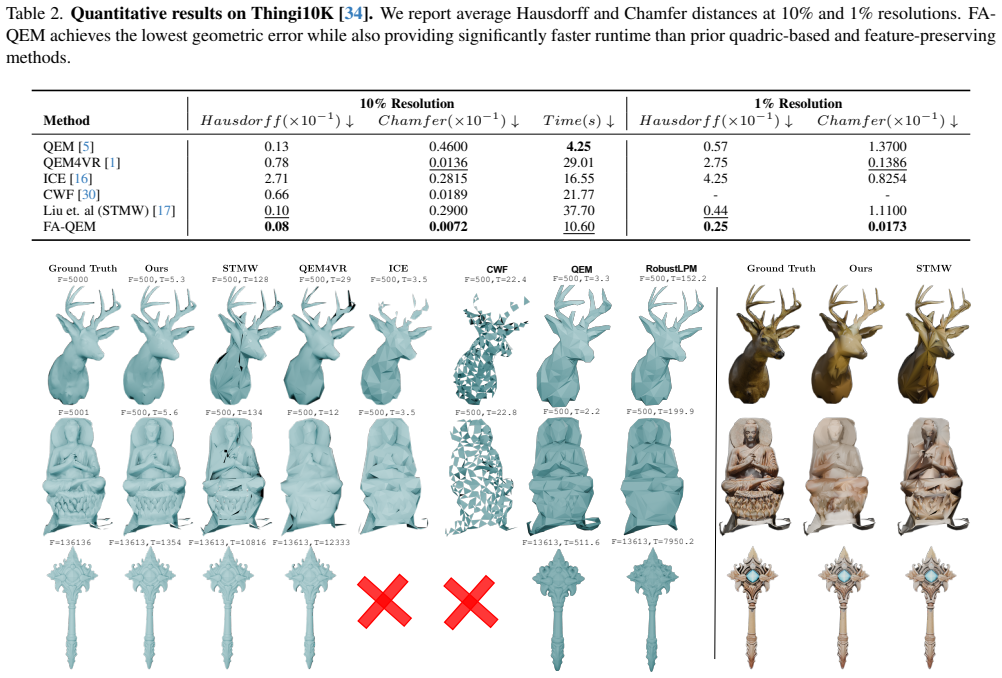
- [Table 2] Table 2 (quantitative results on Thingi10K): the reported geometric-error reductions versus standard QEM and other baselines should include per-mesh standard deviations or statistical tests; without them it is unclear whether the observed improvements are consistent or driven by a few favorable cases.
minor comments (2)
- [Figure 4] Figure 4 (visual comparisons): the simplification ratios and camera angles should be stated explicitly in the caption so readers can directly compare feature preservation.
- [Section 4.3] Section 4.3 (downstream texture mapping): clarify whether the reported appearance-transfer gains are measured with the same mapping algorithm across all simplification methods or whether FA-QEM meshes receive additional post-processing.
Simulated Author's Rebuttal
We thank the referee for the constructive and detailed feedback. We address each major comment below and will revise the manuscript accordingly.
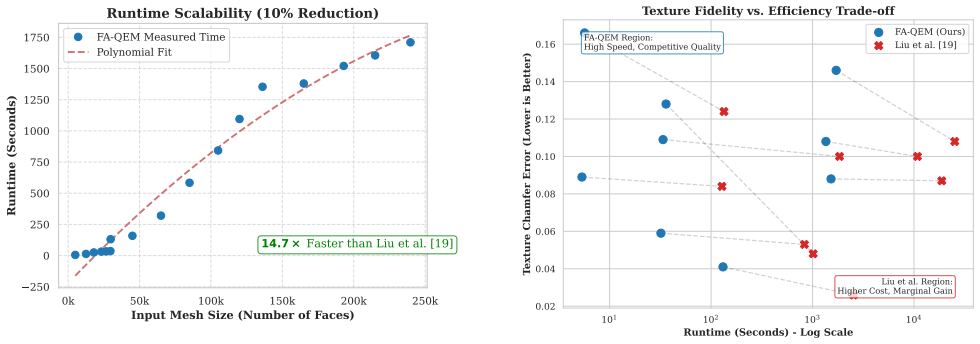
read point-by-point responses
-
Referee: [Section 3] Section 3 (multi-term quadric error formulation): the manuscript must explicitly state the fixed global weights applied to the geometric-deviation, boundary-curvature, and normal-consistency terms and provide an ablation confirming that these weights remain effective without per-mesh adjustment on the diverse noisy inputs; otherwise the robustness and “no tuning” claims rest on an unverified assumption.
Authors: We agree that explicit statement of the weights and supporting evidence are necessary. In the revised manuscript we will state the fixed global weights used for the geometric-deviation, boundary-curvature, and normal-consistency terms directly in Section 3. We will also add an ablation study that evaluates these same fixed weights on the full range of noisy inputs from Thingi10K and the Real-World Textured Things dataset, confirming that no per-mesh retuning is required. revision: yes
-
Referee: [Table 2] Table 2 (quantitative results on Thingi10K): the reported geometric-error reductions versus standard QEM and other baselines should include per-mesh standard deviations or statistical tests; without them it is unclear whether the observed improvements are consistent or driven by a few favorable cases.
Authors: We accept that reporting variability is important for demonstrating consistency. We will revise Table 2 to include per-mesh standard deviations of the geometric-error metrics, thereby allowing readers to evaluate whether the reported gains hold across the dataset rather than being driven by outliers. revision: yes
Circularity Check
No circularity: FA-QEM extends external QEM with independent additive terms
full rationale
The central derivation adds boundary-curvature and normal-consistency terms to the established Garland-Heckbert quadric error metric. These terms are defined directly from mesh geometry (curvature along boundaries, normal deviation) rather than fitted to the simplification output or derived from self-citations. No equation reduces the claimed improvement to a parameter defined by the result itself, and the paper cites the original QEM work as an external foundation. Evaluations on Thingi10K and Real-World Textured Things datasets supply independent empirical checks.
Axiom & Free-Parameter Ledger
axioms (1)
- domain assumption A linear combination of geometric, boundary, and normal terms yields an error metric whose minimization produces optimal vertex placement for feature preservation
Lean theorems connected to this paper
-
IndisputableMonolith/Cost/FunctionalEquation.leanwashburn_uniqueness_aczel unclear?
unclearRelation between the paper passage and the cited Recognition theorem.
We propose a novel multi-term quadric error formulation that jointly encodes geometric deviation, boundary curvature, and surface normal consistency... Qk_gf = Qk_base + Qk_boundary + Qk_normal (Eq. 4) with fixed weights w_area=100, w_boundary=500, w_normal=0.01, w_plane_area=1.0 (Table 1).
-
IndisputableMonolith/Foundation/RealityFromDistinction.leanreality_from_one_distinction unclear?
unclearRelation between the paper passage and the cited Recognition theorem.
cost_total(v′) = cost_gf(v′) + w_area · cost_area(v′) (Eq. 2); boundary curvature via discrete κ and dual-plane quadrics (Eqs. 6-9).
What do these tags mean?
- matches
- The paper's claim is directly supported by a theorem in the formal canon.
- supports
- The theorem supports part of the paper's argument, but the paper may add assumptions or extra steps.
- extends
- The paper goes beyond the formal theorem; the theorem is a base layer rather than the whole result.
- uses
- The paper appears to rely on the theorem as machinery.
- contradicts
- The paper's claim conflicts with a theorem or certificate in the canon.
- unclear
- Pith found a possible connection, but the passage is too broad, indirect, or ambiguous to say the theorem truly supports the claim.
Reference graph
Works this paper leans on
-
[1]
Kanchan Bahirat, Chengyuan Lai, Ryan McMahan, and Bal- akrishnan Prabhakaran. Designing and evaluating a mesh simplification algorithm for virtual reality.ACM Transac- tions on Multimedia Computing, Communications, and Ap- plications, 14:1–26, 2018. 1, 2, 4, 5, 6, 7
work page 2018
-
[2]
Robust low-poly meshing for general 3d mod- els.ACM Trans
Zhen Chen, Zherong Pan, Kui Wu, Etienne V ouga, and Xifeng Gao. Robust low-poly meshing for general 3d mod- els.ACM Trans. Graph., 42(4), 2023. 1, 2, 6
work page 2023
-
[3]
P. Cignoni, C. Montani, and R. Scopigno. A comparison of mesh simplification algorithms.Computers & Graphics, 22 (1):37–54, 1998. 2
work page 1998
-
[4]
M. Garland and P.S. Heckbert. Simplifying surfaces with color and texture using quadric error metrics. InProceed- ings Visualization ’98 (Cat. No.98CB36276), pages 263– 269, 1998. 2, 4
work page 1998
-
[5]
Heckbert.Surface Simplifica- tion Using Quadric Error Metrics
Michael Garland and Paul S. Heckbert.Surface Simplifica- tion Using Quadric Error Metrics. Association for Comput- ing Machinery, New York, NY , USA, 1 edition, 2023. 1, 2, 3, 6, 7, 5
work page 2023
-
[6]
Antoine Gu ´edon and Vincent Lepetit. Sugar: Surface- aligned gaussian splatting for efficient 3d mesh reconstruc- tion and high-quality mesh rendering, 2023. 1
work page 2023
-
[7]
Bernd Hamann. A data reduction scheme for triangulated surfaces.Computer Aided Geometric Design, 11(2):197– 214, 1994. 2
work page 1994
-
[8]
Meshcnn: a network with an edge.ACM Transactions on Graphics, 38(4):1–12, 2019
Rana Hanocka, Amir Hertz, Noa Fish, Raja Giryes, Shachar Fleishman, and Daniel Cohen-Or. Meshcnn: a network with an edge.ACM Transactions on Graphics, 38(4):1–12, 2019. 2
work page 2019
-
[9]
Hugues Hoppe. Progressive meshes. InProceedings of the 23rd Annual Conference on Computer Graphics and Inter- active Techniques, page 99–108, New York, NY , USA, 1996. Association for Computing Machinery. 2
work page 1996
-
[10]
H. Hoppe. New quadric metric for simplifying meshes with appearance attributes. InProceedings Visualization ’99 (Cat. No.99CB37067), pages 59–510, 1999. 2
work page 1999
-
[11]
Hugues Hoppe, Tony DeRose, Tom Duchamp, John McDon- ald, and Werner Stuetzle. Mesh optimization. InProceedings of the 20th Annual Conference on Computer Graphics and Interactive Techniques, page 19–26, New York, NY , USA,
-
[13]
Robust inside-outside segmentation using generalized winding num- bers.ACM Trans
Alec Jacobson, Ladislav Kavan, and Olga Sorkine. Robust inside-outside segmentation using generalized winding num- bers.ACM Trans. Graph., 32(4), 2013. 5
work page 2013
-
[14]
3d gaussian splatting for real-time radiance field rendering, 2023
Bernhard Kerbl, Georgios Kopanas, Thomas Leimk ¨uhler, and George Drettakis. 3d gaussian splatting for real-time radiance field rendering, 2023. 1, 2
work page 2023
-
[15]
Lp centroidal voronoi tessellation and its applications.ACM Trans
Bruno L ´evy and Yang Liu. Lp centroidal voronoi tessellation and its applications.ACM Trans. Graph., 29(4), 2010. 2
work page 2010
-
[16]
P. Lindstrom and G. Turk. Fast and memory efficient polyg- onal simplification. InProceedings Visualization ’98 (Cat. No.98CB36276), pages 279–286, 1998. 2, 4
work page 1998
-
[17]
Surface simplification using intrinsic error metrics, 2023
Hsueh-Ti Derek Liu, Mark Gillespie, Benjamin Chislett, Nicholas Sharp, Alec Jacobson, and Keenan Crane. Surface simplification using intrinsic error metrics, 2023. 1, 2, 6, 7
work page 2023
-
[18]
Sim- plifying triangle meshes in the wild, 2024
Hsueh-Ti Derek Liu, Xiaoting Zhang, and Cem Yuksel. Sim- plifying triangle meshes in the wild, 2024. 1, 2, 5, 6, 7, 8, 3, 4
work page 2024
-
[19]
William E. Lorensen and Harvey E. Cline. Marching cubes: A high resolution 3d surface construction algorithm.SIG- GRAPH Comput. Graph., 21(4):163–169, 1987. 1, 2
work page 1987
-
[20]
Model simplification us- ing vertex-clustering
Kok-Lim Low and Tiow-Seng Tan. Model simplification us- ing vertex-clustering. InProceedings of the 1997 Sympo- sium on Interactive 3D Graphics, page 75–ff., New York, NY , USA, 1997. Association for Computing Machinery. 2
work page 1997
-
[21]
D.P. Luebke. A developer’s survey of polygonal simplifica- tion algorithms.IEEE Computer Graphics and Applications, 21(3):24–35, 2001. 2
work page 2001
-
[22]
Andrea Maggiordomo, Federico Ponchio, Paolo Cignoni, and Marco Tarini. Real-world textured things: A repos- itory of textured models generated with modern photo- reconstruction tools.Computer Aided Geometric Design, 83: 101943, 2020. 6, 7, 1, 2, 3, 5
work page 2020
-
[23]
Srinivasan, Matthew Tancik, Jonathan T
Ben Mildenhall, Pratul P. Srinivasan, Matthew Tancik, Jonathan T. Barron, Ravi Ramamoorthi, and Ren Ng. Nerf: Representing scenes as neural radiance fields for view syn- thesis, 2020. 1, 2
work page 2020
-
[24]
Ben Poole, Ajay Jain, Jonathan T. Barron, and Ben Milden- hall. Dreamfusion: Text-to-3d using 2d diffusion, 2022. 1
work page 2022
-
[25]
Multi-resolution 3d ap- proximation for rendering complex scenes
Jarek Rossignac and Paul Borrel. Multi-resolution 3d ap- proximation for rendering complex scenes. pages 455–465,
-
[26]
William J. Schroeder, Jonathan A. Zarge, and William E. Lorensen. Decimation of triangle meshes. InProceedings of the 19th Annual Conference on Computer Graphics and Interactive Techniques, page 65–70, New York, NY , USA,
-
[28]
Deep marching tetrahedra: a hybrid represen- tation for high-resolution 3d shape synthesis, 2021
Tianchang Shen, Jun Gao, Kangxue Yin, Ming-Yu Liu, and Sanja Fidler. Deep marching tetrahedra: a hybrid represen- tation for high-resolution 3d shape synthesis, 2021. 2
work page 2021
-
[29]
P. Trettner and L. Kobbelt. Fast and robust qef minimization using probabilistic quadrics.Computer Graphics Forum, 39 (2):325–334, 2020. 2
work page 2020
-
[30]
Greg Turk. Re-tiling polygonal surfaces. InProceedings of the 19th Annual Conference on Computer Graphics and Interactive Techniques, page 55–64, New York, NY , USA,
-
[31]
Association for Computing Machinery. 2
-
[32]
Structured 3d latents for scalable and versatile 3d gen- eration
Jianfeng Xiang, Zelong Lv, Sicheng Xu, Yu Deng, Ruicheng Wang, Bowen Zhang, Dong Chen, Xin Tong, and Jiaolong Yang. Structured 3d latents for scalable and versatile 3d gen- eration. InProceedings of the Computer Vision and Pattern Recognition Conference, pages 21469–21480, 2025. 6
work page 2025
-
[33]
Cwf: Consolidating weak features in high-quality mesh simplification, 2024
Rui Xu, Longdu Liu, Ningna Wang, Shuangmin Chen, Shiqing Xin, Xiaohu Guo, Zichun Zhong, Taku Komura, Wenping Wang, and Changhe Tu. Cwf: Consolidating weak features in high-quality mesh simplification, 2024. 1, 2, 6, 7
work page 2024
-
[34]
Pcn: Point completion network, 2019
Wentao Yuan, Tejas Khot, David Held, Christoph Mertz, and Martial Hebert. Pcn: Point completion network, 2019. 7
work page 2019
-
[35]
Cem Yuksel. Mesh color textures. InProceedings of High Performance Graphics, New York, NY , USA, 2017. Associ- ation for Computing Machinery. 5
work page 2017
-
[36]
Hunyuan3d 2.0: Scal- ing diffusion models for high resolution textured 3d assets generation, 2025
Zibo Zhao, Zeqiang Lai, Qingxiang Lin, Yunfei Zhao, Haolin Liu, Shuhui Yang, Yifei Feng, Mingxin Yang, Sheng Zhang, Xianghui Yang, Huiwen Shi, Sicong Liu, Junta Wu, Yihang Lian, Fan Yang, Ruining Tang, Zebin He, Xinzhou Wang, Jian Liu, Xuhui Zuo, Zhuo Chen, Biwen Lei, Hao- han Weng, Jing Xu, Yiling Zhu, Xinhai Liu, Lixin Xu, Changrong Hu, Shaoxiong Yang, ...
work page 2025
-
[37]
Thingi10k: A dataset of 10,000 3d-printing models, 2016
Qingnan Zhou and Alec Jacobson. Thingi10k: A dataset of 10,000 3d-printing models, 2016. 5, 6, 7, 2 Fast and Robust Mesh Simplification for Generated and Real-World 3D Assets Supplementary Material
work page 2016
-
[38]
Implementation Details This supplementary document provides additional imple- mentation and experimental details for FA-QEM, a feature- aware mesh simplification pipeline designed for modern 3D reconstruction and generative workflows. Our implementa- tion focuses on scalability, robustness, and efficiency, en- abling the conversion of dense, unstructured ...
-
[39]
Hyperparameter Justification The performance of FA-QEM is governed by a small set of weighting parameters. Importantly, all hyperparameters used in the main paper are fixed across datasets and models, demonstrating that FA-QEM operates as a general-purpose method without requiring per-instance tuning. The values were determined empirically by testing on a...
-
[40]
Performance and Scalability FA-QEM is designed for efficient processing of large- scale 3D assets arising from reconstruction and generative pipelines. Its performance advantage over prior methods stems from both algorithmic design and implementation- level optimizations. Algorithmic Contributions to Performance:Our primary algorithmic performance gain co...
-
[41]
Detailed Texture Mapping Validation We further evaluate the effectiveness of our texture transfer strategy, particularly in the context of modern 3D pipelines where high-quality appearance must be preserved after ag- gressive geometric simplification. 9.1. Quantitative Trade-off: Efficiency vs. Fidelity In the main paper, we noted that FA-QEM achieves tex...
-
[42]
Robustness and Limitations This section provides a more detailed analysis of FA-QEM’s performance on the challenging cases, substantiating the ro- bustness claims made in the main paper. Large Texture-Varying Inputs:Our method is partic- ularly well-suited for models with complex texture layouts due to our philosophy of decoupling geometry from the UV par...
-
[43]
Additional Qualitative Results We present further qualitative results in the following fig- ures 11, 12, and 13. In Figure 11, the first two meshes are from the Real World Textured Things [21] dataset and the last mesh is generated from Hunyuan3D model [33]. This shows that our method is robust to simplify highly complex and non-manifold meshes. Similarly...
discussion (0)
Sign in with ORCID, Apple, or X to comment. Anyone can read and Pith papers without signing in.