Recognition: 2 theorem links
· Lean TheoremGoal-Oriented Time Adaptivity for Linear Port-Hamiltonian Differential-Algebraic Equations of Index~1
Pith reviewed 2026-05-15 02:02 UTC · model grok-4.3
The pith
Goal-oriented time adaptivity controls energy balance violations in linear port-Hamiltonian DAEs of index 1.
A machine-rendered reading of the paper's core claim, the machinery that carries it, and where it could break.
Core claim
We propose an approach that controls the energy balance violation for port-Hamiltonian differential algebraic equations via time adaptivity using a posteriori grid refinement techniques based on the dual weighted residual method. In particular, we show how one may leverage the port-Hamiltonian structure to efficiently compute the error estimators using a dissipativity-exploiting block-Jacobi approximation. We illustrate the efficacy of the method by means of simulations of electrical circuit models.
What carries the argument
Dissipativity-exploiting block-Jacobi approximation inside a dual-weighted-residual error estimator that drives goal-oriented time-step refinement for port-Hamiltonian DAEs.
If this is right
- Adaptive time grids can be generated automatically that keep the discrete energy balance within a prescribed tolerance for linear index-1 pH-DAEs.
- The computational cost of the error estimator stays linear in the number of degrees of freedom because the block-Jacobi approximation avoids full coupled solves.
- The same indicator can be reused to control other goal functionals that depend on the energy flow, not only the balance itself.
- The method extends the range of problems for which structure-preserving time integration is feasible without redesigning the integrator.
Where Pith is reading between the lines
- The same structure-exploiting estimator idea could be combined with existing discrete-gradient schemes to obtain both local accuracy and global conservation.
- If the block-Jacobi approximation degrades for strongly dissipative or stiff circuits, the method would naturally fall back to more expensive but exact error indicators.
- Because the refinement criterion is goal-oriented, the same framework could be applied to output functionals other than energy, such as voltage at a specific node.
Load-bearing premise
The block-Jacobi approximation that exploits dissipativity remains sufficiently accurate for the chosen goal quantity so that the resulting error indicators still drive useful mesh refinement.
What would settle it
A sequence of refined grids on a known linear circuit where the measured energy-balance residual fails to decrease monotonically once the block-Jacobi estimator is replaced by the exact dual-weighted residual.
Figures



read the original abstract
Port-Hamiltonian systems provide a highly-structured framework for modeling of physical systems. By definition, they encode a balance equation relating energy changes to supplied and dissipated energy. Capturing this energy balance in discrete approximations is a fundamental challenge and often has been achieved by designing particular schemes such as discrete gradient methods. In this work, we propose an approach that controls the energy balance violation for port-Hamiltonian differential algebraic equations via time adaptivity using a posteriori grid refinement techniques based on the dual weighted residual method. In particular, we show how one may leverage the port-Hamiltonian structure to efficiently compute the error estimators using a dissipativity-exploiting block-Jacobi approximation. We illustrate the efficacy of the method by means of simulations of electrical circuit models.
Editorial analysis
A structured set of objections, weighed in public.
Referee Report
Summary. The manuscript proposes a goal-oriented time-adaptive method for linear port-Hamiltonian DAEs of index 1 that controls violations of the energy balance equation. It employs a posteriori grid refinement via the dual-weighted residual (DWR) method and exploits the port-Hamiltonian dissipativity structure through a block-Jacobi approximation to the adjoint system for efficient estimator computation. The approach is demonstrated on electrical-circuit examples.
Significance. If the block-Jacobi approximation to the adjoint remains sufficiently accurate, the method could offer an efficient structure-preserving route to goal-oriented adaptivity for energy-balance control in pH-DAE simulations, a practically relevant task in circuit and multibody modeling. The work correctly identifies the energy-balance violation as a natural goal functional and shows how the pH structure can be used to simplify the estimator; however, the absence of any a-priori accuracy statement or quantitative validation of the approximation prevents a firm assessment of its reliability or novelty relative to existing DWR literature.
major comments (1)
- [§3–4 (adjoint approximation and numerical examples)] The central construction (abstract and §3–4) relies on a dissipativity-exploiting block-Jacobi approximation to the adjoint system for the DWR estimator. No a-priori bound is given on the difference between this approximation and the true coupled adjoint solution, nor is any quantitative comparison (e.g., relative difference in the goal functional or effect on the adapted mesh) reported for the electrical-circuit examples. This approximation is load-bearing for the claim that the resulting indicators reliably drive refinement of the energy-balance violation.
minor comments (2)
- [Abstract] The abstract states that the method “controls the energy balance violation” but supplies no concrete definition of the goal functional or the precise measure of violation used in the DWR estimator.
- [§2] Notation for the port-Hamiltonian DAE (E, J, R, B, …) is introduced without an explicit reference to the standard linear pH-DAE form; a short displayed equation would improve readability.
Simulated Author's Rebuttal
We thank the referee for the careful reading of the manuscript and the constructive comments on the significance of the work. We address the major concern regarding the block-Jacobi approximation below and will revise the manuscript to include additional validation.
read point-by-point responses
-
Referee: [§3–4 (adjoint approximation and numerical examples)] The central construction (abstract and §3–4) relies on a dissipativity-exploiting block-Jacobi approximation to the adjoint system for the DWR estimator. No a-priori bound is given on the difference between this approximation and the true coupled adjoint solution, nor is any quantitative comparison (e.g., relative difference in the goal functional or effect on the adapted mesh) reported for the electrical-circuit examples. This approximation is load-bearing for the claim that the resulting indicators reliably drive refinement of the energy-balance violation.
Authors: We agree that the manuscript would benefit from explicit validation of the block-Jacobi approximation. The approximation is motivated by the dissipativity structure of the port-Hamiltonian system, which allows the adjoint to be decoupled into independent forward and backward solves while preserving the essential energy-balance properties. Although no a-priori bound is derived, the numerical examples already demonstrate that the adapted meshes successfully reduce the energy-balance violation to the desired tolerance. In the revised manuscript we will add quantitative comparisons: for each circuit example we will report the relative difference between the goal functional evaluated with the approximate versus the fully coupled adjoint, together with a side-by-side comparison of the resulting adapted time grids. These additions will confirm that the approximation error remains small enough to preserve the reliability of the refinement indicators. revision: yes
- A rigorous a-priori error bound on the difference between the block-Jacobi approximation and the true coupled adjoint solution.
Circularity Check
No significant circularity; derivation uses standard DWR with structure-exploiting approximation independent of inputs
full rationale
The paper proposes a goal-oriented adaptive time-stepping scheme for linear port-Hamiltonian DAEs that controls energy-balance violation via the dual-weighted residual method. The central technical step is the introduction of a dissipativity-exploiting block-Jacobi approximation to the adjoint system, which is presented as a practical efficiency device rather than a fitted or self-defined quantity. No equation is shown to reduce by construction to a prior fit, no prediction is statistically forced by the same data used for calibration, and no load-bearing uniqueness theorem or ansatz is imported solely via self-citation. The derivation chain therefore remains self-contained against external benchmarks such as the standard DWR theory and the port-Hamiltonian energy-balance identity.
Axiom & Free-Parameter Ledger
Lean theorems connected to this paper
-
IndisputableMonolith/Cost/FunctionalEquation.leanwashburn_uniqueness_aczel (J uniqueness) echoes?
echoesECHOES: this paper passage has the same mathematical shape or conceptual pattern as the Recognition theorem, but is not a direct formal dependency.
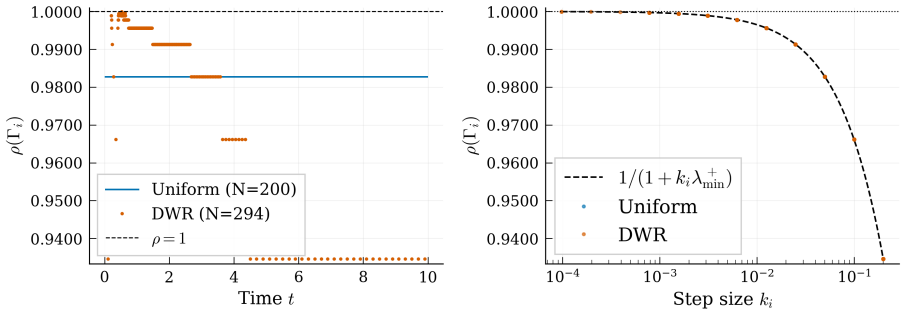
dissipativity-exploiting block-Jacobi approximation... Γᵢ is a strict contraction... α>0 eigenvalue of eS
-
IndisputableMonolith/Foundation/RealityFromDistinction.leanreality_from_one_distinction unclear?
unclearRelation between the paper passage and the cited Recognition theorem.
energy balance violation as QoI... dual weighted residual method
What do these tags mean?
- matches
- The paper's claim is directly supported by a theorem in the formal canon.
- supports
- The theorem supports part of the paper's argument, but the paper may add assumptions or extra steps.
- extends
- The paper goes beyond the formal theorem; the theorem is a base layer rather than the whole result.
- uses
- The paper appears to rely on the theorem as machinery.
- contradicts
- The paper's claim conflicts with a theorem or certificate in the canon.
- unclear
- Pith found a possible connection, but the passage is too broad, indirect, or ambiguous to say the theorem truly supports the claim.
Reference graph
Works this paper leans on
-
[1]
Wolfgang Bangerth and Rolf Rannacher.Adaptive Finite Elements Methods for Differential Equa- tions. Springer Basel AG, 2003
work page 2003
-
[2]
Goal-oriented time adaptivity for port-Hamiltonian systems
Andreas Bartel and Manuel Schaller. Goal-oriented time adaptivity for port-Hamiltonian systems. Journal of Computational and Applied Mathematics, 461:116450, 2025. ISSN 0377-0427
work page 2025
-
[3]
Port-Hamiltonian systems modelling in electrical engineering, 2023
Andreas Bartel, Markus Clemens, Michael G¨ unther, Birgit Jacob, and Timo Reis. Port-Hamiltonian systems modelling in electrical engineering, 2023. URLhttps://arxiv.org/abs/2301.02024
-
[4]
Port-Hamiltonian descriptor systems.Mathematics of Control, Signals, and Systems, 30(4), 2018
Christopher Beattie, Volker Mehrmann, Hongguo Xu, and Hans Zwart. Port-Hamiltonian descriptor systems.Mathematics of Control, Signals, and Systems, 30(4), 2018
work page 2018
-
[5]
Rolf Becker and Rolf Rannacher. An optimal control approach to a posteriori error estimation in finite element methods.Acta Numerica, 10:1–102, 2001
work page 2001
-
[6]
Port-Hamiltonian of rigid multi- body systems, 2025
Thomas Berger, Ren´ e Hochdahl, Timo Reis, and Robert Seifried. Port-Hamiltonian of rigid multi- body systems, 2025. URLhttps://arxiv.org/abs/2504.17063
-
[7]
Markus Clemens, Marvin-Lucas Henkel, Fotios Kasolis, and Michael G¨ unther. A port-Hamiltonian system perspective on electromagneto-quasistatic field formulations of Darwin-type, 2024. URL https://arxiv.org/abs/2404.18767
-
[8]
B. Endtmayer, U. Langer, and T. Wick. Two-side a posteriori error estimates for the dual-weighted residual method.SIAM Journal on Scientific Computing, 42(1):A371–A394, 2020. 25
work page 2020
-
[9]
Timm Faulwasser, Bernhard Maschke, Friedrich Philipp, Manuel Schaller, and Karl Worthmann. Optimal control of port-Hamiltonian descriptor systems with minimal energy supply.SIAM Journal on Control and Optimization, 60(4):2132–2158, 2022
work page 2022
-
[10]
Roland W. Freund. The SPRIM algorithm for structure-preserving order reduction of general RCL circuits. In P. Benner, M. Hinze, and E.J.W. ter Maten, editors,Model Reduction for Circuit Simulation, volume 74 ofLect. Notes Electr. Eng., chapter 2, pages 25–52. Springer, Dordrecht, 2011
work page 2011
-
[11]
Time integration and discrete Hamiltonian systems.Journal of Nonlinear Science, 6:449–467, 1996
Oscar Gonzalez. Time integration and discrete Hamiltonian systems.Journal of Nonlinear Science, 6:449–467, 1996
work page 1996
-
[12]
Lars Gr¨ une, Manuel Schaller, and Anton Schiela. Efficient model predictive control for parabolic PDEs with goal oriented error estimation.SIAM Journal on Scientific Computing, 44(1):A471–A500, 2022
work page 2022
-
[13]
Springer Science & Business Media, 2012
Birgit Jacob and Hans J Zwart.Linear port-Hamiltonian systems on infinite-dimensional spaces. Springer Science & Business Media, 2012
work page 2012
-
[14]
PhD thesis, Humboldt-Universit¨ at zu Berlin, Mathematisch-Naturwissenschaftliche Fakult¨ at I, 2015
Lennart Jansen.A Dissection concept for DAEs. PhD thesis, Humboldt-Universit¨ at zu Berlin, Mathematisch-Naturwissenschaftliche Fakult¨ at I, 2015
work page 2015
-
[15]
Philipp L Kinon, Riccardo Morandin, and Philipp Schulze. Discrete gradient methods for port- Hamiltonian differential-algebraic equations.Preprint arXiv:2505.18810, 2025
-
[16]
Paul Kotyczka and Laurent Lefevre. Discrete-time port-Hamiltonian systems: A definition based on symplectic integration.Systems & Control Letters, 133:104530, 2019
work page 2019
-
[17]
Christian Mehl, Volker Mehrmann, and Michal Wojtylak. Linear algebra properties of dissipative Hamiltonian descriptor systems.SIAM Journal on Matrix Analysis and Applications, 39(3):1489– 1519, 2018
work page 2018
-
[18]
Christian Mehl, Volker Mehrmann, and Michal Wojtylak. Matrix pencils with coefficients that have positive semidefinite Hermitian parts.SIAM Journal on Matrix Analysis and Applications, 43(3): 1186–1212, 2022
work page 2022
-
[19]
Structure-preserving discretization for port-Hamiltonian descriptor systems
Volker Mehrmann and Riccardo Morandin. Structure-preserving discretization for port-Hamiltonian descriptor systems. In2019 IEEE 58th Conference on Decision and Control (CDC), pages 6863–6868, 2019
work page 2019
-
[20]
Volker Mehrmann and Benjamin Unger. Control of port-Hamiltonian differential-algebraic systems and applications.Acta Numerica, 32:395–515, 2023
work page 2023
-
[21]
Dominik Meidner and Boris Vexler. A priori error estimates for space-time finite element discretiza- tion of parabolic optimal control problems part I: Problems without control constraints.SIAM J. Control Optim., 47(3):1150–1177, 2008
work page 2008
-
[22]
PhD thesis, Technische Universit¨ at Berlin, 2024
Riccardo Morandin.Modeling and numerical treatment of port-Hamiltonian descriptor systems. PhD thesis, Technische Universit¨ at Berlin, 2024
work page 2024
-
[23]
PortHamiltonianBenchmarkSystems, 2021
Tim Moser et al. PortHamiltonianBenchmarkSystems, 2021. URLhttps://algopaul.github.io/ PortHamiltonianBenchmarkSystems
work page 2021
-
[24]
PhD thesis, Technical University of Munich, 2023
Tim Fabian Moser.Structure-Preserving Model Reduction of Port-Hamiltonian Descriptor Systems. PhD thesis, Technical University of Munich, 2023
work page 2023
-
[25]
Philipp Schulze. Structure-preserving time discretization of port-Hamiltonian systems via discrete gradient pairs.Preprint arXiv:2311.00403, 2023
-
[26]
Springer Series in Com- putational Mathematics, Berlin, 2006
Vidar Thom´ ee.Galerkin Finite Element Methods for Parabolic Problems. Springer Series in Com- putational Mathematics, Berlin, 2006
work page 2006
-
[27]
Arjan van der Schaft and Dimitri Jeltsema. Port-Hamiltonian systems theory: An introductory overview.Foundations and Trends in Systems and Control, 1(2–3):173–378, 2014. 26
work page 2014
discussion (0)
Sign in with ORCID, Apple, or X to comment. Anyone can read and Pith papers without signing in.