Recognition: no theorem link
Privacy Preserving Multi Agent Path Finding
Pith reviewed 2026-05-15 01:45 UTC · model grok-4.3
The pith
Adding mock agents during planning lets multiple agents find collision-free paths without revealing their exact planned locations to each other.
A machine-rendered reading of the paper's core claim, the machinery that carries it, and where it could break.
Core claim
By inserting mock agents into the planning process, planning-level privacy is obtained so that participants cannot identify the exact planned locations of the real agents. PIBT and LaCAM are adapted to preserve execution-level privacy, meaning agents with limited sensing cannot detect others during movement. A post-processing technique then reduces the sum of costs of the solution without weakening any privacy property.
What carries the argument
Mock agents inserted into the planning process, which carry the argument by masking real agent locations while still enforcing collision constraints.
If this is right
- Planning can proceed without any agent learning the exact routes of others.
- Execution remains safe even when agents cannot sense one another.
- The final solution cost can be lowered after planning while privacy stays intact.
- The same mock-agent technique applies to other MAPF solvers beyond the two demonstrated.
Where Pith is reading between the lines
- The method may scale to warehouse robots or drone fleets where competing operators share a shared space.
- Computational overhead from extra mock agents could be traded against privacy strength by varying their number.
- The post-processing step might be combined with other MAPF optimizers that currently lack privacy features.
Load-bearing premise
Inserting mock agents sufficiently hides real agent locations for all participants without creating detectable information leaks or breaking collision rules, and the modifications to PIBT and LaCAM keep the original algorithms correct.
What would settle it
Run the privacy-preserving planner on a known map with a small number of agents, then have an adversary examine only the published planning output and attempt to recover the true starting positions and goals of the real agents to within one grid cell.
Figures




read the original abstract
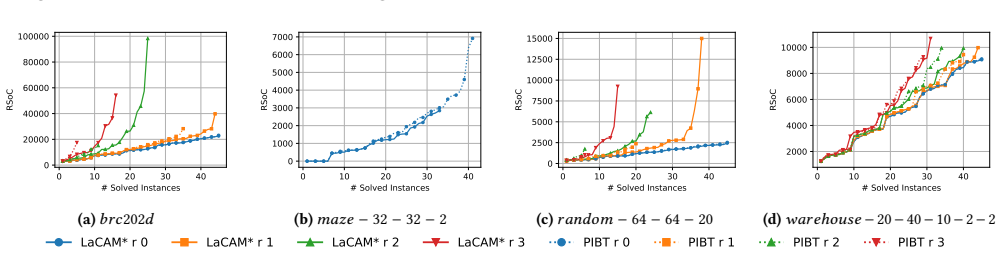
In the multi-agent path finding (MAPF) problem, a group of agents search in a graph for a path for each agent where no two paths collide. While in all applications of MAPF the agents must not collide with each other, in some of them the agents may not wish to share their paths due to privacy constraints. In this work, we formulate two types of privacy constraints for MAPF and propose algorithms that preserve them. The first type of privacy we consider is planning-level privacy, which means that during planning, the agents cannot identify exactly the planned location of the other agents. We propose a general framework for obtaining planning-level privacy, which works by adding mock agents to the planning process. The second type of privacy we consider is execution-level privacy, which is relevant when agents have limited sensing capabilities. Execution-level privacy is preserved if none of the agents is allowed to sense the location of the other agents during execution. We show how to adapt two popular MAPF algorithms, namely PIBT and LaCAM, such that they preserve execution-level privacy. Lastly, we propose a post-processing technique that allows the agents to reduce the sum of costs of the returned solution without losing any privacy. We also implemented our algorithms and evaluated them empirically, showing that the proposed post-processing technique indeed improved cost significantly.
Editorial analysis
A structured set of objections, weighed in public.
Referee Report
Summary. The paper formulates planning-level privacy (agents cannot identify exact planned locations of others during planning) and execution-level privacy (agents with limited sensing cannot sense others' locations during execution) for the MAPF problem. It proposes a general framework using mock agents for planning-level privacy, adapts PIBT and LaCAM to preserve execution-level privacy, introduces a post-processing step to reduce sum-of-costs without privacy loss, and reports empirical results showing cost improvements.
Significance. If the privacy guarantees and correctness properties hold, the work would be significant for privacy-sensitive MAPF applications such as robotics and logistics. Adapting established algorithms (PIBT, LaCAM) and adding a cost-reducing post-processing step without privacy loss are practical strengths; the mock-agent framework offers a general constructive approach. However, the absence of formal proofs or detailed quantitative results in the provided description limits immediate impact.
major comments (3)
- [Abstract / proposed framework] Abstract and framework description: the claim that adding mock agents yields planning-level privacy without detectable leaks or collision violations is central but rests on an unformalized assumption about information leakage; no definition or argument is given showing that mock-agent insertion is sufficient for all participants and does not introduce new detectable patterns.
- [Adaptations of PIBT and LaCAM] Adaptations of PIBT and LaCAM: the modifications for execution-level privacy are presented as preserving correctness, yet no argument or invariant is supplied showing that the privacy constraints do not compromise collision avoidance or the original algorithms' completeness/termination properties, which is load-bearing for the claim that the adapted solvers still solve MAPF.
- [Post-processing technique] Post-processing technique: the method for reducing sum of costs while preserving both privacy notions is described at a high level; without an explicit invariant or proof sketch showing that the post-processing step cannot leak location information (e.g., via observable cost changes), the practical utility claim remains unsupported.
minor comments (2)
- [Abstract] The abstract states that empirical evaluation shows significant cost improvement, but provides no details on instance sizes, baselines, privacy metrics, or overhead; adding a short quantitative summary would strengthen the presentation.
- [Definitions and framework] Notation for the two privacy definitions and for the mock-agent insertion process could be clarified with a small example or pseudocode snippet to aid readability.
Simulated Author's Rebuttal
We thank the referee for their constructive and detailed feedback. We agree that the manuscript would benefit from explicit formal definitions, invariants, and proof sketches to support the privacy and correctness claims. We address each major comment below and will incorporate the necessary additions in the revised version.
read point-by-point responses
-
Referee: [Abstract / proposed framework] Abstract and framework description: the claim that adding mock agents yields planning-level privacy without detectable leaks or collision violations is central but rests on an unformalized assumption about information leakage; no definition or argument is given showing that mock-agent insertion is sufficient for all participants and does not introduce new detectable patterns.
Authors: We acknowledge that the current manuscript does not provide a formal definition of planning-level privacy or a rigorous argument for the mock-agent framework. In the revision, we will add a precise definition of planning-level privacy and include a proof sketch showing that mock-agent insertion prevents identification of exact planned locations for all participants, introduces no detectable patterns, and preserves collision-free solutions. These additions will be placed in a dedicated subsection on the framework. revision: yes
-
Referee: [Adaptations of PIBT and LaCAM] Adaptations of PIBT and LaCAM: the modifications for execution-level privacy are presented as preserving correctness, yet no argument or invariant is supplied showing that the privacy constraints do not compromise collision avoidance or the original algorithms' completeness/termination properties, which is load-bearing for the claim that the adapted solvers still solve MAPF.
Authors: We agree that formal justification is essential. We will revise the sections describing the adapted PIBT and LaCAM algorithms to include invariants that establish preservation of collision avoidance, completeness, and termination while enforcing execution-level privacy. These will be presented with clear statements of the invariants and brief arguments for why they hold. revision: yes
-
Referee: [Post-processing technique] Post-processing technique: the method for reducing sum of costs while preserving both privacy notions is described at a high level; without an explicit invariant or proof sketch showing that the post-processing step cannot leak location information (e.g., via observable cost changes), the practical utility claim remains unsupported.
Authors: We will expand the post-processing section with an explicit invariant and a proof sketch demonstrating that the technique preserves both planning-level and execution-level privacy and cannot leak location information through observable cost changes or other means. This will directly support the practical utility of the approach. revision: yes
Circularity Check
No significant circularity detected
full rationale
The paper proposes a constructive algorithmic framework: mock-agent insertion for planning-level privacy, direct adaptations of PIBT and LaCAM to enforce execution-level privacy, and a post-processing step for cost reduction. No equations, parameters, or claims reduce by construction to fitted inputs or self-referential definitions. No load-bearing self-citations or uniqueness theorems imported from prior author work appear in the derivation. The privacy notions and correctness properties are defined externally and preserved by explicit construction, making the central results self-contained and independently verifiable.
Axiom & Free-Parameter Ledger
axioms (1)
- domain assumption All agents share a common known graph and know each other's start and goal locations during the planning phase.
invented entities (1)
-
mock agents
no independent evidence
Reference graph
Works this paper leans on
-
[1]
Shahar Bardugo, Daniel Koyfman, and Dor Atzmon. 2025. Finding All Optimal So- lutions in Multi-Agent Path Finding. InInternational Symposium on Combinatorial Search. 20–28
2025
-
[2]
Ronen I Brafman. 2015. A privacy preserving algorithm for multi-agent planning and search. In24th International Joint Conference on Artificial Intelligence, IJCAI
2015
-
[3]
International Joint Conferences on Artificial Intelligence, 1530–1536
-
[4]
Stepan Dergachev and Konstantin Yakovlev. 2021. Distributed multi-agent naviga- tion based on reciprocal collision avoidance and locally confined multi-agent path finding. InIEEE International Conference on Automation Science and Engineering (CASE). 1489–1494
2021
-
[5]
Boi Faltings, Thomas Léauté, and Adrian Petcu. 2008. Privacy guarantees through distributed constraint satisfaction. In2008 IEEE/WIC/ACM International Confer- ence on Web Intelligence and Intelligent Agent Technology, Vol. 2. IEEE, 350–358
2008
-
[6]
Ariel Felner, Roni Stern, Solomon Shimony, Eli Boyarski, Meir Goldenberg, Guni Sharon, Nathan Sturtevant, Glenn Wagner, and Pavel Surynek. 2017. Search- based optimal solvers for the multi-agent pathfinding problem: Summary and challenges. InInternational Symposium on Combinatorial Search, Vol. 8. 29–37
2017
-
[7]
Rachel Greenstadt, Barbara Grosz, and Michael D Smith. 2007. SSDPOP: improv- ing the privacy of DCOP with secret sharing. InInternational joint conference on Autonomous agents and multiagent systems (AAMAS). 1–3
2007
-
[8]
Tal Grinshpoun and Tamir Tassa. 2016. P-SyncBB: A privacy preserving branch and bound DCOP algorithm.Journal of Artificial Intelligence Research57 (2016), 621–660
2016
-
[9]
Florence Ho, Rúben Geraldes, Artur Gonçalves, Bastien Rigault, Benjamin Sportich, Daisuke Kubo, Marc Cavazza, and Helmut Prendinger. 2020. Decentral- ized multi-agent path finding for UAV traffic management.IEEE Transactions on Intelligent Transportation Systems23, 2 (2020), 997–1008
2020
-
[10]
M Onur Keskin, Furkan Cantürk, Cihan Eran, and Reyhan Aydoğan. 2024. Decen- tralized multi-agent path finding framework and strategies based on automated negotiation.Autonomous Agents and Multi-Agent Systems38, 1 (2024), 10
2024
-
[11]
Pablo Kogan, Tamir Tassa, and Tal Grinshpoun. 2022. Privacy preserving DCOP solving by mediation. InInternational Symposium on Cyber Security, Cryptology, and Machine Learning. Springer, 487–498
2022
-
[12]
Rotem Lev Lehman, Guy Shani, and Roni Stern. 2021. Partial disclosure of private dependencies in privacy preserving planning. In20th International Conference on Autonomous Agents and Multiagent Systems, AAMAS 2021. International Founda- tion for Autonomous Agents and Multiagent Systems (IFAAMAS), 1563–1565
2021
-
[13]
Rotem Lev Lehman, Guy Shani, and Roni Stern. 2022. Reducing disclosed de- pendencies in privacy preserving planning.Autonomous Agents and Multi-Agent Systems36, 2 (2022), 52
2022
-
[14]
Shlomi Maliah, Guy Shani, and Roni Stern. 2016. Stronger privacy preserving projections for multi-agent planning. InProceedings of the International Conference on Automated Planning and Scheduling, Vol. 26. 221–229
2016
-
[15]
Shlomi Maliah, Guy Shani, and Roni Stern. 2017. Collaborative privacy preserving multi-agent planning: Planners and heuristics.Autonomous agents and multi- agent systems31, 3 (2017), 493–530
2017
-
[16]
Bernhard Nebel. 2024. The computational complexity of multi-agent pathfinding on directed graphs.Artificial Intelligence328 (2024)
2024
-
[17]
Raz Nissim and Ronen Brafman. 2014. Distributed heuristic forward search for multi-agent planning.Journal of Artificial Intelligence Research51 (2014), 293–332
2014
-
[18]
Keisuke Okumura. 2023. Improving LaCAM for Scalable Eventually Optimal Multi-Agent Pathfinding. InProceedings of the Thirty-First International Joint Conference on Artificial Intelligence (IJCAI)
2023
-
[19]
Keisuke Okumura. 2023. LaCAM: Search-Based Algorithm for Quick Multi-Agent Pathfinding. InProceedings of AAAI Conference on Artificial Intelligence (AAAI)
2023
-
[20]
Keisuke Okumura. 2024. Engineering LaCAM ∗: Towards Real-Time, Large-Scale, and Near-Optimal Multi-Agent Pathfinding. InProceedings of International Con- ference on Autonomous Agents and Multiagent Systems (AAMAS)
2024
-
[21]
Keisuke Okumura, Manao Machida, Xavier Défago, and Yasumasa Tamura. 2022. Priority Inheritance with Backtracking for Iterative Multi-agent Path Finding. Artificial Intelligence(2022), 103752. https://doi.org/10.1016/j.artint.2022.103752
-
[22]
Mike Phillips and Maxim Likhachev. 2011. Sipp: Safe interval path planning for dynamic environments. In2011 IEEE international conference on robotics and automation. IEEE, 5628–5635
2011
-
[23]
Poom Pianpak, Tran Cao Son, Phoebe O Toups Dugas, and William Yeoh. 2019. A distributed solver for multi-agent path finding problems. InInternational Con- ference on Distributed Artificial Intelligence (DAI). 1–7
2019
-
[24]
Guni Sharon, Roni Stern, Ariel Felner, and Nathan R Sturtevant. 2015. Conflict- based search for optimal multi-agent pathfinding.Artificial intelligence219 (2015), 40–66
2015
-
[25]
Roni Stern, Nathan Sturtevant, Ariel Felner, Sven Koenig, Hang Ma, Thayne Walker, Jiaoyang Li, Dor Atzmon, Liron Cohen, TK Kumar, et al. 2019. Multi- agent pathfinding: Definitions, variants, and benchmarks. InProceedings of the International Symposium on Combinatorial Search. 151–158
2019
-
[26]
Pavel Surynek. 2010. An Optimization Variant of Multi-Robot Path Planning Is Intractable. InAAAI
2010
-
[27]
Pavel Surynek. 2022. Problem Compilation for Multi-Agent Path Finding: a Survey.. InIJCAI. 5615–5622
2022
-
[28]
Prasanna Velagapudi, Katia Sycara, and Paul Scerri. 2010. Decentralized priori- tized planning in large multirobot teams. InIEEE/RSJ International Conference on Intelligent Robots and Systems. 4603–4609
2010
-
[29]
Hanlin Wang and Michael Rubenstein. 2020. Walk, stop, count, and swap: decen- tralized multi-agent path finding with theoretical guarantees.IEEE Robotics and Automation Letters5, 2 (2020), 1119–1126
2020
-
[30]
M. Yokoo, E.H. Durfee, T. Ishida, and K. Kuwabara. 1998. The distributed constraint satisfaction problem: formalization and algorithms.IEEE Trans- actions on Knowledge and Data Engineering10, 5 (1998), 673–685. https: //doi.org/10.1109/69.729707
-
[31]
Makoto Yokoo, Koutarou Suzuki, and Katsutoshi Hirayama. 2002. Secure dis- tributed constraint satisfaction: Reaching agreement without revealing private information. InInternational Conference on Principles and Practice of Constraint Programming. Springer, 387–401
2002
-
[32]
Jingjin Yu and Steven M. LaValle. 2013. Structure and Intractability of Optimal Multi-Robot Path Planning on Graphs. InAAAI. Privacy Preserving Multi Agent Path Finding - Supplementary Material Rotem Lev Lehman Ben Gurion University of the Negev Be’er Sheva, Israel levlerot@post.bgu.ac.il Roni Stern Ben Gurion University of the Negev Be’er Sheva, Israel s...
2013
discussion (0)
Sign in with ORCID, Apple, or X to comment. Anyone can read and Pith papers without signing in.