Recognition: 2 theorem links
· Lean TheoremToward a Comprehensive Grid of Cepheid Models with MESA. IV. Modest Effects of Rotation on Blue Loops
Pith reviewed 2026-05-15 02:06 UTC · model grok-4.3
The pith
Rotation produces only small luminosity increases in Cepheid blue loops
A machine-rendered reading of the paper's core claim, the machinery that carries it, and where it could break.
Core claim
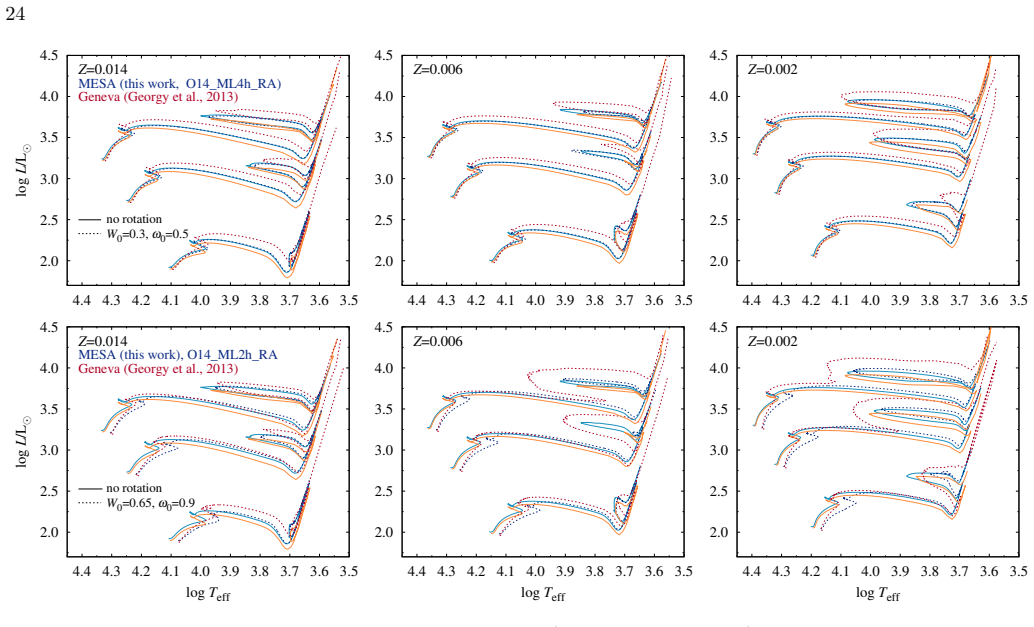
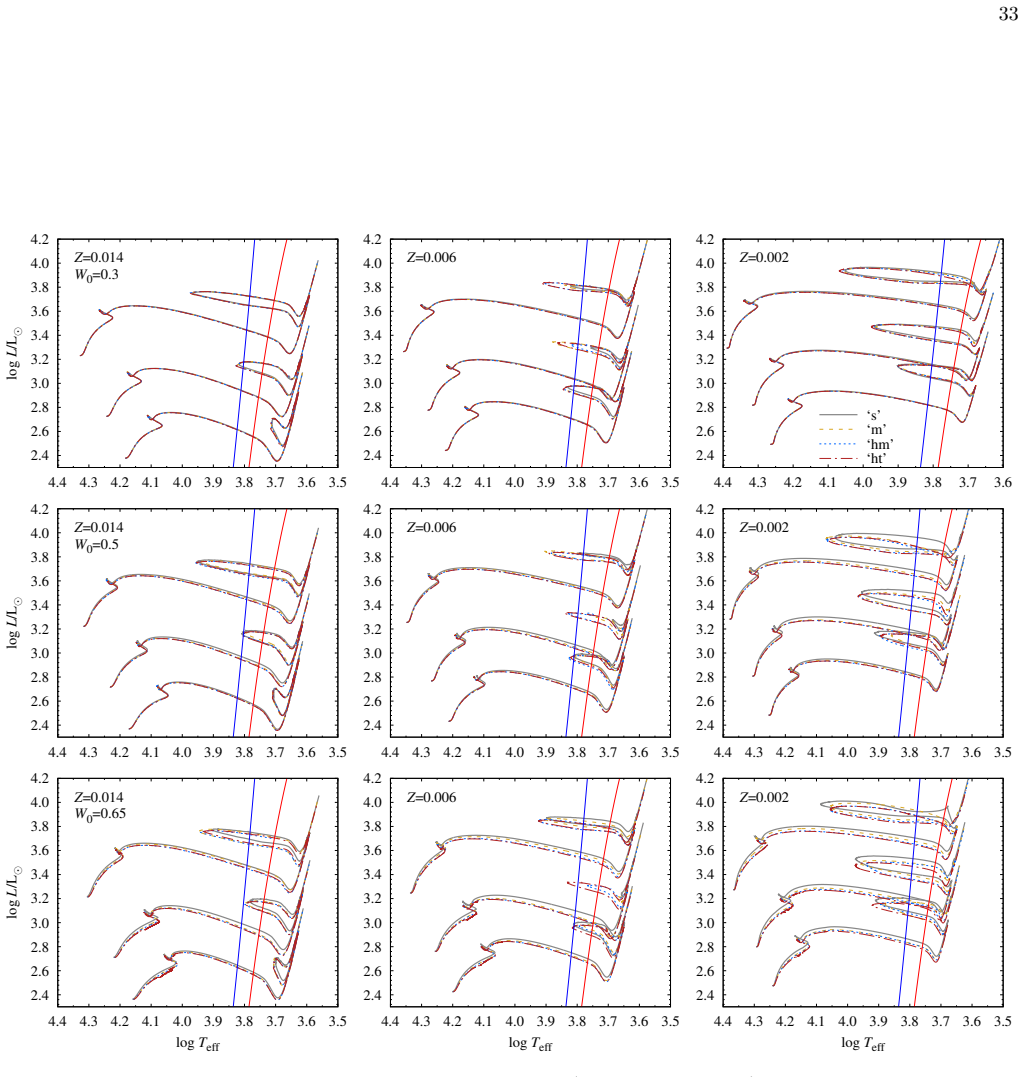
Using the fully diffusive approximation for rotationally induced mixing in MESA, the luminosity levels of the blue loops increase by at most 0.04 dex with higher initial rotation rates, without significant changes to their appearance or extent. This is in contrast to results from the Geneva code using an advective-diffusive scheme, where mixing is more efficient and loops are brighter and more extended. The predicted surface velocities exceed observed values.
What carries the argument
The fully diffusive treatment of rotationally induced mixing in evolutionary models of 2-8 solar mass stars.
If this is right
- Blue loop luminosity and extent remain largely unaffected by rotation.
- The mass discrepancy cannot be solved by rotation alone.
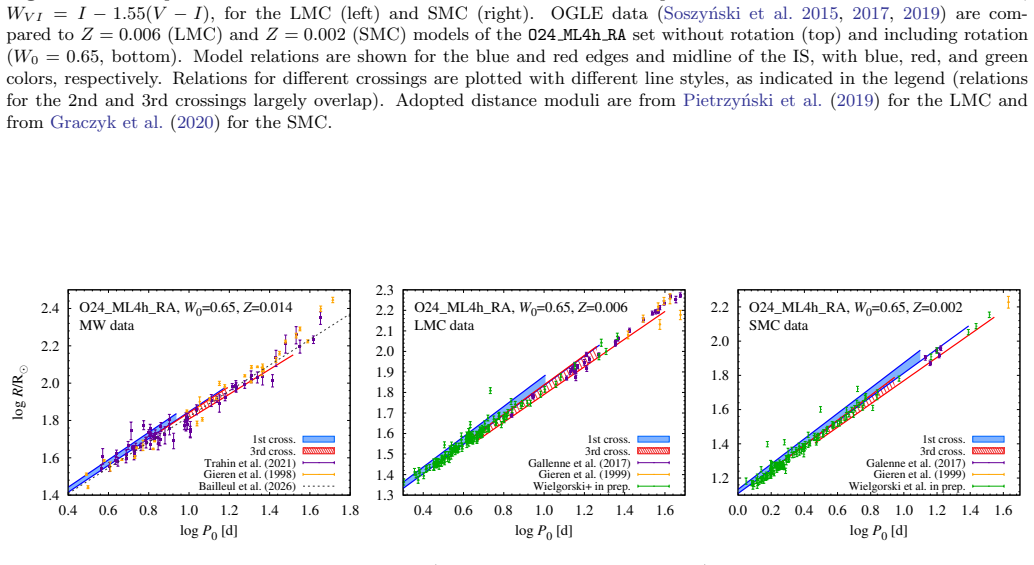
- Period-luminosity and period-radius relations are insensitive to rotation.
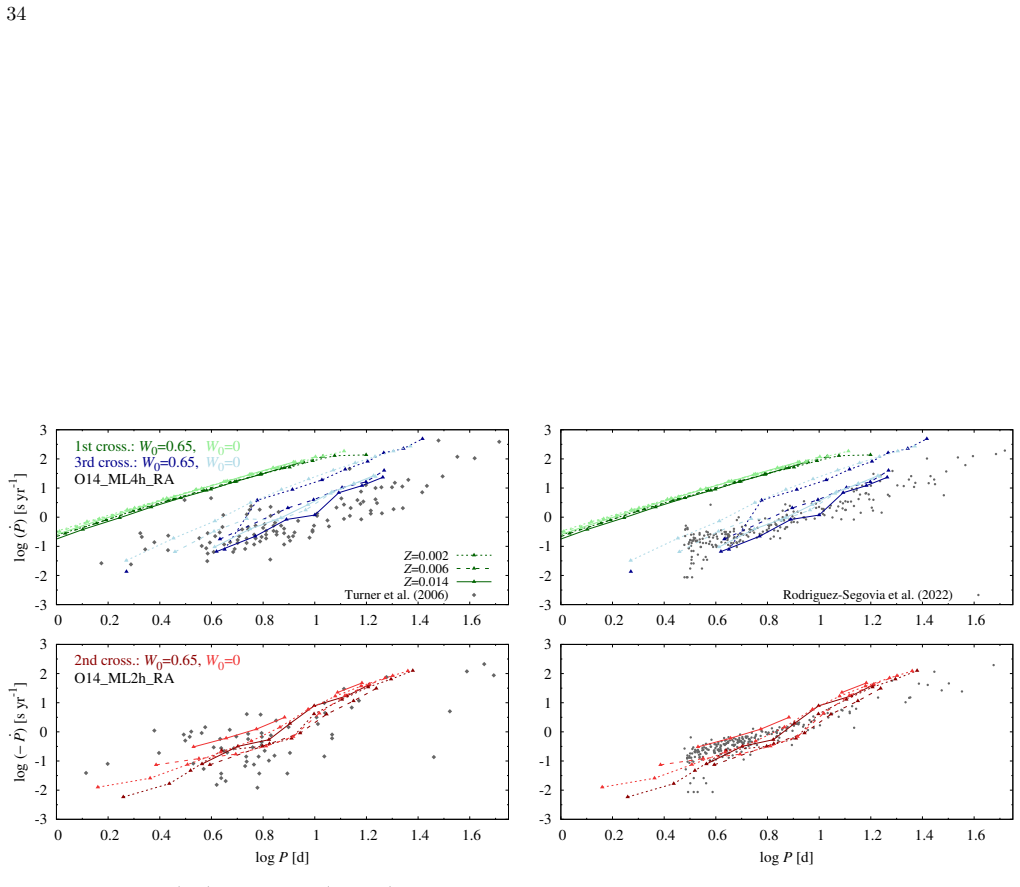
- Period-age relations predict ages a few percent longer.
- Surface rotational velocities are overpredicted compared to observations.
Where Pith is reading between the lines
- Switching to an advective-diffusive mixing scheme could produce larger rotation effects, as seen in other codes.
- Grids of Cepheid models may need to prioritize core overshooting parameters over rotation for accuracy.
- Future work could explore intermediate mixing efficiencies to better match observed rotation velocities.
- Non-rotating models with appropriate overshooting may suffice for most Cepheid property predictions.
Load-bearing premise
The fully diffusive approximation for rotationally induced mixing processes is adequate to capture the effects of rotation on main-sequence and post-main-sequence evolution for these masses and metallicities.
What would settle it
Detection of blue loop luminosities in rotating Cepheids that exceed non-rotating models by more than 0.04 dex, or measurements showing lower surface velocities than predicted, would challenge the findings.
Figures









read the original abstract
Evolutionary tracks for $2-8M_\odot$ stars, with metallicities of $Z=0.014$, $0.006$, and $0.002$, including rotation, are computed with Modules for Experiments in Stellar Astrophysics (MESA). We study how rotation impacts the evolutionary properties of classical Cepheids. We examine whether rotation can offer a plausible explanation for the mass discrepancy problem when it is included in the evolutionary code using the fully diffusive approximation for rotationally induced mixing processes. We find that rotation barely influences the appearance and luminosity levels of the blue loops. While luminosity increases with increasing initial rotation rate, the increase does not exceed 0.04 dex, a fraction of the increase resulting from including the main sequence (MS) core overshooting of $0.2H_p$. As a consequence, rotation alone cannot resolve the mass discrepancy problem without simultaneously requiring significant MS core overshooting. Similar to the mass-luminosity relation, the period-radius and period-luminosity relations are barely affected by rotation, while the period-age relation predicts Cepheid ages to be only a few per cent longer compared with models without rotation. The predicted surface rotational velocities are too large compared with observations. These results are in contrast with those obtained with the Geneva code, which implements rotational mixing using the advective-diffusive scheme. In that approach, the luminosity levels of the loops are significantly higher, their luminosity extent increases, and the predicted rotation velocities are lower, compared with MESA models. The differences between the two approaches arise from significantly more efficient rotation-induced mixing during the MS evolution in models computed with the advective-diffusive scheme.
Editorial analysis
A structured set of objections, weighed in public.
Referee Report
Summary. The manuscript computes MESA evolutionary tracks for 2–8 M⊙ stars at Z=0.014, 0.006, and 0.002, incorporating rotation via the fully diffusive approximation for rotationally induced mixing. It reports that rotation produces only modest changes to blue-loop morphology and luminosity (increases ≤0.04 dex), insufficient to resolve the Cepheid mass discrepancy without 0.2 Hp main-sequence core overshooting. Period-radius and period-luminosity relations are essentially unaffected while the period-age relation yields ages only a few percent longer; surface velocities are overpredicted relative to observations. Results are contrasted with Geneva-code models that employ an advective-diffusive mixing scheme and produce higher loop luminosities.
Significance. If the quantitative bounds hold, the work supplies useful MESA-specific constraints on the role of rotation in Cepheid progenitors and highlights the sensitivity of blue-loop properties to the choice of rotational-mixing implementation. The direct numerical survey across three metallicities and a range of initial rotation rates, together with the explicit Geneva comparison, provides a clear benchmark for future model grids.
major comments (2)
- [Abstract] Abstract: The central quantitative claim that luminosity increases do not exceed 0.04 dex and that rotation alone cannot resolve the mass discrepancy is obtained exclusively under the fully diffusive mixing prescription. The manuscript notes that this prescription overpredicts surface rotational velocities; a test or estimate of how higher mixing efficiency (required to match observed velocities) would affect blue-loop extent and luminosity is needed to establish whether the modest-effect result is robust or prescription-dependent.
- [Abstract] Abstract and methods description: The 0.2 Hp core-overshooting value is adopted from prior literature and held fixed. Because the paper states that the luminosity shift from overshooting exceeds that from rotation, a brief sensitivity check varying overshooting together with rotation would clarify the relative contributions and strengthen the claim that rotation is a secondary effect.
minor comments (1)
- [Abstract] Abstract: The phrase 'a few per cent longer' for the period-age shift should be replaced by a specific range or mean value derived from the grid.
Simulated Author's Rebuttal
We thank the referee for the constructive report and positive assessment of the work's significance. We address the two major comments point by point below, with revisions made where they strengthen the manuscript without altering its core conclusions.
read point-by-point responses
-
Referee: [Abstract] Abstract: The central quantitative claim that luminosity increases do not exceed 0.04 dex and that rotation alone cannot resolve the mass discrepancy is obtained exclusively under the fully diffusive mixing prescription. The manuscript notes that this prescription overpredicts surface rotational velocities; a test or estimate of how higher mixing efficiency (required to match observed velocities) would affect blue-loop extent and luminosity is needed to establish whether the modest-effect result is robust or prescription-dependent.
Authors: We agree that the quantitative bounds (≤0.04 dex luminosity increase) are specific to MESA's fully diffusive implementation of rotational mixing. The manuscript already contrasts these results with Geneva-code models that use an advective-diffusive scheme, which produces more efficient main-sequence mixing, higher blue-loop luminosities, and lower surface velocities that better match observations. This comparison provides the requested estimate: even under the higher-efficiency scheme, rotation-induced luminosity shifts remain modest relative to the mass discrepancy and still require substantial overshooting to resolve it. We have revised the abstract and added a clarifying paragraph in the discussion to make this linkage explicit, while retaining the focus on the diffusive case as the primary MESA result. revision: partial
-
Referee: [Abstract] Abstract and methods description: The 0.2 Hp core-overshooting value is adopted from prior literature and held fixed. Because the paper states that the luminosity shift from overshooting exceeds that from rotation, a brief sensitivity check varying overshooting together with rotation would clarify the relative contributions and strengthen the claim that rotation is a secondary effect.
Authors: The 0.2 Hp overshooting value is indeed taken from the literature and held fixed, as is standard for such grids. Our calculations already show that the luminosity increase from this overshooting level substantially exceeds the rotation-induced shift (≤0.04 dex) at all masses and metallicities examined. To directly address the request for clarification of relative contributions, we have added a brief sensitivity discussion in the revised methods and results sections, referencing how the separate effects combine and confirming that rotation remains secondary even when overshooting is considered at the adopted level. A full re-grid varying both parameters simultaneously was not performed, as the existing data suffice to support the secondary-role conclusion. revision: partial
Circularity Check
No significant circularity in forward MESA evolutionary integrations
full rationale
The paper computes stellar evolutionary tracks for 2-8 solar mass stars using MESA with rotation included via the fully diffusive approximation for mixing. The central results—that rotation increases blue-loop luminosity by at most 0.04 dex and has negligible effect on loop morphology—are direct numerical outputs of these integrations with fixed parameters (overshooting held at 0.2 Hp from prior literature). No predictions reduce to fitted inputs by construction, no self-definitional steps exist, and no load-bearing self-citations make the claims tautological. The contrast with Geneva code results is external. The derivation chain consists of independent forward modeling.
Axiom & Free-Parameter Ledger
free parameters (1)
- main-sequence core overshooting
axioms (2)
- domain assumption Fully diffusive approximation for rotationally induced mixing is sufficient for 2-8 solar-mass stars
- standard math Standard MESA input physics (opacities, nuclear rates, equation of state) are adequate for Cepheid blue loops
Lean theorems connected to this paper
-
IndisputableMonolith/Cost/FunctionalEquation.leanwashburn_uniqueness_aczel unclear?
unclearRelation between the paper passage and the cited Recognition theorem.
We find that rotation barely influences the appearance and luminosity levels of the blue loops. While luminosity increases with increasing initial rotation rate, the increase does not exceed 0.04 dex...
-
IndisputableMonolith/Foundation/ArithmeticFromLogic.leanLogicNat recovery unclear?
unclearRelation between the paper passage and the cited Recognition theorem.
The transport of chemical elements and angular momentum by rotationally induced instabilities is treated within the diffusive approximation.
What do these tags mean?
- matches
- The paper's claim is directly supported by a theorem in the formal canon.
- supports
- The theorem supports part of the paper's argument, but the paper may add assumptions or extra steps.
- extends
- The paper goes beyond the formal theorem; the theorem is a base layer rather than the whole result.
- uses
- The paper appears to rely on the theorem as machinery.
- contradicts
- The paper's claim conflicts with a theorem or certificate in the canon.
- unclear
- Pith found a possible connection, but the passage is too broad, indirect, or ambiguous to say the theorem truly supports the claim.
Reference graph
Works this paper leans on
-
[1]
Aerts, C., Mathis, S., & Rogers, T. M. 2019, ARA&A, 57, 35, doi: 10.1146/annurev-astro-091918-104359
-
[2]
2019, A&A, 631, A77, doi: 10.1051/0004-6361/201935160
Amard, L., Palacios, A., Charbonnel, C., et al. 2019, A&A, 631, A77, doi: 10.1051/0004-6361/201935160
-
[3]
Anderson, R. I. 2013, PhD thesis, University of Geneva, Astronomical Observatory
work page 2013
-
[4]
I., Ekstr¨ om, S., Georgy, C., et al
Anderson, R. I., Ekstr¨ om, S., Georgy, C., et al. 2014, A&A, 564, A100, doi: 10.1051/0004-6361/201322988
-
[5]
2016, A&A, 591, A8, doi: 10.1051/0004-6361/201528031
Meynet, G. 2016, A&A, 591, A8, doi: 10.1051/0004-6361/201528031
-
[6]
1999, NuPhA, 656, 3, doi: 10.1016/S0375-9474(99)00030-5
Angulo, C., Arnould, M., Rayet, M., et al. 1999, NuPhA, 656, 3, doi: 10.1016/S0375-9474(99)00030-5
-
[7]
Asplund, M., Grevesse, N., & Sauval, A. J. 2005, in Astronomical Society of the Pacific Conference Series, Vol. 336, Cosmic Abundances as Records of Stellar Evolution and Nucleosynthesis, ed. T. G. Barnes, III & F. N. Bash, 25
work page 2005
-
[8]
Asplund, M., Grevesse, N., Sauval, A. J., & Scott, P. 2009, ARA&A, 47, 481, doi: 10.1146/annurev.astro.46.060407.145222
-
[9]
C., Nardetto, N., Hocd´ e, V., et al
Bailleul, M. C., Nardetto, N., Hocd´ e, V., et al. 2026, A&A, 706, A336, doi: 10.1051/0004-6361/202557995
- [10]
-
[11]
Bjorkman, J. E., & Cassinelli, J. P. 1993, ApJ, 409, 429, doi: 10.1086/172676
- [12]
- [13]
-
[14]
Brott, I., de Mink, S. E., Cantiello, M., et al. 2011, A&A, 530, A115, doi: 10.1051/0004-6361/201016113
-
[15]
2014, ApJ, 788, 93, doi: 10.1088/0004-637X/788/1/93
Christensen-Dalsgaard, J., & Paxton, B. 2014, ApJ, 788, 93, doi: 10.1088/0004-637X/788/1/93
-
[16]
2011, ApJL, 728, L43, doi: 10.1088/2041-8205/728/2/L43
Cassisi, S., & Salaris, M. 2011, ApJL, 728, L43, doi: 10.1088/2041-8205/728/2/L43
-
[17]
Castelli, F., & Kurucz, R. L. 2003, in IAU Symposium, Vol. 210, Modelling of Stellar Atmospheres, ed. N. Piskunov, W. W. Weiss, & D. F. Gray, A20, doi: 10.48550/arXiv.astro-ph/0405087
work page internal anchor Pith review Pith/arXiv arXiv doi:10.48550/arxiv.astro-ph/0405087 2003
- [18]
-
[19]
2013, ApJ, 764, 21, doi: 10.1088/0004-637X/764/1/21
Chieffi, A., & Limongi, M. 2013, ApJ, 764, 21, doi: 10.1088/0004-637X/764/1/21
-
[20]
2016, ApJ, 823, 102, doi: 10.3847/0004-637X/823/2/102
Choi, J., Dotter, A., Conroy, C., et al. 2016, ApJ, 823, 102, doi: 10.3847/0004-637X/823/2/102
work page internal anchor Pith review doi:10.3847/0004-637x/823/2/102 2016
-
[21]
Cox, A. N. 1980, ARA&A, 18, 15, doi: 10.1146/annurev.aa.18.090180.000311
-
[22]
Cyburt, R. H., Amthor, A. M., Ferguson, R., et al. 2010, ApJS, 189, 240, doi: 10.1088/0067-0049/189/1/240 De Somma, G., Marconi, M., Ripepi, V., et al. 2025, ApJL, 984, L60, doi: 10.3847/2041-8213/adcf92
-
[23]
Deka, M., Ahlborn, F., Braun, T. A. M., & Weiss, A. 2025, A&A, 699, A351, doi: 10.1051/0004-6361/202554292
-
[24]
2016, ApJS, 222, 8, doi: 10.3847/0067-0049/222/1/8
Dotter, A. 2016, ApJS, 222, 8, doi: 10.3847/0067-0049/222/1/8 Ekstr¨ om, S., Georgy, C., Eggenberger, P., et al. 2012, A&A, 537, A146, doi: 10.1051/0004-6361/201117751
-
[25]
Endal, A. S., & Sofia, S. 1976, ApJ, 210, 184, doi: 10.1086/154817
-
[26]
2022, MNRAS, 517, 1538, doi: 10.1093/mnras/stac2732
Espinoza-Arancibia, F., Catelan, M., Hajdu, G., et al. 2022, MNRAS, 517, 1538, doi: 10.1093/mnras/stac2732
-
[27]
Evans, N. R., Schaefer, G. H., Gallenne, A., et al. 2024, ApJ, 971, 190, doi: 10.3847/1538-4357/ad5e7a
-
[28]
Ferguson, J. W., Alexander, D. R., Allard, F., et al. 2005, ApJ, 623, 585, doi: 10.1086/428642
-
[29]
Freedman, W. L., Madore, B. F., Gibson, B. K., et al. 2001, ApJ, 553, 47, doi: 10.1086/320638
-
[30]
Friend, D. B., & Abbott, D. C. 1986, ApJ, 311, 701, doi: 10.1086/164809
-
[31]
Fuller, J., Piro, A. L., & Jermyn, A. S. 2019, MNRAS, 485, 3661, doi: 10.1093/mnras/stz514
-
[32]
2017, A&A, 608, A18, doi: 10.1051/0004-6361/201731589
Gallenne, A., Kervella, P., M´ erand, A., et al. 2017, A&A, 608, A18, doi: 10.1051/0004-6361/201731589
-
[33]
Gallenne, A., Kervella, P., Evans, N. R., et al. 2018, ApJ, 867, 121, doi: 10.3847/1538-4357/aae373
-
[34]
Gallenne, A., Evans, N. R., Kervella, P., et al. 2025, A&A, 693, A111, doi: 10.1051/0004-6361/202452346
-
[35]
2013, A&A, 553, A24, doi: 10.1051/0004-6361/201220558
Georgy, C., Ekstr¨ om, S., Granada, A., et al. 2013, A&A, 553, A24, doi: 10.1051/0004-6361/201220558
-
[36]
P., Fouqu´ e, P., & G´ omez, M
Gieren, W. P., Fouqu´ e, P., & G´ omez, M. 1998, ApJ, 496, 17, doi: 10.1086/305374
-
[37]
Gieren, W. P., Moffett, T. J., & Barnes, III, T. G. 1999, ApJ, 512, 553, doi: 10.1086/306800
-
[38]
Glebbeek, E., Gaburov, E., de Mink, S. E., Pols, O. R., & Portegies Zwart, S. F. 2009, A&A, 497, 255, doi: 10.1051/0004-6361/200810425
-
[39]
Graczyk, D., Pietrzy´ nski, G., Thompson, I. B., et al. 2020, ApJ, 904, 13, doi: 10.3847/1538-4357/abbb2b
-
[40]
Harris, C. R., Millman, K. J., van der Walt, S. J., et al. 2020, Nature, 585, 357, doi: 10.1038/s41586-020-2649-2
-
[41]
Hauschildt, P. H., Allard, F., & Baron, E. 1999a, ApJ, 512, 377, doi: 10.1086/306745
-
[42]
Alexander, D. R. 1999b, ApJ, 525, 871, doi: 10.1086/307954
-
[43]
Heger, A., Langer, N., & Woosley, S. E. 2000, ApJ, 528, 368, doi: 10.1086/308158 37
-
[44]
Heger, A., Woosley, S. E., & Spruit, H. C. 2005, ApJ, 626, 350, doi: 10.1086/429868
-
[45]
Henyey, L., Vardya, M. S., & Bodenheimer, P. 1965, ApJ, 142, 841, doi: 10.1086/148357
-
[46]
The evolution of AGB stars with convective overshoot
Herwig, F. 2000, A&A, 360, 952, doi: 10.48550/arXiv.astro-ph/0007139
work page internal anchor Pith review Pith/arXiv arXiv doi:10.48550/arxiv.astro-ph/0007139 2000
-
[47]
Huang, W., Gies, D. R., & McSwain, M. V. 2010, ApJ, 722, 605, doi: 10.1088/0004-637X/722/1/605
-
[48]
Iglesias, C. A., & Rogers, F. J. 1991, ApJL, 371, L73, doi: 10.1086/186005 —. 1993, ApJ, 412, 752, doi: 10.1086/172958 —. 1996, ApJ, 464, 943, doi: 10.1086/177381
-
[49]
Irwin, A. W. 2004, The FreeEOS Code for Calculating the Equation of State for Stellar Interiors. http://freeeos.sourceforge.net/
work page 2004
-
[50]
Jacyszyn-Dobrzeniecka, A. M., Skowron, D. M., Mr´ oz, P., et al. 2016, AcA, 66, 149, doi: 10.48550/arXiv.1602.09141
work page internal anchor Pith review Pith/arXiv arXiv doi:10.48550/arxiv.1602.09141 2016
-
[51]
Potekhin, A. Y. 2021, ApJ, 913, 72, doi: 10.3847/1538-4357/abf48e
-
[52]
Jermyn, A. S., Bauer, E. B., Schwab, J., et al. 2023, ApJS, 265, 15, doi: 10.3847/1538-4365/acae8d Jofr´ e, P., Heiter, U., & Soubiran, C. 2019, ARA&A, 57, 571, doi: 10.1146/annurev-astro-091918-104509
-
[53]
Keller, S. C. 2008, ApJ, 677, 483, doi: 10.1086/529366
-
[54]
1970, in IAU Colloquium 4: Stellar Rotation, ed
Kippenhahn, R., & Thomas, H.-C. 1970, in IAU Colloquium 4: Stellar Rotation, ed. A. Slettebak, 20
work page 1970
-
[55]
Komatsu, E., Smith, K. M., Dunkley, J., et al. 2011, ApJS, 192, 18, doi: 10.1088/0067-0049/192/2/18
work page internal anchor Pith review doi:10.1088/0067-0049/192/2/18 2011
- [56]
-
[57]
2002, ApJ, 567, 643, doi: 10.1086/338384
Kunz, R., Fey, M., Jaeger, M., et al. 2002, ApJ, 567, 643, doi: 10.1086/338384
-
[58]
2012, A&A, 543, A108, doi: 10.1051/0004-6361/201118331
Lagarde, N., Decressin, T., Charbonnel, C., et al. 2012, A&A, 543, A108, doi: 10.1051/0004-6361/201118331
- [59]
-
[60]
Leavitt, H. S., & Pickering, E. C. 1912, Harvard College Observatory Circular, 173, 1
work page 1912
-
[61]
2009, Physics, Formation and Evolution of Rotating Stars (Springer), doi: 10.1007/978-3-540-76949-1
Maeder, A. 2009, Physics, Formation and Evolution of Rotating Stars (Springer), doi: 10.1007/978-3-540-76949-1
-
[62]
2000, ARA&A, 38, 143, doi: 10.1146/annurev.astro.38.1.143
Maeder, A., & Meynet, G. 2000, ARA&A, 38, 143, doi: 10.1146/annurev.astro.38.1.143
- [63]
-
[64]
Martinelli, L. 2025, The impact of rotational mixing in intermediate-age star clusters with extended main-sequence turn-offs and extended red clumps, Zenodo, doi: 10.5281/zenodo.15601753
-
[65]
2025, MNRAS, 543, 3628, doi: 10.1093/mnras/staf1587
Martinelli, L., Miglio, A., Buldgen, G., et al. 2025, MNRAS, 543, 3628, doi: 10.1093/mnras/staf1587
-
[66]
2013, A&A, 560, A16, doi: 10.1051/0004-6361/201322480
Martins, F., & Palacios, A. 2013, A&A, 560, A16, doi: 10.1051/0004-6361/201322480
-
[67]
Medina, G. E., Lemasle, B., & Grebel, E. K. 2021, MNRAS, 505, 1342, doi: 10.1093/mnras/stab1267
- [68]
-
[69]
2020, ApJ, 896, 128, doi: 10.3847/1538-4357/ab90fb
Guinan, E. 2020, ApJ, 896, 128, doi: 10.3847/1538-4357/ab90fb
-
[70]
Moskalik, P., Buchler, J. R., & Marom, A. 1992, ApJ, 385, 685, doi: 10.1086/170975
-
[71]
2024, A&A, 684, A169, doi: 10.1051/0004-6361/202346979
Nandal, D., Meynet, G., Ekstr¨ om, S., et al. 2024, A&A, 684, A169, doi: 10.1051/0004-6361/202346979
-
[72]
2006, A&A, 453, 309, doi: 10.1051/0004-6361:20054333
Nardetto, N., Mourard, D., Kervella, P., et al. 2006, A&A, 453, 309, doi: 10.1051/0004-6361:20054333
-
[73]
R., Cantiello, M., & Langer, N
Neilson, H. R., Cantiello, M., & Langer, N. 2011, A&A, 529, L9, doi: 10.1051/0004-6361/201116920
-
[74]
Neilson, H. R., & Langer, N. 2012, A&A, 537, A26, doi: 10.1051/0004-6361/201117829
-
[75]
2012, ApJL, 760, L18, doi: 10.1088/2041-8205/760/1/L18
Izzard, R. 2012, ApJL, 760, L18, doi: 10.1088/2041-8205/760/1/L18
-
[76]
Nugis, T., & Lamers, H. J. G. L. M. 2000, A&A, 360, 227
work page 2000
-
[77]
Ostrowski, J., Baran, A. S., Sanjayan, S., & Sahoo, S. K. 2021, MNRAS, 503, 4646, doi: 10.1093/mnras/staa3751
-
[78]
2011, ApJS, 192, 3, doi: 10.1088/0067-0049/192/1/3 20
Paxton, B., Bildsten, L., Dotter, A., et al. 2011, ApJS, 192, 3, doi: 10.1088/0067-0049/192/1/3
-
[79]
2013, ApJS, 208, 4, doi: 10.1088/0067-0049/208/1/4
Paxton, B., Cantiello, M., Arras, P., et al. 2013, ApJS, 208, 4, doi: 10.1088/0067-0049/208/1/4
work page internal anchor Pith review doi:10.1088/0067-0049/208/1/4 2013
-
[80]
2015, ApJS, 220, 15, doi: 10.1088/0067-0049/220/1/15
Paxton, B., Marchant, P., Schwab, J., et al. 2015, ApJS, 220, 15, doi: 10.1088/0067-0049/220/1/15
work page internal anchor Pith review doi:10.1088/0067-0049/220/1/15 2015
discussion (0)
Sign in with ORCID, Apple, or X to comment. Anyone can read and Pith papers without signing in.