Recognition: 2 theorem links
· Lean TheoremDouble Metric Learning for Building Directed Graphs with Chain Connections for the ATLAS ITk Detector
Pith reviewed 2026-05-15 02:14 UTC · model grok-4.3
The pith
Double Metric Learning resolves contrastive loss conflicts in chain connections by learning two node representations for directed graph construction.
A machine-rendered reading of the paper's core claim, the machinery that carries it, and where it could break.
Core claim
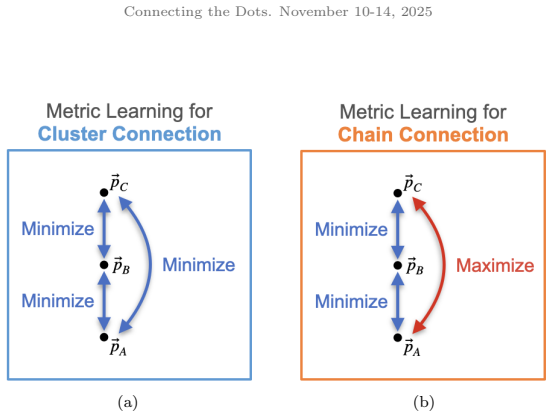
Double Metric Learning learns two separate embeddings for each detector hit. Directed edges are constructed by measuring distance between the first embedding of one hit and the second embedding of another. This decouples the learning objectives that conflict under ordinary contrastive loss when edges must form ordered chains.
What carries the argument
Double Metric Learning, which produces two node embeddings per hit so that directed edge decisions rest on the cross-distance between one embedding of the source and the other embedding of the target.
If this is right
- Graph construction quality improves especially for high transverse-momentum particles.
- Edge directions are recovered directly from the learned representations without extra post-processing.
- The resulting directed graphs supply cleaner input to downstream GNN tracking stages.
- The same two-embedding pattern can be applied to any tracking detector whose hits form chain-like trajectories.
Where Pith is reading between the lines
- The method may reduce the need for separate direction-inference modules in existing GNN pipelines.
- It could be combined with existing embedding regularizers to further control overfitting on simulation.
- Extension to multi-layer graphs might allow simultaneous learning of both spatial and directional relations.
Load-bearing premise
Two independent embeddings per node can be learned without one collapsing into the other or introducing bias that degrades tracking performance on real data.
What would settle it
Running the same Double Metric Learning pipeline on actual ATLAS ITk collision data and finding no improvement in graph purity or direction accuracy over single-metric learning would falsify the central claim.
Figures



read the original abstract
Graph construction is an essential step in the Graph Neural Network (GNN) based tracking pipelines. The goal of the graph construction is to construct a graph that contains only the defined true edge connections between nodes (detector hits). A promising approach for the graph construction is through the Metric Learning approach, where a node representation in an embedding space is learned, and nodes are connected according to their distance in the embedding space. The loss function for the metric learning in this case is a contrastive loss encouraging the true pairs of nodes to be close to each other, and pulling away the false pairs of nodes. This approach presents a conflict of the learning objective for the hopping connections when a true edge is defined as a chain connection in a particle track. To address the conflict for this case, we propose a ``Double Metric Learning'' approach, where two node representations are learned. A directed graph can then be constructed based on the distance between the two representations from two nodes respectively. We test this idea with the ATLAS ITk detector at the HL-LHC using the ATLAS ITk simulation and show better graph construction performance particularly for particles with high transverse momentum compared to the Simple Metric Learning approach. We also show that Double Metric Learning is able to accurately predict edge direction.
Editorial analysis
A structured set of objections, weighed in public.
Referee Report
Summary. The manuscript proposes Double Metric Learning for constructing directed graphs from detector hits in the ATLAS ITk at the HL-LHC. By learning two independent node embeddings per hit, the method constructs directed edges from cross-distances to resolve the contrastive-loss conflict that arises for chain connections (A-B-C) along a particle track; the authors report improved graph-construction performance relative to Simple Metric Learning, especially for high-pT particles, together with accurate edge-direction prediction, all evaluated on ATLAS ITk simulation.
Significance. If the reported gains are shown to arise from the architectural resolution of the chain-connection conflict rather than from doubled embedding capacity, the technique would supply a practical improvement to the graph-construction stage of GNN-based tracking pipelines. The explicit direction prediction is a useful side benefit for downstream directed-graph algorithms. The work is therefore potentially relevant to HL-LHC tracking, but its significance is currently limited by the absence of capacity-matched controls and quantitative metrics.
major comments (2)
- [Abstract] Abstract: the claim of 'better graph construction performance particularly for particles with high transverse momentum' is unsupported by any numerical values, error bars, baseline details, or ablation studies, leaving the central performance claim only weakly evidenced.
- [Results / Experiments] Experimental comparison (implicit in the abstract and results): the Simple Metric Learning baseline is not stated to have been capacity-matched (e.g., by doubling its embedding dimension or parameter count to equal that of the double-representation model), so any observed improvement could be attributable to increased model capacity rather than to the proposed mechanism for resolving contrastive-loss conflicts on chain connections.
minor comments (2)
- [Methods] The notation distinguishing the two learned representations per node should be introduced with explicit equations early in the methods section to improve readability.
- [Discussion] A brief discussion of how the directed-graph output integrates with existing GNN tracking pipelines would help readers assess downstream impact.
Simulated Author's Rebuttal
We thank the referee for the thorough review and valuable comments on our manuscript. We address each major comment below and will make the necessary revisions to strengthen the paper.
read point-by-point responses
-
Referee: [Abstract] Abstract: the claim of 'better graph construction performance particularly for particles with high transverse momentum' is unsupported by any numerical values, error bars, baseline details, or ablation studies, leaving the central performance claim only weakly evidenced.
Authors: We agree with the referee that the abstract's performance claim would be stronger with supporting numerical evidence. In the revised manuscript, we will include specific quantitative results, such as efficiency and purity metrics for high-pT particles with error bars, and clarify the baseline details and any ablation studies performed. revision: yes
-
Referee: [Results / Experiments] Experimental comparison (implicit in the abstract and results): the Simple Metric Learning baseline is not stated to have been capacity-matched (e.g., by doubling its embedding dimension or parameter count to equal that of the double-representation model), so any observed improvement could be attributable to increased model capacity rather than to the proposed mechanism for resolving contrastive-loss conflicts on chain connections.
Authors: This is a fair criticism. The current manuscript does not explicitly describe a capacity-matched baseline for Simple Metric Learning. We will revise the experimental section to include a comparison against a capacity-matched variant of Simple Metric Learning, for example by increasing its embedding dimension to match the total parameters of the Double Metric Learning model. This will help demonstrate whether the gains arise from the double-embedding architecture's ability to resolve the chain-connection conflict in the contrastive loss. revision: yes
Circularity Check
No circularity; architectural proposal tested on external simulation
full rationale
The paper proposes Double Metric Learning as an independent architectural change that learns two node representations to construct directed edges and resolve contrastive-loss conflicts for chain connections. This is motivated by the limitations of standard metric learning and then evaluated empirically on ATLAS ITk simulation data, with reported gains versus the simple baseline. No equations, fitted parameters, or claims reduce by construction to the inputs themselves; no self-citations bear the load of the central result; and the performance claims rest on external simulation benchmarks rather than internal redefinitions or renamings.
Axiom & Free-Parameter Ledger
axioms (1)
- domain assumption Contrastive loss applied separately to two embeddings can encode directed chain connections without conflict
Lean theorems connected to this paper
-
IndisputableMonolith/Cost/FunctionalEquation.leanwashburn_uniqueness_aczel unclear?
unclearRelation between the paper passage and the cited Recognition theorem.
Double Metric Learning... two node representations... distance between the source representation of the first hit and the target representation of the second... resolves the chain conflict
-
IndisputableMonolith/Foundation/BranchSelection.leanbranch_selection unclear?
unclearRelation between the paper passage and the cited Recognition theorem.
contrastive hinge loss... |p_i - p_j|^2 for true pairs, max(0, m - |p_i - p_j|^2) otherwise
What do these tags mean?
- matches
- The paper's claim is directly supported by a theorem in the formal canon.
- supports
- The theorem supports part of the paper's argument, but the paper may add assumptions or extra steps.
- extends
- The paper goes beyond the formal theorem; the theorem is a base layer rather than the whole result.
- uses
- The paper appears to rely on the theorem as machinery.
- contradicts
- The paper's claim conflicts with a theorem or certificate in the canon.
- unclear
- Pith found a possible connection, but the passage is too broad, indirect, or ambiguous to say the theorem truly supports the claim.
Reference graph
Works this paper leans on
-
[1]
Track and vertex reconstruction: From classical to adaptive methods , author =. Rev. Mod. Phys. , volume =. 2010 , month =. doi:10.1103/RevModPhys.82.1419 , url =
-
[2]
Performance of the ATLAS Track Reconstruction Algorithms in Dense Environments in LHC Run 2
Aaboud, M. and others. Performance of the ATLAS Track Reconstruction Algorithms in Dense Environments in LHC Run 2. Eur. Phys. J. C. 2017. doi:10.1140/epjc/s10052-017-5225-7. arXiv:1704.07983
work page internal anchor Pith review Pith/arXiv arXiv doi:10.1140/epjc/s10052-017-5225-7 2017
-
[3]
Description and performance of track and primary-vertex reconstruction with the CMS tracker
Chatrchyan, Serguei and others. Description and performance of track and primary-vertex reconstruction with the CMS tracker. JINST. 2014. doi:10.1088/1748-0221/9/10/P10009. arXiv:1405.6569
work page internal anchor Pith review Pith/arXiv arXiv doi:10.1088/1748-0221/9/10/p10009 2014
-
[4]
Optimizations of the ATLAS ITk GNN reconstruction pipeline. 2025
work page 2025
-
[5]
Performance of a geometric deep learning pipeline for HL-LHC particle tracking
Ju, Xiangyang and others. Performance of a geometric deep learning pipeline for HL-LHC particle tracking. Eur. Phys. J. C. 2021. doi:10.1140/epjc/s10052-021-09675-8. arXiv:2103.06995
-
[6]
Towards a realistic track reconstruction algorithm based on graph neural networks for the HL-LHC
Biscarat, Catherine and Caillou, Sylvain and Rougier, Charline and Stark, Jan and Zahreddine, Jad. Towards a realistic track reconstruction algorithm based on graph neural networks for the HL-LHC. EPJ Web Conf. 2021. doi:10.1051/epjconf/202125103047. arXiv:2103.00916
-
[7]
ATLAS ITk Track Reconstruction with a GNN-based pipeline
Caillou, Sylvain and Calafiura, Paolo and Farrell, Steven Andrew and Ju, Xiangyang and Murnane, Daniel Thomas and Rougier, Charline and Stark, Jan and Vallier, Alexis. ATLAS ITk Track Reconstruction with a GNN-based pipeline. 2022
work page 2022
-
[8]
High Pileup Particle Tracking with Object Condensation
Lieret, Kilian and DeZoort, Gage and Chatterjee, Devdoot and Park, Jian and Miao, Siqi and Li, Pan. High Pileup Particle Tracking with Object Condensation. 2023. arXiv:2312.03823
-
[9]
Accelerating the Inference of the Exa.TrkX Pipeline
Lazar, Alina and others. Accelerating the Inference of the Exa.TrkX Pipeline. J. Phys. Conf. Ser. 2023. doi:10.1088/1742-6596/2438/1/012008. arXiv:2202.06929
-
[10]
The Tracking Machine Learning challenge : Accuracy phase
Amrouche, Sabrina and others. The Tracking Machine Learning challenge : Accuracy phase. The NeurIPS '18 Competition: From Machine Learning to Intelligent Conversations. 2019. doi:10.1007/978-3-030-29135-8_9. arXiv:1904.06778
-
[11]
The Tracking Machine Learning Challenge: Throughput Phase
Amrouche, Sabrina and others. The Tracking Machine Learning Challenge: Throughput Phase. Comput. Softw. Big Sci. 2023. doi:10.1007/s41781-023-00094-w. arXiv:2105.01160
-
[12]
A density-based algorithm for discovering clusters in large spatial databases with noise , year =
Ester, Martin and Kriegel, Hans-Peter and Sander, J\". A density-based algorithm for discovering clusters in large spatial databases with noise , year =. Proceedings of the Second International Conference on Knowledge Discovery and Data Mining , pages =
-
[13]
Stefan Elfwing and Eiji Uchibe and Kenji Doya , keywords =. Sigmoid-weighted linear units for neural network function approximation in reinforcement learning , journal =. 2018 , note =. doi:https://doi.org/10.1016/j.neunet.2017.12.012 , url =
-
[14]
Advances in Neural Information Processing Systems 32 , editor =
PyTorch: An Imperative Style, High-Performance Deep Learning Library , author =. Advances in Neural Information Processing Systems 32 , editor =. 2019 , publisher =
work page 2019
-
[15]
doi:10.5281/zenodo.3828935 , license =
Falcon, William and. doi:10.5281/zenodo.3828935 , license =
-
[16]
Atkinson, Markus Julian and Caillou, Sylvain and Clafiura, Paolo and Collard, Christophe and Farrell, Steven Andrew and Huth, Benjamin and Ju, Xiangyang and Liu, Ryan and Minh Pham, Tuan and Murnane, Daniel (corresponding author) and Neubauer, Mark and Rougier, Charline and Stark, Jan and Torres, Heberth and Vallier, Alexis , title =
-
[17]
Adam: A Method for Stochastic Optimization
Adam: A method for stochastic optimization , author=. arXiv:1412.6980
work page internal anchor Pith review Pith/arXiv arXiv
-
[18]
RAPIDS: Libraries for End to End GPU Data Science , author =. 2023 , url =
work page 2023
-
[19]
Qasim, Shah Rukh and Kieseler, Jan and Iiyama, Yutaro and Pierini, Maurizio. Learning representations of irregular particle-detector geometry with distance-weighted graph networks. Eur. Phys. J. C. 2019. doi:10.1140/epjc/s10052-019-7113-9. arXiv:1902.07987
-
[20]
International Conference on Learning Representations , year=
Graph Attention Networks , author=. International Conference on Learning Representations , year=
- [21]
discussion (0)
Sign in with ORCID, Apple, or X to comment. Anyone can read and Pith papers without signing in.