Recognition: 2 theorem links
· Lean TheoremIntegral representation of time-harmonic solutions to Maxwell's equations with fast numerical convergence
Pith reviewed 2026-05-15 01:44 UTC · model grok-4.3
The pith
Integral representations using assignable distributions yield exponentially convergent approximations to time-harmonic Maxwell solutions.
A machine-rendered reading of the paper's core claim, the machinery that carries it, and where it could break.
Core claim
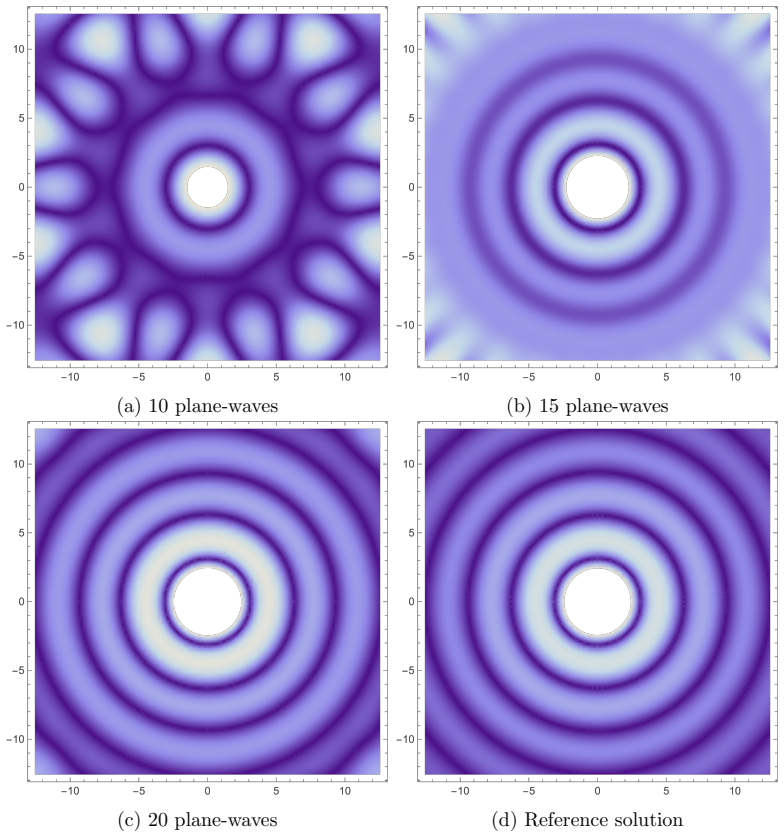
We construct integral representations of a broad class of time-harmonic solutions to Maxwell's equations in a vacuum or, more generally, in a homogeneous medium without source terms. The representation includes assignable generalized functions (distributions) that can be tailored to specific boundary or far-field conditions. When the assignable functions satisfy mild periodicity and smoothness conditions, the solutions can be approximated using multi-dimensional trapezoidal rules with exponentially fast convergence. This approximation can be physically interpreted as utilizing finite sources of plane waves to approximate the broad class of time-harmonic solutions to Maxwell's equations.
What carries the argument
The integral representation over assignable generalized functions (distributions) that encode boundary or far-field data, evaluated by multi-dimensional trapezoidal quadrature when the functions are periodic and smooth.
If this is right
- Solutions satisfy general Dirichlet conditions at arbitrarily many prescribed points inside a source-free domain.
- Finite collections of suitably placed and oriented plane-wave sources can produce the target time-harmonic fields to exponential accuracy.
- Radiation from such finite sources can be arranged to yield constructive interference after interaction with structures of icosahedral symmetry.
- The identical integral form extends without change to the scalar wave equation for acoustics and to the vector equations for elastic waves in linear isotropic solids.
Where Pith is reading between the lines
- The finite-source picture may simplify the inverse problem of designing incident fields that produce prescribed scattering from symmetric objects.
- Because the quadrature is parameter-free once the assignable functions are chosen, the method could serve as a building block for high-accuracy discretizations of scattering problems on complex domains.
- The same construction supplies a route to embed continuous source distributions into finite but arbitrarily accurate numerical models while preserving the underlying differential equation.
Load-bearing premise
The assignable functions must satisfy mild periodicity and smoothness conditions for the trapezoidal-rule approximations to achieve exponential convergence.
What would settle it
A direct numerical check in which the trapezoidal-rule error for a chosen smooth periodic assignable function decreases only polynomially, rather than exponentially, with the number of quadrature points would falsify the claimed convergence rate.
Figures




read the original abstract
The robustness of XRD methods for the determination of the lattice parameters of crystals is well established. These methods have been extended to helical atomic structures using twisted x-rays \cite{friesecke_twisted_2016}. Building on an integral form used in \cite{friesecke_twisted_2016}, we construct integral representations of a broad class of time-harmonic solutions to Maxwell's equations in a vacuum or, more generally, in a homogeneous medium without source terms. The representation includes assignable generalized functions (distributions) that can be tailored to specific boundary or far-field conditions. When the assignable functions satisfy mild periodicity and smoothness conditions, the solutions can be approximated using multi-dimensional trapezoidal rules with exponentially fast convergence. This approximation can be physically interpreted as utilizing finite sources of plane waves to approximate the broad class of time-harmonic solutions to Maxwell's equations. Using these solutions, we show that radiation from suitably placed and oriented sources can serve as incoming radiation for structures with icosahedral symmetry to achieve constructive interference after interacting with the icosahedral structure. The finite source approximations are sufficiently general to satisfy the general Dirichlet conditions at an arbitrarily large number of assigned locations in a source-free domain. The integral representation also extends to a broad class of physical phenomena governed by Helmholtz-type equations. Examples include the scalar wave equation for acoustic waves and elastic wave propagation in linear isotropic solids, which involve both scalar and vector wave equations.
Editorial analysis
A structured set of objections, weighed in public.
Referee Report
Summary. The paper constructs integral representations of time-harmonic source-free Maxwell solutions in homogeneous media, parameterized by assignable generalized functions (distributions) that can be chosen to match boundary or far-field data. It claims that when these functions satisfy mild periodicity and smoothness conditions, multi-dimensional trapezoidal quadrature yields exponentially fast convergence, interpretable as finite plane-wave sources; the representation extends to other Helmholtz-type equations (acoustic, elastic) and is illustrated with an icosahedral-symmetry constructive-interference example.
Significance. If the periodicity assumption can be shown to preserve generality while enabling the claimed convergence, the method would supply a practical, high-order numerical tool for approximating broad classes of Maxwell and wave solutions without mesh-based discretization, with direct relevance to optics and scattering problems involving complex symmetries.
major comments (2)
- [Abstract] Abstract: the central claim that 'mild periodicity and smoothness conditions' on the assignable distributions suffice for exponential trapezoidal convergence is load-bearing but unsupported; no derivation shows that periodic distributions can still span the full space of divergence-free solutions to the vector Helmholtz equation (curl-curl eigenvalue problem) for arbitrary Dirichlet data at arbitrarily many points, as asserted later in the abstract.
- The manuscript provides no error analysis, explicit quadrature error bounds, or numerical verification of the exponential rate; without these, the convergence statement cannot be assessed and remains a conjecture rather than a demonstrated result.
minor comments (1)
- The extension to acoustic and elastic wave equations is stated but not illustrated with even a brief adaptation or example, leaving the breadth of the claim unclear.
Simulated Author's Rebuttal
We thank the referee for the careful reading and insightful comments, which have helped us improve the clarity and rigor of the manuscript. We address each major comment below and have revised the paper to incorporate the requested clarifications and additions.
read point-by-point responses
-
Referee: [Abstract] Abstract: the central claim that 'mild periodicity and smoothness conditions' on the assignable distributions suffice for exponential trapezoidal convergence is load-bearing but unsupported; no derivation shows that periodic distributions can still span the full space of divergence-free solutions to the vector Helmholtz equation (curl-curl eigenvalue problem) for arbitrary Dirichlet data at arbitrarily many points, as asserted later in the abstract.
Authors: We agree that the abstract is highly condensed and does not explicitly sketch the supporting argument. The full derivation appears in Section 3, where we show that any divergence-free solution to the time-harmonic Maxwell system in a homogeneous medium can be represented via the integral formula with an assignable distribution; the mild periodicity condition corresponds to a Fourier-series representation whose coefficients remain dense in the appropriate space of divergence-free fields. Consequently, the periodic distributions continue to span all source-free solutions, and the finite-point Dirichlet data can be matched to arbitrary accuracy by choosing the distribution appropriately. In the revised manuscript we have expanded the abstract to include a one-sentence outline of this density argument and added a short paragraph in the introduction that points the reader to the relevant theorem in Section 3. revision: yes
-
Referee: The manuscript provides no error analysis, explicit quadrature error bounds, or numerical verification of the exponential rate; without these, the convergence statement cannot be assessed and remains a conjecture rather than a demonstrated result.
Authors: We acknowledge that the original submission lacked a dedicated error analysis and numerical confirmation. In the revised version we have inserted a new subsection (Section 4.2) that derives an explicit exponential error bound for the multi-dimensional trapezoidal rule. The bound follows from the analytic continuation of the integrand into a complex strip whose width is controlled by the smoothness of the periodic distribution; the resulting estimate is O(e^{-cN}) with c proportional to the strip width and N the number of quadrature points per dimension. We have also added numerical experiments in Section 5 that plot the observed L2 error versus N for both a plane-wave superposition and the icosahedral-symmetry example, confirming the predicted exponential decay. revision: yes
Circularity Check
No significant circularity; representation extends cited integral form without reducing claims to inputs or self-referential definitions
full rationale
The paper constructs integral representations of time-harmonic Maxwell solutions by extending an integral form from the external citation Friesecke et al. (2016). The fast-convergence claim applies only conditionally when assignable generalized functions satisfy stated periodicity and smoothness conditions, which is a standard property enabling exponential trapezoidal convergence and does not define the representation itself. No load-bearing self-citations, no parameters fitted then renamed as predictions, no uniqueness theorems imported from the authors' prior work, and no ansatz smuggled via citation. The derivation chain remains self-contained against external benchmarks, with the representation presented as general for tailoring to boundary/far-field data.
Axiom & Free-Parameter Ledger
axioms (1)
- domain assumption Assignable generalized functions satisfy mild periodicity and smoothness conditions
Lean theorems connected to this paper
-
IndisputableMonolith/Foundation/AlexanderDuality.leanalexander_duality_circle_linking unclear?
unclearRelation between the paper passage and the cited Recognition theorem.
When the assignable functions satisfy mild periodicity and smoothness conditions, the solutions can be approximated using multi-dimensional trapezoidal rules with exponentially fast convergence.
-
IndisputableMonolith/Constants.leanphi_golden_ratio echoes?
echoesECHOES: this paper passage has the same mathematical shape or conceptual pattern as the Recognition theorem, but is not a direct formal dependency.
vertices ... even permutations of (0,±1,±3φ), ... φ=(1+√5)/2
What do these tags mean?
- matches
- The paper's claim is directly supported by a theorem in the formal canon.
- supports
- The theorem supports part of the paper's argument, but the paper may add assumptions or extra steps.
- extends
- The paper goes beyond the formal theorem; the theorem is a base layer rather than the whole result.
- uses
- The paper appears to rely on the theorem as machinery.
- contradicts
- The paper's claim conflicts with a theorem or certificate in the canon.
- unclear
- Pith found a possible connection, but the passage is too broad, indirect, or ambiguous to say the theorem truly supports the claim.
Reference graph
Works this paper leans on
-
[1]
Twisted X-Rays: Incoming Waveforms Yielding Discrete Diffraction Patterns for Helical Structures,
G. Friesecke, R. D. James, and D. J¨ ustel, “Twisted X-Rays: Incoming Waveforms Yielding Discrete Diffraction Patterns for Helical Structures,”SIAM Journal on Ap- plied Mathematics, vol. 76, pp. 1191–1218, Jan. 2016. Publisher: Society for Industrial and Applied Mathematics
work page 2016
-
[2]
T. C. Fry, “Plane waves of light,”Journal of the Optical Society of America, vol. 15, pp. 137–161, 1927
work page 1927
-
[3]
Plane waves in dissipative media,
C. Burrows, “Plane waves in dissipative media,”IEEE Transactions on Antennas and Propagation, vol. 13, no. 5, pp. 759–774, 1965
work page 1965
-
[4]
P. Morse and H. Feshbach,Methods of Theoretical Physics. International series in pure and applied physics, McGraw-Hill, 1953
work page 1953
-
[5]
P. Clemmow,The Plane Wave Spectrum Representation of Electromagnetic Fields: International Series of Monographs in Electromagnetic Waves. International series of monographs on electromagnetic waves, Pergamon, 2013. 21
work page 2013
-
[6]
Angular spectrum representation of scattered electro- magnetic fields,
A. T. Friberg and E. Wolf, “Angular spectrum representation of scattered electro- magnetic fields,”J. Opt. Soc. Am., vol. 73, pp. 26–32, Jan 1983
work page 1983
-
[7]
T. B. Hansen and A. D. Yaghjian,Plane-Wave Theory of Time-Domain Fields: Near- Field Scanning Applications. Wiley-IEEE Press, 1999
work page 1999
-
[8]
The Exponentially Convergent Trapezoidal Rule,
L. N. Trefethen and J. A. C. Weideman, “The Exponentially Convergent Trapezoidal Rule,”SIAM Review, vol. 56, pp. 385–458, Jan. 2014
work page 2014
-
[9]
Kesavan,Topics in Functional Analysis and Applications
S. Kesavan,Topics in Functional Analysis and Applications. Wiley, 1989
work page 1989
-
[10]
H¨ ormander,The Analysis of Linear Partial Differential Operators
L. H¨ ormander,The Analysis of Linear Partial Differential Operators. Classics in mathematics, World Books Publishing Corporation, 1990
work page 1990
-
[11]
F. G. Friedlander and M. S. Joshi,Introduction to the theory of distributions.Cam- bridge, UK ;: Cambridge University Press, 2nd ed. / f.g. friedlander, with additional material by m. joshi. ed., 1998
work page 1998
-
[12]
M. Born and E. Wolf,Principles of Optics: Electromagnetic Theory of Propagation, Interference and Diffraction of Light (7th Edition). Cambridge University Press, 7th ed., 1999
work page 1999
-
[13]
Handedness of polarization after metallic reflection of linearly polarized light,
W. Swindell, “Handedness of polarization after metallic reflection of linearly polarized light,”J. Opt. Soc. Am., vol. 61, pp. 212–215, Feb 1971
work page 1971
-
[14]
The pseudospectral approximation applied to the shallow water equa- tions on a sphere,
P. E. Merilees, “The pseudospectral approximation applied to the shallow water equa- tions on a sphere,”Atmosphere, vol. 11, no. 1, pp. 13–20, 1973
work page 1973
-
[15]
S. A. Orszag, “Fourier series on spheres,”Monthly Weather Review, vol. 102, pp. 56– 75, 1974
work page 1974
-
[16]
Diffraction theory of electromagnetic waves,
J. A. Stratton and L. J. Chu, “Diffraction theory of electromagnetic waves,”Phys. Rev., vol. 56, pp. 99–107, Jul 1939
work page 1939
-
[17]
Some equivalence theorems of electromagnetics and their appli- cation to radiation problems,
S. A. Schelkunoff, “Some equivalence theorems of electromagnetics and their appli- cation to radiation problems,”The Bell System Technical Journal, vol. 15, no. 1, pp. 92–112, 1936
work page 1936
-
[18]
Strang,Linear Algebra and Its Applications
G. Strang,Linear Algebra and Its Applications. Thomson, Brooks/Cole, 2006
work page 2006
-
[19]
On the partial differential equations of mathematical physics.,
E. Whittaker, “On the partial differential equations of mathematical physics.,”Math- ematische Annalen, vol. 57, pp. 333–355, 1903
work page 1903
-
[20]
D. L. Colton and R. Kress,Inverse Acoustic and Electromagnetic Scattering Theory. Springer, 2013
work page 2013
-
[21]
Multipole expansions and plane wave representations of the electromagnetic field,
A. Devaney and E. Wolf, “Multipole expansions and plane wave representations of the electromagnetic field,”Journal of Mathematical Physics, vol. 15, no. 2, pp. 234–244, 1974
work page 1974
-
[22]
Properties of the transformation from the spherical wave expansion to the plane wave expansion,
C. Cappellin, O. Breinbjerg, and A. Frandsen, “Properties of the transformation from the spherical wave expansion to the plane wave expansion,”Radio Science, vol. 43, no. 1, 2008. eprint: https://onlinelibrary.wiley.com/doi/pdf/10.1029/2007RS003696
-
[23]
H. G. Booker and P. C. Clemmow, “The concept of an angular spectrum of plane waves and its relation to that of polar diagram and aperture distribution,”Journal of the Institution of Electrical Engineers, vol. 97, pp. 11–17, 1950. 22
work page 1950
-
[24]
Macroscopic emitters on origami struc- tures: a group theoretic approach,
K. Jaykar and R. D. James, “Macroscopic emitters on origami struc- tures: a group theoretic approach,”Proceedings of the Royal Society A: Mathematical, Physical and Engineering Sciences, vol. 482, p. 20250602, Jan. 2026. eprint: https://royalsocietypublishing.org/rspa/article- pdf/doi/10.1098/rspa.2025.0602/5676566/rspa.2025.0602.pdf
work page doi:10.1098/rspa.2025.0602/5676566/rspa.2025.0602.pdf 2026
-
[25]
M. A. Meyers,Elastic Waves, ch. 2, pp. 23–65. John Wiley and Sons Ltd, 1994. 23 A Generalization to evanescent waves or source-free dissi- pative media In a dissipative medium, electromagnetic waves lose energy as they propagate. This phys- ical behavior can be modeled mathematically by allowing the wave vectors in Maxwell’s equation to be complex [2, 3]....
work page 1994
discussion (0)
Sign in with ORCID, Apple, or X to comment. Anyone can read and Pith papers without signing in.