Recognition: no theorem link
The thermopower properties of interacting systems
Pith reviewed 2026-05-15 02:41 UTC · model grok-4.3
The pith
Additional interactions beyond on-site repulsion enhance the Seebeck coefficient and produce multiple anomalous sign changes with doping.
A machine-rendered reading of the paper's core claim, the machinery that carries it, and where it could break.
Core claim
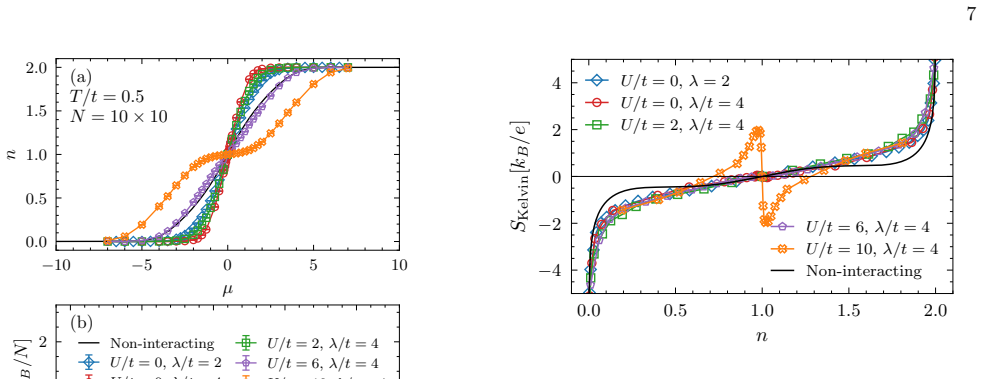
We find that additional interaction scales can enhance the Seebeck coefficient, while also leading to multiple anomalous changes of sign as a function of doping. We also show that the anomalous behavior is connected to a gap opening in the ground state. Moreover, electron-phonon coupling also lead to a Seebeck anomaly, even without on-site repulsion. We connect these changes of sign in the Seebeck coefficient with a restructuring of the Fermi surface and a change in its topology.
What carries the argument
The Seebeck coefficient calculated from extended Hubbard-like Hamiltonians that include attractive, nearest-neighbor, sublattice, and electron-phonon terms, with sign changes tied to Fermi surface restructuring and topology shifts.
If this is right
- Additional interactions enhance the Seebeck coefficient beyond on-site effects alone.
- Multiple sign changes appear as a function of doping due to these extra scales.
- Anomalous behavior ties directly to gap opening in the ground state.
- Electron-phonon coupling produces Seebeck anomalies even without on-site repulsion.
- Sign changes correspond to restructuring of the Fermi surface including topology changes.
Where Pith is reading between the lines
- Engineering nearest-neighbor interactions in materials could be used to achieve larger thermopower values.
- The topology connection suggests similar sign-change patterns may appear in other doped correlated systems.
- Transport measurements sensitive to Fermi surface shape could test the predicted doping dependence.
Load-bearing premise
Numerical calculations of the Seebeck coefficient from the extended models accurately reflect the system's low-energy physics without major errors from finite size or approximations.
What would settle it
A calculation or measurement in a model with added nearest-neighbor interactions showing no Seebeck enhancement or fewer than multiple sign changes across doping.
Figures




read the original abstract
The quest for efficient devices has fueled research in thermoelectric materials. In these materials, the goal is to maximize the Figure of Merit $ZT$. One of the components of this quantity is the Seebeck coefficient, which measures the voltage generated in response to a temperature gradient. Recent studies have revealed that strong electronic correlations can enhance the Seebeck coefficient, leading to anomalous behavior near half-filling. However, the impact of interactions beyond the on-site Hubbard remains mostly unexplored. In this work, we investigate the Seebeck coefficient considering attractive interactions, nearest-neighbor interactions, sublattice potentials and electron-phonon coupling. We find that additional interaction scales can enhance the Seebeck coefficient, while also leading to multiple anomalous changes of sign as a function of doping. We also show that the anomalous behavior is connected to a gap opening in the ground state. Moreover, electron-phonon coupling also lead to a Seebeck anomaly, even without on-site repulsion. We connect these changes of sign in the Seebeck coefficient with a restructuring of the Fermi surface and a change in its topology, an effect commonly seen in cuprates.
Editorial analysis
A structured set of objections, weighed in public.
Referee Report
Summary. The paper investigates the Seebeck coefficient (thermopower) in Hubbard-like models extended by attractive interactions, nearest-neighbor repulsion, sublattice potentials, and electron-phonon coupling. It claims that these additional scales enhance the Seebeck coefficient relative to the pure Hubbard case, produce multiple anomalous sign changes as a function of doping, and that the sign changes are tied to a restructuring of the Fermi surface, a change in its topology, and gap opening in the ground state. Electron-phonon coupling is reported to induce Seebeck anomalies even in the absence of on-site repulsion.
Significance. If the transport calculations are free of uncontrolled approximations, the work would usefully extend the known correlation-enhanced thermopower regime to models with longer-range and electron-phonon terms, providing a microscopic link between Seebeck sign changes and Fermi-surface topology that is relevant to cuprate phenomenology. The explicit demonstration that electron-phonon coupling alone suffices for anomalies is a potentially falsifiable prediction.
major comments (2)
- [Methods] Methods section: the computation of the Seebeck coefficient (presumably via Kubo or Boltzmann transport from the interacting Green's function) must be shown to be converged with respect to cluster size, frequency cutoff, and self-energy approximation; without such checks the reported doping-driven sign changes and topology transitions remain vulnerable to finite-size or truncation artifacts that directly affect the central claim.
- [Results] Results on doping dependence: the link between Seebeck sign changes and Fermi-surface topology restructuring is asserted but requires an explicit diagnostic (e.g., momentum-resolved spectral function or Hall coefficient) at the doping values where sign changes occur; the current connection appears interpretive rather than quantitatively demonstrated.
minor comments (2)
- [Abstract] The abstract states that additional interactions 'enhance' the Seebeck coefficient but does not quantify the enhancement relative to the pure Hubbard baseline or specify the interaction strengths used.
- [Model] Notation for the extended interaction terms (attractive, nearest-neighbor, electron-phonon) should be defined once in the Hamiltonian section and used consistently thereafter.
Simulated Author's Rebuttal
We thank the referee for the careful reading and constructive comments on our manuscript. We appreciate the positive assessment of the work's potential significance and agree that the suggested additions will strengthen the presentation. We address each major comment below and will revise the manuscript accordingly.
read point-by-point responses
-
Referee: [Methods] Methods section: the computation of the Seebeck coefficient (presumably via Kubo or Boltzmann transport from the interacting Green's function) must be shown to be converged with respect to cluster size, frequency cutoff, and self-energy approximation; without such checks the reported doping-driven sign changes and topology transitions remain vulnerable to finite-size or truncation artifacts that directly affect the central claim.
Authors: We agree that explicit convergence tests are necessary to substantiate the robustness of the reported sign changes. In the revised manuscript we will add a dedicated subsection to the Methods section that presents convergence checks with respect to cluster size (including direct comparisons between 2x2 and larger clusters), frequency cutoff, and the self-energy approximation. These tests will be shown to confirm that the doping-dependent anomalies persist and are not sensitive to the numerical parameters. revision: yes
-
Referee: [Results] Results on doping dependence: the link between Seebeck sign changes and Fermi-surface topology restructuring is asserted but requires an explicit diagnostic (e.g., momentum-resolved spectral function or Hall coefficient) at the doping values where sign changes occur; the current connection appears interpretive rather than quantitatively demonstrated.
Authors: We acknowledge that the connection between the Seebeck anomalies and Fermi-surface changes can be made more direct. In the revised version we will include momentum-resolved spectral functions evaluated precisely at the doping values where sign changes occur, explicitly demonstrating gap opening and the associated topology restructuring. We will also add the doping dependence of the Hall coefficient as an additional quantitative diagnostic that corroborates the link to Fermi-surface topology. revision: yes
Circularity Check
No significant circularity; results from direct numerical computation of Seebeck coefficient
full rationale
The paper computes the Seebeck coefficient numerically for extended interacting Hamiltonians (attractive, nearest-neighbor, sublattice, and electron-phonon terms added to Hubbard model). The central claims—enhancement of Seebeck, multiple sign changes with doping, and connection to Fermi-surface restructuring—are presented as outcomes of these calculations rather than any self-definitional loop, fitted parameter renamed as prediction, or load-bearing self-citation. No equations or steps reduce by construction to the inputs; the derivation chain is self-contained against external benchmarks such as the underlying model Hamiltonians and standard transport formulas.
Axiom & Free-Parameter Ledger
free parameters (1)
- interaction strengths (attractive, nearest-neighbor, electron-phonon)
axioms (1)
- domain assumption The extended Hubbard or Holstein-Hubbard Hamiltonian accurately represents the low-energy physics of the materials of interest.
Reference graph
Works this paper leans on
-
[1]
Around half-filling We now discuss the effects of near-neighbor interac- tions on the thermoelectric properties. To this end, we examine the extended Hubbard model (EHM) [32, 44], which describes fermions on a lattice coupled through one-site (U) and first-neighbor (V) interactions, whose Hamiltonian reads H=H K +H U +H V , withϵ i = 0. We begin by examin...
-
[2]
Around quarter-filling Interestingly, Figs. 3 and 4 show an additional sign change of the Seebeck coefficient near quarter-filling, which is robust forT /t≲1. Indeed, a small plateau is evident in Fig. 2 (c) aroundn≈0.5, accompanied by small changes in the corresponding entropy in Fig. 2 (d). By contrast, we do not observe this Seebeck anomaly near quarte...
-
[3]
Around half-filling As in the previous cases, we analyzed the density pro- files, local density of states, and entropy. Since the con- nection between density plateaus and entropy peaks was already highlighted in the previous Hamiltonians, here we show only the Seebeck coefficient in Figure 9. We first analyze the half-filling regime. For ∆ = 0, the syste...
-
[4]
Around quarter-filling We now turn our attention to the quarter-filling regime, in which the ground state is less clear. Figure 9 (a) shows that, as ∆ increases for fixedU/t= 10, the Seebeck response forn≲0.5 has a change from a value close to the noninteracting case (for ∆ = 0) to a large re- sponse with opposite sign (for ∆/t= 2 and 3). Indeed, a clear ...
work page 2023
-
[5]
D. M. Rowe,Thermoelectrics handbook: macro to nano (CRC press, 2005)
work page 2005
-
[6]
R. Kumar and R. Singh,Thermoelectricity and advanced thermoelectric materials(Woodhead Publishing, 2021)
work page 2021
-
[7]
H. J. Goldsmidet al.,Introduction to thermoelectricity, Vol. 121 (Springer, 2010)
work page 2010
-
[8]
M. Dresselhaus, X. Sun, S. Cronin, T. Koga, G. Dres- selhaus, and K. Wang, Prospects for high thermoelectric figures of merit in 2D systems, MRS Online Proceedings Library (OPL)478, 55 (1997)
work page 1997
-
[9]
L. E. Bell, Cooling, heating, generating power, and re- covering waste heat with thermoelectric systems, Science 321, 1457 (2008)
work page 2008
-
[10]
G. J. Snyder and E. S. Toberer, Complex thermoelectric materials, Nature materials7, 105 (2008)
work page 2008
-
[11]
J. M. Tomczak, Thermoelectricity in correlated narrow- gap semiconductors, Journal of Physics: Condensed Mat- ter30, 183001 (2018)
work page 2018
-
[12]
P. Sun, B. Wei, D. Menzel, and F. Steglich, Resonant charge relaxation as a likely source of the enhanced ther- mopower in FeSi, Phys. Rev. B90, 245146 (2014)
work page 2014
-
[13]
A. Bentien, S. Johnsen, G. Madsen, B. Iversen, and 13 F. Steglich, Colossal Seebeck coefficient in strongly cor- related semiconductor FeSb2, EPL (Europhysics Letters) 80, 17008 (2007)
work page 2007
-
[14]
I. Terasaki, Y. Sasago, and K. Uchinokura, Large ther- moelectric power in NaCo 2O4 single crystals, Phys. Rev. B56, R12685 (1997)
work page 1997
-
[15]
N. Ito, M. Ishii, and R. Okazaki, Enhanced Seebeck coef- ficient by a filling-induced Lifshitz transition in KxRhO2, Phys. Rev. B99, 041112 (2019)
work page 2019
- [16]
-
[17]
M. Lee, L. Viciu, L. Li, Y. Wang, M. Foo, S. Watauchi, R. Pascal Jr, R. Cava, and N. Ong, Large enhancement of the thermopower in NaxCoO2 at high Na doping, Nature materials5, 537 (2006)
work page 2006
-
[18]
O. Cyr-Choini` ere, S. Badoux, G. Grissonnanche, B. Mi- chon, S. Afshar, S. Fortier, D. LeBoeuf, D. Graf, J. Day, D. Bonn,et al., Anisotropy of the Seebeck Coefficient in the Cuprate Superconductor YBa2Cu3Oy: Fermi-Surface Reconstruction by Bidirectional Charge Order, Physical Review X7, 031042 (2017)
work page 2017
-
[19]
Y. Wang, D. M. Hamann, D. L. M. Cordova, J. Chen, B. Wang, L. Shen, Z. Cai, H. Shi, E. Karapetrova, I. Ar- avind,et al., Enhanced low-temperature thermoelectric performance in (PbSe) 1+δ (VSe2)1 heterostructures due to highly correlated electrons in charge density waves, Nano Letters20, 8008 (2020)
work page 2020
-
[20]
R. Bhatt, S. Bhattacharya, R. Basu, S. Ahmad, A. Chauhan, G. S. Okram, P. Bhatt, M. Roy, M. Na- vaneethan, Y. Hayakawa,et al., Enhanced thermoelec- tric properties of selenium-deficient layered TiSe 2−x: A charge-density-wave material, ACS applied materials & interfaces6, 18619 (2014)
work page 2014
-
[21]
M.-M. Zemljiˇ c and P. Prelovˇ sek, Thermoelectric power in one-dimensional Hubbard model, Physical Review B—Condensed Matter and Materials Physics71, 085110 (2005)
work page 2005
-
[22]
W. C. d. F. Silva, M. V. Araujo, S. Roy, A. Samanta, N. d. C. Costa, N. Trivedi, and T. Paiva, Effects of strong electronic interactions on the thermopower properties of the repulsive Hubbard model, Phys. Rev. B108, 075101 (2023)
work page 2023
- [23]
-
[24]
M. A. Habitzreuter, W. C. de Freitas Silva, E. O. Riz- zatti, T. Paiva, and M. C. Barbosa, Specific heat and density anomaly in the Hubbard model, Phys. Rev. B 113, 165111 (2026)
work page 2026
-
[25]
W. O. Wang, J. K. Ding, E. W. Huang, B. Moritz, and T. P. Devereaux, Quantitative assessment of the univer- sal thermopower in the Hubbard model, Nature Commu- nications14, 7064 (2023)
work page 2023
-
[26]
J. Mravlje, M. Ulaga, and J. Kokalj, Spin Seebeck coef- ficient and spin-thermal diffusion in the two-dimensional Hubbard model, Phys. Rev. Res.4, 023197 (2022)
work page 2022
-
[27]
P. Wissgott, A. Toschi, H. Usui, K. Kuroki, and K. Held, Enhancement of the Na xCoO2 thermopower due to elec- tronic correlations, Phys. Rev. B82, 201106(R) (2010)
work page 2010
-
[28]
P. Wissgott, A. Toschi, G. Sangiovanni, and K. Held, Ef- fects of electronic correlations and disorder on the ther- mopower of Na xCoO2, Phys. Rev. B84, 085129 (2011)
work page 2011
-
[29]
M. R. Peterson and B. S. Shastry, Kelvin formula for thermopower, Phys. Rev. B82, 195105 (2010)
work page 2010
-
[30]
R. Blankenbecler, D. J. Scalapino, and R. L. Sugar, Monte carlo calculations of coupled boson-fermion sys- tems. i, Phys. Rev. D24, 2278 (1981)
work page 1981
-
[31]
J. E. Hirsch, Discrete Hubbard-Stratonovich transforma- tion for fermion lattice models, Phys. Rev. B28, 4059(R) (1983)
work page 1983
-
[32]
J. E. Hirsch, Two-dimensional Hubbard model: Numer- ical simulation study, Phys. Rev. B31, 4403 (1985)
work page 1985
-
[33]
S. R. White, D. J. Scalapino, R. L. Sugar, N. E. Bick- ers, and R. T. Scalettar, Attractive and repulsive pair- ing interaction vertices for the two-dimensional Hubbard model, Phys. Rev. B39, 839(R) (1989)
work page 1989
-
[34]
R. R. d. Santos, Introduction to quantum Monte Carlo simulations for fermionic systems, Brazilian Journal of Physics33, 36 (2003)
work page 2003
-
[35]
J. Gubernatis, N. Kawashima, and P. Werner, Determi- nant method, inQuantum Monte Carlo Methods: Algo- rithms for Lattice Models(Cambridge University Press,
-
[36]
S. a. d. A. Sousa-J´ unior, N. C. Costa, and R. R. dos Santos, Half-filled extended Hubbard model on a square lattice: Phase boundaries from determinant quantum Monte Carlo simulations, Phys. Rev. B109, 165102 (2024)
work page 2024
-
[37]
N. C. Costa, K. Seki, S. Yunoki, and S. Sorella, Phase di- agram of the two-dimensional Hubbard-Holstein model, Communications Physics3, 80 (2020)
work page 2020
-
[38]
J. E. Hirsch, R. L. Sugar, D. J. Scalapino, and R. Blankenbecler, Monte Carlo simulations of one- dimensional fermion systems, Phys. Rev. B26, 5033 (1982)
work page 1982
-
[39]
S. R. White, R. L. Sugar, and R. T. Scalettar, Algorithm for the simulation of many-electron systems at low tem- peratures, Phys. Rev. B38, 11665 (1988)
work page 1988
-
[40]
S. R. White, D. J. Scalapino, R. L. Sugar, E. Y. Loh, J. E. Gubernatis, and R. T. Scalettar, Numerical study of the two-dimensional Hubbard model, Physical Review B40, 506 (1989)
work page 1989
-
[41]
E. Y. Loh, J. E. Gubernatis, R. T. Scalettar, S. R. White, D. J. Scalapino, and R. L. Sugar, Sign problem in the nu- merical simulation of many-electron systems, Phys. Rev. B41, 9301 (1990)
work page 1990
-
[42]
L.-F. m. c. Arsenault, B. S. Shastry, P. S´ emon, and A.- M. S. Tremblay, Entropy, frustration, and large ther- mopower of doped Mott insulators on the fcc lattice, Phys. Rev. B87, 035126 (2013)
work page 2013
- [43]
- [44]
-
[45]
R. A. Fontenele, N. C. Costa, R. R. dos Santos, and T. Paiva, Two-dimensional attractive Hubbard model and the BCS-BEC crossover, Phys. Rev. B105, 184502 (2022)
work page 2022
-
[46]
R. A. Fontenele, N. C. Costa, T. Paiva, and R. R. dos Santos, Increasing superconductingT c by layering in the attractive hubbard model, Phys. Rev. A110, 053315 14 (2024)
work page 2024
-
[47]
D. P. Arovas, E. Berg, S. A. Kivelson, and S. Raghu, The Hubbard Model, Annual Review of Condensed Matter Physics13, 239 (2022)
work page 2022
-
[48]
H. Q. Lin and J. E. Hirsch, Two-dimensional Hubbard model with nearest- and next-nearest-neighbor hopping, Phys. Rev. B35, 3359 (1987)
work page 1987
-
[49]
A. W. Sandvik, Computational studies of quantum spin systems (2010) pp. 135–338
work page 2010
-
[50]
M. Hohenadler, M. Aichhorn, and W. von der Linden, Spectral function of electron-phonon models by cluster perturbation theory, Phys. Rev. B68, 184304 (2003)
work page 2003
-
[51]
D. S´ en´ echal, D. Perez, and M. Pioro-Ladri` ere, Spectral Weight of the Hubbard Model through Cluster Perturba- tion Theory, Phys. Rev. Lett.84, 522 (2000)
work page 2000
-
[52]
D. S´ en´ echal, D. Perez, and D. Plouffe, Cluster perturba- tion theory for Hubbard models, Phys. Rev. B66, 075129 (2002)
work page 2002
-
[53]
An introduction to quantum cluster methods
D. S´ en´ echal, An introduction to quantum cluster meth- ods (2010), arXiv:0806.2690 [cond-mat.str-el]
work page internal anchor Pith review Pith/arXiv arXiv 2010
-
[54]
N. C. Costa, T. Blommel, W.-T. Chiu, G. Batrouni, and R. T. Scalettar, Phonon dispersion and the competition between pairing and charge order, Phys. Rev. Lett.120, 187003 (2018)
work page 2018
-
[55]
G. G. Batrouni and R. T. Scalettar, Langevin simulations of a long-range electron-phonon model, Phys. Rev. B99, 035114 (2019)
work page 2019
-
[56]
B. Xiao, N. C. Costa, E. Khatami, G. G. Batrouni, and R. T. Scalettar, Charge density wave and superconduc- tivity in the disordered Holstein model, Phys. Rev. B 103, L060501 (2021)
work page 2021
-
[57]
K. Bouadim, N. Paris, F. H´ ebert, G. G. Batrouni, and R. T. Scalettar, Metallic phase in the two-dimensional ionic Hubbard model, Phys. Rev. B76, 085112 (2007)
work page 2007
-
[58]
I. Osborne, T. Paiva, and N. Trivedi, Broken Luttinger theorem in the two-dimensional Fermi-Hubbard model, Phys. Rev. B104, 235122 (2021)
work page 2021
- [59]
-
[60]
M. Civelli, M. Capone, S. S. Kancharla, O. Parcollet, and G. Kotliar, Dynamical Breakup of the Fermi Surface in a Doped Mott Insulator, Phys. Rev. Lett.95, 106402 (2005)
work page 2005
-
[61]
H. Bragan¸ ca, S. Sakai, M. C. O. Aguiar, and M. Civelli, Correlation-Driven Lifshitz Transition at the Emergence of the Pseudogap Phase in the Two-Dimensional Hub- bard Model, Phys. Rev. Lett.120, 067002 (2018)
work page 2018
-
[62]
M. Jarrell and J. Gubernatis, Bayesian inference and the analytic continuation of imaginary-time quantum Monte Carlo data, Physics Reports269, 133 (1996)
work page 1996
-
[63]
A. W. Sandvik, Stochastic method for analytic continu- ation of quantum Monte Carlo data, Phys. Rev. B57, 10287 (1998)
work page 1998
-
[64]
W. O. Wang, J. K. Ding, B. Moritz, E. W. Huang, and T. P. Devereaux, DC Hall coefficient of the strongly cor- related Hubbard model, npj Quantum Materials5, 51 (2020)
work page 2020
-
[65]
R. Luo, T. J. Legvold, G. Eichman, H. Navarro, A. C. Basaran, E. Qiu, I. K. Schuller, and D. Natelson, Spin Seebeck effect in correlated antiferromagnetic V 2O3, Phys. Rev. B112, 184421 (2025)
work page 2025
discussion (0)
Sign in with ORCID, Apple, or X to comment. Anyone can read and Pith papers without signing in.