Recognition: no theorem link
Self-Regulated Learning in Essay Writing: Consistency of Strategies and Impact on Outcomes
Pith reviewed 2026-05-15 02:36 UTC · model grok-4.3
The pith
Secondary school students show three main SRL strategies in online essay writing, with variability across sessions and one linked to better outcomes.
A machine-rendered reading of the paper's core claim, the machinery that carries it, and where it could break.
Core claim
The central discovery is that three dominant SRL strategies were identified from the trace data. Strategies showed variability: many students remained in or shifted to Read first, write next, while none used Write intensively, read selectively in session 2. Although less common, the latter strategy was positively associated with learning outcomes.
What carries the argument
Process mining and unsupervised machine learning techniques applied to metacognition-related trace data from a digital learning platform to identify dominant SRL strategies.
If this is right
- Many students remain in or shift to a read first, write next strategy across the two sessions.
- None of the students used the write intensively, read selectively strategy in the second session.
- The write intensively, read selectively strategy is positively associated with learning outcomes.
- SRL strategies exhibit variability over time rather than remaining consistent.
Where Pith is reading between the lines
- Digital platforms could incorporate real-time monitoring of SRL strategies to offer timely support.
- Interventions aimed at promoting the effective strategy could be tested in similar online settings.
- These patterns may inform broader designs for online education tools targeting adolescent learners.
Load-bearing premise
The logged trace data from the digital platform accurately and comprehensively captures students' metacognitive SRL processes without substantial measurement error, missing actions, or platform-specific biases.
What would settle it
A study using direct observation or different data collection methods that finds different strategy clusters or no association with outcomes would falsify the results.
Figures

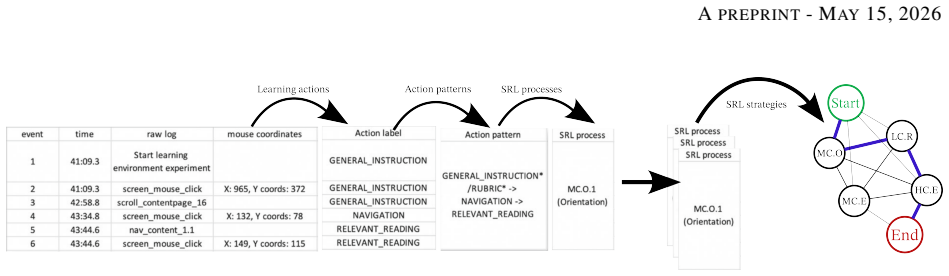


read the original abstract
Background: Abilities for effective self-regulated learning (SRL) are critical for lifelong learning, particularly during adolescence when these skills consolidate and strongly influence future learning. Their importance has grown with the rise of online and blended education. Yet, little is known about how secondary school students self-regulate in online environments, how their SRL processes and strategies evolve, or how they affect outcomes. In secondary education, understanding these processes can reveal patterns and indicators of learning success, informing the design of online support mechanisms. Evidence from repeated-measures designs remains scarce. Objectives: This study aims to examine how secondary school students enact SRL strategies during online essay writing, how these strategies change over time, and how they relate to learning outcomes. Methods: We analysed metacognition-related trace data collected from secondary students during a two-wave online essay-writing task conducted one week apart in two Colombian schools (N = 93 for session 1, N = 95 for session 2) via a digital learning platform. Using a combination of process mining and unsupervised machine learning techniques, we identified dominant SRL strategies grounded in established SRL processes and examined their stability and association with learning outcomes. Results and conclusions: Three dominant SRL strategies were identified. Results showed variability: many students remained in or shifted to Read first, write next, while none used Write intensively, read selectively in session 2. Although less common, latter strategy was positively associated with learning outcomes.
Editorial analysis
A structured set of objections, weighed in public.
Referee Report
Summary. The paper examines self-regulated learning (SRL) strategies among secondary school students in two online essay-writing sessions one week apart (N=93 and 95) using trace logs from a digital platform. It combines process mining and unsupervised machine learning to identify three dominant SRL strategies, assesses their stability and shifts over time, and reports that one less-common strategy (Write intensively, read selectively) is positively associated with learning outcomes while many students remain in or shift to Read first, write next.
Significance. If the logged actions validly encode metacognitive SRL processes, the work provides rare repeated-measures evidence on strategy consistency and outcome links in adolescent online writing, with potential to inform platform design for secondary education.
major comments (2)
- [Methods] Methods: The central claim that trace logs yield interpretable SRL strategies rests on unsupervised clustering without any reported external validation (think-aloud protocols, expert session coding, or correlation with self-report SRL inventories). If clusters primarily capture platform affordances rather than metacognitive processes, both the stability findings and the outcome association become uninterpretable.
- [Results] Results: The reported positive association between the 'Write intensively, read selectively' strategy and outcomes is presented without cluster-validation statistics (e.g., silhouette scores, cross-session stability), exact outcome metrics, or statistical controls for confounders and missing data; these omissions leave the strength and robustness of the link unverifiable.
minor comments (1)
- [Abstract] Abstract: High-level description of sample sizes and methods is given, but details on cluster validation, precise outcome measures, and missing-data handling are absent, reducing the reader's ability to assess the reported associations.
Simulated Author's Rebuttal
We thank the referee for their constructive feedback on our manuscript examining SRL strategies via trace data in online essay writing. We address each major comment below, indicating planned revisions where appropriate.
read point-by-point responses
-
Referee: [Methods] The central claim that trace logs yield interpretable SRL strategies rests on unsupervised clustering without any reported external validation (think-aloud protocols, expert session coding, or correlation with self-report SRL inventories). If clusters primarily capture platform affordances rather than metacognitive processes, both the stability findings and the outcome association become uninterpretable.
Authors: We acknowledge that the absence of external validation (e.g., think-aloud protocols or self-report correlations) is a limitation of the current trace-only design. The clusters were derived by first applying process mining to extract sequential patterns from logged actions, then mapping those to core SRL phases (forethought, performance, reflection) drawn from established models such as Zimmerman (2002). We will revise the Methods section to provide greater detail on feature selection and the theoretical grounding of each action category. We will also add an expanded limitations discussion explicitly addressing the risk that clusters may partly reflect platform affordances and noting that future work should include concurrent validation measures. These changes clarify the interpretive basis without overstating the evidence. revision: partial
-
Referee: [Results] The reported positive association between the 'Write intensively, read selectively' strategy and outcomes is presented without cluster-validation statistics (e.g., silhouette scores, cross-session stability), exact outcome metrics, or statistical controls for confounders and missing data; these omissions leave the strength and robustness of the link unverifiable.
Authors: We will revise the Results section to report silhouette scores for the k-means clustering solution and quantitative measures of cross-session strategy stability (e.g., transition probabilities and Cohen’s kappa). The outcome metric is the platform-generated essay quality score (0–100 scale) based on a rubric covering content, organization, and language use. We will add multiple regression models that control for session order, school, and available baseline performance indicators, along with a description of missing-data handling (primarily listwise deletion given low rates). These additions will allow readers to assess the robustness of the reported association. revision: yes
- We do not have access to concurrent think-aloud protocols, expert-coded sessions, or self-report SRL inventories in the existing dataset, so direct external validation of the clusters cannot be performed retrospectively.
Circularity Check
No significant circularity: empirical identification from external trace logs
full rationale
The paper applies standard process mining and unsupervised machine learning directly to logged trace data collected from secondary students on a digital platform. The three dominant SRL strategies are discovered as clusters in that data rather than defined in terms of the outcome associations or any fitted parameter that would make the target result tautological. No equations, self-definitional reductions, or load-bearing self-citations are present that collapse the reported stability findings or outcome links back to the inputs by construction. The approach remains externally falsifiable against the raw logs and is therefore self-contained.
Axiom & Free-Parameter Ledger
free parameters (1)
- Number of clusters
axioms (1)
- domain assumption Trace data from the digital platform accurately reflects metacognitive SRL processes
Reference graph
Works this paper leans on
-
[1]
Barry J. Zimmerman. Self-regulated learning and academic achievement: An overview.Educational Psychologist, 25(1):3–17, 1990.https://doi.org/10.1207/s15326985ep2501_2
-
[2]
Studying as self-regulated learning
Philip H Winne and Allyson F Hadwin. Studying as self-regulated learning. InMetacognition in educational theory and practice, pages 291–318. Routledge, 1998
work page 1998
-
[3]
Dale H Schunk and Barry Zimmerman.Handbook of self-regulation of learning and performance. Taylor & Francis, 2011
work page 2011
-
[4]
Yizhou Fan, Lyn Lim, Joep Van der Graaf, Jonathan Kilgour, Mladen Rakovi ´c, Johanna Moore, Inge Mole- naar, Maria Bannert, and Dragan Gaševi ´c. Improving the measurement of self-regulated learning using multi-channel data.Metacognition and Learning, 17(3):1025–1055, 2022. https://doi.org/10.1007/ s11409-022-09304-z
work page 2022
-
[5]
A learning analytic approach to unveiling self-regulatory processes in learning tactics
Yizhou Fan, John Saint, Shaveen Singh, Jelena Jovanovic, and Dragan Gaševi´c. A learning analytic approach to unveiling self-regulatory processes in learning tactics. InLAK21: 11th international learning analytics and knowledge conference, pages 184–195, 2021.https://doi.org/10.1145/3448139.344821
-
[6]
Jaclyn Broadbent and Walter L Poon. Self-regulated learning strategies & academic achievement in online higher education learning environments: A systematic review.The Internet and Higher Education, 27:1–13, 2015. https://doi.org/10.1016/j.iheduc.2015.04.007
-
[7]
Namrata Srivastava, Yizhou Fan, Mladen Rakovic, Shaveen Singh, Jelena Jovanovic, Joep Van Der Graaf, Lyn Lim, Surya Surendrannair, Jonathan Kilgour, Inge Molenaar, et al. Effects of internal and external conditions on 13 APREPRINT- MAY15, 2026 strategies of self-regulated learning: A learning analytics study. InLAK22: 12th International Learning Analytics...
-
[9]
Yizhou Fan, Joep van der Graaf, Lyn Lim, Mladen Rakovi´c, Shaveen Singh, Jonathan Kilgour, Johanna Moore, Inge Molenaar, Maria Bannert, and Dragan Gaševi ´c. Towards investigating the validity of measurement of self-regulated learning based on trace data.Metacognition and Learning, 17(3):949–987, 2022. https://doi. org/10.1007/s11409-022-09291-1
-
[10]
Roger Azevedo, Daniel C Moos, Jeffrey A Greene, Fielding I Winters, and Jennifer G Cromley. Why is externally- facilitated regulated learning more effective than self-regulated learning with hypermedia?Educational Technology Research and Development, 56:45–72, 2008.https://doi.org/10.1007/s11423-007-9067-0
-
[11]
Lyn Lim, Maria Bannert, Joep van der Graaf, Yizhou Fan, Mladen Rakovic, Shaveen Singh, Inge Molenaar, and Dragan Gaševi´c. How do students learn with real-time personalized scaffolds?British Journal of Educational Technology, 55(4):1309–1327, 2024.https://doi.org/10.1111/bjet.13414
-
[12]
Sami Heikkinen, Mohammed Saqr, Jonna Malmberg, and Matti Tedre. Supporting self-regulated learning with learning analytics interventions–a systematic literature review.Education and Information Technologies, 28(3):3059–3088, 2023.https://doi.org/10.1007/s10639-022-11281-4
-
[13]
Tongguang Li, Yizhou Fan, Namrata Srivastava, Zijie Zeng, Xinyu Li, Hassan Khosravi, Yi-Shan Tsai, Zachari Swiecki, and Dragan Gaševi´c. Analytics of planning behaviours in self-regulated learning: Links with strategy use and prior knowledge. InLAK24, pages 438–449, 2024.https://doi.org/10.1145/3636555.363690
-
[14]
Halima Alnashiri, Mladen Rakovic, Sadia Nawaz, Xinyu Li, Joni Lämsä, Lyn Lim, Maria Bannert, Sanna Jarvela, and Dragan Gasevic. Using trace data of secondary students to understand metacognitive processes in writing from multiple sources.Journal of Computer Assisted Learning, 41, 09 2025.https://10.1111/jcal.70114
-
[15]
Ikenna Osakwe, Guanliang Chen, Yizhou Fan, Mladen Rakovic, Xinyu Li, Shaveen Singh, Inge Molenaar, Maria Bannert, and Dragan Gaševi´c. Reinforcement learning for automatic detection of effective strategies for self-regulated learning.Computers and Education: Artificial Intelligence, 5:100181, 2023. https://10.1016/ j.caeai.2023.100181
-
[16]
Kiyoshige Garces, Gloria Milena Fernandez-Nieto, Mladen Rakovic, Xinyu Li, Tongguang Li, Linxuan Zhao, Dragan Gaševi´c, Junyu Xuan, and Hua Zuo. Transfer Reinforcement Learning for Self-Regulated Learning Support: An Evaluation Using Successor Representations. InProceedings of the 26th International Conference on Artificial Intelligence in Education, page...
-
[17]
Components of fostering self-regulated learning among students
Charlotte Dignath and Gerhard Büttner. Components of fostering self-regulated learning among students. a meta- analysis on intervention studies at primary and secondary school level.Metacognition and learning, 3(3):231–264, 2008.https://doi.org/10.1007/s11409-008-9029-x
-
[18]
Ameliasari Tauresia Kesuma, Heri Retnawati, and Himawan Putranta. Analysis of self-regulated learning skills in senior high school students: A phenomenological study.TEM Journal, 10(3), 2021. http://temjournal.com/ content/103/TEMJournalAugust2021_1285_1293.pdf
work page 2021
-
[19]
Leonora G. Weil, Stephen M. Fleming, Iroise Dumontheil, Emma J. Kilford, Rimona S. Weil, Geraint Rees, Raymond J. Dolan, and Sarah-Jayne Blakemore. The development of metacognitive ability in adolescence. Consciousness and Cognition, 22(1):264–271, March 2013.https://10.1016/j.concog.2013.01.004
-
[20]
Self-regulated learning processes in secondary education: A network analysis of trace-based measures
Yixin Cheng, Rui Guan, Tongguang Li, Mladen Rakovi´c, Xinyu Li, Yizhou Fan, Flora Jin, Yi-Shan Tsai, Dragan Gaševi´c, and Zachari Swiecki. Self-regulated learning processes in secondary education: A network analysis of trace-based measures. InProceedings of the 15th International Learning Analytics and Knowledge Conference, pages 260–271, 2025.https://doi...
-
[21]
N. L. Higgins, Joseph A. Rathner, and Sarah Frankland. Development of self-regulated learning: a longitudinal study on academic performance in undergraduate science.Research in Science and Technological Education, 2023.https://10.1080/02635143.2021.1997978
-
[22]
Julie Dangremond Stanton, Kathryn Morris Dye, and Me’Shae Johnson. Knowledge of Learning Makes a Difference: A Comparison of Metacognition in Introductory and Senior-Level Biology Students.CBE—Life Sciences Education, 18(2):ar24, June 2019.https://10.1187/cbe.18-12-0239
-
[23]
Shadi Esnaashari, Lesley A. Gardner, Tiru S. Arthanari, and Michael Rehm. Unfolding self-regulated learning profiles of students: A longitudinal study.Journal of Computer Assisted Learning, 39(4):1116–1131, 2023. https://doi.org/10.1111/jcal.12830. 14 APREPRINT- MAY15, 2026
-
[24]
Manita Van Der Stel and Marcel V .J. Veenman. Development of metacognitive skillfulness: A longitudinal study. Learning and Individual Differences, 20(3):220–224, June 2010. https://10.1016/j.lindif.2009.11.005
-
[25]
Mohammed Saqr, Sonsoles López-Pernas, Jelena Jovanovi´c, and Dragan Gaševi´c. Intense, turbulent, or wallowing in the mire: A longitudinal study of cross-course online tactics, strategies, and trajectories.The Internet and Higher Education, 57:100902, April 2023.https://10.1016/j.iheduc.2022.100902
-
[26]
Manita Van Der Stel and Marcel VJ Veenman. Metacognitive skills and intellectual ability of young adolescents: A longitudinal study from a developmental perspective.European Journal of Psychology of Education, 29(1):117– 137, 2014.https://doi.org/10.1007/s10212-013-0190-5
-
[27]
Analytics of learning strategies: Associations with academic performance and feedback
Wannisa Matcha, Dragan Gaševi´c, Nora’ayu Ahmad Uzir, Jelena Jovanovi´c, and Abelardo Pardo. Analytics of learning strategies: Associations with academic performance and feedback. InProceedings of the 9th International Conference on Learning Analytics & Knowledge, pages 461–470, 2019. https://doi.org/10.1145/3303772. 3303787
-
[28]
Mladen Rakovi´c, Wannisa Matcha, Brendan Eagan, Jelena Jovanovi ´c, David Williamson Shaffer, Abelardo Pardo, Dragan Gaševi´c, et al. Network analytics to unveil links of learning strategies, time management, and academic performance in a flipped classroom.Journal of Learning Analytics, 10(3):64–86, 2023. https: //doi.org/10.18608/jla.2023.7843
-
[29]
Ernesto Panadero. A review of self-regulated learning: Six models and four directions for research.Frontiers in Psychology, 8:422, 2017.https://doi.org/10.3389/fpsyg.2017.00422
-
[30]
Susanne de Mooij, Joni Lämsä, Lyn Lim, Olli Aksela, Shruti Athavale, Inti Bistolfi, Flora Jin, Tongguang Li, Roger Azevedo, Maria Bannert, Dragan Gaševi´c, Sanna Järvelä, and Inge Molenaar. A systematic review of self-regulated learning through integration of multimodal data and artificial intelligence.Educational Psychology Review, 37(2):54, 2025.https:/...
-
[31]
Inge Molenaar, Susanne de Mooij, Roger Azevedo, Maria Bannert, Sanna Järvelä, and Dragan Gaševi´c. Measuring self-regulated learning and the role of ai: Five years of research using multimodal multichannel data.Computers in Human Behavior, 139:107540, 2023.https://doi.org/10.1016/j.chb.2022.107540
-
[32]
Maria Bannert, Peter Reimann, and Christoph Sonnenberg. Process mining techniques for analysing patterns and strategies in students’ self-regulated learning.Metacognition and learning, 9:161–185, 2014. https: //doi.org/10.1007/s11409-013-9107-6
-
[33]
Learning strategies, study skills, and self-regulated learning in postsecondary education
Philip H Winne. Learning strategies, study skills, and self-regulated learning in postsecondary education. In Higher Education: Handbook of Theory and Research: Volume 28, pages 377–403. 2013. https://doi.org/ 10.1007/978-94-007-5836-0_8
-
[34]
Using learner trace data to understand metacognitive processes in writing from multiple sources
Mladen Rakovic, Yizhou Fan, Joep van der Graaf, Shaveen Singh, Jonathan Kilgour, Lyn Lim, Johanna Moore, Maria Bannert, Inge Molenaar, and Dragan Gasevic. Using learner trace data to understand metacognitive processes in writing from multiple sources. InLAK22: 12th International Learning Analytics and Knowledge Conference, page 130–141, 2022.https://doi.o...
-
[35]
Joni Lämsä, Susanne De Mooij, Olli Aksela, Shruti Athavale, Inti Bistolfi, Roger Azevedo, Maria Bannert, Dragan Gasevic, Inge Molenaar, and Sanna Järvelä. Measuring secondary education students’ self-regulated learning processes with digital trace data.Learning and Individual Differences, 118:102625, February 2025. https://10.1016/j.lindif.2024.102625
-
[36]
Zepter, Pia Königs, and Alexandra Budke
Diana Gebele, Alexandra L. Zepter, Pia Königs, and Alexandra Budke. Metacognition in argumentative writing based on multiple sources in geography education.European Journal of Investigation in Health, Psychology and Education, 12(8):948–974, 2022.https://www.mdpi.com/2254-9625/12/8/69
work page 2022
-
[37]
The effect of self-regulated strategy education on the writing skills of middle school students
Tuncay Türkben. The effect of self-regulated strategy education on the writing skills of middle school students. International Journal of Education and Literacy Studies, 9(2):52–65, 2021. https://files.eric.ed.gov/ fulltext/EJ1303714.pdf
work page 2021
-
[38]
Nora’ayu Ahmad Uzir, Dragan Gaševi´c, Jelena Jovanovi´c, Wannisa Matcha, Lisa-Angelique Lim, and Anthea Fudge. Analytics of time management and learning strategies for effective online learning in blended environments. InProceedings of the 10th International Conference on Learning Analytics & Knowledge, pages 392–401, 2020. https://doi.org/10.1145/3375462.3375493
-
[39]
Combining analytic methods to unlock sequential and temporal patterns of self-regulated learning
John Saint, Dragan Gaševi´c, Wannisa Matcha, Nora’Ayu Ahmad Uzir, and Abelardo Pardo. Combining analytic methods to unlock sequential and temporal patterns of self-regulated learning. InProceedings of the 10th International Conference on Learning Analytics & Knowledge, pages 402–411, 2020. https://doi.org/10. 1145/3375462.3375487. 15 APREPRINT- MAY15, 2026
-
[40]
Ed Fincham, Dragan Gaševi´c, Jelena Jovanovi´c, and Abelardo Pardo. From study tactics to learning strategies: An analytical method for extracting interpretable representations.IEEE Transactions on Learning Technologies, 12(1):59–72, 2018.https://doi.org/10.1109/TLT.2018.2823317
-
[41]
Diogo R. Ferreira and Daniel Gillblad. Discovering Process Models from Unlabelled Event Logs. In Umesh- war Dayal, Johann Eder, Jana Koehler, and Hajo A. Reijers, editors,Business Process Management, volume 5701, pages 143–158. Springer Berlin Heidelberg, Berlin, Heidelberg, 2009. https://doi.org/10.1007/ 978-3-642-03848-8_11
work page 2009
-
[42]
Richard A. Armstrong. When to use the bonferroni correction.Ophthalmic and Physiological Optics, 34(5):502– 508, 2014.https://doi.org/10.1111/opo.12131
-
[43]
Yizhou Fan, Luzhen Tang, Huixiao Le, Kejie Shen, Shufang Tan, Yueying Zhao, Yuan Shen, Xinyu Li, and Dragan Gaševi´c. Beware of metacognitive laziness: Effects of generative artificial intelligence on learning motivation, processes, and performance.British Journal of Educational Technology, 56(2):489–530, 2025. https://doi.org/10.1111/bjet.13544. 16
discussion (0)
Sign in with ORCID, Apple, or X to comment. Anyone can read and Pith papers without signing in.