Recognition: 2 theorem links
· Lean TheoremStrong electron correlations and ligand hybridization for altermagnetism
Pith reviewed 2026-05-15 02:34 UTC · model grok-4.3
The pith
Strong local electron correlations and ligand hybridization are required for altermagnetism in correlated materials.
A machine-rendered reading of the paper's core claim, the machinery that carries it, and where it could break.
Core claim
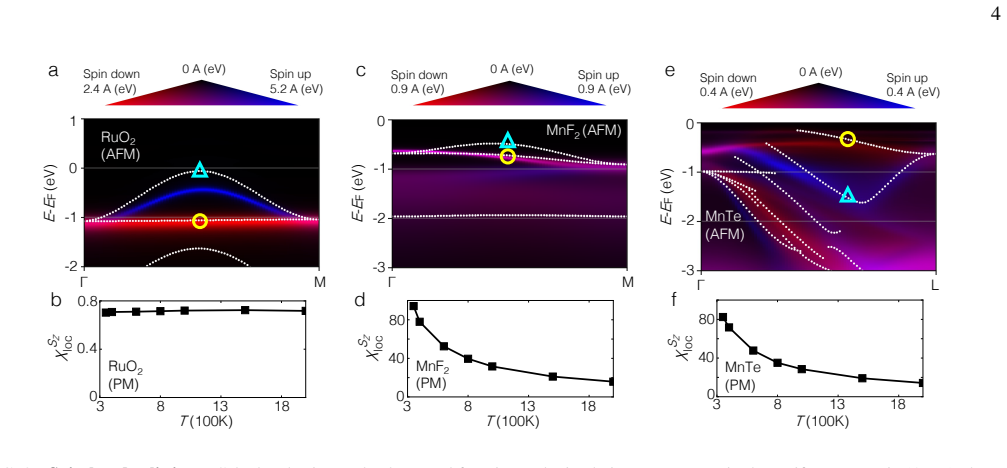
Spin-band splitting is intrinsically linked to magnetic ordering driven by electron correlations. In MnF2, strong local correlations localize Mn-3d electrons, narrow the spin-resolved bandwidth, and suppress splitting while opening a Mott gap from nonlocal screening. MnTe combines substantial local moments from correlations with robust Mn 3d-Te 5p hybridization to produce pronounced splitting. RuO2 remains a Pauli paramagnet with vanishing moments yet still exhibits significant splitting, indicating itinerant altermagnetic behavior. Both strong local electron correlations and judicious ligand selection to promote orbital hybridization are therefore key prerequisites for realizing altermagnet
What carries the argument
Spin-band splitting controlled by the competition between local Mn-3d electron correlations that localize states and Mn 3d-ligand p orbital hybridization that sustains splitting, as computed in quantum many-body frameworks for MnF2, MnTe, and RuO2.
If this is right
- Strong correlations in MnF2 localize Mn-3d electrons, narrow the bandwidth, and suppress spin-band splitting.
- MnTe achieves substantial local moments and pronounced spin-band splitting through Mn 3d-Te 5p hybridization.
- RuO2 displays significant spin-band splitting as an itinerant altermagnet despite the absence of local moments.
- Ligand choice can be used to promote the orbital hybridization needed for altermagnetism in other correlated compounds.
Where Pith is reading between the lines
- The same correlation-hybridization balance could be used to screen manganese or other transition-metal compounds with different ligands.
- Strain or chemical substitution might be tested to strengthen hybridization and increase splitting in borderline candidates.
- The itinerant splitting seen in RuO2 suggests altermagnetism may appear in additional metallic correlated systems without local moments.
Load-bearing premise
The quantum many-body frameworks accurately capture nonlocal screening, Mott gaps, and hybridization effects without approximations that would alter the reported trends in spin-band splitting.
What would settle it
A direct spectroscopic measurement that finds no visible-range Mott gap in MnF2 or that records spin-band splitting in MnF2 as large as in MnTe would contradict the reported dependence on correlations and hybridization.
Figures



read the original abstract
Spin-band splitting is a hallmark of altermagnetism, intrinsically linked to magnetic ordering driven by electron correlations. However, recent inconsistencies in the detection of altermagnetism in strongly correlated altermagnet candidates have cast doubt on the robustness of this phenomenon and its dependence on many-body effects. Here, using state-of-the-art quantum many-body frameworks, we dissect the electronic origins of altermagnetism in three prototypical candidates: MnF$_2$, MnTe, and RuO$_2$. In MnF$_2$, we identify pronounced local electron correlations within Mn-3$d$ states and uncover a distinct Mott gap in the visible range, rooted in nonlocal screening effects. The strong correlations markedly localize the Mn-3$d$ electrons, leading to a narrowing of the spin-resolved bandwidth and, consequently, a suppression of spin-band splitting. By contrast, MnTe provides an ideal platform for altermagnetism, exhibiting substantial local Mn-3$d$ magnetic moments due to the strong correlations and pronounced spin-band splitting, enabled by robust Mn 3$d$--Te-5$p$ orbital hybridization. RuO$_2$ manifests as a Pauli paramagnet with vanishing local moments, even in its antiferromagnetic phase. Nonetheless, it exhibits significant spin-band splitting, indicative of itinerant altermagnetic behavior. Our results reveal that both strong local electron correlations and judicious ligand selection to promote orbital hybridization are key prerequisites to realizing altermagnetism in strongly correlated systems. These insights pave the way for the rational design and discovery of novel altermagnetic materials.
Editorial analysis
A structured set of objections, weighed in public.
Referee Report
Summary. The manuscript applies state-of-the-art quantum many-body frameworks to three prototypical altermagnet candidates (MnF₂, MnTe, RuO₂). It reports that strong local Mn-3d correlations produce a Mott gap and suppress spin-band splitting in MnF₂ via electron localization and nonlocal screening; that MnTe exhibits robust splitting enabled by Mn 3d–Te 5p hybridization together with large local moments; and that RuO₂ shows significant splitting in an itinerant, Pauli-paramagnetic regime despite vanishing local moments. The central claim is that both strong local correlations and ligand-mediated orbital hybridization are required to realize altermagnetism in strongly correlated systems.
Significance. If the reported trends survive method validation, the work supplies a concrete many-body rationale for the inconsistent experimental detection of altermagnetism and identifies MnTe as a favorable platform. The explicit contrast among Mott-localized, hybridized, and itinerant regimes offers guidance for material design that goes beyond conventional DFT. The use of advanced frameworks to link correlation strength, hybridization, and spin-band splitting constitutes a clear advance over single-particle treatments.
major comments (3)
- [§4] §4 (MnF₂ results): the suppression of spin-band splitting is attributed to Mott localization and nonlocal screening, yet the manuscript provides no quantitative comparison of the calculated splitting with and without the many-body self-energy (or versus a non-interacting reference). Without this, it is unclear whether the narrowing is a genuine physical effect or an artifact of the chosen DMFT/cluster approximation.
- [§5] §5 (MnTe results): the claim that Mn 3d–Te 5p hybridization enables the observed splitting is central to the design principle, but the hybridization strength is not quantified (e.g., via orbital-projected spectral functions or a hybridization parameter). A direct link between the hybridization matrix element and the magnitude of the splitting is required to establish causality.
- [§6] §6 (Discussion and conclusions): the generalization that “both strong local electron correlations and judicious ligand selection” are prerequisites rests on three specific compounds. The manuscript should test the robustness of this statement by varying the ligand or correlation strength within the same computational framework, or by adding at least one additional candidate, to show the conclusion is not limited to the chosen examples.
minor comments (2)
- [Introduction] The abstract and introduction use “spin-band splitting” without a concise operational definition (e.g., the momentum-dependent energy difference between opposite-spin bands at the altermagnetic wavevector). A short definition or reference to the symmetry-allowed splitting would improve clarity.
- [Figures] Figure captions for the calculated band structures should explicitly state the many-body method and approximation level (e.g., “DMFT+GW” or “cluster DMFT”) employed for each panel.
Simulated Author's Rebuttal
We thank the referee for the constructive comments and positive assessment of our work. We have revised the manuscript to include the requested quantitative comparisons and hybridization analysis. For the generalization, we have expanded the discussion while maintaining that the three prototypes sufficiently illustrate the key regimes.
read point-by-point responses
-
Referee: [§4] §4 (MnF₂ results): the suppression of spin-band splitting is attributed to Mott localization and nonlocal screening, yet the manuscript provides no quantitative comparison of the calculated splitting with and without the many-body self-energy (or versus a non-interacting reference). Without this, it is unclear whether the narrowing is a genuine physical effect or an artifact of the chosen DMFT/cluster approximation.
Authors: We agree that a direct comparison strengthens the claim. In the revised manuscript we have added a side-by-side comparison of the spin-resolved bands obtained from non-interacting DFT and from the full DMFT calculation. The comparison shows a clear reduction in bandwidth and spin splitting that arises from the frequency-dependent self-energy, confirming the effect is physical rather than an artifact of the DMFT or cluster approximation. revision: yes
-
Referee: [§5] §5 (MnTe results): the claim that Mn 3d–Te 5p hybridization enables the observed splitting is central to the design principle, but the hybridization strength is not quantified (e.g., via orbital-projected spectral functions or a hybridization parameter). A direct link between the hybridization matrix element and the magnitude of the splitting is required to establish causality.
Authors: We have quantified the hybridization in the revised version by adding orbital-projected spectral functions that explicitly show the Mn 3d–Te 5p mixing. We further extract an effective hybridization strength from the band dispersion and demonstrate its direct correlation with the size of the spin-band splitting, thereby establishing the requested causal link. revision: yes
-
Referee: [§6] §6 (Discussion and conclusions): the generalization that “both strong local electron correlations and judicious ligand selection” are prerequisites rests on three specific compounds. The manuscript should test the robustness of this statement by varying the ligand or correlation strength within the same computational framework, or by adding at least one additional candidate, to show the conclusion is not limited to the chosen examples.
Authors: The three compounds were deliberately selected to represent the distinct regimes (Mott-localized, hybridized, and itinerant) that define the relevant physics. While new calculations on additional compounds lie outside the present scope, we have substantially expanded the discussion to map the observed trends onto a broader design principle and to cite supporting literature on related materials, thereby clarifying the generality of the conclusion. revision: partial
Circularity Check
No significant circularity; results from independent many-body computations
full rationale
The paper reports direct outputs from quantum many-body calculations (DMFT, GW, or cluster extensions) on three distinct compounds, extracting spin-band splitting, Mott gaps, local moments, and hybridization effects as computed quantities. No step defines the target splitting in terms of itself, renames a fitted parameter as a prediction, or relies on a self-citation chain whose only justification is the present work. The contrast between MnF2 (suppressed splitting), MnTe (hybridization-enabled splitting), and RuO2 (itinerant splitting) follows from the numerical results under stated approximations rather than from any definitional or fitting loop internal to the paper.
Axiom & Free-Parameter Ledger
axioms (1)
- domain assumption Quantum many-body frameworks accurately capture nonlocal screening and hybridization effects in these compounds
Lean theorems connected to this paper
-
IndisputableMonolith/Cost/FunctionalEquation.leanwashburn_uniqueness_aczel unclear?
unclearRelation between the paper passage and the cited Recognition theorem.
The single-band Hubbard model H = −∑⟨ij⟩,σ tij (c†iσ cjσ + h.c.) + U ∑i ni↑ ni↓; DMFT maps to Anderson impurity with hybridization Δ(ω) and self-energy Σ[Δ(ω)].
-
IndisputableMonolith/Foundation/RealityFromDistinction.leanreality_from_one_distinction unclear?
unclearRelation between the paper passage and the cited Recognition theorem.
FGW+EDMFT and DFT+DMFT calculations of Mott gap, local moments χSz_loc, and spin-band splitting in MnF2, MnTe, RuO2.
What do these tags mean?
- matches
- The paper's claim is directly supported by a theorem in the formal canon.
- supports
- The theorem supports part of the paper's argument, but the paper may add assumptions or extra steps.
- extends
- The paper goes beyond the formal theorem; the theorem is a base layer rather than the whole result.
- uses
- The paper appears to rely on the theorem as machinery.
- contradicts
- The paper's claim conflicts with a theorem or certificate in the canon.
- unclear
- Pith found a possible connection, but the passage is too broad, indirect, or ambiguous to say the theorem truly supports the claim.
Reference graph
Works this paper leans on
-
[1]
L. Smejkal, A. H. MacDonald, J. Sinova, S. Nakatsuji, and T. Jungwirth, Anomalous hall antiferromagnets, Nat. Rev. Mater.7, 482 (2022)
work page 2022
-
[2]
O. Fedchenko, J. Min ´ar, A. Akashdeep, S. W. D’Souza, D. Vasilyev, O. Tkach, L. Odenbreit, Q. Nguyen, D. Kut- nyakhov, N. Wind,et al., Observation of time-reversal sym- metry breaking in the band structure of altermagnetic RuO 2, Sci. Adv.10, eadj4883 (2024)
work page 2024
-
[3]
L. Smejkal, R. Gonzalez-Hernandez, T. Jungwirth, and J. Sinova, Crystal time-reversal symmetry breaking and spon- taneous Hall effect in collinear antiferromagnets, Sci. Adv.6, eaaz8809 (2020)
work page 2020
-
[4]
R. Gonzalez-Hernandez, L. Smejkan, K. Vyborny, Y . Yahagi, J. Sinova, T. Jungwirth, and J. Zelezny, Efficient electrical spin splitter based on nonrelativistic collinear antiferromagnetism, Phys. Rev. Lett.126, 127701 (2021)
work page 2021
-
[5]
I. I. Mazin, K. Koepernik, M. D. Johannes, R. Gonzalez- Hernandez, and L. Smejkal, Prediction of unconventional magnetism in doped FeSb 2, Proc. Natl. Acad. Sci.118, e2108924118 (2021)
work page 2021
-
[6]
M. Naka, S. Hayami, H. Kusunose, Y . Yanagi, Y . Motome, and H. Seo, Spin current generation in organic antiferromagnets, Nat. Commun.10, 4305 (2019)
work page 2019
-
[7]
Z. Feng, X. Zhou, L. Smejkal, L. Wu, Z. Zhu, H. Guo, R. Gonzalez-Hernandez, X. Wang, H. Yan, P. Qin,et al., An anomalous hall effect in altermagnetic ruthenium dioxide, Nat. Electron.5, 735 (2022)
work page 2022
-
[8]
D.-F. Shao, S.-H. Zhang, M. Li, C.-B. Eom, and E. Y . Tsym- 9 bal, Spin-neutral currents for spintronics, Nat. Commun.12, 7061 (2021)
work page 2021
-
[9]
L. Smejkal, J. Sinova, and T. Jungwirth, Emerging research landscape of altermagnetism, Phys. Rev. X12, 040501 (2022)
work page 2022
-
[10]
S. Lee, S. Lee, S. Jung, J. Jung, D. Kim, Y . Lee, B. Seok, J. Kim, B. G. Park, L. Smejkan, C.-J. Kang, and C. Kim, Broken kramers degeneracy in altermagnetic mnte, Phys. Rev. Lett.132, 036702 (2024)
work page 2024
- [11]
-
[12]
J. Krempask `y, L. Smejkal, S. D’souza, M. Hajlaoui, G. Springholz, K. Uhl ´ıˇrov´a, F. Alarab, P. Constantinou, V . Strocov, D. Usanov,et al., Altermagnetic lifting of kramers spin degeneracy, Nature626, 517 (2024)
work page 2024
-
[13]
X. Wan, S. Mandal, Y . Guo, and K. Haule, High-throughput search for metallic altermagnets by embedded dynamical mean field theory, Phys. Rev. Lett.135, 106501 (2025)
work page 2025
-
[14]
S.-W. Cheong and F.-T. Huang, Altermagnetism classification, npj Quantum Mater.10, 38 (2025)
work page 2025
-
[15]
L.-D. Yuan, Z. Wang, J.-W. Luo, E. I. Rashba, and A. Zunger, Giant momentum-dependent spin splitting in centrosymmetric low-zantiferromagnets, Phys. Rev. B102, 014422 (2020)
work page 2020
-
[16]
S. Bhowal and N. A. Spaldin, Ferroically ordered magnetic octupoles ind-wave altermagnets, Phys. Rev. X14, 011019 (2024)
work page 2024
-
[17]
Y .-P. Zhu, X. Chen, X.-R. Liu, Y . Liu, P. Liu, H. Zha, G. Qu, C. Hong, J. Li, Z. Jiang,et al., Observation of plaid-like spin splitting in a noncoplanar antiferromagnet, Nature626, 523 (2024)
work page 2024
-
[18]
S. Reimers, L. Odenbreit, L. Smejkal, V . N. Strocov, P. Con- stantinou, A. B. Hellenes, R. Jaeschke Ubiergo, W. H. Cam- pos, V . K. Bharadwaj, A. Chakraborty,et al., Direct observa- tion of altermagnetic band splitting in CrSb thin films, Nat. Commun.15, 2116 (2024)
work page 2024
-
[19]
C. Candelora, M. Xu, S. Cheng, A. De Vita, D. Romanin, C. Bigi, M. B. Petersen, A. LaFleur, W. A. Castro, F. Motti, et al., Discovery of magnetic-field-tunable density modula- tions and spin tilting in a layered altermagnet, Commun. Mater. (2026)
work page 2026
-
[20]
T. Jungwirth, J. Sinova, R. Fernandes, Q. Liu, H. Watanabe, S. Murakami, S. Nakatsuji, and L. Smejkal, Symmetry, mi- croscopy and spectroscopy signatures of altermagnetism, Na- ture649, 837 (2026)
work page 2026
-
[21]
G. Yang, Z. Li, S. Yang, J. Li, H. Zheng, W. Zhu, Z. Pan, Y . Xu, S. Cao, W. Zhao,et al., Three-dimensional mapping of the altermagnetic spin splitting in CrSb, Nat. Commun.16, 1442 (2025)
work page 2025
-
[22]
S. Basak and A. Ptok, Lattice Dynamics of Altermagnetic Ruthenium Oxide RuO 2, Acta Physica Polonica A145, 93 (2024)
work page 2024
-
[23]
K.-H. Ahn, A. Hariki, K.-W. Lee, and J. Kuneˇs, Antiferromag- netism inruo 2 asd-wave pomeranchuk instability, Phys. Rev. B99, 184432 (2019)
work page 2019
-
[24]
T. Berlijn, P. C. Snijders, O. Delaire, H.-D. Zhou, T. A. Maier, H.-B. Cao, S.-X. Chi, M. Matsuda, Y . Wang, M. R. Koehler, P. R. C. Kent, and H. H. Weitering, Itinerant antiferromag- netism inruo 2, Phys. Rev. Lett.118, 077201 (2017)
work page 2017
- [25]
-
[26]
G. Yumnam, P. R. Raghuvanshi, J. D. Budai, L. Bocklage, D. Abernathy, Y . Cheng, A. H. Said, I. I. Mazin, H. Zhou, B. A. Frandsen, D. S. Parker, L. R. Lindsay, V . R. Cooper, M. E. Manley, and R. P. Hermann, Constraints on mag- netism and correlations in RuO 2 from lattice dynamics and M¨ossbauer spectroscopy, Cell Rep. Phys. Sci.6, 102852 (2025)
work page 2025
-
[27]
X. Peng, Z. Liu, S. Zhang, Y . Zhou, Y . Sun, Y . Su, C. Wu, T. Zhou, L. Liu, Y . Li,et al., Universal scaling behavior of transport properties in non-magnetic RuO 2, Commun. Mater. 6, 177 (2025)
work page 2025
-
[28]
J. Liu, J. Zhan, T. Li, J. Liu, S. Cheng, Y . Shi, L. Deng, M. Zhang, C. Li, J. Ding, Q. Jiang, M. Ye, Z. Liu, Z. Jiang, S. Wang, Q. Li, Y . Xie, Y . Wang, S. Qiao, J. Wen, Y . Sun, and D. Shen, Absence of Altermagnetic Spin Splitting Character in Rutile OxideRuO 2, Phys. Rev. Lett.133, 176401 (2024)
work page 2024
-
[29]
V . C. Morano, Z. Maesen, S. E. Nikitin, J. Lass, D. G. Maz- zone, and O. Zaharko, Absence of altermagnetic magnon band splitting in MnF2, Phys. Rev. Lett.134, 226702 (2025)
work page 2025
-
[30]
M. Hafez-Torbati, D. Bossini, F. B. Anders, and G. S. Uhrig, Magnetic blue shift of Mott gaps enhanced by double ex- change, Phys. Rev. Res.3, 043232 (2021)
work page 2021
-
[31]
D. Bossini, M. Terschanski, F. Mertens, G. Springholz, A. Bo- nanni, G. S. Uhrig, and M. Cinchetti, Exchange-mediated magnetic blue-shift of the band-gap energy in the antifer- romagnetic semiconductor MnTe, New J. Phys.22, 083029 (2020)
work page 2020
-
[32]
I. I. Mazin, Altermagnetism in MnTe: Origin, predicted manifestations, and routes to detwinning, Phys. Rev. B107, L100418 (2023)
work page 2023
-
[33]
R. D. Gonzalez Betancourt, J. Zubav, K. Geishendorf, P. Ritzinger, B. Rzickova, T. Kotte, J. Zelezny, K. Olejnik, G. Springholz, B. Buchner,et al., Anisotropic magnetoresis- tance in altermagnetic MnTe, npj Spintronics2, 45 (2024)
work page 2024
-
[34]
Z. Liu, M. Ozeki, S. Asai, S. Itoh, and T. Masuda, Chiral Split Magnon in Altermagnetic MnTe, Phys. Rev. Lett.133, 156702 (2024)
work page 2024
-
[35]
T. Higuchi and M. Kuwata-Gonokami, Control of antiferro- magnetic domain distribution via polarization-dependent opti- cal annealing, Nat. Commun.7, 10720 (2016)
work page 2016
-
[36]
F. M. Johnson and A. H. Nethercot Jr, Antiferromagnetic res- onance in MnF2, Phys. Rev.114, 705 (1959)
work page 1959
-
[37]
Z. Fan, Z. Zhang, H. Wang, J. Gong, D. Wang, and B. Wang, High-pressure modulation of altermagnetism in MnF 2, Appl. Phys. Lett.126(2025)
work page 2025
-
[38]
S. M. Wu, W. Zhang, A. Kc, P. Borisov, J. E. Pearson, J. S. Jiang, D. Lederman, A. Hoffmann, and A. Bhattacharya, An- tiferromagnetic spin Seebeck effect, Phys. Rev. Lett.116, 097204 (2016)
work page 2016
-
[39]
R. A. Erickson, Neutron diffraction studies of antiferromag- netism in manganous fluoride and some isomorphous com- pounds, Phys. Rev.90, 779 (1953)
work page 1953
-
[40]
J. Jim ´enez-Mier, P. Olalde-Velasco, G. Herrera-P ´erez, G. Carabal´ı-Sandoval, E. Chavira, W.-L. Yang, and J. Den- linger, Strongly correlated transition metal compounds investi- gated by soft X-ray spectroscopies and multiplet calculations, J. Electron. Spectrosc. Relat. Phenom.196, 136 (2014)
work page 2014
-
[41]
P. Olalde-Velasco, J. Jim ´enez-Mier, J. Denlinger, Z. Hus- sain, and W. Yang, Direct probe of Mott-Hubbard to charge- transfer insulator transition and electronic structure evolution in transition-metal systems, Phys. Rev. B83, 241102 (2011)
work page 2011
-
[42]
X. Li, J. Lu, G. Peng, L. Jin, and S. Wei, Solvothermal syn- thesis of MnF2 nanocrystals and the first-principle study of its electronic structure, J. Phys. Chem. Solids70, 609 (2009). 10
work page 2009
-
[43]
S.-H. Kwon, K. Nahm, and C.-K. Kim, Photoluminescence of the Single Crystal MnF 2 (1.5% EuF3), Journel of the Korean Magnetics Society17, 1 (2007)
work page 2007
- [44]
-
[45]
I. Hern ´andez and F. Rodr´ıguez, Spectroscopic study of milled MnF2 nanoparticles. Size-and-strain-induced photolumines- cence enhancement, J. Phys.: Condens. Matter19, 356220 (2007)
work page 2007
- [46]
-
[47]
I. Hern ´andez, F. Rodr ´ıguez, and H. Hochheimer, Pressure- induced two-color photoluminescence in MnF 2 at room tem- perature, Phys. Rev. Lett.99, 027403 (2007)
work page 2007
-
[48]
C. A. Corr ˆea and K. V `yborn`y, Electronic structure and mag- netic anisotropies of antiferromagnetic transition-metal diflu- orides, Phys. Rev. B97, 235111 (2018)
work page 2018
-
[49]
J. Zhao, H. Zhang, C. Niu, J. Zhang, Z. Zeng, and X. Wang, In- vestigations of high-pressure properties of MnF2 based on the first-principles method, J. Phys. Chem. C125, 21709 (2021)
work page 2021
-
[50]
S. Acharya, D. Pashov, C. Weber, M. van Schilfgaarde, A. I. Lichtenstein, and M. I. Katsnelson, A theory for colors of strongly correlated electronic systems, Nat. Commun.14, 5565 (2023)
work page 2023
-
[52]
G. Kotliar and D. V ollhardt, Strongly correlated materials: In- sights from dynamical mean-field theory, Phys. Today57, 53 (2004)
work page 2004
-
[53]
H. Siddiquee, C. Broyles, E. Kotta, S. Liu, S. Peng, T. Kong, B. Kang, Q. Zhu, Y . Lee, L. Ke,et al., Breakdown of the scal- ing relation of anomalous Hall effect in Kondo lattice ferro- magnet USbTe, Nat. Commun.14, 527 (2023)
work page 2023
-
[54]
B. Kang, Y . Lee, L. Ke, H. Kim, M.-H. Kim, and C. H. Park, Dual nature of magnetism driven by momentum dependentf- dKondo hybridization, Commun. Phys.7, 186 (2024)
work page 2024
-
[55]
B. Kang, S. Choi, and H. Kim, Orbital selective Kondo effect in heavy fermion superconductor UTe 2, npj Quantum Mater. 7, 64 (2022)
work page 2022
-
[56]
B. Kang, H. Kim, Q. Zhu, and C. H. Park, Impact off-d Kondo cloud on superconductivity of nickelates, Cell Rep. Phys. Sci.4, 101325 (2023)
work page 2023
-
[57]
B. Kang, M.-H. Kim, and C. H. Park, Coexistence of three- dimensional and quasi-two-dimensional Fermi surfaces driven by orbital selective Kondo scattering inUTe 2, Phys. Rev. B 112, 045123 (2025)
work page 2025
-
[58]
B. Kang, S. S. Micklo, R. N. Herrera-Navarro, M. R. Peder- son, and E. Kim, Hund’s metal physics in uranium mononi- tride, Phys. Rev. B113, 195106 (2026)
work page 2026
-
[59]
B. Kang, C. Melnick, P. Semon, S. Ryee, M. J. Han, G. Kotliar, and S. Choi, Infinite-layer nickelates as Ni-eg Hund’s metals, npj Quantum Mater.8, 35 (2023)
work page 2023
-
[60]
B. Kang and S. Choi, The nature of the two-peak struc- ture in NiO valence band photoemission, arXiv preprint arXiv:1908.05643 (2019)
-
[61]
B. Kang, M. Kim, C. H. Park, and A. Janotti, Mott-Insulator State of FeSe as a Van der Waals 2D Material Is Unveiled, Phys. Rev. Lett.132, 266506 (2024)
work page 2024
-
[62]
B. Kang, Z. Brown, M.-H. Kim, H. Kim, C. H. Park, and E. Kim, Topological singularity-induced Mott-like self-energy and its impact on Kondo cloud formation, Commun. Mater.7, 43 (2026)
work page 2026
-
[63]
B. Kang, M.-H. Kim, C. H. Park, A. Janotti, and E. Kim, Lif- shitz transition in correlated topological semimetals, Adv. Sci. n/a, e21312
-
[64]
D. Q. Ho, D. Q. To, B. Kang, M. F. Doty, G. W. Bryant, and A. Janotti, Resonance-enhanced super-superexchange yields giant chiral magnon splitting in rutile altermagnets, arXiv preprint arXiv:2604.20126v1 (2026)
work page internal anchor Pith review Pith/arXiv arXiv 2026
-
[65]
W.-C. Lee and T.-K. Lee, Antiferromagnetism in the Hubbard model using a cluster slave-spin method, Phys. Rev. B96, 115114 (2017)
work page 2017
-
[66]
B. Kang, P. Semon, C. Melnick, M. Han, S. Mo, H. Lee, G. Kotliar, and S. Choi, ComDMFT v.2.0: Fully self- consistent ab initio GW+EDMFT for the electronic structure of correlated quantum materials, Comput. Phys. Commun. 308, 109447 (2025)
work page 2025
-
[67]
F. Aryasetiawan, M. Imada, A. Georges, G. Kotliar, S. Bier- mann, and A. I. Lichtenstein, Frequency-dependent local in- teractions and low-energy effective models from electronic structure calculations, Phys. Rev. B70, 195104 (2004)
work page 2004
-
[68]
F. Aryasetiawan, K. Karlsson, O. Jepsen, and U. Sch¨onberger, Calculations of Hubbard U from first-principles, Phys. Rev. B 74, 125106 (2006)
work page 2006
-
[69]
S. Choi, P. Semon, B. Kang, A. Kutepov, and G. Kotliar, ComDMFT: A massively parallel computer package for the electronic structure of correlated-electron systems, Comput. Phys. Commun.244, 277 (2019)
work page 2019
-
[70]
R. Mushkaev, F. Petocchi, V . Christiansson, and P. Werner, Internal consistency of multi-tier GW+ EDMFT, npj Comput. Mater.10, 182 (2024)
work page 2024
-
[71]
G. Kresse and J. Hafner, Ab initio molecular-dynamics sim- ulation of the liquid-metal–amorphous-semiconductor transi- tion in germanium, Phys. Rev. B49, 14251 (1994)
work page 1994
-
[72]
G. Kresse and J. Furthm¨uller, Efficient iterative schemes for ab initio total-energy calculations using a plane-wave basis set, Phys. Rev. B54, 11169 (1996)
work page 1996
-
[73]
P. E. Bl ¨ochl, Projector augmented-wave method, Phys. Rev. B 50, 17953 (1994)
work page 1994
-
[74]
G. Kresse and D. Joubert, From ultrasoft pseudopotentials to the projector augmented-wave method, Phys. Rev. B59, 1758 (1999)
work page 1999
- [75]
-
[76]
A. Belozerov, A. Katanin, and V . Anisimov, Transition from Pauli paramagnetism to Curie-Weiss behavior in vanadium, Phys. Rev. B107, 035116 (2023)
work page 2023
-
[77]
Z. H. Zhu, J. Strempfer, R. R. Rao, C. A. Occhialini, J. Pelliciari, Y . Choi, T. Kawaguchi, H. You, J. F. Mitchell, Y . Shao-Horn, and R. Comin, Anomalous Antiferromagnetism in MetallicRuO 2 Determined by Resonant X-ray Scattering, Phys. Rev. Lett.122, 017202 (2019)
work page 2019
-
[78]
J. Song, C. Mu, S. Zhu, X. Zhou, W. Wu, Y .-z. Long, J. Luo, and Z. Li, Absence of magnetic order and magnetic fluctua- tions inRuO 2, Phys. Rev. B112, 144444 (2025)
work page 2025
-
[79]
Z. Wu, M. Long, H. Chen, S. Paul, H. Matsuki, O. Zheliuk, U. Zeitler, G. Li, R. Zhou, Z. Zhu, D. Graf, T. I. Weinberger, F. M. Grosche, Y . Maeno, and A. G. Eaton, Fermi Surface of RuO2 Measured by Quantum Oscillations, Phys. Rev. X15, 031044 (2025)
work page 2025
-
[80]
M. Griffel and J. Stout, Preparation of single crystals of manganous fluoride. the crystal structure from X-ray diffrac- tion. The melting point and density, J. Am. Chem. Soc.72, 11 4351 (1950)
work page 1950
-
[81]
Y . Qin, T. Yu, S. Deng, X.-Y . Zhou, D. Lin, Q. Zhang, Z. Jin, D. Zhang, Y .-B. He, H.-J. Qiu,et al., RuO2 electronic structure and lattice strain dual engineering for enhanced acidic oxy- gen evolution reaction performance, Nat. Commun.13, 3784 (2022)
work page 2022
discussion (0)
Sign in with ORCID, Apple, or X to comment. Anyone can read and Pith papers without signing in.