Recognition: 1 theorem link
· Lean TheoremMulti-mode Photonic Time Crystals Based on Time-Modulated Metasurface Waveguides
Pith reviewed 2026-05-15 02:32 UTC · model grok-4.3
The pith
Time modulation of metasurface waveguides creates tilted intermodal band gaps in photonic time crystals, controllable by modulation phase.
A machine-rendered reading of the paper's core claim, the machinery that carries it, and where it could break.
Core claim
An impenetrable metasurface waveguide under temporal modulation forms a multimode photonic time crystal in which intramodal band gaps arise from same-branch coupling while tilted intermodal band gaps arise from coupling between distinct guided-mode branches; the latter gaps are not restricted to half the modulation frequency, support directional amplification inside the gap, and can be selectively suppressed or enhanced by choosing the modulation phase difference to enforce or break temporal glide symmetry between modes of like or unlike symmetry.
What carries the argument
Temporal modulation of the metasurface waveguide, which induces coupling between guided-mode branches to open tilted intermodal band gaps, with the relative phase of the modulation acting as the symmetry-control parameter via temporal glide symmetry.
If this is right
- Intermodal band gaps appear at frequencies other than half the modulation frequency.
- Directional amplification occurs with net power flow along the guide even within the gap.
- Temporal glide symmetry selectively suppresses or enhances gap formation according to mode symmetry.
- The platform supplies a simpler experimental path to tilted gaps than volumetric dispersive realizations.
Where Pith is reading between the lines
- The phase-control mechanism could be combined with spatial modulation to create hybrid space-time crystals with tunable directionality.
- Higher-order volume modes open routes to multi-frequency parametric processes not accessible in single-mode systems.
- Microwave-frequency prototypes could test the directional amplification before optical scaling.
- Symmetry-selective gap control may connect to topological features in time-varying media.
Load-bearing premise
The metasurface waveguide stays impenetrable and continues to support the assumed guided surface and higher-order volume modes under time modulation without losses or fabrication flaws that would close the intermodal gaps.
What would settle it
Direct measurement showing energy propagating along the waveguide direction inside a predicted intermodal band gap, or experimental demonstration that a specific modulation phase difference closes a gap between same-symmetry modes while opening one between different-symmetry modes.
Figures




read the original abstract
Photonic time crystals are electromagnetic media with periodically time-varying parameters, enabling momentum band gaps, parametric amplification, and frequency conversion beyond what is possible in time-invariant systems. So far, they have been explored mainly in single-mode systems, which limits the range of accessible physical phenomena. Here, we introduce an impenetrable metasurface waveguide as a multimode time-varying platform supporting both guided surface modes and higher-order guided volume modes. We show that temporal modulation in this platform gives rise not only to conventional intramodal band gaps associated with same-branch coupling, but also to tilted intermodal band gaps originating from coupling between different guided-mode branches. Unlike intramodal band gaps, these intermodal band gaps are not restricted to half the modulation frequency and can enable directional wave amplification, where the amplified field carries energy along the waveguide even inside the band gap. We further show that the modulation phase difference provides an effective symmetry-control parameter: by exploiting temporal glide symmetry, one can selectively suppress or enhance gap opening for interactions between modes of the same or different symmetry. These results establish a versatile multimode platform for photonic time crystals, offering one of the simplest and most experimentally accessible routes to tilted band gaps compared with volumetric dispersive PTC implementations and, more broadly, opening new opportunities for time-varying electromagnetic systems.
Editorial analysis
A structured set of objections, weighed in public.
Referee Report
Summary. The manuscript introduces an impenetrable metasurface waveguide as a multimode platform for photonic time crystals supporting both guided surface modes and higher-order volume modes. Temporal modulation produces conventional intramodal band gaps from same-branch coupling as well as tilted intermodal band gaps from coupling between different guided-mode branches; the latter are not restricted to half the modulation frequency and enable directional amplification inside the gap. The modulation phase difference is shown to act as a symmetry-control parameter via temporal glide symmetry, allowing selective suppression or enhancement of gap opening for modes of the same or different symmetry.
Significance. If the numerical and analytical results hold, the work establishes a versatile and experimentally accessible multimode platform for photonic time crystals that realizes tilted band gaps without requiring volumetric dispersive media. The symmetry-control mechanism and directional amplification inside intermodal gaps open new routes for controlling parametric amplification and frequency conversion in time-varying systems.
major comments (2)
- [§3.2, Eq. (11)] §3.2, Eq. (11): the claim that intermodal gaps are tilted and not restricted to half the modulation frequency rests on the Floquet-mode coupling matrix; however, the explicit dependence of the gap tilt angle on the modulation frequency and wavevector mismatch is shown only numerically, without a closed-form expression that would confirm the tilt is a general consequence of inter-branch coupling rather than a parameter-specific feature.
- [§2.1] §2.1: the assumption that the metasurface waveguide remains impenetrable and continues to support the assumed guided surface and volume modes under time modulation is stated without quantitative bounds on the modulation amplitude that would keep radiation losses or mode leakage below the gap size; this is load-bearing for the existence of both intra- and intermodal gaps.
minor comments (2)
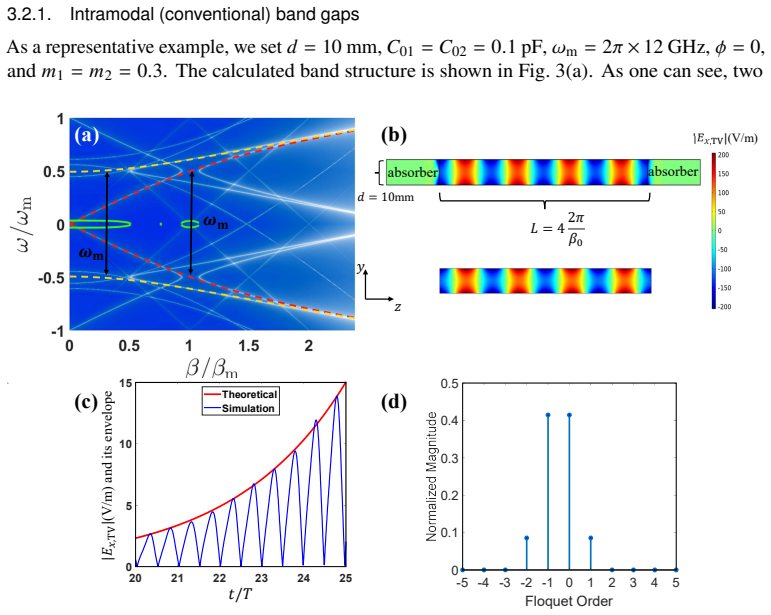
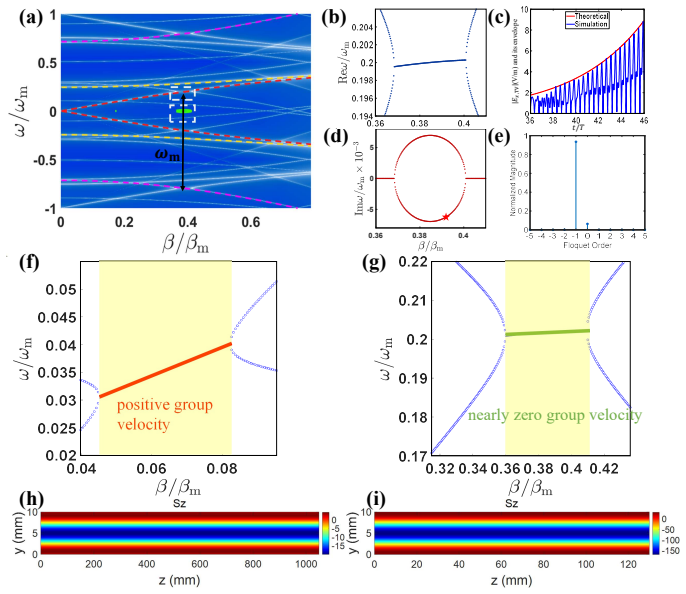
- [Figure 3] Figure 3 caption: the dispersion diagrams lack explicit labeling of the modulation frequency axis in normalized units, making direct comparison of intra- versus intermodal gap locations difficult.
- [Abstract] The abstract states the platform offers 'one of the simplest' routes; this comparative claim should be supported by a brief reference to prior volumetric PTC implementations in the introduction.
Simulated Author's Rebuttal
We thank the referee for the careful reading and constructive comments. We address each major point below and have revised the manuscript to strengthen the presentation where appropriate.
read point-by-point responses
-
Referee: [§3.2, Eq. (11)] §3.2, Eq. (11): the claim that intermodal gaps are tilted and not restricted to half the modulation frequency rests on the Floquet-mode coupling matrix; however, the explicit dependence of the gap tilt angle on the modulation frequency and wavevector mismatch is shown only numerically, without a closed-form expression that would confirm the tilt is a general consequence of inter-branch coupling rather than a parameter-specific feature.
Authors: We agree that an explicit analytical expression would better demonstrate the generality of the tilt. In the revised manuscript we derive, from the off-diagonal elements of the Floquet coupling matrix, an approximate closed-form relation for the gap tilt angle: tan θ ≈ (Δk / 2ω_m) ⋅ (κ_{12}/κ_{11}), where Δk is the wavevector mismatch between the two branches, ω_m the modulation frequency, and κ_{ij} the coupling coefficients. This relation shows that the tilt is a direct and general consequence of inter-branch coupling whenever the modulation does not exactly compensate the frequency difference. The original numerical results are now supplemented by this derivation in §3.2. revision: yes
-
Referee: [§2.1] §2.1: the assumption that the metasurface waveguide remains impenetrable and continues to support the assumed guided surface and volume modes under time modulation is stated without quantitative bounds on the modulation amplitude that would keep radiation losses or mode leakage below the gap size; this is load-bearing for the existence of both intra- and intermodal gaps.
Authors: We acknowledge that quantitative bounds on the modulation amplitude are necessary to justify the impenetrable-waveguide approximation. In the revised §2.1 we add a perturbative estimate showing that radiation loss remains smaller than the gap width provided the relative modulation depth satisfies δϵ/ϵ_0 ≲ 0.12 for the frequencies and wavevectors examined. We further include a short numerical check confirming that the guided-mode profiles persist with negligible leakage inside this range, thereby supporting the validity of both intra- and intermodal gap calculations. revision: yes
Circularity Check
No significant circularity detected
full rationale
The derivation relies on standard time-periodic Maxwell equations and Floquet-mode coupling to predict intramodal and tilted intermodal band gaps in a multimode metasurface waveguide. No parameters are fitted to the target gaps themselves, no self-citations form a load-bearing chain, and no uniqueness theorems or ansatzes are smuggled in. The symmetry-control via modulation phase difference follows directly from the assumed guided modes without reducing the claimed gaps to inputs defined by the result. The platform description is self-contained against external benchmarks of time-varying electromagnetics.
Axiom & Free-Parameter Ledger
free parameters (2)
- modulation amplitude and frequency
- modulation phase difference
axioms (2)
- standard math Maxwell's equations with time-periodic material parameters govern the fields
- domain assumption The metasurface waveguide supports distinct guided surface and higher-order volume modes
Lean theorems connected to this paper
-
IndisputableMonolith/Foundation/ArithmeticFromLogic.lean (LogicNat orbit, 8-tick implied periodicity) and Cost/FunctionalEquation.lean (J-cost uniqueness)reality_from_one_distinction; washburn_uniqueness_aczel unclear?
unclearRelation between the paper passage and the cited Recognition theorem.
temporal modulation ... gives rise not only to conventional intramodal band gaps ... but also to tilted intermodal band gaps ... modulation phase difference provides an effective symmetry-control parameter: by exploiting temporal glide symmetry
What do these tags mean?
- matches
- The paper's claim is directly supported by a theorem in the formal canon.
- supports
- The theorem supports part of the paper's argument, but the paper may add assumptions or extra steps.
- extends
- The paper goes beyond the formal theorem; the theorem is a base layer rather than the whole result.
- uses
- The paper appears to rely on the theorem as machinery.
- contradicts
- The paper's claim conflicts with a theorem or certificate in the canon.
- unclear
- Pith found a possible connection, but the passage is too broad, indirect, or ambiguous to say the theorem truly supports the claim.
Reference graph
Works this paper leans on
-
[1]
Metamaterials with high degrees of freedom: space, time, and more,
N. Engheta, “Metamaterials with high degrees of freedom: space, time, and more,” Nanophotonics10, 639–642 (2020)
work page 2020
-
[2]
Z. Hayran and F. Monticone, “Using time-varying systems to challenge fundamental limitations in electromagnetics: Overview and summary of applications,” IEEE Antennas Propag. Mag.65, 29–38 (2023)
work page 2023
-
[3]
V. Pacheco-Peña and N. Engheta, “Temporal aiming,” Light. Sci. & Appl.9, 129 (2020)
work page 2020
-
[4]
Antireflection temporal coatings,
V. Pacheco-Peña and N. Engheta, “Antireflection temporal coatings,” Optica7, 323–331 (2020)
work page 2020
-
[5]
Temporal interface in dispersive hyperbolic media,
G. Ptitcyn, D. M. Solís, M. S. Mirmoosa, and N. Engheta, “Temporal interface in dispersive hyperbolic media,” Nanophotonics (2025)
work page 2025
-
[6]
Temporal photonic crystals with modulations of both permittivity and permeability,
J. S. Martínez-Romero, O. Becerra-Fuentes, and P. Halevi, “Temporal photonic crystals with modulations of both permittivity and permeability,” Phys. Rev. A93, 063813 (2016)
work page 2016
-
[7]
Photonic floquet media with a complex time-periodic permittivity,
N. Wang, Z.-Q. Zhang, and C. T. Chan, “Photonic floquet media with a complex time-periodic permittivity,” Phys. Rev. B98, 085142 (2018)
work page 2018
-
[8]
Theory and applications of photonic time crystals: a tutorial,
M. M. Asgari, P. Garg, X. Wang,et al., “Theory and applications of photonic time crystals: a tutorial,” Adv. Opt. Photonics16, 958–1063 (2024)
work page 2024
-
[9]
Amplified emission and lasing in photonic time crystals,
M. Lyubarov, Y. Lumer, A. Dikopoltsev,et al., “Amplified emission and lasing in photonic time crystals,” Science 377, 425–428 (2022)
work page 2022
-
[10]
Smith-purcell radiation from time grating,
J.-F. Zhu, A. Nussupbekov, Y. Fan,et al., “Smith-purcell radiation from time grating,” Newton1(2025)
work page 2025
-
[11]
Light emission by free electrons in photonic time-crystals,
A. Dikopoltsev, Y. Sharabi, M. Lyubarov,et al., “Light emission by free electrons in photonic time-crystals,” Proc. National Acad. Sci.119, e2119705119 (2022)
work page 2022
-
[12]
Nonuniform wave momentum band gap in biaxial anisotropic photonic time crystals,
J. Dong, S. Zhang, H. He,et al., “Nonuniform wave momentum band gap in biaxial anisotropic photonic time crystals,” Phys. Rev. Lett.134, 063801 (2025)
work page 2025
-
[13]
M. Ciabattoni, Z. Hayran, and F. Monticone, “Observation of broadband super-absorption of electromagnetic waves through space-time symmetry breaking,” Sci. Adv.11, eads7407 (2025)
work page 2025
-
[14]
Temporal transfer matrix method for lorentzian dispersive time-varying media,
F. Feng, N. Wang, and G. P. Wang, “Temporal transfer matrix method for lorentzian dispersive time-varying media,” Appl. Phys. Lett.124(2024)
work page 2024
-
[15]
Floquet engineering of polaritonic amplification in dispersive photonic time crystals,
M. G. Ozlu, V. Mkhitaryan, C. B. Fruhling,et al., “Floquet engineering of polaritonic amplification in dispersive photonic time crystals,” Phys. Rev. Res.7, 023214 (2025)
work page 2025
-
[16]
Metasurface-based realization of photonic time crystals,
X. Wang, M. S. Mirmoosa, V. S. Asadchy,et al., “Metasurface-based realization of photonic time crystals,” Sci. advances9, eadg7541 (2023)
work page 2023
-
[17]
Expanding momentum bandgaps in photonic time crystals through resonances,
X. Wang, P. Garg, M. Mirmoosa,et al., “Expanding momentum bandgaps in photonic time crystals through resonances,” Nat. Photonics19, 149–155 (2025)
work page 2025
-
[18]
Photonic time crystals assisted by quasi-bound states in the continuum,
P. Garg, E. Almpanis, L. Zimmer,et al., “Photonic time crystals assisted by quasi-bound states in the continuum,” arXiv preprint arXiv:2507.15644 (2025)
-
[19]
Tretyakov,Analytical modeling in applied electromagnetics(Artech House, 2003)
S. Tretyakov,Analytical modeling in applied electromagnetics(Artech House, 2003)
work page 2003
-
[20]
Parallel-plate waveguides formed by penetrable metasurfaces,
X. Ma, M. S. Mirmoosa, and S. A. Tretyakov, “Parallel-plate waveguides formed by penetrable metasurfaces,” IEEE Trans. on Antennas Propag.68, 1773–1785 (2019)
work page 2019
-
[21]
D. M. Pozar,Microwave engineering: theory and techniques(John wiley & sons, 2021)
work page 2021
-
[22]
Temporally-topological defect modes in photonic time crystals,
M. Lin, S. Ahmed, M. Jamil,et al., “Temporally-topological defect modes in photonic time crystals,” Opt. Express 32, 9820–9836 (2024)
work page 2024
-
[23]
An idea of implementing photonic space-time crystals using metasurfaces,
O. Shahriar and M. Mahdy, “An idea of implementing photonic space-time crystals using metasurfaces,” arXiv preprint arXiv:2409.00139 (2024)
-
[24]
Electrically tunable space–time metasurfaces at optical frequencies,
J. Sisler, P. Thureja, M. Y. Grajower,et al., “Electrically tunable space–time metasurfaces at optical frequencies,” Nat. Nanotechnol.19, 1491–1498 (2024)
work page 2024
-
[25]
Space-time metallic metasurfaces for frequency conversion and beamforming,
S. Moreno-Rodríguez, A. Alex-Amor, P. Padilla,et al., “Space-time metallic metasurfaces for frequency conversion and beamforming,” Phys. Rev. Appl.21, 064018 (2024)
work page 2024
-
[26]
Photonics of time-varying media,
E. Galiffi, R. Tirole, S. Yin,et al., “Photonics of time-varying media,” Adv. Photonics4, 014002–014002 (2022)
work page 2022
-
[27]
Tutorial on the conservation of momentum in photonic time-varying media,
A. Ortega-Gomez, M. Lobet, J. E. Vázquez-Lozano, and I. Liberal, “Tutorial on the conservation of momentum in photonic time-varying media,” Opt. Mater. Express13, 1598–1608 (2023)
work page 2023
-
[28]
Photonic time-crystals-fundamental concepts,
E. Lustig, O. Segal, S. Saha,et al., “Photonic time-crystals-fundamental concepts,” Opt. Express31, 9165–9170 (2023)
work page 2023
-
[29]
Topological aspects of photonic time crystals,
E. Lustig, Y. Sharabi, and M. Segev, “Topological aspects of photonic time crystals,” Optica5, 1390–1395 (2018)
work page 2018
-
[30]
Energy transport velocity in photonic time crystals,
K. Lee, Y. Kim, K. W. Kim, and B. Min, “Energy transport velocity in photonic time crystals,” arXiv preprint arXiv:2602.03453 (2026)
-
[31]
J. R. Zurita-Sánchez, P. Halevi, and J. C. Cervantes-González, “Reflection and transmission of a wave incident on a slab with a time-periodic dielectric function𝜀(𝑡),” Phys. Rev. A79, 053821 (2009)
work page 2009
-
[32]
T. Mealy and F. Capolino, “Exceptional points of degeneracy with indirect band gap induced by mixing forward and backward propagating waves,” Phys. Rev. A107, 012214 (2023)
work page 2023
-
[33]
Ultrawidebandmetasurfacelensesbasedonoff-shifted opposite layers,
O.Quevedo-Teruel,M.Ebrahimpouri,andM.NgMouKehn,“Ultrawidebandmetasurfacelensesbasedonoff-shifted opposite layers,” IEEE Antennas Wirel. Propag. Lett.15, 484–487 (2016)
work page 2016
-
[34]
Glide-symmetric lens antenna in gap waveguide technology,
W. Yuan, J. F. Chen, C. Zhang,et al., “Glide-symmetric lens antenna in gap waveguide technology,” IEEE Trans. on Antennas Propag.68, 2612–2620 (2019)
work page 2019
-
[35]
Glide symmetries and their application for electromagnetic periodic structures,
O. Quevedo-Teruel, “Glide symmetries and their application for electromagnetic periodic structures,” in2019 International Symposium on Antennas and Propagation (ISAP),(2019), pp. 1–3
work page 2019
-
[36]
Floquet topological phases protected by time glide symmetry,
T. Morimoto, H. C. Po, and A. Vishwanath, “Floquet topological phases protected by time glide symmetry,” Phys. Rev. B95, 195155 (2017)
work page 2017
-
[37]
Study of parallel-plate waveguides bordered by reactive huygens metasurfaces,
K. Hosseini, H. Younesiraad, and M. Dehmollaian, “Study of parallel-plate waveguides bordered by reactive huygens metasurfaces,” IEEE Trans. on Antennas Propag.71, 3371–3381 (2023)
work page 2023
-
[38]
Space-time-modulated metasurfaces with spatial discretization: Free-space n-path systems,
Z. Wu, C. Scarborough, and A. Grbic, “Space-time-modulated metasurfaces with spatial discretization: Free-space n-path systems,” Phys. Rev. Appl.14, 064060 (2020)
work page 2020
-
[39]
Realization of spatiotemporal photonic crystals based on active metasurface,
X. Ye, Y. G. Wang, J. F. Yao,et al., “Realization of spatiotemporal photonic crystals based on active metasurface,” Laser & Photonics Rev.19, 2401345 (2025)
work page 2025
-
[40]
Emulating faraday rotation with nonmagnetic time-modulated metasurface,
Y. Li, K. Chen, J. Zhao,et al., “Emulating faraday rotation with nonmagnetic time-modulated metasurface,” IEEE Trans. on Microw. Theory Tech. (2025)
work page 2025
-
[41]
Plasmonic metamaterial time crystal,
T. Guo, J. Sueiro, G. M. Andolina,et al., “Plasmonic metamaterial time crystal,” arXiv preprint arXiv:2510.02845 (2025)
-
[42]
Appendix A In the main text, we just consider waveguide formed by two capacitive metasurfaces. Without lossofgenerality,wefurtherconsidertwometasurfaceswithdifferenttypesofimpedancebeyond purely capacitive reactance, including two inductive sheets, one inductive and one capacitive sheet, and two LC resonant sheets in this section. The theory for TE eigenm...
-
[43]
Appendix B This section shows the detailed matrix used in the main text. Equation (10a) can be rewritten as: 𝑒−𝑗 √ 𝜔2 𝑁 𝜖0 𝜇0 −𝛽 2𝑑 0· · ·0 0𝑒 −𝑗 √︃ 𝜔2 𝑁−1 𝜖0 𝜇0 −𝛽 2𝑑 · · · ... ... ... . . . ... 0 0· · ·𝑒 −𝑗 √ 𝜔2 −𝑁 𝜖0 𝜇0 −𝛽 2𝑑 𝐻+, 𝑁 𝐻+, 𝑁−1 ... 𝐻+,−𝑁 + 𝑒 𝑗 √ 𝜔2 𝑁 𝜖0 𝜇0 −𝛽 2𝑑 0· · ·0 0𝑒 𝑗 √...
-
[44]
Appendix C To explain why the band gap is tilted and which parameters are associated with the tilt angle, we then analytically calculate the tilt angle within the framework of temporal coupled mode theory. Webeginbyconsideringaconfigurationwherethedispersivebanddiagramsupportstwo bands, both exhibiting positive group velocity. Under temporal modulation, o...
discussion (0)
Sign in with ORCID, Apple, or X to comment. Anyone can read and Pith papers without signing in.