Recognition: no theorem link
Joint Transmit and Receive Antenna Orientation Design for Secure MIMO Communications
Pith reviewed 2026-05-15 02:12 UTC · model grok-4.3
The pith
Dynamically optimizing rotatable antenna orientations in MIMO systems enhances secrecy rates by reshaping channels to favor legitimate users over eavesdroppers.
A machine-rendered reading of the paper's core claim, the machinery that carries it, and where it could break.
Core claim
By jointly optimizing the transmit beamforming, artificial noise covariance, and the orientations of rotatable antennas at transmitter and receiver, the effective MIMO channels can be reshaped to increase the secrecy rate, with the optimization handled via alternating updates derived from the minimum mean-square error framework and Riemannian Frank-Wolfe method.
What carries the argument
The alternating optimization algorithm that alternates between closed-form solutions for beamforming and AN covariance and Riemannian Frank-Wolfe updates for antenna orientations.
If this is right
- Significant secrecy rate gains are achieved in simulations compared to fixed-orientation schemes.
- The scheme converges rapidly.
- It extends to multi-receiver secure transmission scenarios.
- The approach works for both SISO and general MIMO cases.
Where Pith is reading between the lines
- If hardware for rotatable antennas becomes common in 6G, this could reduce reliance on traditional encryption by enhancing physical layer security.
- The method might be adapted for scenarios with imperfect channel knowledge by incorporating robust optimization.
- Testing in real-world environments with mobility could reveal practical limitations not captured in simulations.
Load-bearing premise
The design assumes the transmitter has perfect knowledge of the channel matrices to both the legitimate receiver and the eavesdropper.
What would settle it
If simulations or real measurements show that the secrecy rate with optimized orientations is no higher than with fixed orientations when using the same power and noise settings, the claimed gains would be falsified.
Figures



read the original abstract
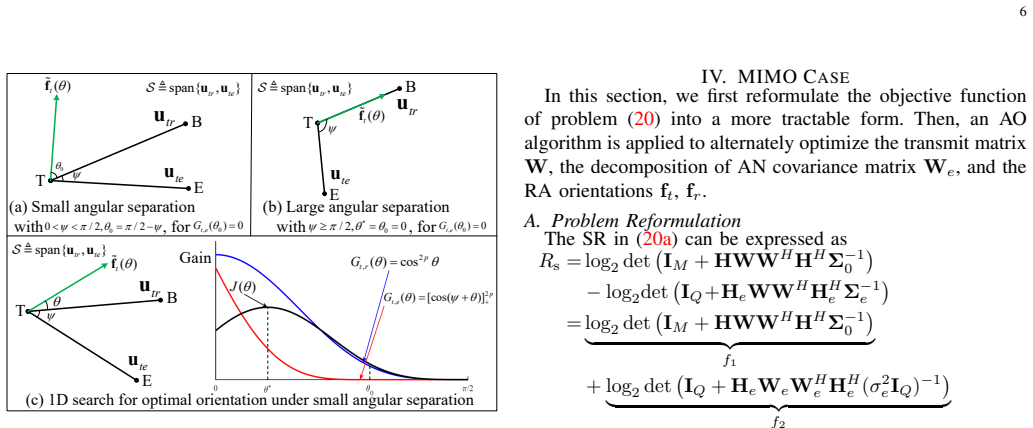
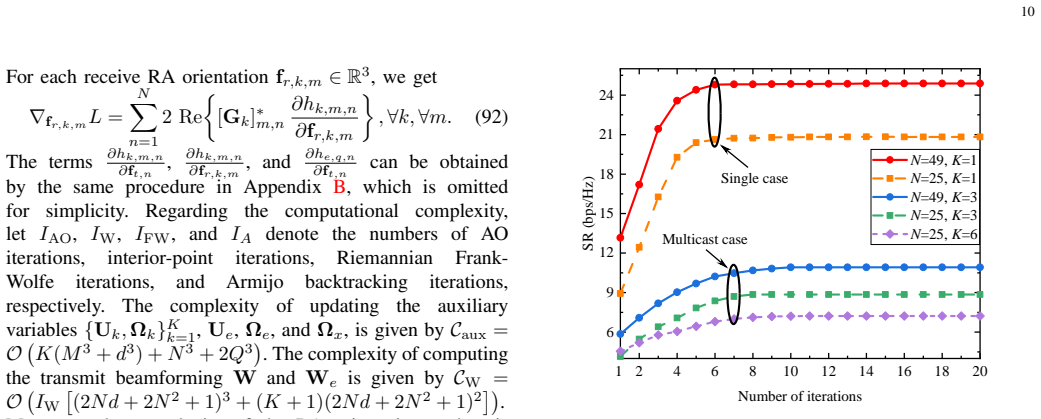
Physical layer security (PLS) is a promising paradigm for safeguarding 6G wireless networks by exploiting the inherent characteristics of wireless channels. However, the efficiency of conventional PLS is often limited by fixed orientation antennas. This paper investigates a rotatable antenna (RA)-aided secure multiple-input multiple-output (MIMO) communication system, where both the transmitter and the receiver are equipped with RAs in the presence of an eavesdropper. By dynamically optimizing the orientations of RAs, we can proactively reshape the effective MIMO channels to enhance legitimate transmission while simultaneously suppressing information leakage to the eavesdropper. We formulate a secrecy rate maximization problem by jointly optimizing the transmit beamforming, artificial noise (AN) covariance matrix, and the transmit/receive RA orientations, subject to the transmit power budget and antenna orientation constraints. To tackle the resulting highly coupled and non-convex problem, we first study a simplified single-input single-output (SISO) case to reveal the structure of the optimal RA orientation. For the general MIMO case, we develop an alternating optimization algorithm by reformulating the original problem through the minimum mean-square error framework. In particular, the transmit beamforming and AN covariance matrix are derived in semi-closed forms, while the RA orientations are updated via the Riemannian Frank-Wolfe method. The proposed design is further extended to the multi-receiver secure transmission scenario. Simulation results show that the proposed scheme converges rapidly and achieves significant secrecy rate gains over the conventional fixed-orientation scheme.
Editorial analysis
A structured set of objections, weighed in public.
Referee Report
Summary. The paper investigates a rotatable antenna (RA)-aided secure MIMO system in which both the transmitter and legitimate receiver employ RAs in the presence of an eavesdropper. It formulates a secrecy-rate maximization problem that jointly optimizes transmit beamforming, artificial-noise covariance, and the RA orientations at both ends, subject to power and orientation constraints. A SISO case is analyzed to reveal the structure of the optimal orientation; the general MIMO case is solved via an alternating optimization that reformulates the objective through the MMSE framework, yielding semi-closed-form expressions for beamforming and AN covariance together with Riemannian Frank-Wolfe updates for the orientations. The algorithm is extended to the multi-receiver setting, and numerical results are presented to illustrate rapid convergence and secrecy-rate gains relative to fixed-orientation baselines.
Significance. If the reported gains hold, the work demonstrates that dynamic RA orientation supplies a useful additional degree of freedom for physical-layer security, allowing the effective MIMO channels to be reshaped so that legitimate singular values are strengthened while leakage is suppressed. The algorithmic approach (MMSE reformulation plus Riemannian optimization) is standard yet applied here in a novel RA context, and the explicit SISO structural result plus the multi-receiver extension are clear contributions. The significance is limited by the idealized channel-knowledge assumptions underlying the simulation claims.
major comments (1)
- [Numerical Results] The secrecy-rate objective and the alternating optimization (MMSE reformulation for beamforming/AN and Riemannian Frank-Wolfe for orientations) are evaluated under the assumption of perfect knowledge of all channel matrices, including the eavesdropper channels H_e and G_e. No robustness term, worst-case formulation, or Monte-Carlo evaluation over CSI estimation error appears in the problem statement or numerical section; because the reported dB gains rely on precise AN null-space alignment and orientation-driven channel reshaping, this assumption is load-bearing for the central simulation claim.
minor comments (1)
- [Abstract] The abstract states that beamforming and AN covariance are derived in 'semi-closed forms,' yet the precise expressions and the conditions under which they hold are not summarized; adding a short statement of the final closed-form expressions would improve readability.
Simulated Author's Rebuttal
We thank the referee for the constructive feedback and for recognizing the algorithmic contributions and the value of the SISO structural result. We address the single major comment below.
read point-by-point responses
-
Referee: [Numerical Results] The secrecy-rate objective and the alternating optimization (MMSE reformulation for beamforming/AN and Riemannian Frank-Wolfe for orientations) are evaluated under the assumption of perfect knowledge of all channel matrices, including the eavesdropper channels H_e and G_e. No robustness term, worst-case formulation, or Monte-Carlo evaluation over CSI estimation error appears in the problem statement or numerical section; because the reported dB gains rely on precise AN null-space alignment and orientation-driven channel reshaping, this assumption is load-bearing for the central simulation claim.
Authors: We agree that the presented results rely on perfect CSI of all links, including the eavesdropper channels. This is the standard modeling choice in the PLS literature when the goal is to characterize the fundamental gains obtainable from a new degree of freedom (here, RA orientation). The MMSE reformulation and Riemannian updates are derived under this assumption, and the numerical gains illustrate the potential improvement when perfect alignment is possible. In the revised manuscript we will (i) explicitly restate the perfect-CSI assumption in Section II and in the caption of the numerical results, (ii) add a short paragraph in the conclusions discussing the sensitivity of the scheme to CSI errors and noting that robust or worst-case extensions constitute a natural follow-up direction, and (iii) include a brief Monte-Carlo experiment under additive Gaussian CSI error to illustrate graceful degradation. These changes clarify the scope of the claims without requiring a complete reformulation of the optimization problem. revision: yes
Circularity Check
No circularity: derivation relies on external MMSE framework and standard alternating optimization
full rationale
The paper formulates a standard secrecy-rate maximization objective and solves it via an alternating algorithm that reformulates the problem through the minimum mean-square error (MMSE) framework, which is an established external technique. Beamforming and AN covariance are derived in semi-closed form, and RA orientations use the Riemannian Frank-Wolfe method; none of these steps reduce by construction to a fitted parameter, self-definition, or self-citation chain. The SISO case is used only to reveal structure, not to force the MIMO result. Simulations report empirical gains under perfect CSI, but the derivation itself remains self-contained against external benchmarks and does not rename or smuggle in prior results as new predictions.
Axiom & Free-Parameter Ledger
axioms (1)
- domain assumption Perfect channel state information of legitimate and eavesdropper links is available at the transmitter.
Reference graph
Works this paper leans on
-
[1]
On the road to 6G: Visions, requirements, key technologies, and testbeds,
C.-X. Wang, X. You, X. Gaoet al., “On the road to 6G: Visions, requirements, key technologies, and testbeds,”IEEE Commun. Surveys & Tuts., vol. 25, no. 2, pp. 905–974, Feb. 2023
work page 2023
-
[2]
Security and privacy for 6G: A survey on prospective technologies and challenges,
V .-L. Nguyen, P.-C. Lin, B.-C. Chenget al., “Security and privacy for 6G: A survey on prospective technologies and challenges,”IEEE Commun. Surveys & Tuts., vol. 23, no. 4, pp. 2384–2428, Aug. 2021
work page 2021
-
[3]
Stallings,Cryptography and Network Security: Principles and Prac- tice
W. Stallings,Cryptography and Network Security: Principles and Prac- tice. New York, NY , USA: Prentice Hall Press, 2010
work page 2010
-
[4]
Physical layer security in wireless networks: A tutorial,
Y .-S. Shiuet al., “Physical layer security in wireless networks: A tutorial,”IEEE Wireless Commun., vol. 18, no. 2, pp. 66–74, Apr. 2011
work page 2011
-
[5]
Secure transmission with multiple antennas I: The MISOME wiretap channel,
A. Khisti and G. W. Wornell, “Secure transmission with multiple antennas I: The MISOME wiretap channel,”IEEE Trans. Inf. Theory, vol. 56, no. 7, pp. 3088–3104, Jun. 2010
work page 2010
-
[6]
Secure beamforming in downlink MISO nonorthogonal multiple access systems,
Y . Li, M. Jiang, Q. Zhang, Q. Li, and J. Qin, “Secure beamforming in downlink MISO nonorthogonal multiple access systems,”IEEE Trans. V eh. Tech., vol. 66, no. 8, pp. 7563–7567, Jan. 2017
work page 2017
-
[7]
Secrecy wireless information and power transfer with MISO beamforming,
L. Liu, R. Zhang, and K.-C. Chua, “Secrecy wireless information and power transfer with MISO beamforming,”IEEE Trans. Signal Process., vol. 62, no. 7, pp. 1850–1863, Jan. 2014
work page 2014
-
[8]
H. Niuet al., “A survey on artificial noise for physical layer security: Opportunities, technologies, guidelines, advances, and trends,”IEEE Commun. Surveys & Tuts, vol. 28, pp. 341–381, Sept. 2025
work page 2025
-
[9]
Power allocation for artificial-noise secure MIMO precoding systems,
S.-H. Tsai and H. V . Poor, “Power allocation for artificial-noise secure MIMO precoding systems,”IEEE Trans. Signal Process., vol. 62, no. 13, pp. 3479–3493, Jun. 2014
work page 2014
-
[10]
P.-H. Lin, S.-H. Lai, S.-C. Linet al., “On secrecy rate of the generalized artificial-noise assisted secure beamforming for wiretap channels,”IEEE J. Sel. Areas Commun., vol. 31, no. 9, pp. 1728–1740, Aug. 2013
work page 2013
-
[11]
Modeling and performance analysis for movable antenna enabled wireless communications,
L. Zhu, W. Ma, and R. Zhang, “Modeling and performance analysis for movable antenna enabled wireless communications,”IEEE Trans. Wireless Commun., vol. 23, no. 6, pp. 6234–6250, Nov. 2023
work page 2023
-
[12]
Movable antenna-enhanced secure communication: Opportunities, challenges, and solutions,
Y . Ma, K. Liu, L. Zhu, Y . Liu, Y . Zhu, and D. B. d. Costa, “Movable antenna-enhanced secure communication: Opportunities, challenges, and solutions,”IEEE Wireless Commun., early access, Jan. 2026
work page 2026
-
[13]
Movable antennas-assisted secure transmission without eavesdroppers’ instantaneous CSI,
G. Hu, Q. Wuet al., “Movable antennas-assisted secure transmission without eavesdroppers’ instantaneous CSI,”IEEE Trans. Mobile Com- put., vol. 23, no. 12, pp. 14 263–14 279, Aug. 2024
work page 2024
-
[14]
Secure MIMO communication relying on movable antennas,
J. Tanget al., “Secure MIMO communication relying on movable antennas,”IEEE Trans. Commun., vol. 73, no. 4, pp. 2159–2175, Sept. 2024
work page 2024
-
[15]
Secure wireless communication via movable-antenna array,
G. Huet al., “Secure wireless communication via movable-antenna array,”IEEE Signal Process. Lett., vol. 31, pp. 516–520, Jan. 2024
work page 2024
-
[16]
Movable-antenna aided secure transmission for integrated sensing and communication systems,
Y . Ma, K. Liu, and Y . Liu, “Movable-antenna aided secure transmission for integrated sensing and communication systems,” inProc. IEEE GC Wkshps, Cape Town, South Africa, Dec. 2024, pp. 1–6
work page 2024
-
[17]
X. Shao and R. Zhang, “6DMA enhanced wireless network with flexible antenna position and rotation: Opportunities and challenges,”IEEE Commun. Mag., vol. 63, no. 4, pp. 121–128, Mar. 2025
work page 2025
-
[18]
6D movable antenna based on user distribution: Modeling and optimization,
X. Shao, Q. Jiang, and R. Zhang, “6D movable antenna based on user distribution: Modeling and optimization,”IEEE Trans. Wireless Commun., vol. 24, no. 1, pp. 355–370, Nov. 2024
work page 2024
-
[19]
6D movable antenna enhanced wireless network via discrete position and rotation optimization,
X. Shao, R. Zhang, Q. Jianget al., “6D movable antenna enhanced wireless network via discrete position and rotation optimization,”IEEE J. Sel. Areas Commun., vol. 43, no. 3, pp. 674–687, Jan. 2025
work page 2025
-
[20]
6DMA-assisted secure wireless communications,
Y . Qianet al., “6DMA-assisted secure wireless communications,”IEEE Commun. Lett., vol. 30, pp. 1499–1503, Mar. 2026
work page 2026
-
[21]
6DMA-aided cell-free massive MIMO communication,
X. Shiet al., “6DMA-aided cell-free massive MIMO communication,” IEEE Wireless Commun. Lett., vol. 14, no. 5, pp. 1361–1365, Feb. 2025
work page 2025
-
[22]
Rotatable antenna-empowered wireless networks: A tutorial,
B. Zhenget al., “Rotatable antenna-empowered wireless networks: A tutorial,”arXiv preprint arXiv: 2603.25559, 2026
-
[23]
Rotatable antenna enabled spectrum sharing: Joint antenna orientation and beamforming design,
X. Peng, Q. Wu, Z. Zhenget al., “Rotatable antenna enabled spectrum sharing: Joint antenna orientation and beamforming design,”IEEE Trans. Wireless Commun., early access, Apr. 2026
work page 2026
-
[24]
Rotatable antenna-enabled wireless communication: Modeling and optimization,
B. Zheng, Q. Wu, T. Ma, and R. Zhang, “Rotatable antenna-enabled wireless communication: Modeling and optimization,”IEEE Trans. Commun., vol. 74, pp. 6825–6842, Mar. 2026
work page 2026
-
[25]
A. Zheng, Q. Wuet al., “Wireless communication with cross-linked rotatable antenna array: Architecture design and rotation optimization,” arXiv preprint arXiv: 2601.04862, 2026
-
[26]
Rotatable antennas for integrated sensing and communications,
C. Zhou, C. You, B. Zheng, X. Shao, and R. Zhang, “Rotatable antennas for integrated sensing and communications,”IEEE Wireless Commun. Lett., vol. 14, no. 9, pp. 2838–2842, Jun. 2025
work page 2025
-
[27]
Low-altitude ISAC with rotatable active and passive arrays,
Z. Zhenget al., “Low-altitude ISAC with rotatable active and passive arrays,”arXiv preprint arXiv: 2512.20987, 2025
-
[28]
Average secrecy capacity maximization of rotatable antenna-assisted secure communications,
P. Jiang, Q. Li, L. Mai, and Q. Zhang, “Average secrecy capacity maximization of rotatable antenna-assisted secure communications,” arXiv preprint arXiv:2511.18097, 2026
-
[29]
Rotatable antenna-enabled secure wireless communica- tion,
L. Daiet al., “Rotatable antenna-enabled secure wireless communica- tion,”IEEE Wireless Commun. Lett., vol. 14, no. 11, pp. 3440–3444, Jul. 2025
work page 2025
-
[30]
Rotatable antenna array enabled UA V mmWave massive MIMO communication,
X. Zhanget al., “Rotatable antenna array enabled UA V mmWave massive MIMO communication,”IEEE Trans. Commun., vol. 74, pp. 1219–1236, Oct. 2025
work page 2025
-
[31]
K. R. Jha, N. Rana, and S. K. Sharma, “Design of compact antenna array for MIMO implementation using characteristic mode analysis for 5G NR and Wi-Fi 6 applications,”IEEE Open J. Antennas Propag., vol. 4, pp. 262–277, Feb. 2023
work page 2023
-
[32]
Efficient channel estimation for rotatable antenna- enabled wireless communication,
X. Xionget al., “Efficient channel estimation for rotatable antenna- enabled wireless communication,”IEEE Wireless Commun. Lett., vol. 14, no. 11, pp. 3719–3723, Aug. 2025
work page 2025
-
[33]
Secure beamforming for MIMO broadcasting with wire- less information and power transfer,
Q. Shiet al., “Secure beamforming for MIMO broadcasting with wire- less information and power transfer,”IEEE Trans. Wireless Commun., vol. 14, no. 5, pp. 2841–2853, Jan. 2015
work page 2015
-
[34]
Weighted sum-rate maximization using weighted MMSE for MIMO-BC beamforming design,
S. S. Christensenet al., “Weighted sum-rate maximization using weighted MMSE for MIMO-BC beamforming design,”IEEE Trans. Wireless Commun., vol. 7, no. 12, pp. 4792–4799, Dec. 2008
work page 2008
-
[35]
CVX: MATLAB software for disciplined convex programming,
M. Grant and S. Boyd, “CVX: MATLAB software for disciplined convex programming,”Second Edition, Third Printing, pp. 1–786, Jan. 2020
work page 2020
discussion (0)
Sign in with ORCID, Apple, or X to comment. Anyone can read and Pith papers without signing in.