Recognition: 1 theorem link
· Lean TheoremGraceful Labeling of Two Families of Spiders
Pith reviewed 2026-05-15 02:45 UTC · model grok-4.3
The pith
Spiders with sufficiently rapidly increasing leg lengths are graceful.
A machine-rendered reading of the paper's core claim, the machinery that carries it, and where it could break.
Core claim
Any spider with legs L1,...,Ls (s >= 1) satisfying |E(L2)| >= 2|E(L1)| + 4 and |E(Li+1)| >= 2|E(Li)| + 2 for i in {2,...,s-1} is graceful. The paper also supplies an explicit graceful labeling for the family of spiders that have one leg of arbitrary length and all remaining legs of length at most two, with the center vertex labeled 0; this labeling permits further attachments of paths at the center while preserving gracefulness.
What carries the argument
The relaxed path-attachment theorem: if G is graceful under labeling f and f(u) + floor(n/2) + 1 <= n with n not congruent to 1 modulo 4, then joining u to an endpoint of a disjoint n-vertex path produces a graceful graph.
Load-bearing premise
The attachment construction requires that the path length n is not congruent to 1 modulo 4, and the spiders must satisfy the stated leg-length growth inequalities.
What would settle it
A concrete spider satisfying the leg inequalities for which no graceful labeling exists, or a computation showing the attachment fails for some allowed n and some graceful G.
Figures

read the original abstract
A \emph{graceful labeling} of a graph $G$ is an injective function $f : V(G) \to \{0, \ldots, |E(G)|\}$ such that $\{\,|f(u)-f(v)| : uv \in E(G)\,\} = \{1, \ldots, |E(G)|\}$. If such a labeling exists, then we call $G$ \emph{graceful}. Introduced by Rosa in 1967, graceful labeling has been widely studied, and the Graceful Tree Conjecture asserts that every tree is graceful. The conjecture is known to hold for several classes of trees, including caterpillars, trees with at most four leaves, trees of diameter at most five, and certain spiders. An important subclass is that of \emph{$\alpha$-labelings}, where a graceful labeling $f$ admits an integer $\alpha$ such that each edge joins a vertex with label at most $\alpha$ to one with label greater than $\alpha$. A result from 1982 by Huang, Kotzig, and Rosa shows that if $H$ has an $\alpha$-labeling with a vertex $u$ labeled $0$ or $\alpha$, and $G$ has a graceful labeling with a vertex $v$ labeled $0$, then identifying $u$ and $v$ yields a graceful graph, though this requires a $0$-labeled vertex in $G$. We prove a related result that relaxes this condition: if $G$ has a graceful labeling $f$ such that $f(u)+\lfloor n/2 \rfloor + 1 \le n$ and $n \not\equiv 1 \pmod{4}$, where $u\in V(G)$ and $n\ge 2$ is an integer, then joining $u$ to an end vertex of the vertex-disjoint $n$-vertex path $P_n$ yields a graceful graph. As an application, we show that any spider with legs $L_1,\ldots,L_s$ ($s \ge 1$) satisfying $|E(L_{2})| \ge 2|E(L_1)|+ 4$ and $|E(L_{i+1})| \ge 2|E(L_i)|+ 2$ for $i \in \{2,\ldots, s-1\}$ is graceful. Furthermore, we give an explicit graceful labeling for spiders with one leg of arbitrary length and all others of length at most two such that the center is labeled by $0$. This labeling enables the construction of larger graceful spiders by attaching paths at the center.
Editorial analysis
A structured set of objections, weighed in public.
Referee Report
Summary. The paper proves a relaxation of the Huang-Kotzig-Rosa 1982 theorem: if a graph G admits a graceful labeling f with f(u) + floor(n/2) + 1 ≤ n and n ≢ 1 (mod 4), then the graph obtained by attaching an n-vertex path at u is graceful. It applies this result inductively to show that any spider whose legs L1,…,Ls satisfy |E(L2)| ≥ 2|E(L1)| + 4 and |E(L_{i+1})| ≥ 2|E(Li)| + 2 for i ≥ 2 is graceful. The paper also supplies an explicit 0-centered graceful labeling for the family of spiders having one leg of arbitrary length and all remaining legs of length at most 2.
Significance. If the claims hold, the work enlarges the known graceful spiders and supplies a flexible attachment lemma that may be reusable for other trees. The constructive nature of both the relaxed theorem and the explicit one-long-leg labeling constitutes a concrete advance toward the Graceful Tree Conjecture.
major comments (1)
- §3, Theorem 3.1: the inductive step that selects the path length n meeting both the congruence condition and the label bound f(u) + floor(n/2) + 1 ≤ n is only sketched; an explicit formula or algorithm for choosing n from the leg-length inequalities would make the construction fully verifiable.
minor comments (3)
- The definition of a spider (center vertex plus paths) is introduced only in §4; moving a brief formal definition to the introduction would improve readability.
- Notation: the symbol n is used both for the path length in the relaxed theorem and for the total number of edges in some spider statements; a local redefinition or subscript would eliminate ambiguity.
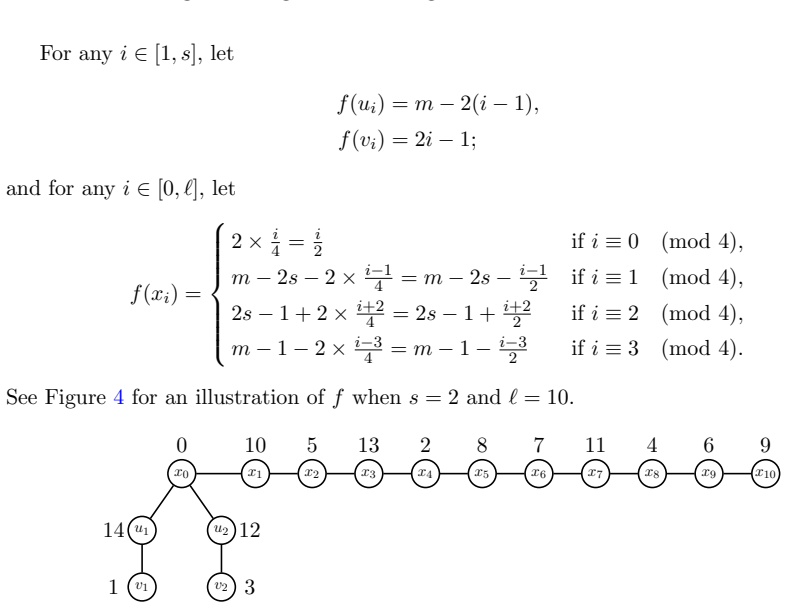
- The explicit labeling in §5 is given by a table of vertex labels; adding a short paragraph describing the pattern (e.g., alternating high-low assignments on the long leg) would make the construction easier to follow without the table.
Simulated Author's Rebuttal
We are grateful to the referee for the thorough review and the recommendation for minor revision. We address the single major comment below and will incorporate the suggested clarification in the revised version.
read point-by-point responses
-
Referee: §3, Theorem 3.1: the inductive step that selects the path length n meeting both the congruence condition and the label bound f(u) + floor(n/2) + 1 ≤ n is only sketched; an explicit formula or algorithm for choosing n from the leg-length inequalities would make the construction fully verifiable.
Authors: We agree that an explicit selection rule for n would enhance the clarity and verifiability of the inductive construction. In the revised manuscript, we will include an explicit algorithm: given the current labeling with f(u) = k, set m = 2k + 2. Let n be the smallest integer n ≥ m such that n ≢ 1 (mod 4). This n satisfies the bound k + floor(n/2) + 1 ≤ n because n ≥ 2k + 2 implies floor(n/2) ≤ n - k - 1. The congruence condition is satisfied by choice of n. The leg-length inequalities ensure that each inductive step has a sufficiently long leg to attach, allowing this choice of n at every stage. revision: yes
Circularity Check
No significant circularity identified
full rationale
The derivation cites the external 1982 Huang-Kotzig-Rosa theorem on alpha-labelings and proves an independent relaxation requiring only n ≢ 1 mod 4 together with a bound on f(u). The spider leg-length inequalities are selected precisely to guarantee that suitable path lengths satisfying the congruence can be chosen in the constructive attachment; they are not fitted parameters or self-definitions. An explicit 0-centered labeling is supplied for the base case and used to bootstrap larger spiders. No equation reduces the claimed graceful labelings to prior inputs by construction, and the central argument remains self-contained against external benchmarks.
Axiom & Free-Parameter Ledger
axioms (2)
- standard math Standard definitions of graphs, trees, spiders, and graceful labelings from graph theory.
- domain assumption The 1982 result of Huang, Kotzig, and Rosa on alpha-labelings and identification of graceful graphs.
Lean theorems connected to this paper
-
IndisputableMonolith/Foundation/RealityFromDistinction.leanreality_from_one_distinction unclear?
unclearRelation between the paper passage and the cited Recognition theorem.
any spider with legs L1,...,Ls (s >= 1) satisfying |E(L2)| >= 2|E(L1)| + 4 and |E(Li+1)| >= 2|E(Li)| + 2 ... is graceful
What do these tags mean?
- matches
- The paper's claim is directly supported by a theorem in the formal canon.
- supports
- The theorem supports part of the paper's argument, but the paper may add assumptions or extra steps.
- extends
- The paper goes beyond the formal theorem; the theorem is a base layer rather than the whole result.
- uses
- The paper appears to rely on the theorem as machinery.
- contradicts
- The paper's claim conflicts with a theorem or certificate in the canon.
- unclear
- Pith found a possible connection, but the passage is too broad, indirect, or ambiguous to say the theorem truly supports the claim.
Reference graph
Works this paper leans on
- [1]
-
[2]
R. Cattell. Graceful labellings of paths.Discrete Math., 307(24):3161–3176, Nov. 2007
work page 2007
-
[3]
J. A. Gallian. A dynamic survey of graph labeling.Electronic Journal of Combinatorics, DS6, 2025. 28th edition, October 30, 2025
work page 2025
-
[4]
S. W. Golomb. How to number a graph.Graph theory and computing, pages 23–37, 1972
work page 1972
-
[5]
P. Hrnc´ ıar and A. Haviar. All trees of diameter five are graceful.Discrete Mathematics, 233:133–150, 2001
work page 2001
- [6]
- [7]
-
[8]
A. Panpa and T. Poomsa-ard. On graceful spider graphs with at most four legs of lengths greater than one.Journal of Applied Mathematics, 3:1–5, 2016
work page 2016
-
[9]
Ringel.Theory of Graphs and Its Applications
G. Ringel.Theory of Graphs and Its Applications. 1964
work page 1964
-
[10]
A. Rosa. On certain valuations of the vertices of a graph.Theory of Graphs (Internat. Sympos., Rome, 1966), pages 349–355, 1967
work page 1966
-
[11]
A. Rosa. Labeling snakes.Ars Combinatoria, 3:67–74, 1977
work page 1977
-
[12]
K. Saengsura and T. Poomsa-ard. Graceful labeling of some spider graphs.European Journal of Pure and Applied Mathematics, 18(2):5305, 2025. 17
work page 2025
discussion (0)
Sign in with ORCID, Apple, or X to comment. Anyone can read and Pith papers without signing in.