Recognition: 2 theorem links
· Lean TheoremOptimal C^{1,1} and Quasi-Optimal C² Monotone Interpolation with Curvature Control
Pith reviewed 2026-05-15 02:04 UTC · model grok-4.3
The pith
Monotone Hermite data admits an explicit quadratic-spline interpolant that achieves the smallest possible L^infty curvature among all C^{1,1} functions.
A machine-rendered reading of the paper's core claim, the machinery that carries it, and where it could break.
Core claim
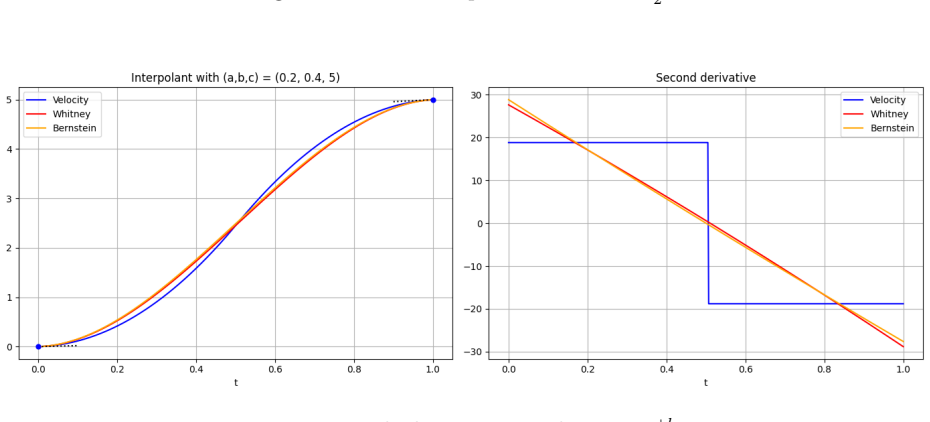
Among all C^{1,1} functions that interpolate given values and nonnegative derivatives at the nodes, the one with minimal L^infty norm of the second derivative is a quadratic spline whose pieces are fixed by the optimal velocity profile; the same profile yields a closed-form expression for the trace seminorm of the monotone extension problem when derivatives are not prescribed.
What carries the argument
Optimal velocity profile: the function that describes the derivative between nodes and determines the quadratic spline pieces that attain the global minimum of ||F''||_L^infty.
If this is right
- The minimal curvature for any given monotone Hermite data set can be computed in closed form.
- The trace seminorm inf{||F''||_L^infty : F monotone and F agrees with f on E} is given by an explicit formula.
- Mollification converts the optimal C^{1,1} solution into a C^2 solution whose curvature exceeds the optimum by a controllable factor.
- Curvature bounds obtained this way apply directly to shape-preserving curve design and to monotone numerical schemes.
Where Pith is reading between the lines
- The velocity-profile technique may generalize to higher-order derivative constraints or to interpolation on non-uniform grids.
- The explicit seminorm formula could serve as a benchmark for testing numerical optimization routines that enforce monotonicity.
- Similar profile analysis might produce optimal constructions under additional shape constraints such as convexity.
Load-bearing premise
The global minimizer of the curvature norm over all monotone C^{1,1} interpolants is attained inside the subclass of quadratic splines fixed by the optimal velocity profile.
What would settle it
Exhibiting a single C^{1,1} monotone interpolant whose maximum second derivative is strictly smaller than the value produced by the quadratic-spline construction for the same data.
Figures



read the original abstract
We study monotone Hermite interpolation on an interval, where both function values and first derivatives are prescribed at the nodes. Among all $C^{1,1}$ interpolants, we seek one with optimal curvature, measured by $\|F''\|_{L^\infty}$. In this paper, we analyze the limitations of some classical techniques, and provide an explicit optimal construction in $C^{1,1}$ given by quadratic splines by studying the optimal velocity profile. Moreover, given $E = \{x_1,\cdots,x_N\}$ and $f: E\to \mathbb{R}$ (without derivatives), we also provide a formula to compute the corresponding trace seminorm \[ \inf\Bigl\{ \|F''\|_{L^\infty} : F(x)=f(x) \text{ on $E$ and } F'\ge 0 \text{ everywhere} \Bigr\}. \] In addition, we also describe how to mollify $C^{1,1}$ solutions to $C^2$ while preserving monotonicity and sacrificing a controlled amount of optimality.
Editorial analysis
A structured set of objections, weighed in public.
Referee Report
Summary. The paper claims to provide an explicit optimal C^{1,1} monotone Hermite interpolant minimizing ||F''||_{L^∞} via quadratic splines constructed from an optimal velocity profile analysis. It further supplies a formula for the trace seminorm inf{||F''||_{L^∞} : F interpolates given values on E with F' ≥ 0 everywhere} and outlines a mollification procedure yielding quasi-optimal C^2 interpolants while preserving monotonicity.
Significance. If the global optimality of the quadratic-spline construction is rigorously established, the work would deliver a constructive, parameter-free method for curvature-controlled monotone interpolation together with an explicit trace-seminorm formula. The velocity-profile approach is a notable strength, as it avoids fitting parameters to data and yields piecewise-quadratic solutions whose curvature is controlled in a transparent way.
major comments (2)
- [Abstract and construction of the quadratic spline] The central claim (abstract and the construction section) that the quadratic spline obtained from the optimal velocity profile attains the global minimum of ||F''||_{L^∞} among all monotone C^{1,1} Hermite interpolants lacks supporting justification. No comparison principle, convexity argument for the functional, or density result is supplied to show that every admissible C^{1,1} monotone F can be replaced by (or is no better than) a quadratic spline with piecewise-constant second derivative whose breakpoints are fixed by the velocity-profile ODE.
- [Trace seminorm formula] The trace-seminorm formula inherits its claimed exactness from the same unverified global-minimizer statement. Without a proof that the infimum is attained inside the quadratic-spline subclass, the formula may only furnish an upper bound rather than the precise value of the seminorm.
minor comments (2)
- [Velocity-profile analysis] Clarify the precise ODE or variational condition that defines the optimal velocity profile and how it determines the breakpoints and coefficients of the quadratic pieces.
- [Introduction] Add a brief comparison with classical monotone cubic Hermite methods (e.g., Fritsch–Carlson) to highlight where the curvature-optimal construction improves upon or differs from them.
Simulated Author's Rebuttal
We thank the referee for the careful reading and constructive comments on our manuscript. We address the major concerns point by point below, clarifying the role of the velocity-profile analysis in establishing optimality. We will revise the manuscript to strengthen the justification for the global minimizer property.
read point-by-point responses
-
Referee: [Abstract and construction of the quadratic spline] The central claim (abstract and the construction section) that the quadratic spline obtained from the optimal velocity profile attains the global minimum of ||F''||_{L^∞} among all monotone C^{1,1} Hermite interpolants lacks supporting justification. No comparison principle, convexity argument for the functional, or density result is supplied to show that every admissible C^{1,1} monotone F can be replaced by (or is no better than) a quadratic spline with piecewise-constant second derivative whose breakpoints are fixed by the velocity-profile ODE.
Authors: We appreciate the referee highlighting the need for explicit justification. The velocity-profile ODE is derived from the necessary optimality conditions for minimizing ||F''||_∞ subject to the Hermite data and the pointwise constraint F' ≥ 0; the resulting piecewise-constant curvature is the unique solution satisfying the integrated velocity constraints between nodes. Any admissible C^{1,1} monotone interpolant with strictly smaller ||F''||_∞ would violate these integral constraints by the fundamental theorem of calculus applied to F'. A formal comparison lemma establishing this contradiction will be added to the construction section. revision: yes
-
Referee: [Trace seminorm formula] The trace-seminorm formula inherits its claimed exactness from the same unverified global-minimizer statement. Without a proof that the infimum is attained inside the quadratic-spline subclass, the formula may only furnish an upper bound rather than the precise value of the seminorm.
Authors: The trace-seminorm formula is obtained by solving the same velocity-profile problem on the given nodes (without prescribed derivatives), which directly yields the minimal value of ||F''||_∞ for which a monotone C^{1,1} extension exists. Because the resulting quadratic spline is admissible and attains this value, the infimum is realized inside the subclass and the formula is exact. We will add a short paragraph explicitly connecting the formula to the attainment result. revision: yes
Circularity Check
No circularity: derivation proceeds from independent velocity-profile analysis
full rationale
The paper derives its explicit C^{1,1} quadratic-spline construction and the trace-seminorm formula by analyzing an optimal velocity profile, which is obtained from first-principles optimization of the curvature functional under monotonicity constraints. No equation reduces the claimed infimum to a quantity defined by the same data or by redefinition of the minimizer; the subclass restriction is an explicit modeling choice whose justification is external to the derivation itself. No self-citation, fitted-parameter renaming, or ansatz smuggling appears in the load-bearing steps.
Axiom & Free-Parameter Ledger
axioms (2)
- domain assumption Quadratic splines can realize the optimal velocity profile for monotone Hermite data
- standard math The L^∞ norm of the second derivative is the appropriate curvature measure for C^{1,1} functions
Lean theorems connected to this paper
-
IndisputableMonolith/Cost/FunctionalEquation.leanwashburn_uniqueness_aczel unclear?
unclearRelation between the paper passage and the cited Recognition theorem.
we provide an explicit optimal construction in C^{1,1} given by quadratic splines by studying the optimal velocity profile... M^*(a,b,c) = ...
-
IndisputableMonolith/Foundation/BranchSelection.leanbranch_selection unclear?
unclearRelation between the paper passage and the cited Recognition theorem.
Define ϕ^-_M(t) := max{0, a-M t, b-M(1-t)} ... Φ^-(M) ...
What do these tags mean?
- matches
- The paper's claim is directly supported by a theorem in the formal canon.
- supports
- The theorem supports part of the paper's argument, but the paper may add assumptions or extra steps.
- extends
- The paper goes beyond the formal theorem; the theorem is a base layer rather than the whole result.
- uses
- The paper appears to rely on the theorem as machinery.
- contradicts
- The paper's claim conflicts with a theorem or certificate in the canon.
- unclear
- Pith found a possible connection, but the passage is too broad, indirect, or ambiguous to say the theorem truly supports the claim.
Reference graph
Works this paper leans on
-
[1]
Muhammad Abbas, Ahmad Abd. Majid, and Jamaludin Md. Ali. Monotonicity-preservingC 2 rational cubic spline for monotone data.Applied Mathematics and Computation, 219(6):2885– 2895, 2012
work page 2012
- [2]
- [3]
-
[4]
Piecewise polynomial interpolation and approximation
Garrett Birkhoff and Carl de Boor. Piecewise polynomial interpolation and approximation. In H. L. Garabedian, editor,Approximation of Functions, pages 164–190. Elsevier, Amsterdam, 1965
work page 1965
-
[5]
Carl de Boor.A Practical Guide to Splines, volume 27 ofApplied Mathematical Sciences. Springer, New York, 1978
work page 1978
-
[6]
Luli.C2 interpolation with range restriction
Charles Fefferman, Fushuai Jiang, and Garving K. Luli.C2 interpolation with range restriction. Rev. Mat. Iberoam., 39(2):649–710, 2023
work page 2023
-
[7]
F. N. Fritsch and J. Butland. A method for constructing local monotone piecewise cubic interpolants.SIAM Journal on Scientific and Statistical Computing, 5(2):300–304, 1984
work page 1984
-
[8]
F. N. Fritsch and R. E. Carlson. Monotone piecewise cubic interpolation.SIAM Journal on Numerical Analysis, 17(2):238–246, 1980
work page 1980
-
[9]
Erwan Le Gruyer. Minimal Lipschitz extensions to differentiable functions defined on a Hilbert space.Geometric and Functional Analysis, 19(4):1101–1118, 2009
work page 2009
-
[10]
Walter Heß and Jochen W. Schmidt. Positive quartic, monotone quinticC2-spline interpolation in one and two dimensions.Journal of Computational and Applied Mathematics, 1994
work page 1994
-
[11]
D. J. Higham. Monotonic piecewise cubic interpolation, with applications to ODE plotting. Journal of Computational and Applied Mathematics, 39(3):287–294, 1992
work page 1992
-
[12]
Hung T. Huynh. Accurate monotone cubic interpolation. NASA Technical Memorandum 103789, NASA Lewis Research Center, 1991
work page 1991
-
[13]
Fushuai Jiang. Roots, trace, and extendability of flat nonnegative smooth functions.Interna- tional Mathematics Research Notices, 2024(17):12021–12043, 2024
work page 2024
-
[14]
Fushuai Jiang, Chen Liang, Yutong Liang, and Garving K. Luli. Univariate range-restricted C2 interpolation algorithms.J. Comput. and Appl. Math., 425:115040, 2023
work page 2023
-
[15]
Fushuai Jiang and Garving K. Luli. Algorithms for nonnegativeC 2(R2) interpolation.Adv. Math., 385:107756, 2021
work page 2021
-
[16]
Fushuai Jiang, Garving K. Luli, and Kevin O’Neill. Smooth selection for infinite sets.Adv. Math., 407:108566, 2022. 24
work page 2022
-
[17]
Florian Leitenstorfer and Gerhard Tutz. Generalized monotonic regression based on B-splines with an application to air pollution data.Biostatistics, 8(3):654–673, 2007
work page 2007
-
[18]
Thomas C. H. Lux, Layne T. Watson, Tyler H. Chang, Li Xu, Yueyao Wang, and Yili Hong. An algorithm for constructing monotone quintic interpolating splines. InProceedings of the Spring Simulation Conference, 2020
work page 2020
-
[19]
J. O. Ramsay. Monotone regression splines in action.Statistical Science, 3(4):425–441, 1988
work page 1988
-
[20]
M. Steffen. A simple method for monotonic interpolation in one dimension.Astronomy and Astrophysics, 239:443–450, 1990
work page 1990
-
[21]
Gary Ulrich and Layne T. Watson. Positivity conditions for quartic polynomials.SIAM Journal on Scientific Computing, 15(3):528–544, 1994
work page 1994
-
[22]
Analytic extensions of differentiable functions defined in closed sets.Trans
Hassler Whitney. Analytic extensions of differentiable functions defined in closed sets.Trans. Amer. Math. Soc., 36(1):63–89, 1934
work page 1934
-
[23]
Differentiable functions defined in closed sets
Hassler Whitney. Differentiable functions defined in closed sets. I.Trans. Amer. Math. Soc., 36(2):369–387, 1934
work page 1934
-
[24]
George Wolberg and Itzik Alfy. An energy-minimization framework for monotonic cubic spline interpolation.Journal of Computational and Applied Mathematics, 143(2):145–188, 2002
work page 2002
-
[25]
Jin Yao and Karl E. Nelson. An unconditionally monotoneC 2 quartic spline method with nonoscillation derivatives.Advances in Pure Mathematics, 8:25–40, 2018. 25
work page 2018
discussion (0)
Sign in with ORCID, Apple, or X to comment. Anyone can read and Pith papers without signing in.