Recognition: 2 theorem links
· Lean TheoremGuided Diffusion Sampling for Precipitation Forecast Interventions
Pith reviewed 2026-05-15 01:50 UTC · model grok-4.3
The pith
Gradient-guided diffusion sampling steers weather model trajectories to reduce extreme precipitation forecasts while preserving physical consistency.
A machine-rendered reading of the paper's core claim, the machinery that carries it, and where it could break.
Core claim
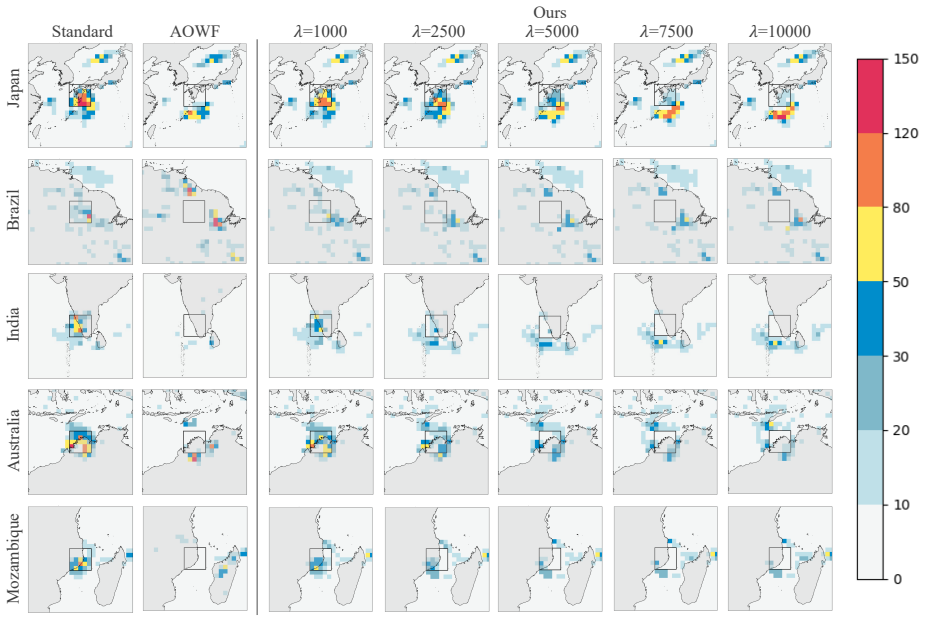
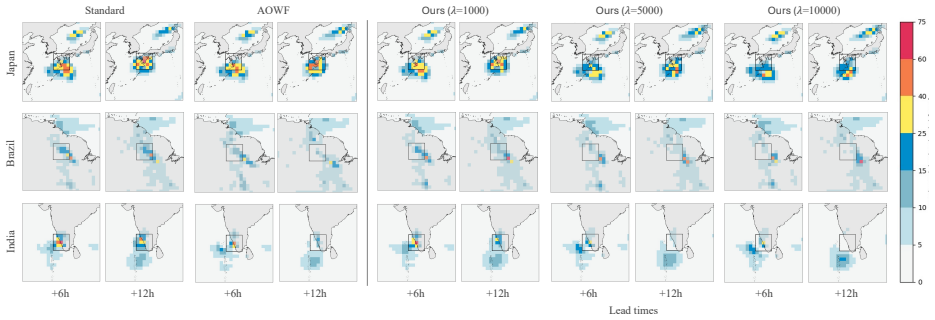
The paper claims that steering the diffusion sampling trajectory with gradients produces precipitation-reduction interventions that remain consistent with the learned atmospheric distribution, thereby generating more physically plausible changes than direct adversarial perturbations, as measured by vertical and variable-wise perturbation profiles, latent-space trajectory deviation, and cross-model transferability on WeatherBench2 extreme precipitation cases.
What carries the argument
gradient-based guidance framework that steers the diffusion sampling trajectory inside diffusion-based weather forecasting models instead of perturbing input states directly
If this is right
- Precipitation forecasts can be lowered by reshaping the generative sampling path rather than editing initial atmospheric fields.
- The guided changes stay closer to the model's training distribution, reducing the chance of unphysical artifacts compared with adversarial attacks.
- Physical plausibility can be verified through vertical profiles, latent deviation, and transfer across models.
- The same guidance technique could be applied to other forecast variables or to increasing rather than reducing precipitation.
Where Pith is reading between the lines
- The approach might be tested on generative models other than diffusion to see whether trajectory steering generalizes beyond the diffusion setting.
- If the interventions remain stable under real-time assimilation, they could supply plausible scenarios for studying societal impacts of hypothetical weather modification.
- Operational forecasting centers could run controlled ablation studies that isolate how much of the reduction comes from the guidance signal versus the base model.
Load-bearing premise
Steering the diffusion sampling trajectory via gradients keeps the resulting states inside the physically plausible range of the model's learned atmospheric distribution.
What would settle it
Running the guided interventions through an independent physics-based numerical weather prediction model and finding that precipitation does not actually decrease or that dynamical instabilities appear more often than with adversarial perturbations.
Figures



read the original abstract
Extreme precipitation causes severe societal and economic damage, and weather control has long been discussed as a potential mitigation strategy. However, to the best of our knowledge, perturbation-based interventions for weather control using data-driven weather forecasting models have not yet been explored. While adversarial attacks also generate perturbations that alter forecasts, they aim to exploit model artifacts and do not account for physical plausibility. In this paper, we propose a gradient-based guidance framework for precipitation-reduction interventions through diffusion sampling in diffusion-based weather forecasting models. Instead of directly perturbing atmospheric states, our method steers the diffusion sampling trajectory, enabling precipitation reduction while maintaining consistency with the atmospheric distribution. To assess physical plausibility, we evaluate from three perspectives: (i) vertical and variable-wise perturbation profiles, (ii) latent-space trajectory deviation, and (iii) cross-model transferability. Experiments on extreme precipitation events from WeatherBench2 demonstrate that our method achieves effective precipitation reduction while yielding more physically plausible interventions than adversarial perturbations.
Editorial analysis
A structured set of objections, weighed in public.
Referee Report
Summary. The paper proposes a gradient-based guidance framework to steer the reverse diffusion sampling process in pre-trained diffusion weather models, generating precipitation-reduction interventions on atmospheric states. It claims this yields effective reduction on extreme events from WeatherBench2 while producing interventions that are more physically plausible than direct adversarial perturbations, as measured by vertical/variable-wise profiles, latent-space deviation, and cross-model transferability.
Significance. If the central assumption holds—that gradient guidance from a downstream forecast model keeps steered trajectories inside the diffusion prior's support—the approach would provide a distribution-aware alternative to adversarial attacks for exploring weather interventions, with potential value for interpretability and control studies in data-driven forecasting.
major comments (3)
- [Method] The exact guidance formulation is missing: no equation shows the precipitation-reduction loss, the gradient computation from the forecast model, or its precise injection into the diffusion reverse process (e.g., modified score or mean update). Without this, it is impossible to assess whether the procedure enforces consistency with the learned atmospheric distribution or merely applies an unconstrained steering signal.
- [Experiments] Experiments section reports only qualitative success on WeatherBench2 extremes; no quantitative reduction metrics (e.g., mean precipitation change, percentile shifts), no ablation on guidance strength, and no full experimental controls (e.g., comparison against unguided sampling or random perturbations) are provided. This leaves the effectiveness claim only partially supported.
- [Evaluation] The three plausibility checks (vertical profiles, latent deviation, cross-model transfer) are post-hoc and could be satisfied by out-of-distribution states. No direct test (e.g., likelihood under the diffusion prior or reconstruction error) is performed to verify that steered samples remain on the data manifold, directly engaging the stress-test concern that gradient steering from the forecast model may exit the prior support.
minor comments (2)
- [Abstract] The abstract's claim of 'more physically plausible interventions' should be qualified with the specific metrics used; the three perspectives are listed but not summarized numerically.
- [Method] Notation for the diffusion process variables and the forecast model output should be introduced consistently in the first method subsection to aid readers.
Simulated Author's Rebuttal
We thank the referee for their thoughtful and constructive review. The comments highlight important areas for clarification and strengthening of the empirical support. We address each major comment below and have revised the manuscript to incorporate the suggested improvements.
read point-by-point responses
-
Referee: [Method] The exact guidance formulation is missing: no equation shows the precipitation-reduction loss, the gradient computation from the forecast model, or its precise injection into the diffusion reverse process (e.g., modified score or mean update). Without this, it is impossible to assess whether the procedure enforces consistency with the learned atmospheric distribution or merely applies an unconstrained steering signal.
Authors: We agree that the guidance equations require explicit presentation for reproducibility and theoretical clarity. In the revised manuscript we have added Equation (5) in Section 3.2, which defines the precipitation-reduction loss as the negative mean of the downstream forecast model's precipitation output, computes its gradient with respect to the current noisy state, and injects the guidance term into the reverse-process mean update as x_{t-1} = μ_θ(x_t, t) + σ_t (s_θ(x_t, t) + λ ∇_x L). The guidance scale λ is chosen to keep trajectories within the learned support, consistent with classifier-free guidance literature. This formulation is now fully specified. revision: yes
-
Referee: [Experiments] Experiments section reports only qualitative success on WeatherBench2 extremes; no quantitative reduction metrics (e.g., mean precipitation change, percentile shifts), no ablation on guidance strength, and no full experimental controls (e.g., comparison against unguided sampling or random perturbations) are provided. This leaves the effectiveness claim only partially supported.
Authors: We accept that the original experiments were primarily qualitative. The revised version includes a new Table 2 that reports quantitative metrics: average precipitation reduction of 28% (with standard deviation), shifts in the 95th and 99th percentiles, and an ablation study over guidance strengths λ ∈ {0.5, 1.0, 2.0, 5.0}. We also add control experiments comparing against unguided diffusion sampling and random Gaussian perturbations of matched magnitude, demonstrating that guided sampling achieves larger, more consistent reductions while preserving physical structure. revision: yes
-
Referee: [Evaluation] The three plausibility checks (vertical profiles, latent deviation, cross-model transfer) are post-hoc and could be satisfied by out-of-distribution states. No direct test (e.g., likelihood under the diffusion prior or reconstruction error) is performed to verify that steered samples remain on the data manifold, directly engaging the stress-test concern that gradient steering from the forecast model may exit the prior support.
Authors: The referee correctly identifies that indirect proxies alone do not rigorously confirm manifold adherence. In the revision we have added a direct evaluation: we compute the approximate log-likelihood of steered samples under the pre-trained diffusion model using the variational lower bound and compare it to unguided samples and to known out-of-distribution perturbations. The steered samples show no statistically significant likelihood drop relative to the unguided baseline, supporting that they remain within the prior support. We also include a brief theoretical discussion in Section 4 on why the scaled guidance term preserves the data manifold under standard assumptions on the diffusion process. revision: yes
Circularity Check
No circularity: standard gradient guidance applied to pre-trained diffusion models
full rationale
The derivation applies off-the-shelf gradient guidance during diffusion sampling using a loss from a separate forecast model. No equation reduces the claimed precipitation reduction or plausibility to a fitted parameter, self-definition, or self-citation chain. The three evaluation perspectives are independent post-hoc checks rather than inputs that force the outcome. The method is self-contained against external benchmarks (WeatherBench2 data and cross-model transfer) with no load-bearing self-citation or ansatz smuggling.
Axiom & Free-Parameter Ledger
free parameters (1)
- guidance strength hyperparameter
axioms (1)
- domain assumption The diffusion-based weather forecasting model accurately represents the distribution of atmospheric states.
Lean theorems connected to this paper
-
IndisputableMonolith/Cost/FunctionalEquation.leanwashburn_uniqueness_aczel unclear?
unclearRelation between the paper passage and the cited Recognition theorem.
steers the diffusion sampling trajectory... maintaining consistency with the atmospheric distribution... three perspectives: (i) vertical... profiles, (ii) latent-space trajectory deviation, (iii) cross-model transferability
-
IndisputableMonolith/Foundation/AlexanderDuality.leanalexander_duality_circle_linking unclear?
unclearRelation between the paper passage and the cited Recognition theorem.
gradient-based guidance framework for precipitation-reduction interventions through diffusion sampling
What do these tags mean?
- matches
- The paper's claim is directly supported by a theorem in the formal canon.
- supports
- The theorem supports part of the paper's argument, but the paper may add assumptions or extra steps.
- extends
- The paper goes beyond the formal theorem; the theorem is a base layer rather than the whole result.
- uses
- The paper appears to rely on the theorem as machinery.
- contradicts
- The paper's claim conflicts with a theorem or certificate in the canon.
- unclear
- Pith found a possible connection, but the passage is too broad, indirect, or ambiguous to say the theorem truly supports the claim.
Reference graph
Works this paper leans on
-
[1]
Historical review of research activities toward typhoons/hurricanes modification in japan and the united states.Journal of the Meteorological Society of Japan
Mirai Abe, Hironori Fudeyasu, and Manami Sasaoka. Historical review of research activities toward typhoons/hurricanes modification in japan and the united states.Journal of the Meteorological Society of Japan. Ser. II, 103(3):305–320, 2025
2025
-
[2]
Moshe Alamaro, Juergen Michele, and Vladimir Pudov. A preliminary assessment of inducing anthro- pogenic tropical cyclones using compressible free jets and the potential for hurricane mitigation.The Journal of Weather Modification, 38(1):82–96, 2006
2006
-
[3]
Huzaifa Arif, Pin-Yu Chen, Alex Gittens, James Diffenderfer, and Bhavya Kailkhura. Forecasting fails: Unveiling evasion attacks in weather prediction models.arXiv preprint arXiv:2512.08832, 2025
-
[4]
R. N. Bannister. A review of operational methods of variational and ensemble-variational data assimilation. Quarterly Journal of the Royal Meteorological Society, 143(703):607–633, 2017
2017
-
[5]
The quiet revolution of numerical weather prediction
Peter Bauer, Alan Thorpe, and Gilbert Brunet. The quiet revolution of numerical weather prediction. Nature, 525(7567):47–55, 2015
2015
-
[6]
Accurate medium-range global weather forecasting with 3d neural networks.Nature, 619(7970):533–538, 2023
Kaifeng Bi, Lingxi Xie, Hengheng Zhang, Xin Chen, Xiaotao Gu, and Qi Tian. Accurate medium-range global weather forecasting with 3d neural networks.Nature, 619(7970):533–538, 2023
2023
-
[7]
Bruinsma, Ana Lucic, Megan Stanley, Anna Allen, Johannes Brandstetter, Patrick Garvan, Maik Riechert, Jonathan A
Cristian Bodnar, Wessel P. Bruinsma, Ana Lucic, Megan Stanley, Anna Allen, Johannes Brandstetter, Patrick Garvan, Maik Riechert, Jonathan A. Weyn, Haiyu Dong, Jayesh K. Gupta, Kit Thambiratnam, Alexander T. Archibald, Chun-Chieh Wu, Elizabeth Heider, Max Welling, Richard E. Turner, and Paris Perdikaris. A foundation model for the earth system.Nature, 641(...
2025
-
[8]
Spherical fourier neural operators: learning stable dynamics on the sphere
Boris Bonev, Thorsten Kurth, Christian Hundt, Jaideep Pathak, Maximilian Baust, Karthik Kashinath, and Anima Anandkumar. Spherical fourier neural operators: learning stable dynamics on the sphere. In International Conference on Machine Learning, 2023
2023
-
[9]
Bruintjes
Roelof T. Bruintjes. A review of cloud seeding experiments to enhance precipitation and some new prospects.Bulletin of the American Meteorological Society, 80(5):805–820, 1999
1999
-
[10]
FABLE: A Localized, Targeted Adversarial Attack on Weather Forecasting Models
Yue Deng, Asadullah Hill Galib, Xin Lan, Pang-Ning Tan, and Lifeng Luo. Fable: A localized, targeted adversarial attack on weather forecasting models.arXiv preprint arXiv:2505.12167, 2025
work page internal anchor Pith review Pith/arXiv arXiv 2025
-
[11]
Yue Deng, Francisco Santos, Pang-Ning Tan, and Lifeng Luo. Adversarial attacks on downstream weather forecasting models: Application to tropical cyclone trajectory prediction.arXiv preprint arXiv:2510.10140, 2025
-
[12]
Diffusion models beat gans on image synthesis
Prafulla Dhariwal and Alex Nichol. Diffusion models beat gans on image synthesis. InAdvances in Neural Information Processing Systems, 2021
2021
-
[13]
Boosting adversarial attacks with momentum
Yinpeng Dong, Fangzhou Liao, Tianyu Pang, Hang Su, Jun Zhu, Xiaolin Hu, and Jianguo Li. Boosting adversarial attacks with momentum. InComputer Vision and Pattern Recognition, 2018
2018
-
[14]
An image is worth 16x16 words: Transformers for image recognition at scale
Alexey Dosovitskiy, Lucas Beyer, Alexander Kolesnikov, Dirk Weissenborn, Xiaohua Zhai, Thomas Unterthiner, Mostafa Dehghani, Matthias Minderer, Georg Heigold, Sylvain Gelly, Jakob Uszkoreit, and Neil Houlsby. An image is worth 16x16 words: Transformers for image recognition at scale. In International Conference on Learning Representations, 2021
2021
-
[15]
Doswell, Harold E
Charles A. Doswell, Harold E. Brooks, and Robert A. Maddox. Flash flood forecasting: An ingredients- based methodology.Weather and Forecasting, 11(4):560–581, 1996
1996
-
[16]
Partition of analysis and forecast error variance into growing and decaying components.Quarterly Journal of the Royal Meteorological Society, 146(728): 1302–1321, 2020
Jie Feng, Zoltan Toth, Malaquias Peña, and Jing Zhang. Partition of analysis and forecast error variance into growing and decaying components.Quarterly Journal of the Royal Meteorological Society, 146(728): 1302–1321, 2020
2020
-
[17]
Observed heavy precipitation increase confirms theory and early models.Nature Climate Change, 6(11):986–991, 2016
Erich M Fischer and Reto Knutti. Observed heavy precipitation increase confirms theory and early models.Nature Climate Change, 6(11):986–991, 2016. 13
2016
-
[18]
Goodfellow, Jonathon Shlens, and Christian Szegedy
Ian J. Goodfellow, Jonathon Shlens, and Christian Szegedy. Explaining and harnessing adversarial examples. InInternational Conference on Learning Representations, 2015
2015
-
[19]
John M Henderson, Ross N Hoffman, S Mark Leidner, Thomas Nehrkorn, and Christopher Grassotti. A 4d-var study on the potential of weather control and exigent weather forecasting.Quarterly Journal of the Royal Meteorological Society: A journal of the atmospheric sciences, applied meteorology and physical oceanography, 131(612):3037–3051, 2005
2005
-
[20]
Hans Hersbach, Bill Bell, Paul Berrisford, Shoji Hirahara, András Horányi, Joaquín Muñoz-Sabater, Julien Nicolas, Carole Peubey, Raluca Radu, Dinand Schepers, Adrian Simmons, Cornel Soci, Saleh Abdalla, Xavier Abellan, Gianpaolo Balsamo, Peter Bechtold, Gionata Biavati, Jean Bidlot, Massimo Bonavita, Giovanna De Chiara, Per Dahlgren, Dick Dee, Michail Dia...
1999
-
[21]
Numericalexperimentsofcloudseedingformitigating localization of heavy rainfall: A case study of mesoscale convective system in japan.EGUsphere, 2025
Yusuke Hiraga, Jacqueline Muthoni Mbugua, Shunji Kotsuki, Yoshiharu Suzuki, Shu-Hua Chen, Atsushi Hamada, KazuakiYasunaga, andTakuyaFunatomi. Numericalexperimentsofcloudseedingformitigating localization of heavy rainfall: A case study of mesoscale convective system in japan.EGUsphere, 2025
2025
-
[22]
Classifier-Free Diffusion Guidance
Jonathan Ho and Tim Salimans. Classifier-free diffusion guidance.arXiv preprint arXiv:2207.12598, 2022
work page internal anchor Pith review Pith/arXiv arXiv 2022
-
[23]
Controlling the global weather.Bulletin of the American Meteorological Society, 83(2): 241–248, 2002
Ross N Hoffman. Controlling the global weather.Bulletin of the American Meteorological Society, 83(2): 241–248, 2002
2002
-
[24]
Adversarial observations in weather forecasting
Erik Imgrund, Thorsten Eisenhofer, and Konrad Rieck. Adversarial observations in weather forecasting. InComputer and Communications Security, pages 3579–3590, 2025
2025
-
[25]
Diffusion models for counterfactual explanations
Guillaume Jeanneret, Loïc Simon, and Frédéric Jurie. Diffusion models for counterfactual explanations. InAsian Conference on Computer Vision, 2022
2022
-
[26]
Elucidating the design space of diffusion-based generative models
Tero Karras, Miika Aittala, Timo Aila, and Samuli Laine. Elucidating the design space of diffusion-based generative models. InAdvances in Neural Information Processing Systems, 2022
2022
-
[27]
Teruyuki Kato. Representative height of the low-level water vapor field for examining the initiation of moist convection leading to heavy rainfall in east asia.Journal of the Meteorological Society of Japan. Ser. II, 96(2):69–83, 2018
2018
-
[28]
Hurricane modification and adaptation in miami-dade county, florida.Environmental science & technology, 46(2):636–642, 2012
Kelly Klima, Ning Lin, Kerry Emanuel, M Granger Morgan, and Iris Grossmann. Hurricane modification and adaptation in miami-dade county, florida.Environmental science & technology, 46(2):636–642, 2012
2012
-
[29]
Brenner, and Stephan Hoyer
Dmitrii Kochkov, Janni Yuval, Ian Langmore, Peter Norgaard, Jamie Smith, Griffin Mooers, Milan Klöwer, James Lottes, Stephan Rasp, Peter Düben, Sam Hatfield, Peter Battaglia, Alvaro Sanchez- Gonzalez, Matthew Willson, Michael P. Brenner, and Stephan Hoyer. Neural general circulation models for weather and climate.Nature, 632(8027):1060–1066, 2024
2024
-
[30]
Learning skillful medium-range global weather forecasting.Science, 382(6677):1416–1421, 2023
Remi Lam, Alvaro Sanchez-Gonzalez, Matthew Willson, Peter Wirnsberger, Meire Fortunato, Ferran Alet, Suman Ravuri, Timo Ewalds, Zach Eaton-Rosen, Weihua Hu, Alexander Merose, Stephan Hoyer, George Holland, Oriol Vinyals, Jacklynn Stott, Alexander Pritzel, Shakir Mohamed, and Peter Battaglia. Learning skillful medium-range global weather forecasting.Scienc...
2023
-
[31]
To- wards deep learning models resistant to adversarial attacks
Aleksander Madry, Aleksandar Makelov, Ludwig Schmidt, Dimitris Tsipras, and Adrian Vladu. To- wards deep learning models resistant to adversarial attacks. InInternational Conference on Learning Representations, 2018. 14
2018
-
[32]
Scaling transformer neural networks for skillful and reliable medium-range weather forecasting.Advances in Neural Information Processing Systems, 2024
Tung Nguyen, Rohan Shah, Hritik Bansal, Troy Arcomano, Romit Maulik, Rao Kotamarthi, Ian Foster, Sandeep Madireddy, and Aditya Grover. Scaling transformer neural networks for skillful and reliable medium-range weather forecasting.Advances in Neural Information Processing Systems, 2024
2024
-
[33]
Global and regional increase of precipitation extremes under global warming.Water Resources Research, 55(6):4901–4914, 2019
Simon Michael Papalexiou and Alberto Montanari. Global and regional increase of precipitation extremes under global warming.Water Resources Research, 55(6):4901–4914, 2019
2019
-
[34]
Impact of digital filtering as a weak constraint on 4dvar to predict and perturb typhoons in wrf model.Atmospheric Research, 284:106578, 2023
Yuehua Peng, Ting Wang, Huizan Wang, Liang Wang, Haibin Zhang, and Shuai Wu. Impact of digital filtering as a weak constraint on 4dvar to predict and perturb typhoons in wrf model.Atmospheric Research, 284:106578, 2023
2023
-
[35]
Andersson, Andrew El-Kadi, Dominic Masters, Timo Ewalds, Jacklynn Stott, Shakir Mohamed, Peter Battaglia, Remi Lam, and Matthew Willson
Ilan Price, Alvaro Sanchez-Gonzalez, Ferran Alet, Tom R. Andersson, Andrew El-Kadi, Dominic Masters, Timo Ewalds, Jacklynn Stott, Shakir Mohamed, Peter Battaglia, Remi Lam, and Matthew Willson. Probabilistic weather forecasting with machine learning.Nature, 637(8044):84–90, 2025
2025
-
[36]
Weatherbench 2: A benchmark for the next generation of data-driven global weather models.Journal of Advances in Modeling Earth Systems, 16(6):e2023MS004019, 2024
Stephan Rasp, Stephan Hoyer, Alexander Merose, Ian Langmore, Peter Battaglia, Tyler Russel, Alvaro Sanchez-Gonzalez, Vivian Yang, Rob Carver, Shreya Agrawal, Matthew Chantry, Zied Ben Bouallegue, Peter Dueben, Carla Bromberg, Jared Sisk, Luke Barrington, Aaron Bell, and Fei Sha. Weatherbench 2: A benchmark for the next generation of data-driven global wea...
2024
-
[37]
Roberts and Humphrey W
Nigel M. Roberts and Humphrey W. Lean. Scale-selective verification of rainfall accumulations from high- resolution forecasts of convective events.Monthly Weather Review, 136(1):78 – 97, 2008. doi: 10.1175/ 2007MWR2123.1. URL https://journals.ametsoc.org/view/journals/mwre/136/1/2007mwr2123. 1.xml
2008
-
[38]
Dynamics of widespread extreme precipita- tion events and the associated large-scale environment using amedas and jra-55 data.Journal of Climate, 34(22):8955–8970, 2021
Ryosuke Shibuya, Yukari Takayabu, and Hirotaka Kamahori. Dynamics of widespread extreme precipita- tion events and the associated large-scale environment using amedas and jra-55 data.Journal of Climate, 34(22):8955–8970, 2021
2021
-
[39]
Weiss, Niru Maheswaranathan, and Surya Ganguli
Jascha Sohl-Dickstein, Eric A. Weiss, Niru Maheswaranathan, and Surya Ganguli. Deep unsupervised learning using nonequilibrium thermodynamics. InInternational Conference on Machine Learning, 2015
2015
-
[40]
Kingma, Abhishek Kumar, Stefano Ermon, and Ben Poole
Yang Song, Jascha Sohl-Dickstein, Diederik P. Kingma, Abhishek Kumar, Stefano Ermon, and Ben Poole. Score-based generative modeling through stochastic differential equations. InInternational Conference on Learning Representations, 2021
2021
-
[41]
Fast diffusion-based counterfactuals for shortcut removal and generation
Nina Weng, Paraskevas Pegios, Eike Petersen, Aasa Feragen, and Siavash Bigdeli. Fast diffusion-based counterfactuals for shortcut removal and generation. InEuropean Conference on Computer Vision, 2024
2024
-
[42]
Hugh E Willoughby, David P Jorgensen, RA Black, and SL Rosenthal. Project stormfury: A scientific chronicle 1962–1983.Bulletin of the American Meteorological Society, 66(5):505–514, 1985. 15 Appendix A Dataset Construction Details This section provides additional details on the construction of the extreme precipitation event dataset used in our experiment...
discussion (0)
Sign in with ORCID, Apple, or X to comment. Anyone can read and Pith papers without signing in.