Recognition: 2 theorem links
· Lean TheoremAIM-DDI: A Model-Agnostic Multimodal Integration Module for Drug-Drug Interaction Prediction
Pith reviewed 2026-05-15 01:41 UTC · model grok-4.3
The pith
AIM-DDI turns structural, chemical and semantic drug data into shared tokens so any DDI prediction model can fuse them without custom redesigns.
A machine-rendered reading of the paper's core claim, the machinery that carries it, and where it could break.
Core claim
AIM-DDI represents heterogeneous modality information as tokens in a shared latent space and applies a unified fusion module to model cross-modality dependencies, allowing the same integration method to be plugged into different DDI prediction architectures and yielding consistent performance gains, especially in the both-unseen drug setting.
What carries the argument
Token representation of modalities inside a shared latent space plus a unified fusion module that models token dependencies across modalities.
If this is right
- The module produces consistent accuracy gains when attached to many existing DDI architectures.
- Largest relative gains occur under the both-unseen drug condition.
- No architecture-specific retraining or post-hoc tuning is required for the integration step.
- Multimodal signals can be treated as a reusable component rather than a model-locked subroutine.
Where Pith is reading between the lines
- The same token-fusion pattern could be tested on other multimodal biomedical tasks such as protein-drug or disease-drug prediction.
- If the shared space generalizes well, future models might start with this module as a default rather than designing fusion from scratch.
- Performance could be further probed by measuring how many modalities are needed before the gains plateau.
Load-bearing premise
Representing each modality as tokens in one shared latent space and fusing them with a single module will capture the necessary cross-modal relationships for reliable generalization to unseen drugs.
What would settle it
An experiment that replaces the shared latent space and unified fusion with separate per-modality encoders and measures whether the performance advantage disappears in the both-unseen test setting.
Figures

read the original abstract
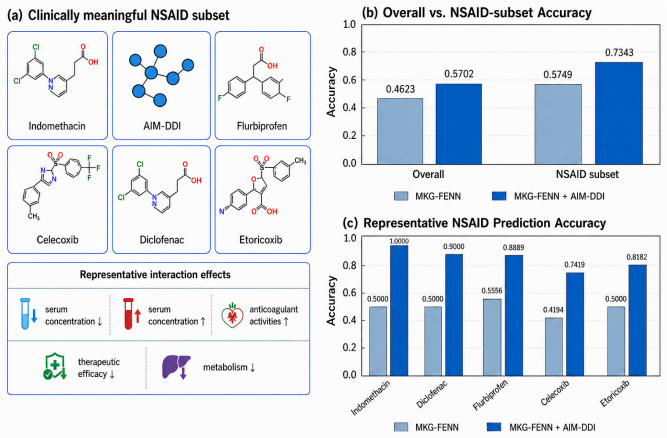
Drug-drug interaction (DDI) prediction is a critical task in computational biomedicine, as adverse interactions between co-administered drugs can cause severe side effects and clinical risks. A key challenge is unseen-drug generalization, where interactions must be predicted for drugs not observed during training. Although multimodal DDI models exploit diverse drug-related information, their fusion mechanisms are often tied to specific prediction architectures, limiting their reuse across models. To address this, we propose AIM-DDI, an architecture-independent multimodal integration module that represents heterogeneous modality information as tokens in a shared latent space. By modeling dependencies across modality tokens through a unified fusion module, AIM-DDI enables model-agnostic integration of structural, chemical, and semantic drug signals across different DDI prediction architectures. Extensive evaluations across diverse DDI models and DrugBank-based settings show that AIM-DDI consistently improves prediction performance, with the strongest gains under the most challenging both-unseen setting where neither drug in a test pair is observed during training. These results suggest that treating multimodal integration as a reusable module, rather than a model-specific fusion component, is an effective strategy for robust unseen-drug DDI prediction.
Editorial analysis
A structured set of objections, weighed in public.
Referee Report
Summary. The manuscript proposes AIM-DDI, an architecture-independent multimodal integration module for drug-drug interaction (DDI) prediction. It tokenizes heterogeneous drug information from structural, chemical, and semantic modalities into a shared latent space and applies a unified fusion module to capture cross-modality dependencies. The module is designed to be pluggable into different base DDI prediction architectures without requiring architecture-specific adjustments. Experiments across multiple models on DrugBank-derived splits report consistent performance gains, with the largest improvements observed in the both-unseen setting where neither drug in a test pair appears in the training data.
Significance. If the reported gains hold under scrutiny, the contribution is significant because it reframes multimodal fusion as a reusable, architecture-agnostic component rather than an embedded, model-specific mechanism. This modularity could facilitate broader adoption and better unseen-drug generalization in DDI prediction, an area where new compounds continually appear. The evaluation across diverse base architectures and the emphasis on the both-unseen split provide direct empirical support for the practical value of the approach.
minor comments (2)
- [Abstract] Abstract: The claims of 'consistent improvements' and 'strongest gains' in the both-unseen setting are stated without any accompanying quantitative metrics, confidence intervals, or baseline comparisons, making it difficult to gauge the practical magnitude of the reported benefits.
- [§4] §4 (Experiments): The manuscript should report ablation results isolating the contribution of the tokenization step versus the fusion module, as well as error bars across multiple random seeds, to strengthen the evidence that the gains arise specifically from the proposed integration strategy.
Simulated Author's Rebuttal
We thank the referee for the positive summary and significance assessment of AIM-DDI. The report accurately captures the core contribution of a pluggable, architecture-independent fusion module and its empirical benefits, especially in the both-unseen setting. We are grateful for the minor-revision recommendation and will address any editorial or minor points in the revised manuscript.
Circularity Check
No significant circularity detected
full rationale
The paper presents AIM-DDI as a pluggable architecture-independent module that tokenizes heterogeneous modalities into a shared latent space and applies a uniform fusion step. No equations, derivations, or fitted parameters are described that reduce by construction to the module's own inputs. Claims of model-agnostic integration and improved unseen-drug generalization rest on empirical evaluations across multiple base DDI architectures and DrugBank splits (including both-unseen), which constitute external benchmarks rather than internal self-predictions. No self-citations, uniqueness theorems, or ansatzes are invoked as load-bearing premises in the provided text. The construction is therefore self-contained against external performance metrics.
Axiom & Free-Parameter Ledger
Lean theorems connected to this paper
-
IndisputableMonolith/Cost/FunctionalEquation.leanwashburn_uniqueness_aczel unclear?
unclearRelation between the paper passage and the cited Recognition theorem.
modality-token integration module ... models dependencies across modalities independently of a specific prediction architecture
What do these tags mean?
- matches
- The paper's claim is directly supported by a theorem in the formal canon.
- supports
- The theorem supports part of the paper's argument, but the paper may add assumptions or extra steps.
- extends
- The paper goes beyond the formal theorem; the theorem is a base layer rather than the whole result.
- uses
- The paper appears to rely on the theorem as machinery.
- contradicts
- The paper's claim conflicts with a theorem or certificate in the canon.
- unclear
- Pith found a possible connection, but the passage is too broad, indirect, or ambiguous to say the theorem truly supports the claim.
Reference graph
Works this paper leans on
-
[1]
Wishart and Yannick D
David S. Wishart and Yannick D. Feunang and An C. Guo and Elvis J. Lo and Ana Marcu and Jason R. Grant and Tanvir Sajed and Daniel Johnson and Carin Li and Zinat Sayeeda and others , title =. Nucleic Acids Research , volume =. 2018 , doi =
2018
-
[2]
Similarity-based modeling in large-scale prediction of drug-drug interactions , journal =
Santiago Vilar and Rom. Similarity-based modeling in large-scale prediction of drug-drug interactions , journal =. 2014 , doi =
2014
-
[3]
Proceedings of the National Academy of Sciences , volume =
Jae Yong Ryu and Hyun Uk Kim and Sang Yup Lee , title =. Proceedings of the National Academy of Sciences , volume =. 2018 , doi =
2018
-
[4]
Bioinformatics , volume =
Marinka Zitnik and Monica Agrawal and Jure Leskovec , title =. Bioinformatics , volume =. 2018 , doi =
2018
-
[5]
Bioinformatics , volume =
Yifan Deng and Xiangxiang Xu and Yu Qiu and Jing Xia and Wen Zhang and Shichao Liu , title =. Bioinformatics , volume =. 2020 , doi =
2020
-
[6]
Proceedings of the AAAI Conference on Artificial Intelligence , volume =
Di Wu and Wen Sun and Yi He and Zhong Chen and Xin Luo , title =. Proceedings of the AAAI Conference on Artificial Intelligence , volume =. 2024 , doi =
2024
-
[7]
Communications Medicine , volume =
Yaqing Wang and Zaifei Yang and Quanming Yao , title =. Communications Medicine , volume =. 2024 , doi =
2024
-
[8]
Artificial Intelligence in Medicine , volume =
Changpeng Zhao and Dongfang Han and Zicheng Zuo and Turdi Tohti , title =. Artificial Intelligence in Medicine , volume =. 2025 , doi =
2025
-
[9]
Knowledge and Information Systems , volume =
Yuanxian Li and Yuan Du and Hong Peng and Zhenli He and Xin Jin and Cheng Xie , title =. Knowledge and Information Systems , volume =. 2026 , doi =
2026
-
[10]
2023 , eprint =
Zeming Chen and Alejandro Hern. 2023 , eprint =
2023
-
[11]
Focal Loss for Dense Object Detection , booktitle =
Tsung-Yi Lin and Priya Goyal and Ross Girshick and Kaiming He and Piotr Doll. Focal Loss for Dense Object Detection , booktitle =. 2017 , doi =
2017
-
[12]
eLife , volume =
Systematic integration of biomedical knowledge prioritizes drugs for repurposing , author =. eLife , volume =. 2017 , doi =
2017
-
[13]
Bioinformatics , volume =
Jinhyuk Lee and Wonjin Yoon and Sungdong Kim and Donghyeon Kim and Sunkyu Kim and Chan Ho So and Jaewoo Kang , title =. Bioinformatics , volume =. 2020 , doi =
2020
-
[14]
Aging and Disease , volume =
Supakanya Wongrakpanich and Amaraporn Wongrakpanich and Khadijah Melhado and Janani Rangaswami , title =. Aging and Disease , volume =. 2018 , doi =
2018
-
[15]
Therapeutics and Clinical Risk Management , volume =
Nicholas Moore and Charles Pollack and Paul Butkerait , title =. Therapeutics and Clinical Risk Management , volume =. 2015 , doi =
2015
-
[16]
PLOS ONE , volume =
Nathnael Abdu and Syed Azhar Syed Sulaiman and Tewodros Tesfaye and Wubshet Worku , title =. PLOS ONE , volume =. 2020 , doi =
2020
-
[17]
Nucleic acids research , volume=
KEGG: kyoto encyclopedia of genes and genomes , author=. Nucleic acids research , volume=. 2000 , publisher=
2000
discussion (0)
Sign in with ORCID, Apple, or X to comment. Anyone can read and Pith papers without signing in.