Recognition: no theorem link
Randomized Atomic Feature Models for Physics-Informed Identification of Dynamic Systems
Pith reviewed 2026-05-15 02:38 UTC · model grok-4.3
The pith
Impulse responses are recovered as random superpositions of damped exponentials from poles sampled inside a disk using convex optimization with physical constraints.
A machine-rendered reading of the paper's core claim, the machinery that carries it, and where it could break.
Core claim
Impulse responses are represented as random superpositions of stable atoms, namely damped complex exponentials associated with poles sampled inside a prescribed disk. Identification is cast as a convex regularized least-squares problem with optional linear, second-order-cone, and KYP constraints. The main analytic point is an operator-theoretic Disk-Bochner viewpoint: positive measures over stable poles generate positive-definite kernels with a radius-dependent shift defect, while a converse scalar disk moment representation for an arbitrary kernel is characterized by subnormality of the canonical shift. This yields an RKHS-to-l1 embedding, a valid finite atomic gauge from sampled poles, and
What carries the argument
Randomized atomic features consisting of damped complex exponentials with poles inside a disk, which induce a finite atomic gauge and enable an RKHS-to-l1 embedding for sparse recovery under restricted-eigenvalue conditions on the disk-Vandermonde matrix.
If this is right
- The framework directly encodes stability margins, modal localization, DC-gain bounds, monotonicity, passivity, relative degree, settling-time targets, and time/frequency-domain error bounds.
- Physically meaningful priors compensate for poor excitation and improve constrained impulse-response recovery in under-informative data settings.
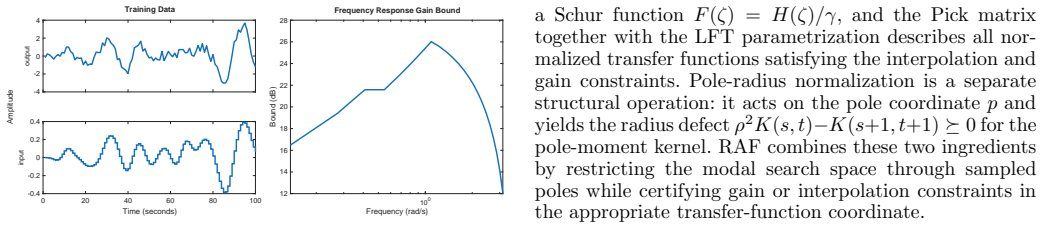
- Normalized transfer-function problems connect to Nevanlinna-Pick interpolation and LFT set-membership.
- Random-feature convergence and sparse-recovery guarantees hold conditionally on the restricted-eigenvalue properties of the realized design matrix.
Where Pith is reading between the lines
- The same randomization idea could be applied to other regions of the complex plane to handle marginally stable or unstable dynamics without altering the convex formulation.
- Hybrid combinations with neural-network feature extractors could extend the modal interpretability to high-dimensional nonlinear identification tasks.
- Numerical validation on multi-input multi-output industrial datasets would test whether the restricted-eigenvalue guarantees remain practical at scale.
Load-bearing premise
Random sampling of poles inside a prescribed disk produces a sufficiently rich and stable atomic dictionary whose finite realizations satisfy the restricted-eigenvalue properties needed for the stated sparse-recovery guarantees.
What would settle it
A concrete counterexample in which the realized disk-Vandermonde matrix violates the restricted eigenvalue condition for the chosen sampling distribution, causing the convex program to return unstable or non-unique models even when physical constraints are enforced.
Figures


read the original abstract
We present a physics-informed framework for system identification based on randomized stable atomic features. Impulse responses are represented as random superpositions of stable atoms, namely damped complex exponentials associated with poles sampled inside a prescribed disk. Identification is then cast as a convex regularized least-squares problem with optional linear, second-order-cone, and KYP constraints. The approach generalizes random Fourier and random Laplace features to the damped, nonstationary regime relevant to engineering systems while retaining modal interpretability and scalable finite-dimensional computation. The main analytic point is an operator-theoretic Disk-Bochner viewpoint: positive measures over stable poles generate positive-definite kernels with a radius-dependent shift defect, while a converse scalar disk moment representation for an arbitrary kernel is characterized by subnormality of the canonical shift. We prove this statement, establish an RKHS-to-l1 embedding, show that sampled poles induce a valid finite atomic gauge, discuss random-feature convergence, and state sparse-recovery guarantees conditionally on the restricted-eigenvalue properties of the realized disk-Vandermonde or input-output design matrix. We also connect the normalized transfer function problem to Nevanlinna-Pick interpolation and LFT set-membership. The framework directly encodes stability margins, modal localization, DC-gain bounds, monotonicity, passivity, relative degree, settling-time targets, and time/frequency-domain error bounds. Numerical comparisons illustrate how physically meaningful priors can compensate for poor excitation and improve constrained impulse-response recovery in an under-informative data setting.
Editorial analysis
A structured set of objections, weighed in public.
Referee Report
Summary. The paper proposes a physics-informed system identification framework that represents impulse responses as random superpositions of stable atoms (damped complex exponentials with poles sampled inside a prescribed disk). Identification is cast as convex regularized least-squares with optional linear, SOC, and KYP constraints. The central analytic contribution is an operator-theoretic Disk-Bochner representation: positive measures over stable poles induce positive-definite kernels with a radius-dependent shift defect, with a converse characterization via subnormality of the canonical shift; the work also establishes an RKHS-to-l1 embedding, shows that sampled poles induce a valid finite atomic gauge, discusses random-feature convergence, and states sparse-recovery guarantees conditionally on restricted-eigenvalue properties of the realized disk-Vandermonde or input-output matrix. Connections to Nevanlinna-Pick interpolation and LFT set-membership are drawn, and the approach is illustrated numerically for incorporating stability margins and other priors in under-informative regimes.
Significance. If the conditional sparse-recovery claims can be strengthened with explicit probabilistic control on the random dictionary, the framework would offer a flexible, interpretable generalization of random Fourier/Laplace features to damped nonstationary systems while directly encoding engineering priors such as stability, passivity, and settling time. The Disk-Bochner viewpoint and RKHS-to-l1 embedding constitute a clean operator-theoretic foundation that could support further modal analysis and set-membership methods.
major comments (1)
- [Main analytic contribution (Disk-Bochner viewpoint, RKHS-to-l1 embedding, and sparse-recovery guarantees)] The sparse-recovery guarantees (stated in the main analytic contribution following the Disk-Bochner representation) are conditional on the realized disk-Vandermonde or input-output design matrix satisfying restricted-eigenvalue properties. No concentration inequalities, lower bounds on the minimal eigenvalue, or explicit conditions on disk radius and number of random poles are derived to ensure these properties hold with high probability under uniform sampling inside the disk. This leaves the finite atomic gauge and convex recovery claims formal rather than operational for the under-informative data regimes highlighted in the numerical comparisons.
minor comments (1)
- [Abstract and analytic sections] The abstract asserts proofs of the Disk-Bochner statement, RKHS-to-l1 embedding, and random-feature convergence, but the main text would benefit from expanded step-by-step derivations (particularly for the subnormality characterization) to allow independent verification.
Simulated Author's Rebuttal
We thank the referee for their thorough review and valuable feedback on our paper. We provide a point-by-point response to the major comment below.
read point-by-point responses
-
Referee: The sparse-recovery guarantees (stated in the main analytic contribution following the Disk-Bochner representation) are conditional on the realized disk-Vandermonde or input-output design matrix satisfying restricted-eigenvalue properties. No concentration inequalities, lower bounds on the minimal eigenvalue, or explicit conditions on disk radius and number of random poles are derived to ensure these properties hold with high probability under uniform sampling inside the disk. This leaves the finite atomic gauge and convex recovery claims formal rather than operational for the under-informative data regimes highlighted in the numerical comparisons.
Authors: We acknowledge that the sparse-recovery guarantees are indeed conditional on the restricted-eigenvalue (RE) properties of the realized design matrix, and we do not provide new concentration inequalities or explicit probabilistic bounds in the manuscript. This is because the main focus of our work is on the operator-theoretic foundations, including the Disk-Bochner representation for positive measures over stable poles and the converse characterization via subnormality of the shift operator, as well as the RKHS-to-l1 embedding. The finite atomic gauge and recovery claims are presented in this conditional form, consistent with many results in random feature methods and structured compressive sensing where the probabilistic analysis of the dictionary is treated separately. For the under-informative regimes in our numerics, the constraints (stability, passivity, etc.) provide the practical regularization. In response to this comment, we will revise the manuscript to include additional discussion on the conditions under which the RE property is expected to hold, based on existing literature on random matrices with poles in the disk, and note that full probabilistic guarantees remain an open direction for future work. Thus, we make a partial revision by adding clarifying text without deriving new bounds. revision: partial
Circularity Check
No circularity; operator-theoretic claims proven independently and recovery guarantees stated conditionally
full rationale
The paper proves its central Disk-Bochner representation and RKHS-to-l1 embedding directly, states sparse-recovery results only conditionally on the realized matrix satisfying restricted-eigenvalue properties (without deriving those properties from the same data or by construction), and encodes physics priors as explicit constraints rather than tautological fits. No derivation step reduces to a self-definition, a fitted input renamed as prediction, or a load-bearing self-citation chain. The framework remains self-contained against external benchmarks.
Axiom & Free-Parameter Ledger
free parameters (2)
- disk radius
- regularization weight
axioms (2)
- domain assumption Positive measures over stable poles generate positive-definite kernels with a radius-dependent shift defect
- domain assumption Sampled poles induce a valid finite atomic gauge
Reference graph
Works this paper leans on
-
[1]
SIAM Journal on Matrix Analysis and Applications , year =
Fazel, Maryam and Pong, Ting Kei and Sun, Defeng and Tseng, Paul , title =. SIAM Journal on Matrix Analysis and Applications , year =
-
[2]
IEEE Transactions on Information Theory , volume =
Tang, Gongguo and Bhaskar, Badri Narayan and Recht, Benjamin , title =. IEEE Transactions on Information Theory , volume =. 2013 , pages =
work page 2013
- [3]
- [4]
-
[5]
Boyd, Stephen and Barratt, Craig , title =
- [6]
-
[7]
IEEE Transactions on Control Systems Technology , year =
Tóth, Roland and Felici, Federico and Piga, Dario and Mercère, Guillaume , title =. IEEE Transactions on Control Systems Technology , year =
- [8]
-
[9]
Proceedings of the AAAI Conference on Artificial Intelligence , year =
Mukuta, Yusuke and Ushiku, Yoshitaka and Harada, Tatsuya , title =. Proceedings of the AAAI Conference on Artificial Intelligence , year =
-
[10]
Annual Reviews in Control , year =
Mercère, Guillaume and Bombois, Xavier and Garnier, Hugues , title =. Annual Reviews in Control , year =
-
[11]
Brunton, Steven L. and Proctor, Joshua L. and Kutz, J. Nathan , title =. Proceedings of the National Academy of Sciences (PNAS) , year =
-
[12]
IEEE Transactions on Automatic Control , year =
Amir Ali Ahmadi and Mohammad Khadir , title =. IEEE Transactions on Automatic Control , year =
-
[13]
Implementation of algorithms for tuning parameters in regularized least squares problems in system identification , journal =. 2013 , issn =
work page 2013
-
[14]
Tianshi Chen and Martin S. Andersen , title =. Automatica , volume =. 2021 , issn =
work page 2021
- [15]
- [16]
-
[17]
Learning with Kernels: Support Vector Machines, Regularization, Optimization, and Beyond , author=. 2002 , publisher=
work page 2002
-
[18]
Advances in Neural Information Processing Systems , volume=
Random Features for Large-Scale Kernel Machines , author=. Advances in Neural Information Processing Systems , volume=. 2007 , pages=
work page 2007
-
[19]
Journal of Machine Learning Research , volume=
On the Equivalence Between Kernel Quadrature Rules and Random Feature Expansions , author=. Journal of Machine Learning Research , volume=
-
[20]
Analysis and Applications , volume=
Online Learning with Markov Sampling , author=. Analysis and Applications , volume=. 2009 , publisher=
work page 2009
-
[21]
Kernel Methods in System Identification, Machine Learning and Function Estimation: A Unified View , author=. Automatica , volume=. 2014 , publisher=
work page 2014
-
[22]
Regularized Least Squares Methods for System Identification , author=. Automatica , volume=. 2012 , publisher=
work page 2012
- [23]
- [24]
-
[25]
Journal of Machine Learning Research , volume=
Hilbert Space Embeddings and Metrics on Probability Measures , author=. Journal of Machine Learning Research , volume=
-
[26]
Communications of the ACM , volume=
Random Feature Maps for Shift-Invariant Kernels , author=. Communications of the ACM , volume=
-
[27]
Dilation Theory: A Guided Tour
Shalit, Orr Moshe. Dilation Theory: A Guided Tour. Operator Theory, Functional Analysis and Applications. 2021
work page 2021
-
[28]
On kernel design for regularized. Automatica , volume =. 2018 , issn =
work page 2018
-
[29]
Identification of Low Order Systems in a. IFAC-PapersOnLine , volume =. 2024 , note =
work page 2024
-
[30]
A Randomized Algorithm for Parsimonious Model Identification , year=
Yılmaz, Burak and Bekiroglu, Korkut and Lagoa, Constantino and Sznaier, Mario , journal=. A Randomized Algorithm for Parsimonious Model Identification , year=
-
[31]
Miller, Jared and Singh, Rajiv and Sznaier, Mario , booktitle=. 2020 , volume=
work page 2020
-
[32]
Yilmaz, B. and Lagoa, C. and Sznaier, M. , booktitle=. An efficient atomic norm minimization approach to identification of low order models , year=
-
[33]
Linear system identification via atomic norm regularization , year=
Shah, Parikshit and Bhaskar, Badri Narayan and Tang, Gongguo and Recht, Benjamin , booktitle=. Linear system identification via atomic norm regularization , year=
-
[34]
Completely Bounded Maps and Operator Algebras , publisher=
Paulsen, Vern , year=. Completely Bounded Maps and Operator Algebras , publisher=
-
[35]
Heuberger, P. S. C. and van den Hof, P. M. J. and Wahlberg, B. , title =. Automatica , year =
- [36]
-
[37]
A Nevanlinna–Pick Approach to Time-Domain Constrained
Rotstein, H\'. A Nevanlinna–Pick Approach to Time-Domain Constrained. SIAM Journal on Control and Optimization , volume =
-
[38]
Mixed Time/Frequency-Domain Based Robust Identification , journal =. 1998 , author =
work page 1998
-
[39]
Bhaskar, B. and Tang, G. and Recht, B. , title =. IEEE Transactions on Signal Processing , volume =
-
[40]
Chi, Y. and Chen, Y. , title =. IEEE Transactions on Signal Processing , volume =
-
[41]
Near minimax line spectral estimation , year=
Tang, Gongguo and Bhaskar, Badri Narayan and Recht, Benjamin , booktitle=. Near minimax line spectral estimation , year=
- [42]
-
[43]
Sparse Identification of Nonlinear Dynamics with Control (SINDYc) , journal =. 2016 , note =
work page 2016
-
[44]
Boyd, Stephen and El Ghaoui, Laurent and Feron, Eric and Balakrishnan, Venkataramanan , title =
-
[45]
Sub-Hardy Hilbert Spaces in the Unit Disk , author=. 1994 , publisher=
work page 1994
-
[46]
Bickel and Ya'acov Ritov and A
Peter J. Bickel and Ya'acov Ritov and A. Tsybakov , journal=. Simultaneous analysis of. 2008 , volume=
work page 2008
-
[47]
Roig-Solvas, Biel and Sznaier, M. , booktitle=. Globally Convergent Low Complexity Algorithms for Semidefinite Programming , year=
discussion (0)
Sign in with ORCID, Apple, or X to comment. Anyone can read and Pith papers without signing in.