Recognition: 2 theorem links
· Lean TheoremFrom spin splitting to projected mass in altermagnetic Chern matter
Pith reviewed 2026-05-15 02:14 UTC · model grok-4.3
The pith
In altermagnets, the exchange mass projected onto Hall-active sectors determines Chern responses, not spin splitting alone.
A machine-rendered reading of the paper's core claim, the machinery that carries it, and where it could break.
Core claim
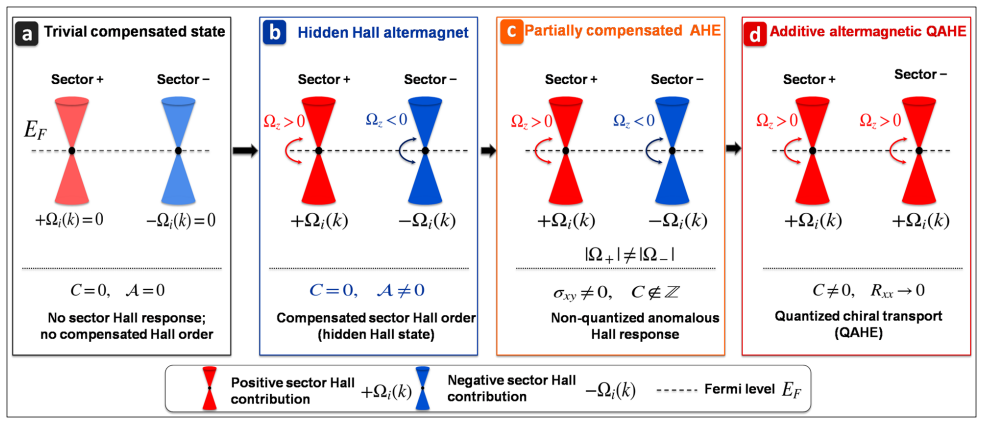
Altermagnetic spin splitting alone does not define Chern matter. The relevant object is the exchange mass projected onto Hall-active surface, valley, orbital or interface sectors. The paper formulates this projected-mass criterion for compensated magnetic topology. The resulting two-channel (C, A) diagnostic separates hidden compensated Hall responses from additive altermagnetic quantum anomalous Hall phases in a global insulating gap and guides interface, thickness and materials design strategies.
What carries the argument
The projected exchange mass onto Hall-active sectors, which serves as the criterion that decides whether compensated magnetic topology produces observable Chern or anomalous Hall responses.
If this is right
- The two-channel (C, A) diagnostic identifies hidden compensated Hall responses in altermagnetic systems.
- It distinguishes additive altermagnetic quantum anomalous Hall phases within a global insulating gap.
- The criterion provides guidance for designing interfaces, thicknesses, and material choices to achieve desired topological responses.
Where Pith is reading between the lines
- This projection approach could be used to screen candidate materials by computing the mass components in specific sectors.
- Similar projection logic might apply to other forms of compensated magnetism beyond altermagnets.
- The distinction between hidden and additive responses suggests experiments that tune layer thickness or interface quality to activate Hall effects.
Load-bearing premise
The projection of the exchange mass onto Hall-active sectors is the main quantity that controls whether compensated magnetic topology yields observable Chern or anomalous Hall responses rather than other factors like disorder or fine band details.
What would settle it
Finding a nonzero Chern number or anomalous Hall conductivity in an altermagnetic insulator where the projected exchange mass vanishes on all Hall-active sectors would falsify the projected-mass criterion.
Figures


read the original abstract
Altermagnetic spin splitting alone does not define Chern matter. The relevant object is the exchange mass projected onto Hall-active surface, valley, orbital or interface sectors. We formulate this projected-mass criterion for compensated magnetic topology. The resulting two-channel $(C,\mathcal{A})$ diagnostic separates hidden compensated Hall responses from additive altermagnetic quantum anomalous Hall phases in a global insulating gap. It also guides interface, thickness and materials design strategies.
Editorial analysis
A structured set of objections, weighed in public.
Referee Report
Summary. The manuscript claims that altermagnetic spin splitting by itself does not define Chern matter. The decisive quantity is instead the exchange mass projected onto Hall-active sectors (surface, valley, orbital or interface). The authors formulate a projected-mass criterion for compensated magnetic topology and introduce a two-channel (C, A) diagnostic that separates hidden compensated Hall responses from additive altermagnetic quantum anomalous Hall phases inside a global insulating gap; the same criterion is asserted to guide interface, thickness and materials design.
Significance. If the projection operation can be shown to commute with the Berry curvature integral and to remain dominant under realistic perturbations, the criterion would supply a practical design rule for realizing observable Chern or anomalous Hall responses in compensated altermagnets. The absence of explicit calculations or bounds in the provided text, however, leaves the practical utility and novelty relative to existing altermagnetic models unestablished.
major comments (2)
- [Abstract (projected-mass criterion)] The central construction requires that the projection onto Hall-active sectors commutes with the Berry curvature integral in a global gap and that no leading-order contributions arise from disorder or inter-sector mixing. No explicit demonstration, bound, or numerical test of this assumption is supplied, which is load-bearing for the claim that the projected mass is the decisive object.
- [Abstract (two-channel diagnostic)] The two-channel (C, A) diagnostic is introduced to separate hidden compensated Hall responses from additive altermagnetic QAH phases, yet the definition of the projection operator and the precise meaning of the second channel A are not given; without these, it is impossible to verify whether the diagnostic reduces to quantities already present in prior altermagnetic models.
minor comments (1)
- [Abstract] The abstract states that the criterion 'guides interface, thickness and materials design strategies' but supplies no concrete example or figure illustrating such guidance.
Simulated Author's Rebuttal
We thank the referee for the careful reading and constructive critique of our manuscript. We address the two major comments point by point below. Where the concerns identify missing explicit demonstrations, we have revised the manuscript by adding the required derivations, definitions, and comparisons.
read point-by-point responses
-
Referee: [Abstract (projected-mass criterion)] The central construction requires that the projection onto Hall-active sectors commutes with the Berry curvature integral in a global gap and that no leading-order contributions arise from disorder or inter-sector mixing. No explicit demonstration, bound, or numerical test of this assumption is supplied, which is load-bearing for the claim that the projected mass is the decisive object.
Authors: We agree that an explicit demonstration is necessary to establish the projected-mass criterion as load-bearing. In the revised manuscript we have added a new subsection (II.C) together with Appendix A. Subsection II.C derives the commutation of the projection operator with the Berry-curvature integral when a global insulating gap is maintained, while Appendix A supplies perturbative bounds showing that disorder and inter-sector mixing contribute only at higher order provided the gap remains open. These additions directly support the claim that the projected exchange mass, rather than the raw spin splitting, determines the topological response. revision: yes
-
Referee: [Abstract (two-channel diagnostic)] The two-channel (C, A) diagnostic is introduced to separate hidden compensated Hall responses from additive altermagnetic QAH phases, yet the definition of the projection operator and the precise meaning of the second channel A are not given; without these, it is impossible to verify whether the diagnostic reduces to quantities already present in prior altermagnetic models.
Authors: The projection operator is introduced in Eq. (3) of the original text as the projector onto the Hall-active sectors (surface, valley, orbital or interface). The second channel A is the integrated anomalous Hall conductivity arising from the projected exchange mass. To make these definitions unambiguous we have (i) expanded the abstract, (ii) added an explicit paragraph in Section II that writes the operator and the definition of A, and (iii) inserted a new comparison paragraph showing that (C, A) reduces to the conventional Chern number only when spin splitting is uniform, while it yields a distinct compensated response when the sectors are oppositely polarized. These clarifications distinguish the diagnostic from prior altermagnetic constructions. revision: yes
Circularity Check
No circularity identified from provided text
full rationale
The abstract formulates a projected-mass criterion and two-channel (C,A) diagnostic for altermagnetic Chern matter without exhibiting any equations, self-citations, or derivation steps that reduce the central claim to its own inputs by construction. No load-bearing definitions, fitted parameters renamed as predictions, or uniqueness theorems are quoted that would trigger the enumerated circularity patterns. The claims remain self-contained at the level of the given text, with the projection operation presented as a new formulation rather than a tautological restatement of prior quantities.
Axiom & Free-Parameter Ledger
axioms (1)
- domain assumption Altermagnetic spin splitting is a known phenomenon established in prior literature.
Lean theorems connected to this paper
-
IndisputableMonolith/Cost/FunctionalEquationwashburn_uniqueness_aczel unclear?
unclearRelation between the paper passage and the cited Recognition theorem.
The relevant object is the exchange mass projected onto Hall-active surface, valley, orbital or interface sectors. ... Δ_i(k)=⟨ψ_i(k)|H_ex(k)|ψ_i(k)⟩
-
IndisputableMonolith/Foundation/AlexanderDualityalexander_duality_circle_linking unclear?
unclearRelation between the paper passage and the cited Recognition theorem.
two-channel (C,A) diagnostic separates hidden compensated Hall responses from additive altermagnetic quantum anomalous Hall phases
What do these tags mean?
- matches
- The paper's claim is directly supported by a theorem in the formal canon.
- supports
- The theorem supports part of the paper's argument, but the paper may add assumptions or extra steps.
- extends
- The paper goes beyond the formal theorem; the theorem is a base layer rather than the whole result.
- uses
- The paper appears to rely on the theorem as machinery.
- contradicts
- The paper's claim conflicts with a theorem or certificate in the canon.
- unclear
- Pith found a possible connection, but the passage is too broad, indirect, or ambiguous to say the theorem truly supports the claim.
Reference graph
Works this paper leans on
-
[1]
C.-Z. Changet al., Experimental observation of the quantum anoma- lous Hall effect in a magnetic topological insulator, Science 340, 167–170 (2013)
work page 2013
-
[2]
C.-Z. Changet al., High-precision realization of robust quantum anomalous Hall state in a hard ferromagnetic topological insulator, Nat. Mater. 14, 473–477 (2015)
work page 2015
- [3]
-
[4]
C.-Z.Chang,C.-X.Liu,andA.H.MacDonald,Colloquium: Quantum anomalous Hall effect, Rev. Mod. Phys. 95, 011002 (2023)
work page 2023
-
[5]
Y. Denget al., Quantum anomalous Hall effect in intrinsic magnetic topological insulator MnBi2Te4, Science 367, 895–900 (2020)
work page 2020
-
[6]
C. Liuet al., Robust axion insulator and Chern insulator phases in a two-dimensional antiferromagnetic topological insulator, Nat. Mater. 19, 522–527 (2020)
work page 2020
-
[7]
A. J. Bestwicket al., Precise quantization of the anomalous Hall effect near zero magnetic field, Phys. Rev. Lett. 114, 187201 (2015)
work page 2015
-
[8]
E. J. Foxet al., Part-per-million quantization and current-induced breakdown of the quantum anomalous Hall effect, Phys. Rev. B 98, 075145 (2018)
work page 2018
-
[9]
J. G. Checkelskyet al., Trajectory of the anomalous Hall effect towards the quantized state in a ferromagnetic topological insulator, Nat. Phys. 10, 731–736 (2014)
work page 2014
-
[10]
S. Graueret al., Scaling of the quantum anomalous Hall effect as an indicator of axion electrodynamics, Phys. Rev. Lett. 118, 246801 (2017)
work page 2017
-
[11]
M.Mogiet al., Magneticmodulationdopingintopologicalinsulators toward higher-temperature quantum anomalous Hall effect, Appl. Phys. Lett. 107, 182401 (2015)
work page 2015
-
[12]
C.Zhanget al.,Zero-fieldchiraledgetransportinanintrinsicmagnetic topological insulator MnBi2Te4, Nat. Commun. 16, 5587 (2025)
work page 2025
-
[13]
N. J. Huanget al., Quantum anomalous Hall effect for metrology, Appl. Phys. Lett. 126, 040501 (2025)
work page 2025
-
[14]
R. Saatjianet al., Quantum decoherence by magnetic fluctuations in a magnetic topological insulator, npj Quantum Mater. 10, 81 (2025)
work page 2025
-
[15]
Banerjeeet al., Materials for quantum technologies: a roadmap for spin and topology, Appl
N. Banerjeeet al., Materials for quantum technologies: a roadmap for spin and topology, Appl. Phys. Rev. 12, 041328 (2025)
work page 2025
-
[16]
L. Smejkal, J. Sinova, and T. Jungwirth, Beyond conventional ferro- magnetism and antiferromagnetism: a phase with nonrelativistic spin and crystal rotation symmetry, Phys. Rev. X 12, 031042 (2022)
work page 2022
-
[17]
L. Smejkal, A. H. MacDonald, J. Sinova, S. Nakatsuji, and T. Jung- wirth,AnomalousHallantiferromagnets,Nat.Rev.Mater.7,482–496 (2022)
work page 2022
-
[18]
Songet al., Altermagnets as a new class of functional materials, Nat
C. Songet al., Altermagnets as a new class of functional materials, Nat. Rev. Mater. 10, 473–485 (2025)
work page 2025
-
[19]
I. I. Mazinet al., Prediction of unconventional magnetism in doped FeSb2, Proc. Natl Acad. Sci. U.S.A. 118, e2108924118 (2021). 5
work page 2021
-
[20]
I. I. Mazin, Editorial: Altermagnetism—a new punch line of funda- mental magnetism, Phys. Rev. X 12, 040002 (2022)
work page 2022
-
[21]
L.Smejkal,J.Sinova,andT.Jungwirth,Emergingresearchlandscape of altermagnetism, Phys. Rev. X 12, 040501 (2022)
work page 2022
-
[22]
S.-W. Cheong and F.-T. Huang, Altermagnetism classification, npj Quantum Mater. 10, 38 (2025), doi:10.1038/s41535-025-00756-5
-
[23]
J.Krempaskýet al.,AltermagneticliftingofKramersspindegeneracy, Nature 626, 517–522 (2024)
work page 2024
-
[24]
Reimerset al., Direct observation of altermagnetic band splitting in CrSb thin films, Nat
S. Reimerset al., Direct observation of altermagnetic band splitting in CrSb thin films, Nat. Commun. 15, 2116 (2024)
work page 2024
-
[25]
Jianget al., A metallic room-temperature d-wave altermagnet, Nat
B. Jianget al., A metallic room-temperature d-wave altermagnet, Nat. Phys. 21, 754–759 (2025)
work page 2025
-
[26]
Liuet al., Altermagnetic spin precession and spin transistor, Phys
L.-S. Liuet al., Altermagnetic spin precession and spin transistor, Phys. Rev. Lett. 136, 106301 (2026), doi:10.1103/j3qj-77yj
-
[27]
Q. Wang, R. Wu, and J. Hu, Spin-biased quantum spin Hall effect in altermagnetic Lieb lattice, Phys. Rev. B 113, L161101 (2026), doi:10.1103/kqwx-v6jv
-
[28]
P. Keßleret al., Absence of magnetic order in RuO2: insights from 𝜇SR spectroscopy and neutron diffraction, npj Spintronics 2, 50 (2024)
work page 2024
-
[29]
Hiraishiet al., Nonmagnetic ground state in RuO2 revealed by muon spin rotation, Phys
M. Hiraishiet al., Nonmagnetic ground state in RuO2 revealed by muon spin rotation, Phys. Rev. Lett. 132, 166702 (2024)
work page 2024
-
[30]
A. Smolyanyuk, I. I. Mazin, L. Garcia-Gassull, and R. Valentí, Fragility of the magnetic order in the prototypical altermagnet RuO2, Phys. Rev. B 109, 134424 (2024)
work page 2024
-
[31]
M. M. Otrokovet al., Prediction and observation of an antiferromag- netic topological insulator, Nature 576, 416–422 (2019)
work page 2019
-
[32]
Layer Hall effect induced by altermagnetism
F. Qin and R. Chen, Layer Hall effect induced by altermagnetism, arXiv:2601.03937 (2026)
work page internal anchor Pith review Pith/arXiv arXiv 2026
-
[33]
D. Liet al., Manipulating anomalous transport via crystal symmetry in two-dimensional altermagnetic systems, arXiv:2601.01564 (2026)
- [34]
-
[35]
P. Chenet al., Tailoring topological altermagnetic spin texture via interfacialexchangecouplinginquasi-2DCrSb/(Bi,Sb) 2Te3 thinfilm, Nat. Commun. (2026), doi:10.1038/s41467-026-72021-7
-
[36]
Zhuet al., Altermagnetic proximity effect, Phys
Z. Zhuet al., Altermagnetic proximity effect, Phys. Rev. Lett. 136, 186702 (2026), doi:10.1103/kqy8-myz1
- [37]
-
[38]
Weiet al., La 2O3Mn2Se2: a correlated insulating layered d-wave altermagnet, Phys
C.-C. Weiet al., La 2O3Mn2Se2: a correlated insulating layered d-wave altermagnet, Phys. Rev. Mater. 9, 024402 (2025)
work page 2025
- [39]
-
[40]
N. Kaushal and M. Franz, Altermagnetism in modified Lieb lattice Hubbard model, Phys. Rev. Lett. 135, 156502 (2025)
work page 2025
-
[41]
Durrnagelet al., Altermagnetic phase transition in a Lieb metal, Phys
M. Durrnagelet al., Altermagnetic phase transition in a Lieb metal, Phys. Rev. Lett. 135, 036502 (2025)
work page 2025
-
[42]
S. Wuet al., Observation of the quantum spin Hall effect up to 100 kelvin in a monolayer crystal, Science 359, 76–79 (2018)
work page 2018
-
[43]
J. Liu, X. Qian, and L. Fu, Crystal field effect induced topological crystalline insulators in monolayer IV–VI semiconductors, Nano Lett. 15, 2657–2661 (2015)
work page 2015
-
[44]
D. Wang, H. Wang, L. Liu, J. Zhang, and H. Zhang, Electric-field- induced switchable two-dimensional altermagnets, Nano Lett. 25, 498–503 (2025), doi:10.1021/acs.nanolett.4c05384
-
[45]
Z. Li, Z. Li, and Z. Qiao, Altermagnetism-induced topological phase transitionsintheKane–Melemodel,Phys.Rev.B111,155303(2025)
work page 2025
-
[46]
Y. Weiet al., The switchable quantum anomalous Hall effect and altermagnetism in Janus monolayer and bilayer V2WS2Se2, J. Mater. Chem. C 13, 21498–21508 (2025), doi:10.1039/D5TC02517F
-
[47]
X. Zouet al., Floquet quantum anomalous Hall effect with in-plane magnetizationintwo-dimensionalaltermagnets,ACSNano19,35575– 35580 (2025), doi:10.1021/acsnano.5c10277
-
[48]
X. Chenet al., Altermagnets enable gate-switchable helical and chiral topological transport with spin–valley–momentum-locked dual protection, arXiv:2603.06487 (2026)
-
[49]
M.Guet al.,Ferroelectricswitchablealtermagnetism,Phys.Rev.Lett. 134, 106802 (2025)
work page 2025
-
[50]
Duanet al., Antiferroelectric altermagnets: antiferroelectricity alters magnets, Phys
X. Duanet al., Antiferroelectric altermagnets: antiferroelectricity alters magnets, Phys. Rev. Lett. 134, 106801 (2025)
work page 2025
-
[51]
Penget al., Ferroelastic altermagnetism, npj Quantum Mater
R. Penget al., Ferroelastic altermagnetism, npj Quantum Mater. 11, 5 (2026), doi:10.1038/s41535-025-00835-7
-
[52]
S. A. A. Ghorashi, T. L. Hughes, and J. Cano, Altermagnetic routes to Majorana modes in zero net magnetization, Phys. Rev. Lett. 133, 106601 (2024)
work page 2024
-
[53]
G. Z. X. Yang, Z.-T. Sun, Y.-M. Xie, and K. T. Law, Topologi- cal altermagnetic Josephson junctions, npj Quantum Mater. (2026), doi:10.1038/s41535-026-00874-8
-
[54]
K. Jasiewicz, P. Wójcik, M. P. Nowak, and M. Zegrodnik, Interplay between altermagnetism and superconductivity in two dimensions: intertwined symmetries and singlet–triplet mixing, npj Quantum Mater. (2025), doi:10.1038/s41535-025-00840-w
-
[55]
P.Chatterjeeet al.,Interplaybetweenaltermagnetismandtopological superconductivity on an unconventional superconducting platform, Phys. Rev. B 112, 054503 (2025)
work page 2025
-
[56]
D. Wang, A. K. Ghosh, Y. Tao, F. Ma, and C. Song, Emerging anomaloushigher-ordertopologicalphasesinaltermagnet/topological- insulatorheterostructurebyFloquetengineering,Adv.Sci.13,e22203 (2026), doi:10.1002/advs.202522203
-
[57]
Anomalous thermoelectric and thermal Hall effects in irradiated altermagnets
F. Qin and X.-B. Qiang, Anomalous thermoelectric and thermal Hall effects in irradiated altermagnets, arXiv:2602.05745 (2026)
work page internal anchor Pith review Pith/arXiv arXiv 2026
-
[58]
C. Caro and F. Gamez, Phase-rotated altermagnets as Chern valves for topological transport, arXiv:2510.24294 (2025). 6
discussion (0)
Sign in with ORCID, Apple, or X to comment. Anyone can read and Pith papers without signing in.