Recognition: no theorem link
Anomalous thermoelectric and thermal Hall effects in irradiated altermagnets
Pith reviewed 2026-05-16 07:00 UTC · model grok-4.3
The pith
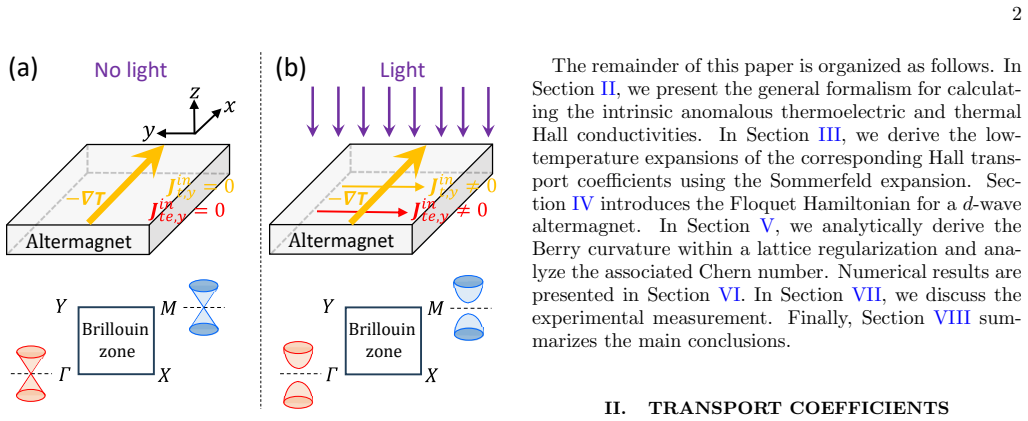
Irradiating a d-wave altermagnet with elliptically polarized light transforms it into a Chern insulator that exhibits anomalous thermoelectric and thermal Hall effects.
A machine-rendered reading of the paper's core claim, the machinery that carries it, and where it could break.
Core claim
A d-wave altermagnet irradiated by elliptically polarized high-frequency light acquires a Chern insulating character through the opening of a topological gap at the M point while the underlying altermagnetic order remains intact. In this phase the intrinsic thermoelectric Hall conductivity is linear in temperature away from the gap but drops to zero inside it, and the thermal Hall conductivity becomes quantized, furnishing clear signatures of the light-induced topology.
What carries the argument
The light-induced topological gap at the M point, opened by the elliptically polarized photon beam, which endows the altermagnet with a nonzero Chern number while preserving its magnetic order.
If this is right
- The thermoelectric Hall coefficient is linear in temperature at low T but vanishes inside the induced gap and peaks at the gap boundaries near M and Gamma.
- The thermal Hall coefficient becomes quantized throughout the bandwidth once the Chern phase is realized.
- Thermoelectric and thermal Hall measurements can distinguish the light-induced topological gap from any trivial gap that might appear under the same drive.
- These transport signatures remain robust as long as the altermagnetic order survives the irradiation.
Where Pith is reading between the lines
- The same irradiation protocol could be applied to other altermagnetic symmetries to produce different Chern numbers or even higher-order topological phases.
- Quantized thermal Hall response in a zero-static-field platform might enable compact topological thermoelectric devices.
- Sweeping light intensity or polarization angle should produce a tunable gap size whose closure would be visible as a divergence in the thermoelectric Hall peaks.
Load-bearing premise
High-frequency elliptically polarized light opens a topological gap at the M point while preserving the altermagnetic order and without causing significant heating or decoherence.
What would settle it
A low-temperature measurement showing whether the thermal Hall conductivity is quantized to a nonzero integer multiple of k_B^2 T / h across the bandwidth would confirm or refute the Chern insulating phase.
Figures


read the original abstract
We show that a $d$-wave altermagnet can be transformed into a Chern insulator by irradiating it with elliptically polarized light from a high-frequency photon beam. We further explore the intrinsic anomalous thermoelectric and thermal Hall effects in light-irradiated altermagnets. At low temperatures, the thermoelectric Hall coefficient exhibits a linear temperature dependence but vanishes within the energy gap between the conduction and valence bands near the $M$ point. However, it displays pronounced peaks and dips at the gap boundaries near both the $M$ and $\Gamma$ points, suggesting that thermoelectric Hall conductivity is a sensitive probe for these gapped regions. Similarly, the low-temperature thermal Hall coefficient, which also shows a linear temperature dependence, becomes quantized across the bandwidth, reflecting the underlying topological character of the light-induced Chern insulating phase. These results establish thermoelectric and thermal Hall transports as powerful signatures of topology in driven altermagnetic systems.
Editorial analysis
A structured set of objections, weighed in public.
Referee Report
Summary. The manuscript claims that high-frequency elliptically polarized light drives a d-wave altermagnet into a Chern insulator by opening a topological gap at the M point while preserving altermagnetic order; it then computes the resulting anomalous thermoelectric Hall and thermal Hall effects, reporting linear-in-T behavior at low temperature, peaks/dips at gap edges near M and Γ, and quantization of the thermal Hall coefficient across the bandwidth as a signature of the induced topology.
Significance. If the Floquet-induced Chern phase is rigorously established, the work would provide a concrete light-control protocol for realizing Chern insulators in altermagnets and position thermoelectric and thermal Hall transport as sensitive, experimentally accessible diagnostics of the light-induced topology, with relevance to driven topological spintronics.
major comments (2)
- [Abstract and §3] Abstract and §3 (model and Floquet drive): the central claim that elliptically polarized high-frequency light produces a Chern insulator rests on an unshown high-frequency expansion (Magnus/van Vleck) of the time-periodic Hamiltonian; no explicit effective Hamiltonian, value of the induced gap Δ relative to ħω, or direct computation of the Berry curvature integral yielding a nonzero Chern number is provided, leaving the topological character unverified.
- [§4.2] §4.2 (thermal Hall conductivity): the assertion that the low-T thermal Hall coefficient becomes quantized across the bandwidth is load-bearing for the topological interpretation, yet no explicit integration of the Berry curvature over the Brillouin zone or confirmation that higher-order 1/ω corrections preserve the invariant is shown; without this the quantization cannot be confirmed from the effective model.
minor comments (2)
- [Abstract] Abstract: the statement that the thermoelectric Hall coefficient 'vanishes within the energy gap' should specify whether this refers to the conductivity or the coefficient itself, and clarify the precise temperature window.
- [§4 and figures] Figure captions and §4: several plots of Hall coefficients versus temperature or chemical potential lack explicit labels for the driving parameters (frequency, intensity, ellipticity) used, making it difficult to assess the regime of validity.
Simulated Author's Rebuttal
We thank the referee for the detailed and constructive report. The comments highlight the need for explicit derivations to rigorously support the topological claims. We will revise the manuscript to include the missing details on the Floquet expansion and Berry curvature calculations, thereby strengthening the evidence for the light-induced Chern phase and its transport signatures.
read point-by-point responses
-
Referee: [Abstract and §3] Abstract and §3 (model and Floquet drive): the central claim that elliptically polarized high-frequency light produces a Chern insulator rests on an unshown high-frequency expansion (Magnus/van Vleck) of the time-periodic Hamiltonian; no explicit effective Hamiltonian, value of the induced gap Δ relative to ħω, or direct computation of the Berry curvature integral yielding a nonzero Chern number is provided, leaving the topological character unverified.
Authors: We agree that the high-frequency expansion was not presented explicitly. In the revised manuscript we will add the Magnus/van Vleck expansion of the time-periodic Hamiltonian, derive the effective static Hamiltonian, give the explicit expression for the light-induced gap Δ at the M point in terms of the drive amplitude and ħω, and compute the Berry curvature integral over the Brillouin zone to obtain the Chern number (which equals ±1). These additions will directly verify the Chern-insulating character. revision: yes
-
Referee: [§4.2] §4.2 (thermal Hall conductivity): the assertion that the low-T thermal Hall coefficient becomes quantized across the bandwidth is load-bearing for the topological interpretation, yet no explicit integration of the Berry curvature over the Brillouin zone or confirmation that higher-order 1/ω corrections preserve the invariant is shown; without this the quantization cannot be confirmed from the effective model.
Authors: We acknowledge the omission. The revised version will include an explicit plot and integration of the Berry curvature over the full Brillouin zone, confirming that the thermal Hall conductivity is quantized to the expected value set by the Chern number at low temperature. We will also add a brief discussion (supported by a perturbative estimate) showing that, within the high-frequency regime used in the paper, the leading 1/ω corrections do not close the gap or change the topological invariant for the parameter range considered. revision: yes
Circularity Check
No circularity: standard Floquet + topological transport applied to altermagnet
full rationale
The derivation applies the high-frequency Magnus/van Vleck expansion to a time-periodic Hamiltonian for an elliptically polarized drive on a d-wave altermagnet, obtains an effective static Hamiltonian, computes its Berry curvature to identify a Chern insulator, and then evaluates thermoelectric and thermal Hall conductivities from the resulting bands using standard Kubo or semiclassical formulas. None of these steps define a quantity in terms of itself, rename a fitted parameter as a prediction, or rest on a load-bearing self-citation whose validity is presupposed by the present work. The effective Chern number and transport coefficients are computed from the explicit effective Hamiltonian rather than assumed; the paper therefore remains self-contained against external benchmarks (Floquet theory, Chern-number integrability, and linear-response transport).
Axiom & Free-Parameter Ledger
free parameters (1)
- light frequency, intensity, and ellipticity parameters
axioms (2)
- standard math Floquet theory applies to the time-periodic light driving of the electronic system
- domain assumption The d-wave altermagnet possesses band crossings at M and Gamma points that can be gapped topologically by the drive
Forward citations
Cited by 1 Pith paper
-
From spin splitting to projected mass in altermagnetic Chern matter
Altermagnetic Chern matter is defined by a projected exchange mass on Hall-active sectors rather than spin splitting alone, yielding a two-channel (C, A) diagnostic that separates hidden compensated Hall responses fro...
Reference graph
Works this paper leans on
-
[1]
Berry-Phase Effect in Anomalous Thermoelectric Transport,
Di Xiao, Yugui Yao, Zhong Fang, and Qian Niu, “Berry-Phase Effect in Anomalous Thermoelectric Transport,” Phys. Rev. Lett.97, 026603 (2006)
work page 2006
-
[2]
Transverse magnetic heat transport on the surface of a topological insulator,
Takehito Yokoyama and Shuichi Murakami, “Transverse magnetic heat transport on the surface of a topological insulator,” Phys. Rev. B83, 161407 (2011)
work page 2011
-
[3]
Xiao-Bin Qiang, Z. Z. Du, Hai-Zhou Lu, and X. C. Xie, “Topological and disorder corrections to the transverse Wiedemann-Franz law and Mott relation in kagome magnets and Dirac materials,” Phys. Rev. B107, L161302 (2023)
work page 2023
-
[4]
The chiral anomaly and thermopower of Weyl fermions in the half-Heusler GdPtBi,
Max Hirschberger, Satya Kushwaha, Zhijun Wang, Quinn Gibson, Sihang Liang, Carina A Belvin, Bog- dan Andrei Bernevig, Robert J Cava, and Nai Phuan Ong, “The chiral anomaly and thermopower of Weyl fermions in the half-Heusler GdPtBi,” Nature materials 15, 1161 (2016)
work page 2016
-
[5]
Topolog- ical thermoelectrics,
Chenguang Fu, Yan Sun, and Claudia Felser, “Topolog- ical thermoelectrics,” APL Materials8, 040913 (2020)
work page 2020
-
[6]
Anomalous photo-thermal effects in multi-layered semi-Dirac black phosphorus,
Parijat Sengupta and Luis A Jauregui, “Anomalous photo-thermal effects in multi-layered semi-Dirac black phosphorus,” Journal of Applied Physics130, 054303 (2021)
work page 2021
-
[7]
H. Zhang, C. Q. Xu, and X. Ke, “Topological Nernst effect, anomalous Nernst effect, and anomalous thermal Hall effect in the Dirac semimetal Fe 3Sn2,” Phys. Rev. B103, L201101 (2021)
work page 2021
-
[8]
Anomalous transport due to Weyl fermions in the chiral antiferromagnets Mn 3X, X= Sn, Ge,
Taishi Chen, Takahiro Tomita, Susumu Minami, Mingx- uan Fu, Takashi Koretsune, Motoharu Kitatani, Ikhlas Muhammad, Daisuke Nishio-Hamane, Rieko Ishii, Fu- miyuki Ishii,et al., “Anomalous transport due to Weyl fermions in the chiral antiferromagnets Mn 3X, X= Sn, Ge,” Nature communications12, 572 (2021)
work page 2021
-
[9]
Giant anomalous Nernst sig- nal in the antiferromagnet YbMnBi2,
Yu Pan, Congcong Le, Bin He, Sarah J Watzman, Mengyu Yao, Johannes Gooth, Joseph P Heremans, Yan Sun, and Claudia Felser, “Giant anomalous Nernst sig- nal in the antiferromagnet YbMnBi2,” Nature materials 21, 203 (2022)
work page 2022
-
[10]
Observation of the anomalous Nernst effect in altermagnetic candidate Mn5Si3,
Anton´ ın Badura, Warlley H Campos, Venkata K Bharadwaj, Isma¨ ıla Kounta, Lisa Michez, Matthieu Pe- tit, Javier Rial, Miina Leivisk¨ a, Vincent Baltz, Filip Krizek,et al., “Observation of the anomalous Nernst effect in altermagnetic candidate Mn5Si3,” Nature Com- munications16, 7111 (2025)
work page 2025
-
[11]
Crystal Thermal Transport in Altermag- netic RuO2,
Xiaodong Zhou, Wanxiang Feng, Run-Wu Zhang, Li- bor ˇSmejkal, Jairo Sinova, Yuriy Mokrousov, and Yugui Yao, “Crystal Thermal Transport in Altermag- netic RuO2,” Phys. Rev. Lett.132, 056701 (2024)
work page 2024
-
[12]
Nonvolatile anomalous Nernst ef- fect in Mn5Si3 with a collinear N´ eel vector,
L. Han, X.Z. Fu, W.Q. He, J.K. Dai, Y.X. Zhu, W.F. Yang, Y.L. Chen, J.C. Zhang, W.X. Zhu, H. Bai, C. Chen, D.Z. Hou, C.H. Wan, X.F. Han, C. Song, J.W. Liu, and F. Pan, “Nonvolatile anomalous Nernst ef- fect in Mn5Si3 with a collinear N´ eel vector,” Phys. Rev. Appl.23, 044066 (2025)
work page 2025
-
[13]
Dynamic Gen- eration of Spin-Orbit Coupling,
Congjun Wu and Shou-Cheng Zhang, “Dynamic Gen- eration of Spin-Orbit Coupling,” Phys. Rev. Lett.93, 036403 (2004)
work page 2004
-
[14]
Fermi liquid instabilities in the spin channel,
Congjun Wu, Kai Sun, Eduardo Fradkin, and Shou- Cheng Zhang, “Fermi liquid instabilities in the spin channel,” Phys. Rev. B75, 115103 (2007)
work page 2007
-
[15]
Theory of uncon- ventional metamagnetic electron states in orbital band systems,
Wei-Cheng Lee and Congjun Wu, “Theory of uncon- ventional metamagnetic electron states in orbital band systems,” Phys. Rev. B80, 104438 (2009)
work page 2009
-
[16]
Un- conventional magnetism in spin-orbit coupled systems,
Jian-Keng Yuan, Zhiming Pan, and Congjun Wu, “Un- conventional magnetism in spin-orbit coupled systems,” Phys. Rev. B113, 014426 (2026)
work page 2026
-
[17]
Momentum-dependent spin splitting by collinear anti- ferromagnetic ordering,
Satoru Hayami, Yuki Yanagi, and Hiroaki Kusunose, “Momentum-dependent spin splitting by collinear anti- ferromagnetic ordering,” Journal of the Physical Society of Japan88, 123702 (2019)
work page 2019
-
[18]
Satoru Hayami, Yuki Yanagi, and Hiroaki Kusunose, “Bottom-up design of spin-split and reshaped electronic band structures in antiferromagnets without spin-orbit coupling: Procedure on the basis of augmented multi- poles,” Phys. Rev. B102, 144441 (2020)
work page 2020
-
[19]
Multifunctional antiferromagnetic materials with giant piezomagnetism and noncollinear spin current,
Hai-Yang Ma, Mengli Hu, Nana Li, Jianpeng Liu, Wang Yao, Jin-Feng Jia, and Junwei Liu, “Multifunctional antiferromagnetic materials with giant piezomagnetism and noncollinear spin current,” Nature communications 12, 2846 (2021)
work page 2021
-
[20]
Altermagnets as a new class of functional materials,
Cheng Song, Hua Bai, Zhiyuan Zhou, Lei Han, Helena Reichlova, J Hugo Dil, Junwei Liu, Xianzhe Chen, and Feng Pan, “Altermagnets as a new class of functional materials,” Nature Reviews Materials10, 473 (2025)
work page 2025
-
[21]
Chemi- cal design of monolayer altermagnets,
Runzhang Xu, Yifan Gao, and Junwei Liu, “Chemi- cal design of monolayer altermagnets,” National Science Review13, nwaf528 (2026). 8
work page 2026
-
[22]
Catalog ofC-Paired Spin-Momentum Lock- ing in Antiferromagnetic Systems,
Mengli Hu, Xingkai Cheng, Zhenqiao Huang, and Jun- wei Liu, “Catalog ofC-Paired Spin-Momentum Lock- ing in Antiferromagnetic Systems,” Phys. Rev. X15, 021083 (2025)
work page 2025
-
[23]
Libor ˇSmejkal, Anna Birk Hellenes, Rafael Gonz´ alez- Hern´ andez, Jairo Sinova, and Tomas Jungwirth, “Giant and Tunneling Magnetoresistance in Unconventional Collinear Antiferromagnets with Nonrelativistic Spin- Momentum Coupling,” Phys. Rev. X12, 011028 (2022)
work page 2022
-
[24]
Libor ˇSmejkal, Jairo Sinova, and Tomas Jungwirth, “Beyond Conventional Ferromagnetism and Antiferro- magnetism: A Phase with Nonrelativistic Spin and Crystal Rotation Symmetry,” Phys. Rev. X12, 031042 (2022)
work page 2022
-
[25]
Emerging Research Landscape of Altermagnetism,
Libor ˇSmejkal, Jairo Sinova, and Tomas Jungwirth, “Emerging Research Landscape of Altermagnetism,” Phys. Rev. X12, 040501 (2022)
work page 2022
-
[26]
Altermagnetism in MnTe: Origin, pre- dicted manifestations, and routes to detwinning,
I. I. Mazin, “Altermagnetism in MnTe: Origin, pre- dicted manifestations, and routes to detwinning,” Phys. Rev. B107, L100418 (2023)
work page 2023
-
[27]
Altermagnetic lifting of Kramers spin degeneracy,
J Krempask` y, L ˇSmejkal, SW D’souza, M Hajlaoui, G Springholz, K Uhl´ ıˇ rov´ a, F Alarab, PC Constantinou, V Strocov, D Usanov,et al., “Altermagnetic lifting of Kramers spin degeneracy,” Nature626, 517 (2024)
work page 2024
-
[28]
Broken Kramers Degen- eracy in Altermagnetic MnTe,
Suyoung Lee, Sangjae Lee, Saegyeol Jung, Jiwon Jung, Donghan Kim, Yeonjae Lee, Byeongjun Seok, Jaeyoung Kim, Byeong Gyu Park, Libor ˇSmejkal, Chang-Jong Kang, and Changyoung Kim, “Broken Kramers Degen- eracy in Altermagnetic MnTe,” Phys. Rev. Lett.132, 036702 (2024)
work page 2024
-
[29]
Observation of a giant band splitting in altermagnetic MnTe,
T. Osumi, S. Souma, T. Aoyama, K. Yamauchi, A. Honma, K. Nakayama, T. Takahashi, K. Ohgushi, and T. Sato, “Observation of a giant band splitting in altermagnetic MnTe,” Phys. Rev. B109, 115102 (2024)
work page 2024
-
[30]
Magne- tocaloric effect for the altermagnetic candidate MnTe,
N. N. Orlova, V. D. Esin, A. V. Timonina, N. N. Kolesnikov, and E. V. Deviatov, “Magne- tocaloric effect for the altermagnetic candidate MnTe,” arXiv:2510.02777 (2025)
-
[31]
Direct observation of altermagnetic band splitting in CrSb thin films,
Sonka Reimers, Lukas Odenbreit, Libor ˇSmejkal, Vladimir N Strocov, Procopios Constantinou, Anna B Hellenes, Rodrigo Jaeschke Ubiergo, Warlley H Cam- pos, Venkata K Bharadwaj, Atasi Chakraborty,et al., “Direct observation of altermagnetic band splitting in CrSb thin films,” Nature Communications15, 2116 (2024)
work page 2024
-
[32]
Large Band Splitting ing-Wave Altermagnet CrSb,
Jianyang Ding, Zhicheng Jiang, Xiuhua Chen, Zicheng Tao, Zhengtai Liu, Tongrui Li, Jishan Liu, Jianping Sun, Jinguang Cheng, Jiayu Liu, Yichen Yang, Runfeng Zhang, Liwei Deng, Wenchuan Jing, Yu Huang, Yum- ing Shi, Mao Ye, Shan Qiao, Yilin Wang, Yanfeng Guo, Donglai Feng, and Dawei Shen, “Large Band Splitting ing-Wave Altermagnet CrSb,” Phys. Rev. Lett.13...
work page 2024
-
[33]
Scaling behavior of magnetoresistance and Hall resistivity in the altermagnet CrSb,
Xin Peng, Yuzhi Wang, Shengnan Zhang, Yi Zhou, Yuran Sun, Yahui Su, Chunxiang Wu, Tingyu Zhou, Le Liu, Hangdong Wang, Jinhu Yang, Bin Chen, Zhong Fang, Jianhua Du, Zhiwei Jiao, Quansheng Wu, and Minghu Fang, “Scaling behavior of magnetoresistance and Hall resistivity in the altermagnet CrSb,” Phys. Rev. B111, 144402 (2025)
work page 2025
-
[34]
Manipulation of the altermagnetic order in CrSb via crystal symmetry,
Zhiyuan Zhou, Xingkai Cheng, Mengli Hu, Ruiyue Chu, Hua Bai, Lei Han, Junwei Liu, Feng Pan, and Cheng Song, “Manipulation of the altermagnetic order in CrSb via crystal symmetry,” Nature638, 645 (2025)
work page 2025
-
[35]
Pre- diction of unconventional magnetism in doped FeSb 2,
Igor I Mazin, Klaus Koepernik, Michelle D Johannes, Rafael Gonz´ alez-Hern´ andez, and LiborˇSmejkal, “Pre- diction of unconventional magnetism in doped FeSb 2,” Proceedings of the National Academy of Sciences118, e2108924118 (2021)
work page 2021
-
[36]
Intrinsic anomalous Hall effect in altermagnets,
Lotan Attias, Alex Levchenko, and Maxim Khodas, “Intrinsic anomalous Hall effect in altermagnets,” Phys. Rev. B110, 094425 (2024)
work page 2024
-
[37]
Cole Phillips, Ganesh Pokharel, Kyryl Shtefiienko, Sha- lika R. Bhandari, David E. Graf, D. P. Rai, and Ke- shav Shrestha, “Electronic structure of the altermagnet candidate FeSb2: High-field torque magnetometry and density functional theory studies,” Phys. Rev. B111, 075141 (2025)
work page 2025
-
[38]
Anisotropy of the anomalous Hall effect in thin films of the altermagnet candidate Mn5Si3,
Miina Leivisk¨ a, Javier Rial, Anton´ ın Bad’ura, Rafael Lopes Seeger, Isma¨ ıla Kounta, Sebastian Beckert, Dominik Kriegner, Isabelle Joumard, Eva Schmoranzerov´ a, Jairo Sinova, Olena Gomonay, Andy Thomas, Sebastian T. B. Goennenwein, Helena Re- ichlov´ a, LiborˇSmejkal, Lisa Michez, Tom´ aˇ s Jungwirth, and Vincent Baltz, “Anisotropy of the anomalous H...
work page 2024
-
[39]
Obser- vation of a spontaneous anomalous Hall response in the Mn5Si3 d-wave altermagnet candidate,
Helena Reichlova, Rafael Lopes Seeger, Rafael Gonz´ alez-Hern´ andez, Ismaila Kounta, Richard Schlitz, Dominik Kriegner, Philipp Ritzinger, Michaela Lam- mel, Miina Leivisk¨ a, Anna Birk Hellenes,et al., “Obser- vation of a spontaneous anomalous Hall response in the Mn5Si3 d-wave altermagnet candidate,” Nature Com- munications15, 4961 (2024)
work page 2024
-
[40]
Altermagnetic variants in thin films of Mn 5Si3,
Javier Rial, Miina Leivisk¨ a, Gregor Skobjin, An- ton´ ın Bad’ura, Gilles Gaudin, Florian Disdier, Richard Schlitz, Isma¨ ıla Kounta, Sebastian Beckert, Dominik Kriegner, Andy Thomas, Eva Schmoranzerov´ a, Libor ˇSmejkal, Jairo Sinova, Tom´ a ˇ s Jungwirth, Lisa Michez, Helena Reichlov´ a, Sebastian T. B. Goennenwein, Olena Gomonay, and Vincent Baltz, “A...
work page 2024
-
[41]
Electrical 180 switching of N´ eel vector in spin-splitting antiferromagnet,
Lei Han, Xizhi Fu, Rui Peng, Xingkai Cheng, Jiankun Dai, Liangyang Liu, Yidian Li, Yichi Zhang, Wenxuan Zhu, Hua Bai,et al., “Electrical 180 switching of N´ eel vector in spin-splitting antiferromagnet,” Science Ad- vances10, eadn0479 (2024)
work page 2024
-
[42]
Exploration of altermag- netism in RuO 2,
Yu-Xin Li, Yiyuan Chen, Liqing Pan, Shuai Li, Song- Bo Zhang, and Hai-Zhou Lu, “Exploration of altermag- netism in RuO 2,” arXiv:2509.19932 (2025)
-
[43]
Antiferromagnetism in RuO 2 asd-wave Pomeranchuk instability,
Kyo-Hoon Ahn, Atsushi Hariki, Kwan-Woo Lee, and Jan Kuneˇ s, “Antiferromagnetism in RuO 2 asd-wave Pomeranchuk instability,” Phys. Rev. B99, 184432 (2019)
work page 2019
-
[44]
Crystal time-reversal symmetry breaking and spontaneous Hall effect in collinear antiferromagnets,
Libor ˇSmejkal, Rafael Gonz´ alez-Hern´ andez, Tom´ aˇ s Jungwirth, and Jairo Sinova, “Crystal time-reversal symmetry breaking and spontaneous Hall effect in collinear antiferromagnets,” Science advances6, eaaz8809 (2020)
work page 2020
-
[45]
Spin-neutral cur- rents for spintronics,
Ding-Fu Shao, Shu-Hui Zhang, Ming Li, Chang-Beom Eom, and Evgeny Y Tsymbal, “Spin-neutral cur- rents for spintronics,” Nature Communications12, 7061 (2021)
work page 2021
-
[46]
Efficient Electrical Spin Splitter Based on Nonrelativistic Collinear Antiferro- 9 magnetism,
Rafael Gonz´ alez-Hern´ andez, Libor ˇSmejkal, Karel V´ yborn´ y, Yuta Yahagi, Jairo Sinova, Tom´ a ˇ s Jung- wirth, and Jakub ˇZelezn´ y, “Efficient Electrical Spin Splitter Based on Nonrelativistic Collinear Antiferro- 9 magnetism,” Phys. Rev. Lett.126, 127701 (2021)
work page 2021
-
[47]
Tilted spin current generated by the collinear antiferromagnet ruthenium dioxide,
Arnab Bose, Nathaniel J Schreiber, Rakshit Jain, Ding- Fu Shao, Hari P Nair, Jiaxin Sun, Xiyue S Zhang, David A Muller, Evgeny Y Tsymbal, Darrell G Schlom, et al., “Tilted spin current generated by the collinear antiferromagnet ruthenium dioxide,” Nature Electron- ics5, 267 (2022)
work page 2022
-
[48]
Observation of Spin Splitting Torque in a Collinear Antiferromagnet RuO 2,
H. Bai, L. Han, X. Y. Feng, Y. J. Zhou, R. X. Su, Q. Wang, L. Y. Liao, W. X. Zhu, X. Z. Chen, F. Pan, X. L. Fan, and C. Song, “Observation of Spin Splitting Torque in a Collinear Antiferromagnet RuO 2,” Phys. Rev. Lett.128, 197202 (2022)
work page 2022
-
[49]
Observation of Spin-Splitter Torque in Collinear Antiferromagnetic RuO2,
Shutaro Karube, Takahiro Tanaka, Daichi Sugawara, Naohiro Kadoguchi, Makoto Kohda, and Junsaku Nitta, “Observation of Spin-Splitter Torque in Collinear Antiferromagnetic RuO2,” Phys. Rev. Lett.129, 137201 (2022)
work page 2022
-
[50]
Direct and inverse spin splitting effects in altermagnetic RuO 2,
Yaqin Guo, Jing Zhang, Zengtai Zhu, Yuan-yuan Jiang, Longxing Jiang, Chuangwen Wu, Jing Dong, Xing Xu, Wenqing He, Bin He,et al., “Direct and inverse spin splitting effects in altermagnetic RuO 2,” Advanced Sci- ence11, 2400967 (2024)
work page 2024
-
[51]
Evidence for sin- gle variant in altermagnetic RuO2 (101) thin films,
Cong He, Zhenchao Wen, Jun Okabayashi, Yoshio Miura, Tianyi Ma, Tadakatsu Ohkubo, Takeshi Seki, Hiroaki Sukegawa, and Seiji Mitani, “Evidence for sin- gle variant in altermagnetic RuO2 (101) thin films,” Na- ture Communications16, 8235 (2025)
work page 2025
-
[52]
G-type antiferromagnetic BiFeO 3 is a multiferroicg- wave altermagnet,
Andrea Urru, Daniel Seleznev, Yujia Teng, Se Young Park, Sebastian E. Reyes-Lillo, and Karin M. Rabe, “G-type antiferromagnetic BiFeO 3 is a multiferroicg- wave altermagnet,” Phys. Rev. B112, 104411 (2025)
work page 2025
-
[53]
Topological textures and emergent altermagnetic sig- natures in ultrathin BiFeO3,
George Fratian, Maya Ramesh, Xinyan Li, Evan- gelos Golias, Yousra Nahas, Sebastian Maria Ul- rich Schultheis, Julian Skolaut, Marti Checa, Arund- hati Ghosal, Jan Priessnitz, F. C. Fobasso Mbognou, Shashank Kumar Ojha, Shiyu Zhou, Alexander Qualls, Kai Litzius, Christoph Klewe, Peter Meisenheimer, Lau- rent Bellaiche, Libor ˇSmejkal, Darrell G. Schlom, Y...
-
[54]
Sajid Husain, Maya Ramesh, Qian Song, Sergei Prokhorenko, Shashank Kumar Ojha, Surya Narayan Panda, Xinyan Li, Yousra Nahas, Yogesh Kumar, Push- pendra Gupta, Tenzin Chang, Alan Ji in Jung, Rog´ erio de Sousa, James G. Analytis, Lane W. Martin, Zhi Yao, Sang-Wook Cheong, Laurent Bellaiche, Manuel Bibes, Darrell G. Schlom, and Ramamoorthy Ramesh, “Anisotro...
-
[55]
Electric field switching of altermagnetic spin-splitting in multiferroic skyrmions,
Gui Wang, Yuhang Li, Bin Li, Xianzhe Chen, Jiant- ing Dong, Weizhao Chen, Xiaobing Chen, Naifu Zheng, Maosen Guo, Aomei Tong, Hua Bai, Hongrui Zhang, Yifan Gao, Kaiwen Shen, Jiangyuan Zhu, Jiahao Han, Yingfen Wei, Hao Jiang, Xumeng Zhang, Ming Wang, Kebiao Xu, Wu Shi, Pengfei Wang, Jia Zhang, Qihang Liu, Cheng Song, Qi Liu, Xincheng Xie, and Ming Liu, “El...
-
[56]
A metallic room-temperatured- wave altermagnet,
Bei Jiang, Mingzhe Hu, Jianli Bai, Ziyin Song, Chao Mu, Gexing Qu, Wan Li, Wenliang Zhu, Hanqi Pi, Zhongxu Wei,et al., “A metallic room-temperatured- wave altermagnet,” Nature Physics21, 754 (2025)
work page 2025
-
[57]
Atomic- scale spin sensing of a 2Dd-wave altermagnet via helical tunneling,
Zhuying Wang, Shuikang Yu, Xingkai Cheng, Xiaoyu Xiao, Wanru Ma, Feixiong Quan, Hongxi Song, Kun- ming Zhang, Yunmei Zhang, Yitian Ma,et al., “Atomic- scale spin sensing of a 2Dd-wave altermagnet via helical tunneling,” arXiv preprint arXiv:2512.23290 (2025)
-
[58]
Fayuan Zhang, Xingkai Cheng, Zhouyi Yin, Changchao Liu, Liwei Deng, Yuxi Qiao, Zheng Shi, Shuxuan Zhang, Junhao Lin, Zhengtai Liu,et al., “Crystal- symmetry-paired spin–valley locking in a layered room- temperature metallic altermagnet candidate,” Nature Physics21, 760 (2025)
work page 2025
-
[59]
Observation of spin- valley locked nodal lines in a quasi-2D altermagnet,
Quanxin Hu, Xingkai Cheng, Qingchen Duan, Yudong Hu, Bei Jiang, Yusen Xiao, Yaqi Li, Mojun Pan, Li- wei Deng, Changchao Liu,et al., “Observation of spin- valley locked nodal lines in a quasi-2D altermagnet,” arXiv:2601.02883 (2026)
-
[60]
dc Josephson Effect in Altermagnets,
Jabir Ali Ouassou, Arne Brataas, and Jacob Linder, “dc Josephson Effect in Altermagnets,” Phys. Rev. Lett. 131, 076003 (2023)
work page 2023
-
[61]
Finite-momentum Cooper pairing in proximitized altermagnets,
Song-Bo Zhang, Lun-Hui Hu, and Titus Neupert, “Finite-momentum Cooper pairing in proximitized altermagnets,” Nature Communications15, 136301 (2024)
work page 2024
-
[62]
Qiang Cheng and Qing-Feng Sun, “Orientation- dependent josephson effect in spin-singlet superconductor/altermagnet/spin-triplet supercon- ductor junctions,” Phys. Rev. B109, 024517 (2024)
work page 2024
-
[63]
Phase-shifted Andreev levels in an altermagnet Josephson junction,
C. W. J. Beenakker and T. Vakhtel, “Phase-shifted Andreev levels in an altermagnet Josephson junction,” Phys. Rev. B108, 075425 (2023)
work page 2023
-
[64]
φJosephson Junction Induced by Al- termagnetism,
Bo Lu, Kazuki Maeda, Hiroyuki Ito, Keiji Yada, and Yukio Tanaka, “φJosephson Junction Induced by Al- termagnetism,” Phys. Rev. Lett.133, 226002 (2024)
work page 2024
-
[65]
Tunable second harmonic in al- termagnetic josephson junctions,
Hai-Peng Sun, Song-Bo Zhang, Chang-An Li, and Bj¨ orn Trauzettel, “Tunable second harmonic in al- termagnetic josephson junctions,” Phys. Rev. B111, 165406 (2025)
work page 2025
-
[66]
Yuri Fukaya, Kazuki Maeda, Keiji Yada, Jorge Cayao, Yukio Tanaka, and Bo Lu, “Josephson effect and odd- frequency pairing in superconducting junctions with unconventional magnets,” Phys. Rev. B111, 064502 (2025)
work page 2025
-
[67]
Amartya Pal, Debashish Mondal, Tanay Nag, and Ar- ijit Saha, “Josephson current signature of Floquet Ma- jorana and topological accidental zero modes in alter- magnet heterostructures,” Phys. Rev. B112, L201408 (2025)
work page 2025
-
[68]
Andreev reflection in altermagnets,
Chi Sun, Arne Brataas, and Jacob Linder, “Andreev reflection in altermagnets,” Phys. Rev. B108, 054511 (2023)
work page 2023
-
[69]
Andreev reflection at the altermagnet- superconductor interface,
Micha l Papaj, “Andreev reflection at the altermagnet- superconductor interface,” Phys. Rev. B108, L060508 (2023)
work page 2023
-
[70]
Motohiko Ezawa, “Intrinsic nonlinear conductivity in- duced by quantum geometry in altermagnets and mea- surement of the in-plane N´ eel vector,” Phys. Rev. B 110, L241405 (2024)
work page 2024
-
[71]
Quantum Geometry Induced Nonlinear Trans- port in Altermagnets,
Yuan Fang, Jennifer Cano, and Sayed Ali Akbar Gho- rashi, “Quantum Geometry Induced Nonlinear Trans- port in Altermagnets,” Phys. Rev. Lett.133, 106701 (2024)
work page 2024
-
[72]
Tian-Xin Liu, Fu-Yang Chen, Xin Xiao, Hou-Jian Duan, Rui-Qiang Wang, and Ming-Xun Deng, “Enhancement 10 of the linear and nonlinear planar Hall effect by alter- magnets on the surface of topological insulators,” Phys. Rev. B111, 155124 (2025)
work page 2025
-
[73]
Tunneling magnetoresistance effect in altermag- nets,
Yu-Fei Sun, Yue Mao, Yu-Chen Zhuang, and Qing-Feng Sun, “Tunneling magnetoresistance effect in altermag- nets,” Phys. Rev. B112, 094411 (2025)
work page 2025
-
[74]
Altermagnetism- induced parity anomaly in weak topological insulators,
Yu-Hao Wan and Qing-Feng Sun, “Altermagnetism- induced parity anomaly in weak topological insulators,” Phys. Rev. B111, 045407 (2025)
work page 2025
-
[75]
Bulk photovoltaic effects in alter- magnets,
Motohiko Ezawa, “Bulk photovoltaic effects in alter- magnets,” Phys. Rev. B111, L201405 (2025)
work page 2025
-
[76]
Layer Hall effect induced by altermagnetism
Fang Qin and Rui Chen, “Layer Hall effect induced by altermagnetism,” arXiv:2601.03937 (2026)
work page internal anchor Pith review Pith/arXiv arXiv 2026
-
[77]
Quasicrys- talline Altermagnetism,
Rui Chen, Bin Zhou, and Dong-Hui Xu, “Quasicrys- talline Altermagnetism,” arXiv:2507.18408 (2025)
-
[78]
Classification of Magnetism and Altermag- netism in Quasicrystals,
Zhi-Yan Shao, Chen Lu, Zhiming Pan, Yu-Bo Liu, and Fan Yang, “Classification of Magnetism and Altermag- netism in Quasicrystals,” arXiv:2508.15702 (2025)
-
[79]
Unconventional Altermagnetism in Quasicrystals: A Hyperspatial Projective Construction
Yiming Li, Mingxiang Pan, Jun Leng, Yuxiao Chen, and Huaqing Huang, “Unconventional Altermagnetism in Quasicrystals: A Hyperspatial Projective Construc- tion,” arXiv:2508.01564 (2025)
work page internal anchor Pith review Pith/arXiv arXiv 2025
-
[80]
Hao-Jie Lin, Song-Bo Zhang, Hai-Zhou Lu, and X. C. Xie, “Coulomb Drag in Altermagnets,” Phys. Rev. Lett. 134, 136301 (2025)
work page 2025
discussion (0)
Sign in with ORCID, Apple, or X to comment. Anyone can read and Pith papers without signing in.