Recognition: 2 theorem links
· Lean TheoremWatch your neighbors: Training statistically accurate chaotic systems with local phase space information
Pith reviewed 2026-05-15 02:32 UTC · model grok-4.3
The pith
A surrogate model for chaotic dynamics is trained by matching pushforward distributions of local phase space coverings under maximum mean discrepancy to achieve both accurate Jacobians and long-term statistics.
A machine-rendered reading of the paper's core claim, the machinery that carries it, and where it could break.
Core claim
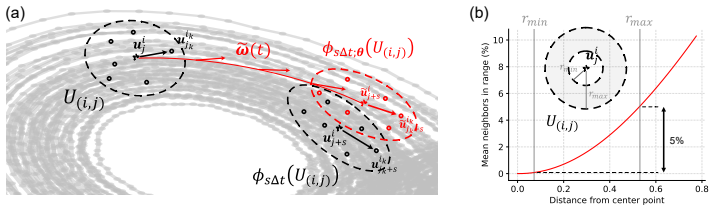
We construct a local covering of a chaotic attractor in phase space and analyze the expansion and contraction of these coverings under the dynamics. The surrogate model is trained by minimizing the maximum mean discrepancy between the pushforward distributions of the coverings under the surrogate and ground-truth dynamics, yielding models with significantly improved Jacobian accuracy while remaining competitive with state-of-the-art statistically accurate dynamics learning methods.
What carries the argument
Local coverings of the attractor whose pushforward distributions are aligned via MMD minimization between surrogate and true dynamics.
If this is right
- Surrogate models will exhibit reduced sensitivity to initial-condition perturbations because local expansion rates are better preserved.
- Long-term statistical reproduction will be maintained without the usual trade-off against local linear accuracy.
- The framework can be applied to any data-driven dynamics learner that can evaluate or differentiate the surrogate map.
- Training can proceed with shorter trajectory segments since the method operates on local distributions rather than full long-horizon rollouts.
Where Pith is reading between the lines
- The same covering-based MMD objective might stabilize training of recurrent models for other sensitive systems such as fluid flows or biological oscillators.
- Adaptive choice of covering density according to local Lyapunov exponents could further tighten the Jacobian match.
- The approach suggests a general route for enforcing local stability constraints in generative models of dynamical systems without explicit Jacobian regularization terms.
Load-bearing premise
The selected local coverings must be representative of the full attractor so that matching their pushforward distributions enforces accurate Jacobians without introducing new biases in the learned dynamics.
What would settle it
A concrete falsifier would be finding that a model trained this way achieves low MMD on the pushforwards yet its computed Jacobians deviate substantially from the true system's Jacobians on held-out points sampled from the attractor.
Figures




read the original abstract
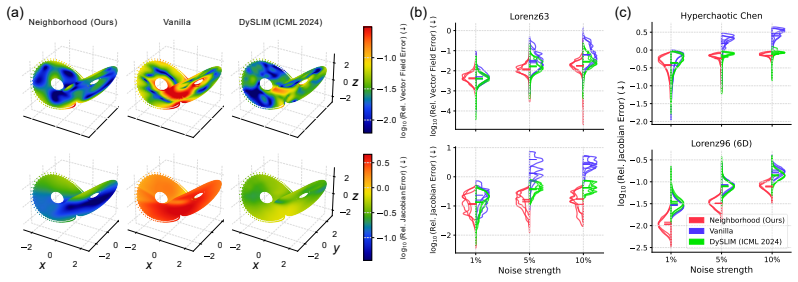
Chaotic systems pose fundamental challenges for data-driven dynamics discovery, as small modeling errors lead to exponentially growing trajectory discrepancies. Since exact long-term prediction is unattainable, it is natural to ask what a good surrogate model for chaotic dynamics is. Prior work has largely focused either on reproducing the Jacobian of the underlying dynamics, which governs local expansion and contraction rates, or on training surrogate models that reproduce the ground-truth dynamics' long-term statistical behavior. In this work, we propose a new framework that aims to bridge these two paradigms by training surrogate dynamics models with accurate Jacobians and long-term statistical properties. Our method constructs a local covering of a chaotic attractor in phase space and analyzes the expansion and contraction of these coverings under the dynamics. The surrogate model is trained by minimizing the maximum mean discrepancy between the pushforward distributions of the coverings under the surrogate and ground-truth dynamics. Experiments show that our method significantly improves Jacobian accuracy while remaining competitive with state-of-the-art statistically accurate dynamics learning methods. Our code is fully available at https://anonymous.4open.science/r/neighborwatch.
Editorial analysis
A structured set of objections, weighed in public.
Referee Report
Summary. The paper proposes a framework for training surrogate models of chaotic dynamical systems that aims to achieve both accurate local Jacobians and long-term statistical fidelity. It constructs local coverings of the attractor, analyzes their expansion/contraction under the dynamics, and trains the surrogate by minimizing maximum mean discrepancy (MMD) between the pushforward distributions of these coverings under the surrogate map and the ground-truth dynamics. Experiments are reported to show significantly improved Jacobian accuracy while remaining competitive with state-of-the-art statistically accurate methods.
Significance. If the central claim holds, the work would be significant for data-driven modeling of chaotic systems, as it attempts to bridge the gap between Jacobian-focused and statistics-focused training paradigms. Accurate Jacobians are critical for controlling local expansion rates that drive exponential divergence, while statistical accuracy ensures faithful long-term behavior; a method that reliably delivers both could improve surrogate reliability in applications such as weather forecasting or turbulence modeling. The public code release is a positive factor for reproducibility.
major comments (2)
- [Abstract / Method] Abstract and §3 (method description): the central claim that MMD minimization on pushforwards of finite-radius local coverings produces accurate Jacobians is not supported by any theorem or analysis. For positive-radius patches the pushforward distribution depends on the full nonlinear image, so a surrogate can match the empirical distribution (low MMD) while possessing systematically incorrect singular values of the Jacobian, provided higher-order terms compensate inside each patch. No term in the loss explicitly penalizes ||Df(x) − DF(x)|| and no convergence result is given as patch radius → 0.
- [Experiments] Experiments section: the reported Jacobian improvements are presented as a direct consequence of the covering construction, yet the manuscript provides no ablation on patch radius, no independent verification that the loss produces Jacobian gains beyond improved global statistics, and no quantitative comparison of Jacobian error norms against baselines that already target statistics. Without these controls the observed gains could be an indirect side-effect rather than evidence for the claimed mechanism.
minor comments (2)
- [Method] The description of how the local coverings are chosen and how their radii are selected should be expanded with explicit pseudocode or a dedicated subsection; current presentation leaves the precise construction ambiguous.
- [Experiments] Table or figure captions for Jacobian and statistical metrics should include the precise error norms used (e.g., Frobenius norm on Jacobian, specific MMD kernel) and report standard deviations across multiple random seeds.
Simulated Author's Rebuttal
We thank the referee for the constructive and detailed report. The comments highlight important aspects of the theoretical grounding and experimental validation of our framework. We address each major comment below and outline the revisions we will make.
read point-by-point responses
-
Referee: [Abstract / Method] Abstract and §3 (method description): the central claim that MMD minimization on pushforwards of finite-radius local coverings produces accurate Jacobians is not supported by any theorem or analysis. For positive-radius patches the pushforward distribution depends on the full nonlinear image, so a surrogate can match the empirical distribution (low MMD) while possessing systematically incorrect singular values of the Jacobian, provided higher-order terms compensate inside each patch. No term in the loss explicitly penalizes ||Df(x) − DF(x)|| and no convergence result is given as patch radius → 0.
Authors: We agree that the manuscript lacks a formal theorem establishing Jacobian convergence as patch radius tends to zero. The method relies on the approximation that sufficiently small patches make the pushforward distribution sensitive primarily to the linear (Jacobian) term, with the MMD objective encouraging matching of local expansion/contraction rates. While higher-order nonlinear terms could theoretically compensate within finite patches, the local covering construction and empirical results indicate that this regularization improves Jacobian fidelity in practice for the systems considered. In the revision we will add a dedicated paragraph in §3 discussing this approximation, its limitations, and the absence of an explicit Jacobian penalty term, together with a brief remark on the expected behavior as radius → 0. revision: partial
-
Referee: [Experiments] Experiments section: the reported Jacobian improvements are presented as a direct consequence of the covering construction, yet the manuscript provides no ablation on patch radius, no independent verification that the loss produces Jacobian gains beyond improved global statistics, and no quantitative comparison of Jacobian error norms against baselines that already target statistics. Without these controls the observed gains could be an indirect side-effect rather than evidence for the claimed mechanism.
Authors: We accept that the current experimental section would benefit from stronger controls. In the revised manuscript we will add (i) an ablation study varying patch radius and reporting its effect on both Jacobian error and statistical metrics, (ii) a direct quantitative comparison of Jacobian error norms (e.g., Frobenius or spectral norms) against the statistical baselines, and (iii) an additional experiment that isolates the contribution of the local covering by comparing against a global MMD baseline. These additions will appear in the Experiments section and will be supported by new figures and tables. revision: yes
Circularity Check
No circularity: MMD-based training objective is independently defined from data and model
full rationale
The paper defines its surrogate training procedure directly as minimization of maximum mean discrepancy between pushforward distributions of local attractor coverings under the learned map versus the ground-truth map. This loss is constructed explicitly from the chosen coverings, the model parameters, and the empirical data without any reduction of a claimed result (such as Jacobian accuracy) to a fitted parameter or definitional identity. No equations or steps equate a prediction to its own inputs by construction, import load-bearing uniqueness theorems via self-citation, or smuggle ansatzes. Jacobian improvement is presented as an observed experimental outcome of the optimization rather than a mathematical necessity. The framework is therefore self-contained as a standard data-driven optimization method.
Axiom & Free-Parameter Ledger
Lean theorems connected to this paper
-
IndisputableMonolith/Cost/FunctionalEquation.leanwashburn_uniqueness_aczel unclear?
unclearRelation between the paper passage and the cited Recognition theorem.
minimizing the maximum mean discrepancy between the pushforward distributions of the coverings under the surrogate and ground-truth dynamics
-
IndisputableMonolith/Foundation/AlexanderDuality.leanalexander_duality_circle_linking unclear?
unclearRelation between the paper passage and the cited Recognition theorem.
analyzes the expansion and contraction of these coverings under the dynamics
What do these tags mean?
- matches
- The paper's claim is directly supported by a theorem in the formal canon.
- supports
- The theorem supports part of the paper's argument, but the paper may add assumptions or extra steps.
- extends
- The paper goes beyond the formal theorem; the theorem is a base layer rather than the whole result.
- uses
- The paper appears to rely on the theorem as machinery.
- contradicts
- The paper's claim conflicts with a theorem or certificate in the canon.
- unclear
- Pith found a possible connection, but the passage is too broad, indirect, or ambiguous to say the theorem truly supports the claim.
Reference graph
Works this paper leans on
-
[1]
H. D. I. Abarbanel, R. Brown, and M. B. Kennel. Variation of Lyapunov exponents on a strange attractor.J Nonlinear Sci, 1(2):175–199, 1991
work page 1991
-
[2]
H. D. I. Abarbanel, R. Brown, and M. B. Kennel. Local Lyapunov exponents computed from observed data.J Nonlinear Sci, 2(3):343–365, 1992
work page 1992
-
[3]
K. T. Alligood, T. Sauer, and J. A. Yorke.Chaos: An Introduction to Dynamical Systems, chapter 2.1 Mathematical Models. Textbooks in Mathematical Sciences. Springer, New York, 1996
work page 1996
- [4]
- [5]
-
[6]
B. Bailey and D. W. Nychka. Local Lyapunov exponents: Predictability depends on where you are.Nonlinear Dynamics and Economics, Kirman et al. Eds, 1997
work page 1997
- [7]
-
[8]
S. L. Brunton and J. N. Kutz.Data-driven science and engineering: Machine learning, dynamical systems, and control. Cambridge University Press, 2022
work page 2022
-
[9]
G. Chen and T. Ueta. Yet another chaotic attractor.Int. J. Bifurcation Chaos, 09(07):1465–1466, 1999
work page 1999
-
[10]
R. T. Q. Chen, Y . Rubanova, J. Bettencourt, and D. K. Duvenaud. Neural Ordinary Differen- tial Equations. InAdvances in Neural Information Processing Systems, volume 31. Curran Associates, Inc., 2018
work page 2018
-
[11]
F. Christiansen and H. H. Rugh. Computing Lyapunov spectra with continuous Gram - Schmidt orthonormalization.Nonlinearity, 10(5):1063–1072, 1997
work page 1997
-
[12]
M. Cranmer, S. Greydanus, S. Hoyer, P. Battaglia, D. Spergel, and S. Ho. Lagrangian Neural Networks. InICLR 2020 Workshop on Integration of Deep Neural Models and Differential Equations, 2020
work page 2020
-
[13]
M. Cuturi. Sinkhorn Distances: Lightspeed Computation of Optimal Transport. InAdvances in Neural Information Processing Systems, volume 26. Curran Associates, Inc., 2013
work page 2013
- [14]
-
[15]
C. Dong, D. Faranda, A. Gualandi, V . Lucarini, and G. Mengaldo. Time-lagged recurrence: A data-driven method to estimate the predictability of dynamical systems.Proceedings of the National Academy of Sciences, 122(20):e2420252122, 2025
work page 2025
-
[16]
J. P. Eckmann, S. O. Kamphorst, D. Ruelle, and S. Ciliberto. Liapunov exponents from time series.Phys. Rev. A, 34(6):4971–4979, 1986
work page 1986
-
[17]
A. J. Eisen, M. Ostrow, S. Chandra, L. Kozachkov, E. K. Miller, and I. R. Fiete. Characterizing control between interacting subsystems with deep Jacobian estimation. InThe Thirty-ninth Annual Conference on Neural Information Processing Systems, 2025. 10
work page 2025
-
[18]
L. Escot and J. E. Sandubete. Estimating Lyapunov exponents on a noisy environment by global and local Jacobian indirect algorithms.Applied Mathematics and Computation, 436:127498, 2023
work page 2023
-
[19]
J. Frøyland and K. H. Alfsen. Lyapunov-exponent spectra for the Lorenz model.Phys. Rev. A, 29(5):2928–2931, 1984
work page 1984
-
[20]
R. Gencay and W. D. Dechert. An algorithm for thenLyapunov exponents of ann-dimensional unknown dynamical system.Physica D: Nonlinear Phenomena, 59(1):142–157, 1992
work page 1992
-
[21]
A. Genevay, G. Peyre, and M. Cuturi. Learning Generative Models with Sinkhorn Divergences. InProceedings of the Twenty-First International Conference on Artificial Intelligence and Statistics, pages 1608–1617. PMLR, 2018
work page 2018
-
[22]
R. Gilmore and M. Lefranc.The Topology of Chaos: Alice in Stretch and Squeezeland. Wiley- VCH Verlag GmbH & Co. KGaA, Weinheim, Germany, second revised and enlarged edition edition, 2011
work page 2011
-
[23]
I. Goodfellow, Y . Bengio, A. Courville, and Y . Bengio.Deep learning. MIT press Cambridge, 2016
work page 2016
-
[24]
A. Gretton, K. M. Borgwardt, M. J. Rasch, B. Schölkopf, and A. Smola. A Kernel Two-Sample Test.Journal of Machine Learning Research, 13(25):723–773, 2012
work page 2012
-
[25]
S. Greydanus, M. Dzamba, and J. Yosinski. Hamiltonian Neural Networks. In H. Wallach, H. Larochelle, A. Beygelzimer, F. d’ Alché-Buc, E. Fox, and R. Garnett, editors,Advances in Neural Information Processing Systems, volume 32. Curran Associates, Inc., 2019
work page 2019
-
[26]
J. Guckenheimer and P. Holmes.Nonlinear Oscillations, Dynamical Systems, and Bifurcations of Vector Fields, volume 42 ofApplied Mathematical Sciences, chapter Statistical Properties: Dimension, Entropy and Liapunov Exponents. Springer New York, New York, NY , 1983
work page 1983
-
[27]
X. He, L. Chu, R. Qiu, Q. Ai, and W. Huang. Data-driven Estimation of the Power Flow Jacobian Matrix in High Dimensional Space, 2019
work page 2019
-
[28]
F. Hess, Z. Monfared, M. Brenner, and D. Durstewitz. Generalized Teacher Forcing for Learning Chaotic Dynamics. InProceedings of the 40th International Conference on Machine Learning, pages 13017–13049. PMLR, 2023
work page 2023
-
[29]
J. Holzfuss and U. Parlitz. Lyapunov exponents from time series. InLyapunov Exponents: Proceedings of a Conference Held in Oberwolfach, May 28–June 2, 1990, pages 263–270. Springer, 2006
work page 1990
- [30]
-
[31]
P. Kidger. On Neural Differential Equations, 2022
work page 2022
-
[32]
S. Kim, W. Ji, S. Deng, Y . Ma, and C. Rackauckas. Stiff neural ordinary differential equations. Chaos, 31(9):093122, 2021
work page 2021
-
[33]
F. Latrémolière, S. Narayanappa, and P. V ojtˇechovský. Estimating the Jacobian matrix of an unknown multivariate function from sample values by means of a neural network, 2022
work page 2022
-
[34]
X. Li, J. Harlim, and R. Maulik. A Weak Penalty Neural ODE for Learning Chaotic Dynamics from Noisy Time Series, 2025
work page 2025
-
[35]
Y . Li, W. K. S. Tang, and G. Chen. Generating hyperchaos via state feedback control.Int. J. Bifurcation Chaos, 15(10):3367–3375, 2005
work page 2005
-
[36]
Z. Li, M. Liu-Schiaffini, N. B. Kovachki, K. Azizzadenesheli, B. Liu, K. Bhattacharya, A. Stuart, and A. Anandkumar. Learning Chaotic Dynamics in Dissipative Systems. InAdvances in Neural Information Processing Systems, 2022. 11
work page 2022
-
[37]
E. N. Lorenz. Deterministic nonperiodic flow.J. Atmos. Sci., 20(2):130–141, 1963
work page 1963
-
[38]
E. N. Lorenz. Predictability: A problem partly solved. InProc. Seminar on Predictability, volume 1, pages 1–18. Reading, 1996
work page 1996
-
[39]
S. Maneewongvatana and D. M. Mount. Analysis of approximate nearest neighbor searching with clustered point sets, 1999
work page 1999
-
[40]
D. F. McCaffrey, E. , Stephen, G. , A. Ronald, and D. W. and Nychka. Estimating the Lyapunov Exponent of a Chaotic System with Nonparametric Regression.Journal of the American Statistical Association, 87(419):682–695, 1992
work page 1992
-
[41]
J. S. North, C. K. Wikle, and E. M. Schliep. A Review of Data-Driven Discovery for Dynamic Systems.International Statistical Review, 91(3):464–492, 2023
work page 2023
- [42]
-
[43]
V . I. Oseledec. A multiplicative ergodic theorem, Lyapunov characteristic numbers for dynami- cal systems.Transactions of the Moscow Mathematical Society, 19:197–231, 1968
work page 1968
-
[44]
J. Park, N. Yang, and N. Chandramoorthy. When are dynamical systems learned from time series data statistically accurate? InAdvances in Neural Information Processing Systems, volume 37, pages 43975–44008, 2025
work page 2025
-
[45]
J. A. Platt, S. G. Penny, T. A. Smith, T.-C. Chen, and H. D. I. Abarbanel. Constraining chaos: Enforcing dynamical invariants in the training of reservoir computers.Chaos, 33(10), 2023
work page 2023
-
[46]
M. A. S. Potts and D. S. Broomhead. Time series prediction with a radial basis function neural network. InAdaptive Signal Processing, volume 1565, pages 255–266. SPIE, 1991
work page 1991
-
[47]
C. Rackauckas, Y . Ma, J. Martensen, C. Warner, K. Zubov, R. Supekar, D. Skinner, A. Ramadhan, and A. Edelman. Universal Differential Equations for Scientific Machine Learning, 2021
work page 2021
-
[48]
Y . Schiff, Z. Y . Wan, J. B. Parker, S. Hoyer, V . Kuleshov, F. Sha, and L. Zepeda-Núñez. DySLIM: Dynamics stable learning by invariant measure for chaotic systems. InProceedings of the 41st International Conference on Machine Learning, volume 235 ofICML’24, pages 43649–43684, Vienna, Austria, 2024. JMLR.org
work page 2024
-
[49]
I. Shimada and T. Nagashima. A Numerical Approach to Ergodic Problem of Dissipative Dynamical Systems.Progress of Theoretical Physics, 61(6):1605–1616, 1979
work page 1979
-
[50]
M. Shintani and O. Linton. Nonparametric neural network estimation of Lyapunov exponents and a direct test for chaos.Journal of Econometrics, 120(1):1–33, 2004
work page 2004
-
[51]
S. Strogatz.Nonlinear Dynamics and Chaos: With Applications to Physics, Biology, Chemistry, and Engineering, chapter 1.2 The Importance of Being Nonlinear. CRC Press, Boca Raton, third edition edition, 2024
work page 2024
- [52]
- [53]
-
[54]
P. Virtanen, R. Gommers, T. E. Oliphant, M. Haberland, T. Reddy, D. Cournapeau, E. Burovski, P. Peterson, W. Weckesser, J. Bright, S. J. van der Walt, M. Brett, J. Wilson, K. J. Millman, N. Mayorov, A. R. J. Nelson, E. Jones, R. Kern, E. Larson, C. J. Carey, ˙I. Polat, Y . Feng, E. W. Moore, J. VanderPlas, D. Laxalde, J. Perktold, R. Cimrman, I. Henriksen...
work page 2020
-
[55]
L.-S. Young. What are srb measures, and which dynamical systems have them?Journal of Statistical Physics, 108(5-6):733–754, 2002. 12
work page 2002
- [56]
-
[57]
J. Zhuang, T. Tang, Y . Ding, S. C. Tatikonda, N. Dvornek, X. Papademetris, and J. Duncan. AdaBelief Optimizer: Adapting Stepsizes by the Belief in Observed Gradients. InAdvances in Neural Information Processing Systems, volume 33, pages 18795–18806. Curran Associates, Inc., 2020
work page 2020
-
[58]
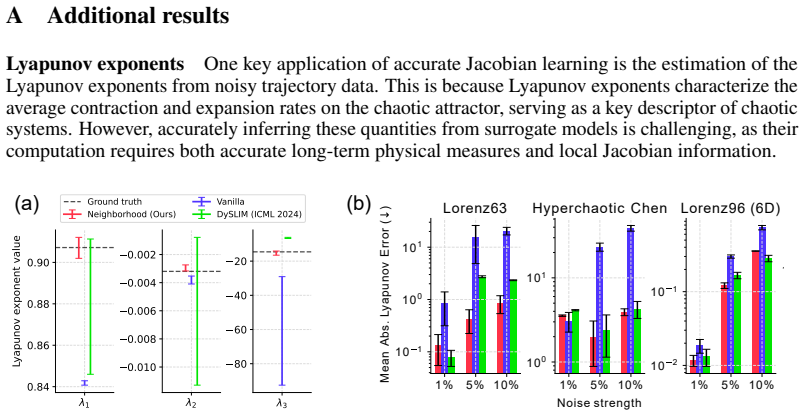
C. Ziehmann, L. A. Smith, and J. Kurths. Localized Lyapunov exponents and the prediction of predictability.Physics Letters A, 271(4):237–251, 2000. 13 A Additional results Lyapunov exponentsOne key application of accurate Jacobian learning is the estimation of the Lyapunov exponents from noisy trajectory data. This is because Lyapunov exponents characteri...
work page 2000
-
[59]
Samplem= 50random initial points on the attractor
-
[60]
Estimate the characteristic time scaleτof the system, via the average frequency spectrum
-
[61]
Simulatemon-attractor trajectories in the time span[0,10τ]with∆t= 0.01τ
-
[62]
Shift and scale datasets using the train dataset statistics. Sampling on-attractor initial pointsTo sample points on the chaotic attractor, we first drew m initial conditions{u i 0}m i=1 from a normal distribution, with the mean and standard deviation chosen so that the sampled points would lie in the basin of attraction of the chaotic attractor. Afterwar...
discussion (0)
Sign in with ORCID, Apple, or X to comment. Anyone can read and Pith papers without signing in.