Recognition: 2 theorem links
· Lean TheoremTunable high-Q Janus-to-chiral bound states in the continuum in bilayer PhCs
Pith reviewed 2026-05-15 02:13 UTC · model grok-4.3
The pith
Symmetry-selective displacements in bilayer photonic crystals convert Janus bound states into tunable high-Q chiral resonances.
A machine-rendered reading of the paper's core claim, the machinery that carries it, and where it could break.
Core claim
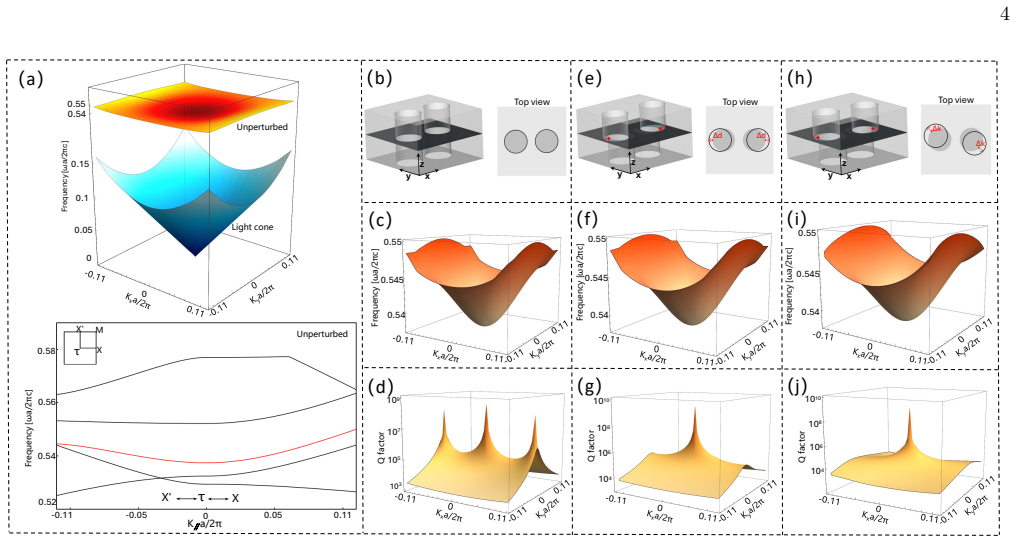
Starting from a symmetry-protected Γ-point BIC, interlayer displacement generates opposite topological charges in the upward and downward radiation channels. Adding a diagonal in-plane displacement reconstructs the polarization topology around the BIC to create a Janus-chiral BIC with strong handedness selectivity. In contrast, other in-plane perturbations produce chiral quasi-BICs that retain finite radiative coupling, allowing continuous tuning of both circular dichroism and resonance wavelength. Material conductivity is shown to act as a dissipative control parameter that actively modulates the chiral response, achieving switchable CD exceeding 0.89. Near-field distributions and multipole
What carries the argument
Bilayer all-dielectric photonic crystal using symmetry-selective perturbations (interlayer displacement followed by diagonal in-plane displacement) to split topological charges and reconstruct polarization topology around the BIC.
If this is right
- Circular dichroism and resonance wavelength of the chiral quasi-BICs can be tuned continuously by varying the in-plane displacement.
- Material conductivity supplies an independent dissipative knob that switches the chiral response on and off with CD above 0.89.
- The Janus-chiral BIC maintains high-Q while enforcing handedness selectivity in both radiation channels.
- The chiral response originates from a symmetry-induced imbalance in local optical handedness combined with a spin-selective magnetic-dipole resonance.
- The structure supplies a scalable geometric route to reconfigurable high-Q chiral photonics.
Where Pith is reading between the lines
- The same displacement sequence could be adapted to other wave platforms such as acoustic or mechanical metamaterials that support BICs.
- Electrical gating to modulate conductivity would allow real-time switching of the chiral output in an integrated device.
- The topological charge difference between radiation channels may enable directional chiral emitters or sensors that distinguish handedness by propagation direction.
- Combining the bilayer geometry with gain media could push the Q-factor even higher while retaining the tunable chirality.
Load-bearing premise
The symmetry-selective perturbations preserve high-Q factors while producing strong chirality without significant extra scattering from real fabrication imperfections.
What would settle it
A fabricated sample in which the measured Q-factor drops below 10^4 or the circular dichroism falls below 0.5 when the interlayer and diagonal displacements are introduced would falsify the claim of preserved high-Q tunable chirality.
Figures



read the original abstract
We propose a bilayer all-dielectric PhC for controlling Janus bound states in the continuum (BIC) and optical chirality through symmetry-selective perturbations. Starting from a symmetry-protected $\Gamma$-point BIC, we use interlayer displacement as one geometric control knob to generate different topological charges in the upward radiation and downward radiation channels. A subsequent diagonal in-plane displacement reconstructs the polarization topology around the BIC and generates a Janus-chiral BIC with strong handedness selectivity. In contrast, other in-plane perturbations generate chiral quasi-BICs with finite radiative coupling, for which the circular dichroism (CD) and resonance wavelength can be continuously tuned. We further show that material conductivity provides an additional dissipative degree of freedom for actively modulating the chiral response, with a switchable CD exceeding 0.89. Near-field optical-chirality distributions and multipole decompositions reveal that the chiral response originates from a symmetry-induced imbalance of local optical handedness and a spin-selective magnetic-dipole resonance. These results reveal the topological relationship between Janus radiation, polarization singularities and intrinsic chirality, thus paving a scalable route toward reconfigurable high-$Q$ chiral photonics.
Editorial analysis
A structured set of objections, weighed in public.
Referee Report
Summary. The manuscript proposes a bilayer all-dielectric photonic crystal to control Janus bound states in the continuum and optical chirality via symmetry-selective geometric perturbations. Starting from a symmetry-protected Γ-point BIC, interlayer displacement splits topological charges between upward and downward radiation channels; a subsequent diagonal in-plane displacement reconstructs the polarization topology to produce a Janus-chiral BIC with strong handedness selectivity. Other in-plane perturbations yield tunable chiral quasi-BICs, while material conductivity is introduced as an active tuning parameter that enables switchable circular dichroism exceeding 0.89. The chiral response is attributed to symmetry-induced imbalance in local optical handedness and spin-selective magnetic-dipole resonance, as revealed by near-field distributions and multipole decompositions.
Significance. If the numerical results hold under realistic conditions, the work establishes a clear topological link between Janus radiation, polarization singularities, and intrinsic chirality, offering a scalable, all-dielectric route to reconfigurable high-Q chiral photonics. The explicit use of conductivity as a dissipative control knob and the multipole-based mechanistic insight are notable strengths that could guide future device design.
major comments (2)
- [Abstract and numerical results] Abstract and numerical results sections: the central claim that the proposed interlayer and diagonal displacements preserve high-Q factors while enabling CD > 0.89 rests on ideal-geometry simulations; no disorder-averaged or tolerance analysis (e.g., 1–2 % random deviations in displacement parameters) is provided, leaving open the possibility that additional radiative or scattering channels collapse the reported Q values.
- [Numerical simulations] Numerical simulations: the multipole decompositions and Q-factor calculations are performed without reported sensitivity studies on the two free geometric parameters (interlayer displacement and diagonal in-plane displacement), which directly control the transition from symmetry-protected BIC to Janus-chiral BIC and are therefore load-bearing for the tunability claims.
minor comments (2)
- [Abstract] The abstract would benefit from specifying the dielectric material, operating wavelength range, and exact definition of the CD metric used to obtain the value 0.89.
- Consider adding a brief discussion of how the conductivity modulation is physically realized (e.g., via carrier injection or gating) to strengthen the active-tuning narrative.
Simulated Author's Rebuttal
We thank the referee for their constructive feedback and positive evaluation of our work. We address each major comment below and will revise the manuscript to include the suggested analyses.
read point-by-point responses
-
Referee: [Abstract and numerical results] Abstract and numerical results sections: the central claim that the proposed interlayer and diagonal displacements preserve high-Q factors while enabling CD > 0.89 rests on ideal-geometry simulations; no disorder-averaged or tolerance analysis (e.g., 1–2 % random deviations in displacement parameters) is provided, leaving open the possibility that additional radiative or scattering channels collapse the reported Q values.
Authors: We agree that demonstrating robustness against fabrication imperfections is important for the practical relevance of our results. In the revised manuscript, we will add a new subsection or supplementary material presenting tolerance analysis. Specifically, we will introduce 1-2% random deviations in the interlayer and diagonal displacement parameters, perform ensemble averages over multiple realizations, and show that the high-Q factors and CD > 0.89 are preserved, with only minor shifts in resonance wavelengths. This will confirm that the symmetry-protected nature of the BIC mitigates the impact of small perturbations. revision: yes
-
Referee: [Numerical simulations] Numerical simulations: the multipole decompositions and Q-factor calculations are performed without reported sensitivity studies on the two free geometric parameters (interlayer displacement and diagonal in-plane displacement), which directly control the transition from symmetry-protected BIC to Janus-chiral BIC and are therefore load-bearing for the tunability claims.
Authors: We acknowledge the need for sensitivity studies on these key parameters. We will include additional figures in the revised manuscript showing the dependence of Q-factors, CD, and resonance properties on small variations in interlayer displacement and diagonal in-plane displacement. These studies will demonstrate the range over which the Janus-chiral BIC remains stable and tunable, supporting the claims of continuous tunability via geometric perturbations. revision: yes
Circularity Check
No significant circularity detected
full rationale
The derivation begins from a standard symmetry-protected Γ-point BIC (an established concept in the literature) and applies explicit geometric perturbations whose effects on radiation channels, polarization topology, Q-factors, and chirality are obtained via direct electromagnetic calculations and multipole decompositions. No load-bearing step reduces by construction to a fitted parameter renamed as a prediction, a self-citation chain, or a definitional equivalence; the reported CD values and tunability follow from the modeled structures rather than from re-labeling of inputs.
Axiom & Free-Parameter Ledger
free parameters (2)
- interlayer displacement
- diagonal in-plane displacement
axioms (2)
- domain assumption Existence of symmetry-protected Gamma-point BIC in the unperturbed bilayer PhC
- standard math Maxwell equations govern the electromagnetic response in all-dielectric media
Lean theorems connected to this paper
-
IndisputableMonolith/Foundation/AlexanderDuality.leanalexander_duality_circle_linking unclear?
unclearRelation between the paper passage and the cited Recognition theorem.
Starting from a symmetry-protected Γ-point BIC, we use interlayer displacement as one geometric control knob to generate different topological charges in the upward radiation and downward radiation channels. A subsequent diagonal in-plane displacement reconstructs the polarization topology around the BIC and generates a Janus-chiral BIC...
-
IndisputableMonolith/Cost/FunctionalEquation.leanwashburn_uniqueness_aczel unclear?
unclearRelation between the paper passage and the cited Recognition theorem.
material conductivity provides an additional dissipative degree of freedom for actively modulating the chiral response, with a switchable CD exceeding 0.89
What do these tags mean?
- matches
- The paper's claim is directly supported by a theorem in the formal canon.
- supports
- The theorem supports part of the paper's argument, but the paper may add assumptions or extra steps.
- extends
- The paper goes beyond the formal theorem; the theorem is a base layer rather than the whole result.
- uses
- The paper appears to rely on the theorem as machinery.
- contradicts
- The paper's claim conflicts with a theorem or certificate in the canon.
- unclear
- Pith found a possible connection, but the passage is too broad, indirect, or ambiguous to say the theorem truly supports the claim.
Reference graph
Works this paper leans on
-
[1]
D. C. Marinica, A. G. Borisov, and S. V. Shabanov, Phys- ical Review Letters100, 183902 (2008)
work page 2008
-
[2]
C. W. Hsu, B. Zhen, A. D. Stone, J. D. Joannopou- los, and M. Soljaˇ ci´ c, Nature Reviews Materials1, 16048 (2016)
work page 2016
-
[3]
M. Kang, T. Liu, C. T. Chan, and M. Xiao, Nature Re- views Physics5, 659 (2023)
work page 2023
-
[4]
J. Wang, P. Li, X. Zhao, Z. Qian, X. Wang, F. Wang, X. Zhou, D. Han, L. Shi, and J. Zi, Photonics Insights3, R01 (2024)
work page 2024
-
[5]
M. Kang, S. Zhang, M. Xiao, and H. Xu, Physical Review Letters126, 117402 (2021)
work page 2021
- [6]
-
[7]
H. Qin, Z. Su, M. Liu, Y. Zeng, M.-C. Tang, M. Li, Y. Shi, W. Huang, C.-W. Qiu, and Q. Song, Light: Sci- ence & Applications12, 66 (2023)
work page 2023
-
[8]
C. Zhou, L. Huang, R. Jin, L. Xu, G. Li, M. Rahmani, X. Chen, W. Lu, and A. E. Miroshnichenko, Laser & Photonics Reviews17, 2200564 (2023)
work page 2023
-
[9]
T. Sang, Q. Mi, C. Yang, X. Zhang, Y. Wang, Y. Ren, and T. Xu, Nanophotonics13, 1369 (2024)
work page 2024
- [10]
-
[11]
H. Qin, S. Chen, W. Zhang, H. Zhang, R. Pan, J. Li, L. Shi, J. Zi, and X. Zhang, Nature Communications15, 9080 (2024)
work page 2024
-
[12]
H. Qin, Z. Su, Z. Zhang, W. Lv, Z. Yang, W. Chen, X. Gao, H. Wei, Y. Shi, B. Li, J. Zhou, R. Fleury, C.-W. Qiu, and Q. Song, Nature639, 602 (2025)
work page 2025
-
[13]
Y. Yang, C. Peng, Y. Liang, Z. Li, and S. Noda, Physical Review Letters113, 037401 (2014)
work page 2014
-
[14]
X. Gao, C. W. Hsu, B. Zhen, X. Lin, J. D. Joannopoulos, M. Soljaˇ ci´ c, and H. Chen, Scientific Reports6, 31908 (2016)
work page 2016
-
[15]
J. Jin, X. Yin, L. Ni, M. Soljaˇ ci´ c, B. Zhen, and C. Peng, Nature574, 501 (2019)
work page 2019
- [16]
-
[17]
A. Kodigala, T. Lepetit, Q. Gu, B. Bahari, Y. Fainman, and B. Kant´ e, Nature541, 196 (2017)
work page 2017
-
[18]
F. Yesilkoy, E. R. Arvelo, Y. Jahani, M. Liu, A. Tittl, V. Cevher, Y. Kivshar, and H. Altug, Nature Photonics 13, 390 (2019)
work page 2019
-
[19]
S. Li, C. Zhou, T. Liu, and S. Xiao, Physical Review A 100, 063803 (2019)
work page 2019
-
[20]
K. Koshelev, S. Kruk, E. Melik-Gaykazyan, J.-H. Choi, A. Bogdanov, H.-G. Park, and Y. Kivshar, Science367, 288 (2020)
work page 2020
-
[21]
T. Liu, M. Qin, J. Qiu, X. Tu, H. Qiu, F. Wu, T. Yu, Q. Liu, and S. Xiao, Nano Letters25, 3646 (2025). 12
work page 2025
-
[22]
F. Ye, Y. Yu, X. Xi, and X. Sun, Laser & Photonics Reviews16, 2100429 (2022)
work page 2022
-
[23]
Z. Yu, X. Xi, J. Ma, H. K. Tsang, C.-L. Zou, and X. Sun, Optica6, 1342 (2019)
work page 2019
-
[24]
Z. Yu, Y. Tong, H. K. Tsang, and X. Sun, Nature Com- munications11, 2602 (2020)
work page 2020
-
[25]
B. Zhen, C. W. Hsu, L. Lu, A. D. Stone, and M. Soljaˇ ci´ c, Physical review letters113, 257401 (2014)
work page 2014
-
[26]
W. Liu, B. Wang, Y. Zhang, J. Wang, M. Zhao, F. Guan, X. Liu, L. Shi, and J. Zi, Physical Review Letters123, 116104 (2019)
work page 2019
-
[27]
B. Wang, W. Liu, M. Zhao, J. Wang, Y. Zhang, A. Chen, F. Guan, X. Liu, L. Shi, and J. Zi, Nature Photonics14, 623 (2020)
work page 2020
-
[28]
J. Wang, L. Shi, and J. Zi, Physical Review Letters129, 236101 (2022)
work page 2022
-
[29]
P. Hu, J. Wang, Q. Jiang, J. Wang, L. Shi, D. Han, Z. Q. Zhang, C. T. Chan, and J. Zi, Optica9, 1353 (2022)
work page 2022
-
[30]
P. Hu, C. Xie, Q. Song, A. Chen, H. Xiang, D. Han, and J. Zi, National Science Review10, nwac043 (2023)
work page 2023
-
[31]
J. Wu, J. Chen, X. Qi, Z. Guo, J. Wang, F. Wu, Y. Sun, Y. Li, H. Jiang, L. Shi, J. Zi, and H. Chen, Photonics Research12, 638 (2024)
work page 2024
-
[32]
W. Ye, Y. Gao, and J. Liu, Physical Review Letters124, 153904 (2020)
work page 2020
-
[33]
M. Kang, Z. Zhang, T. Wu, X. Zhang, Q. Xu, A. Kras- nok, J. Han, and A. Al` u, Nature Communications13, 4536 (2022)
work page 2022
- [34]
-
[35]
W. Lv, H. Qin, Z. Su, C. Zhang, J. Huang, Y. Shi, B. Li, P. Genevet, and Q. Song, Science Advances10, eads0157 (2024)
work page 2024
-
[36]
Q.-A. Tu, H. Zhou, D. Zhao, Y. Meng, M. Gong, and Z. Gao, Photonics Research12, 2972 (2024)
work page 2024
-
[37]
C.-Y. Ji, H. S. Nguyen, and G. Hu, Newton (2025)
work page 2025
-
[38]
M. Kang, M. Xiao, and C. T. Chan, Physical Review Letters134, 013805 (2025)
work page 2025
- [39]
-
[40]
H. Zuo, S. Xia, and H. Meng, Physical Review B112, 165414 (2025)
work page 2025
-
[41]
M. V. Gorkunov, A. A. Antonov, and Y. S. Kivshar, Physical Review Letters125, 093903 (2020)
work page 2020
-
[42]
C. Chen, H. Deng, X. Sha, W. Chen, C. Peng,et al., Nature613, 474 (2023)
work page 2023
-
[43]
Y. Chen, Z.-L. Deng, X. Sha, W. Chen, Y.-J. Wang, and X.-P. Li, Nano Letters21, 167 (2021)
work page 2021
-
[44]
H. Barkaoui, K. Du, Y. Chen, S. Xiao, and Q. Song, Physical Review B107, 045305 (2023)
work page 2023
-
[45]
Q. Duan, Y. Zeng, Y. Yin, J. Xu, Z. Chen, Z. Hao, H. Chen, and Y. Liu, Photonics Research11, 1919 (2023)
work page 1919
-
[46]
S. Wan, K. Wang, F. Wang, C. Guan, W. Li, J. Liu, A. Bogdanov, P. A. Belov, and J. Shi, Optics Letters47, 3291 (2022)
work page 2022
-
[47]
Y. Tang, Y. Liang, J. Yao, M. K. Chen, S. Lin, Z. Wang, J. Zhang, X. G. Huang, C. Yu, and D. P. Tsai, Laser & Photonics Reviews17, 2200597 (2023)
work page 2023
-
[48]
Y. Yi, H. Duan, H. He, S. Yang, Y. Zhang, L. Wang, Z. Xiong, C. Gao, and C. Zhou, Applied Physics Letters 126(2025)
work page 2025
-
[49]
S. Cao, P. Sun, J. Yu, Q. Wulan, L. Xing, Y. Liu, and Z. Liu, Applied Optics64, 1660 (2025)
work page 2025
- [50]
-
[51]
C. Qin, Y. Deng, T. Lyu, C. Meng, S. Im Sande, S. I. Bozhevolnyi, J. Shi, and F. Ding, Photonics Research13, 69 (2024)
work page 2024
-
[52]
W. Zhao, Q. Zhang, H. Zheng, Y. Bai, Y. Yu, Z. Chen, X. Yun, and S.-D. Liu, Optics Letters48, 1252 (2023)
work page 2023
-
[53]
X. Zhao, J. Wang, W. Liu, Z. Che, X. Wang, C. Chan, L. Shi, and J. Zi, Physical Review Letters133, 036201 (2024)
work page 2024
-
[54]
Y. Zhou, B. Huang, Z. Wang, and W. Hong, Optics Com- munications568, 130703 (2024)
work page 2024
- [55]
- [56]
-
[57]
S. Yang, X. Zhang, J. Liu, H. Feng, H. Meng, Y. Jia, and Y. Gao, Physics Letters A547, 130540 (2025)
work page 2025
- [58]
-
[59]
Z. Zhou, B. Yin, and J. Michel, Light: Science & Appli- cations4, e358 (2015)
work page 2015
- [60]
-
[61]
H. Yang, Z. Xie, H. He, Q. Zhang, and X. Yuan, APL Photonics6(2021)
work page 2021
- [62]
-
[63]
Y.-H. Kim, Y. Zhai, H. Lu, X. Pan, C. Xiao, E. Arthur, J. J. Berry, M. C. Beard, Z. V. Vardeny, and K. Zhu, Science371, 1129 (2021)
work page 2021
-
[64]
X. Yin, M. Schaferling, B. Metzger, and H. Giessen, Nano Letters13, 6238 (2013)
work page 2013
- [65]
-
[66]
H. Zhou, Y. Chen,et al., Light: Science & Applications 9, 95 (2020)
work page 2020
- [67]
-
[68]
S. Yin, D. Xiao, J. Liu, K. Li, H. He, S. Jiang, D. Luo, X. W. Sun, W. Ji, and Y. J. Liu, IEEE Photonics Journal 10, 1 (2018)
work page 2018
-
[69]
X. Shu, Q. Zhong, K. Hong, O. You, J. Wang, G. Hu, A. Al` u, S. Zhang, D. N. Christodoulides, and L. Chen, Light: Science & Applications13, 65 (2024)
work page 2024
-
[70]
Y. Yang, V. Kravtsov, D. Pikhulya,et al., Nano Letters 19, 8082 (2019)
work page 2019
-
[71]
X. Zeng, K. Chen, Y. Shen, Q. Wang, Y. Qin, Y. Zhu, Z. Zhou, and S. Zhuang, Photonics Research13, 2371 (2025)
work page 2025
-
[72]
F. Ding, S. Tang, and S. I. Bozhevolnyi, Advanced Pho- tonics Research2, 2000173 (2021)
work page 2021
- [73]
- [74]
-
[75]
A. Raja, K. Mukherjee, and J. Roy, Photonic Network Communications41, 242 (2021)
work page 2021
-
[76]
Y. Li, Y. Mao, S. Yin, Y. Zhou, Z. Sun, and Z. Tang, Frontiers in Physics13, 1572555 (2025)
work page 2025
-
[77]
C. A. Balanis,Advanced Engineering Electromagnetics, 2nd ed. (John Wiley & Sons, 2012). 13
work page 2012
-
[78]
J. D. Jackson,Classical Electrodynamics, 3rd ed. (John Wiley & Sons, 1999)
work page 1999
discussion (0)
Sign in with ORCID, Apple, or X to comment. Anyone can read and Pith papers without signing in.