Recognition: no theorem link
Singular Asymptotics of SPADE in Quantum Source Discrimination
Pith reviewed 2026-05-15 01:59 UTC · model grok-4.3
The pith
SPADE and direct imaging share the same leading log canonical threshold but differ in multiplicity for aligned sources, while misalignment shifts their discrimination scales and creates an exact blind separation for binary-SPADE.
A machine-rendered reading of the paper's core claim, the machinery that carries it, and where it could break.
Core claim
In the aligned Gaussian case, direct imaging and SPADE share the same real log canonical threshold λ=1/2 but differ in multiplicity, yielding a universal subleading advantage of aligned SPADE in the local prior-weighted regime. In the misaligned setting, misaligned binary-SPADE and direct imaging acquire nontrivial local power on different intrinsic scales s=O(n^{-1/4}) and s=O(n^{-1/2}), respectively, with binary-SPADE exhibiting an exact blind separation s*=2θ.
What carries the argument
The real log canonical threshold λ together with its multiplicity, obtained from the poles of the zeta function of the Bayes free energy for the singular statistical models of one- versus two-point-source discrimination.
If this is right
- The multiplicity difference supplies a concrete, universal correction that improves the Bayes risk for aligned SPADE at moderate photon numbers.
- Misalignment moves the onset of useful discrimination to a coarser scale for binary-SPADE than for direct imaging.
- Binary-SPADE possesses an exact null at separation twice the misalignment angle where its power equals the false-alarm rate.
- Model singularities organize the finite-photon behavior of quantum source discrimination and set the practical limits of ideal benchmarks.
Where Pith is reading between the lines
- Hybrid detectors that switch between direct imaging and SPADE according to measured alignment could avoid the blind separation.
- The same singularity analysis could be applied to three-source or extended-object discrimination to predict additional blind spots.
- Non-Gaussian point-spread functions would likely alter the multiplicity and therefore the size of the subleading advantage.
- Alignment tolerances must be controlled to within a fraction of the intrinsic scale s to realize the predicted SPADE benefit.
Load-bearing premise
The optical response is exactly Gaussian and the binary-SPADE reduction captures the full leading O(s squared) leakage contrast near alignment with higher-mode corrections entering only at O(s to the fourth).
What would settle it
Numerical computation of the finite-n Neyman-Pearson power curves for photon numbers around 100, checking whether the subleading term for aligned SPADE matches the multiplicity prediction and whether binary-SPADE power drops exactly to the false-alarm rate at separation s equal to twice the misalignment angle.
Figures

read the original abstract
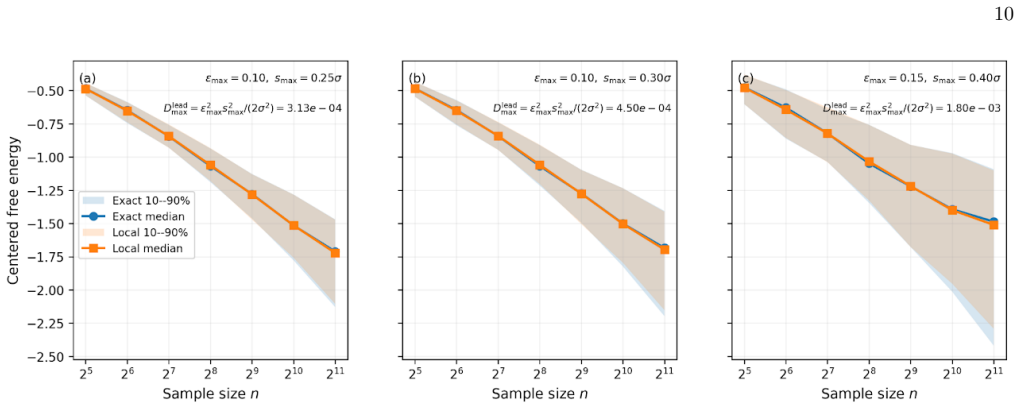
We study far-field discrimination between one and two incoherent point sources in the singular regime of weak and closely spaced emitters. Under ideal alignment, spatial-mode demultiplexing (SPADE) attains the quantum-optimal large-sample Stein exponent, but the finite-photon behavior near the one-source boundary and the effect of realistic imperfections remain less understood. Using singular learning theory, we analyze both the aligned and misaligned problems. In the aligned Gaussian case, we derive the zeta-function poles for direct imaging and SPADE, show that both share the same real log canonical threshold $\lambda=1/2$ but differ in multiplicity, and obtain the corresponding Bayes free-energy asymptotics. This yields a universal subleading advantage of aligned SPADE in the local prior-weighted regime. In the misaligned setting, we study a physically motivated binary-SPADE reduction that retains the full leading $O(s^2)$ leakage contrast near alignment, with corrections from the detailed higher-mode redistribution entering only at $O(s^4)$. We show that misaligned binary-SPADE and direct imaging acquire nontrivial local power on different intrinsic scales, $s=O(n^{-1/4})$ and $s=O(n^{-1/2})$, respectively. However, finite-$n$ Neyman--Pearson comparisons under common physical conditions reveal that direct imaging is stronger on the plotted grids and that misaligned binary-SPADE exhibits an exact blind separation $s^\ast=2\theta$, where its power collapses to $\alpha$. These results identify model singularity as a structural organizing principle for finite-photon quantum discrimination and clarify how ideal aligned SPADE benchmarks can fail to translate into finite-$n$ advantages under misalignment.
Editorial analysis
A structured set of objections, weighed in public.
Referee Report
Summary. The paper applies singular learning theory to derive the asymptotics of spatial-mode demultiplexing (SPADE) versus direct imaging for one-versus-two incoherent point-source discrimination in the singular regime. In the aligned Gaussian case, it computes zeta-function poles showing that both methods share the real log canonical threshold λ=1/2 but differ in multiplicity, yielding a subleading advantage for SPADE in the local prior-weighted regime via Bayes free-energy asymptotics. In the misaligned case, it analyzes a binary-SPADE reduction that is stated to preserve the leading O(s²) leakage contrast (with O(s⁴) corrections), producing distinct intrinsic scales s=O(n^{-1/4}) for binary-SPADE and s=O(n^{-1/2}) for direct imaging, an exact blind separation s*=2θ for binary-SPADE, and finite-n Neyman-Pearson comparisons favoring direct imaging.
Significance. If the central derivations hold, the work provides a concrete organizing principle—model singularity—for understanding when ideal quantum advantages in source discrimination survive or collapse under misalignment and finite photon number. The explicit scale separation and blind-spot prediction offer falsifiable guidance for quantum optics experiments. The use of singular learning theory to obtain parameter-free thresholds and subleading terms is a methodological strength that could extend to other singular quantum hypothesis-testing problems.
major comments (2)
- [Misaligned setting] The misaligned binary-SPADE analysis (abstract and misaligned-setting paragraphs) asserts that the reduction retains the full leading O(s²) leakage contrast near alignment while higher-mode redistribution corrections enter only at O(s⁴). This modeling choice is load-bearing for the claimed intrinsic scales s=O(n^{-1/4}) versus s=O(n^{-1/2}) and the exact blind separation s*=2θ. No explicit expansion of the Gaussian-PSF mode-overlap integrals or coefficient comparison is supplied to confirm that the s² coefficient matches direct imaging while the s⁴ term remains parametrically smaller; if the O(s²) term deviates, both the scale separation and blind-spot location fail.
- [Aligned Gaussian case] § (aligned Gaussian case): the derivation of the zeta-function poles that establish the shared real log canonical threshold λ=1/2 with differing multiplicities is central to the subleading SPADE advantage. The manuscript states the poles and resulting Bayes free-energy asymptotics but does not display the intermediate residue calculations or the explicit zeta-function expressions; independent verification of these steps is required to confirm the multiplicity difference and the local prior-weighted regime result.
minor comments (2)
- [Abstract] The abstract refers to the 'local prior-weighted regime' without a one-sentence definition or pointer to the relevant prior; a brief clarification would improve accessibility.
- [Neyman-Pearson comparisons] The finite-n Neyman-Pearson comparisons are summarized but the precise definition of the decision threshold and the grid parameters (e.g., photon number n, misalignment θ) should be stated explicitly in a table or equation for reproducibility.
Simulated Author's Rebuttal
We thank the referee for the careful reading and constructive comments on our manuscript. We address each major comment below and will revise the manuscript to incorporate the requested explicit derivations and expansions for improved verifiability.
read point-by-point responses
-
Referee: [Misaligned setting] The misaligned binary-SPADE analysis (abstract and misaligned-setting paragraphs) asserts that the reduction retains the full leading O(s²) leakage contrast near alignment while higher-mode redistribution corrections enter only at O(s⁴). This modeling choice is load-bearing for the claimed intrinsic scales s=O(n^{-1/4}) versus s=O(n^{-1/2}) and the exact blind separation s*=2θ. No explicit expansion of the Gaussian-PSF mode-overlap integrals or coefficient comparison is supplied to confirm that the s² coefficient matches direct imaging while the s⁴ term remains parametrically smaller; if the O(s²) term deviates, both the scale separation and blind-spot location fail.
Authors: We acknowledge that the explicit Taylor expansion of the Gaussian-PSF overlap integrals was not displayed. The leading O(s²) term arises identically from the first-order small-separation approximation in both binary-SPADE and direct imaging, while O(s⁴) corrections originate from higher-mode redistribution in the SPADE basis. In the revised manuscript we will add the explicit series expansion of the relevant integrals (up to O(s⁴)) together with a direct coefficient comparison, confirming that the s² coefficient is unchanged and thereby supporting the intrinsic scales and the exact blind spot at s*=2θ. revision: yes
-
Referee: [Aligned Gaussian case] § (aligned Gaussian case): the derivation of the zeta-function poles that establish the shared real log canonical threshold λ=1/2 with differing multiplicities is central to the subleading SPADE advantage. The manuscript states the poles and resulting Bayes free-energy asymptotics but does not display the intermediate residue calculations or the explicit zeta-function expressions; independent verification of these steps is required to confirm the multiplicity difference and the local prior-weighted regime result.
Authors: We agree that the intermediate steps are essential for independent verification. The zeta functions are obtained via resolution of singularities in the respective parameter spaces; the shared real pole at λ=1/2 appears with multiplicity 1 for direct imaging and multiplicity 2 for SPADE, producing the subleading advantage in the local prior-weighted Bayes free energy. In the revision we will include an appendix containing the explicit zeta-function expressions and the detailed residue calculations that establish these poles and multiplicities. revision: yes
Circularity Check
No significant circularity in the derivation chain
full rationale
The paper applies singular learning theory to derive zeta-function poles, log canonical thresholds (λ=1/2), and Bayes free-energy asymptotics for both direct imaging and SPADE. In the misaligned case the binary-SPADE reduction is introduced as an explicit modeling assumption that retains the leading O(s²) leakage contrast with O(s⁴) corrections; the claimed intrinsic scales s=O(n^{-1/4}) and blind separation s*=2θ are direct mathematical consequences of that assumption together with the external theory, not a redefinition or statistical fit of the output quantities to the inputs. No load-bearing step reduces to a self-citation, a fitted parameter renamed as a prediction, or an ansatz smuggled via prior work. The derivation remains self-contained once the model assumptions and singular learning theory are granted.
Axiom & Free-Parameter Ledger
axioms (1)
- domain assumption The source discrimination model satisfies the regularity conditions of singular learning theory that allow zeta-function pole analysis and log canonical threshold extraction.
Reference graph
Works this paper leans on
- [1]
- [2]
-
[3]
X.-M. Lu, H. Krovi, R. Nair, S. Guha, and J. H. Shapiro, npj Quantum Inf.4, 64 (2018)
work page 2018
- [4]
- [5]
-
[6]
J. O. de Almeida, J. Ko lody´ nski, C. Hirche, M. Lewen- stein, and M. Skotiniotis, Phys. Rev. A103, 022406 (2021)
work page 2021
- [7]
-
[8]
J. A. Hartigan, inProceedings of the Berkeley Conference in Honor of Jerzy Neyman and Jack Kiefer, Vol. 2, pp. 807–810 (1985)
work page 1985
- [9]
-
[10]
S. Watanabe, Algebraic Geometry and Statistical Learning Theory (Cambridge University Press, Cambridge, England, 2009)
work page 2009
-
[11]
N. Kariya and S. Watanabe, Commun. Stat. Theory Methods51, 5873–5888 (2022)
work page 2022
-
[12]
N. Kariya and S. Watanabe, IEICE Trans. Fundam. Electron. Commun. Comput. Sci. E103.A, 1274–1282 (2020)
work page 2020
- [13]
-
[14]
M. F. Atiyah, Commun. Pure Appl. Math.13, 145–150 (1970)
work page 1970
-
[15]
K. Schlichtholz, T. Linowski, M. Walschaers, N. Treps, L. Rudnicki, and G. Sorelli, Optica Quantum2, 29-34 (2024)
work page 2024
discussion (0)
Sign in with ORCID, Apple, or X to comment. Anyone can read and Pith papers without signing in.