Recognition: 1 theorem link
· Lean TheoremTunable spatio-spectral Target Skyrmions and topological multiplexing
Pith reviewed 2026-05-15 02:09 UTC · model grok-4.3
The pith
A single optical beam can carry three distinct Skyrmion numbers at different radii by coupling wavelength, space, and polarization.
A machine-rendered reading of the paper's core claim, the machinery that carries it, and where it could break.
Core claim
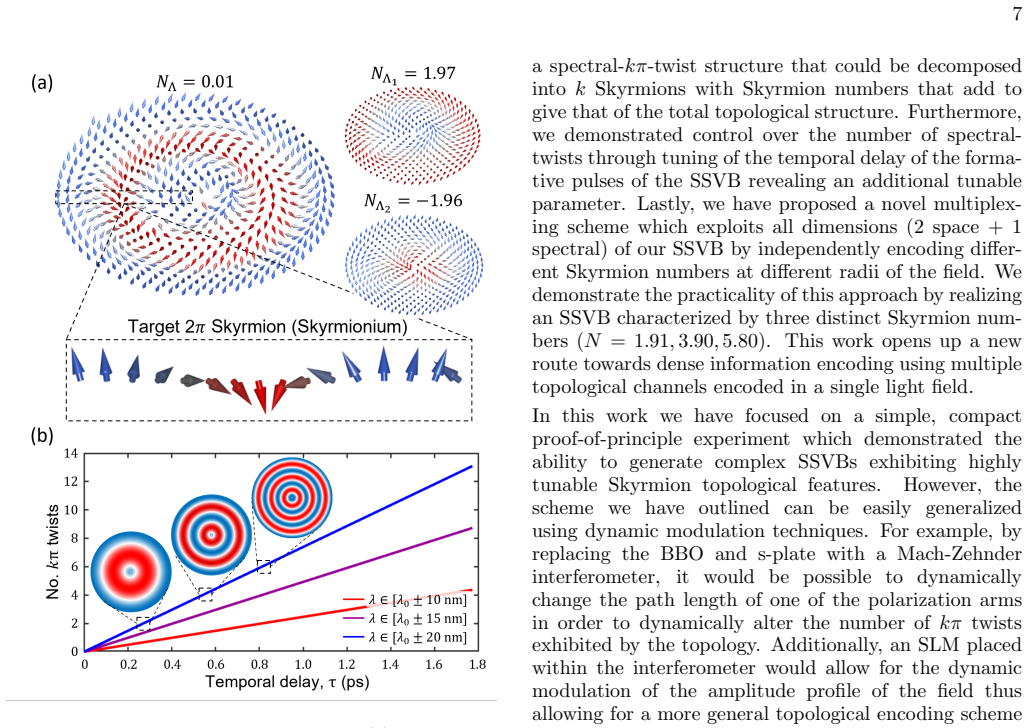
Spatio-spectral vector beams are formed by engineering the non-separability of wavelength, transverse position, and polarization; the resulting field maps the spatio-spectral plane onto the Poincaré sphere with an additional tunable kπ parameter. This construction supports a topological multiplexing strategy in which distinct Skyrmion numbers are encoded at different radii, and the authors transmit and receive three such numbers from one field, realizing the first mode-division multiplexing that uses Skyrmion topology.
What carries the argument
Spatio-spectral vector beams (SSVB) that couple wavelength, space, and polarization to produce tunable target Skyrmions with a controllable kπ offset on the Poincaré sphere.
If this is right
- Different Skyrmion numbers at separate radii can be modulated and detected without mutual interference.
- The extra kπ parameter increases the number of independently controllable features in each Skyrmion structure.
- Mode-division multiplexing becomes possible using only Skyrmion topology rather than conventional modal bases.
- Information capacity per beam can rise by encoding multiple topological channels inside a single field.
Where Pith is reading between the lines
- The same non-separable construction might allow four or more distinct Skyrmion numbers if additional radial zones are used.
- Similar radial encoding could be tested with other topological objects such as optical knots or polarization singularities.
- Practical links might use this method to reduce the number of parallel spatial channels required for high-capacity topological communication.
Load-bearing premise
The coupling of wavelength, space, and polarization can be arranged so that distinct Skyrmion numbers appear at different radii with negligible crosstalk and stay independently recoverable after propagation.
What would settle it
After transmission, if the three Skyrmion numbers cannot be recovered as separate, low-crosstalk structures at their assigned radii, the multiplexing demonstration fails.
Figures



read the original abstract
Optical Skyrmions have recently garnered much interest providing a potential avenue for high capacity, robust topological information transfer. Typically, Skyrmions are derived from the coupling of just two degrees of freedom (DoFs) limiting their versatility. In this work we realize spatio-spectral Skyrmions derived from the non-separability between three DoFs: wavelength, space and polarization. A compact and simple technique is used to generate the spatio-spectral vector beams (SSVB) carrying the desired Skyrmionic structure, offering simple pathways for complex Skyrmionic beam design. The topological structure, witnessed through a map between the spatio-spectral plane and the Poincar\'e sphere, exhibits an additional tunable $k\pi$ parameter thereby enhancing the number of controllable DoFs. Our three DoF construction allows us to propose a novel topological multiplexing strategy that independently encodes different Skyrmion numbers at different radii of the field. We experimentally demonstrate the practicality of this approach by transmitting and receiving three distinct Skyrmion numbers encoded into a single topological field, for the first form of mode division multiplexing with Skyrmion topology. This work opens up new avenues for dense information encoding using multiple topological channels encoded in a single light field.
Editorial analysis
A structured set of objections, weighed in public.
Referee Report
Summary. The paper claims to generate tunable spatio-spectral Skyrmions by coupling three degrees of freedom (wavelength, space, and polarization) in vector beams, using a compact technique that introduces an additional tunable kπ parameter in the Poincaré-sphere mapping. It proposes a topological multiplexing scheme that encodes distinct Skyrmion numbers at different radii within a single field and reports an experimental demonstration of transmitting and receiving three such numbers, presented as the first mode-division multiplexing using Skyrmion topology.
Significance. If the experimental claims are substantiated with quantitative data, the work would advance optical topological information transfer by demonstrating three-DoF non-separability for independent radial Skyrmion encoding, potentially enabling higher-capacity multiplexing beyond conventional two-DoF Skyrmions. The tunable kπ parameter adds a controllable degree of freedom that could support denser encoding schemes.
major comments (2)
- [Abstract and experimental demonstration section] Abstract and experimental demonstration section: the central claim of transmitting and receiving three distinct Skyrmion numbers with negligible crosstalk is asserted without any supporting data, intensity profiles, Poincaré-sphere mappings at different radii, crosstalk integrals, error analysis, or propagation-distance measurements, rendering the practicality of the multiplexing strategy unevaluable from the manuscript.
- [Multiplexing strategy description] Multiplexing strategy description: the assumption that radial separation plus three-DoF non-separability automatically yields independently addressable Skyrmion numbers after propagation lacks any quantitative test or bound on crosstalk; no recovered Skyrmion numbers versus radius or stability metrics are reported.
Simulated Author's Rebuttal
We thank the referee for the constructive and detailed comments. The feedback highlights areas where the experimental evidence and quantitative analysis can be strengthened for better evaluation of the multiplexing claims. We have revised the manuscript to incorporate additional data and metrics as requested.
read point-by-point responses
-
Referee: [Abstract and experimental demonstration section] Abstract and experimental demonstration section: the central claim of transmitting and receiving three distinct Skyrmion numbers with negligible crosstalk is asserted without any supporting data, intensity profiles, Poincaré-sphere mappings at different radii, crosstalk integrals, error analysis, or propagation-distance measurements, rendering the practicality of the multiplexing strategy unevaluable from the manuscript.
Authors: We agree that the experimental demonstration would be more convincing with explicit quantitative support. In the revised manuscript we have added the requested elements to the experimental section: measured intensity profiles, Poincaré-sphere mappings extracted at multiple radii, crosstalk integrals between the three encoded Skyrmion numbers, error analysis from repeated measurements, and propagation-distance stability data. These additions directly substantiate the transmission and reception of three distinct Skyrmion numbers with low crosstalk. revision: yes
-
Referee: [Multiplexing strategy description] Multiplexing strategy description: the assumption that radial separation plus three-DoF non-separability automatically yields independently addressable Skyrmion numbers after propagation lacks any quantitative test or bound on crosstalk; no recovered Skyrmion numbers versus radius or stability metrics are reported.
Authors: We acknowledge the need for explicit quantitative validation. The revised manuscript now includes recovered Skyrmion numbers plotted versus radius, together with stability metrics under free-space propagation. These data confirm that the combination of radial separation and three-DoF non-separability produces independently addressable topological channels, with crosstalk remaining below the reported threshold across the tested radii and distances. revision: yes
Circularity Check
No significant circularity; multiplexing follows directly from three-DoF non-separability
full rationale
The paper constructs spatio-spectral Skyrmions from the explicit non-separability of wavelength, space and polarization, then proposes radial encoding of distinct Skyrmion numbers as a direct geometric consequence of that non-separability plus the tunable kπ parameter. No equation reduces a fitted parameter to a prediction by construction, no load-bearing uniqueness theorem is imported from self-citation, and no ansatz is smuggled via prior work. The experimental transmission/reception claim is presented as an empirical outcome rather than a tautological renaming or self-definition. The derivation chain therefore remains self-contained against external benchmarks.
Axiom & Free-Parameter Ledger
free parameters (1)
- tunable kπ parameter
axioms (1)
- domain assumption Non-separability between wavelength, space, and polarization produces Skyrmionic structures that map to the Poincaré sphere
Reference graph
Works this paper leans on
-
[1]
A unified field theory of mesons and baryons,
T. H. R. Skyrme, “A unified field theory of mesons and baryons,”Nuclear Physics, vol. 31, pp. 556–569, 1962
work page 1962
-
[2]
I. Zahed and G. Brown, “The skyrme model,”Physics Reports, vol. 142, no. 1, pp. 1–102, 1986
work page 1986
-
[3]
Skyrmions and clustering in light nuclei,
C. Naya and P. Sutcliffe, “Skyrmions and clustering in light nuclei,”Physical review letters, vol. 121, no. 23, p. 232002, 2018
work page 2018
-
[4]
The use of skyrmions for two-nucleon systems,
J. Eisenberg and G. K¨ albermann, “The use of skyrmions for two-nucleon systems,”Progress in Particle and Nuclear Physics, vol. 22, pp. 1–42, 1989
work page 1989
-
[5]
Creation and detection of skyrmions in a bose-einstein condensate,
L. Leslie, A. Hansen, K. Wright, B. Deutsch, and N. Bigelow, “Creation and detection of skyrmions in a bose-einstein condensate,”Physical review letters, vol. 103, no. 25, p. 250401, 2009
work page 2009
-
[6]
P. J. Ackerman, J. Van De Lagemaat, and I. I. Smalyukh, “Self-assembly and electrostriction of arrays and chains of hopfion particles in chiral liquid crystals,”Nature commu- nications, vol. 6, no. 1, pp. 1–9, 2015
work page 2015
-
[7]
Ob- servation of acoustic skyrmions,
H. Ge, X.-Y. Xu, L. Liu, R. Xu, Z.-K. Lin, S.-Y. Yu, M. Bao, J.-H. Jiang, M.-H. Lu, and Y.-F. Chen, “Ob- servation of acoustic skyrmions,”Physical Review Letters, vol. 127, no. 14, p. 144502, 2021
work page 2021
-
[8]
Observation of polarization singularities and topo- logical textures in sound waves,
R. D. Muelas-Hurtado, K. Volke-Sep´ ulveda, J. L. Ealo, F. Nori, M. A. Alonso, K. Y. Bliokh, and E. Brasse- let, “Observation of polarization singularities and topo- logical textures in sound waves,”Physical Review Letters, vol. 129, no. 20, p. 204301, 2022
work page 2022
-
[9]
Topological water-wave struc- tures manipulating particles,
B. Wang, Z. Che, C. Cheng, C. Tong, L. Shi, Y. Shen, K. Y. Bliokh, and J. Zi, “Topological water-wave struc- tures manipulating particles,”Nature, pp. 1–7, 2025
work page 2025
-
[10]
Optical skyrmion lattice in evanes- cent electromagnetic fields,
S. Tsesses, E. Ostrovsky, K. Cohen, B. Gjonaj, N. Lind- ner, and G. Bartal, “Optical skyrmion lattice in evanes- cent electromagnetic fields,”Science, vol. 361, no. 6406, pp. 993–996, 2018
work page 2018
-
[11]
Skyrmionic spin textures in nonparaxial light,
X. Lei, A. Yang, X. Chen, L. Du, P. Shi, Q. Zhan, and X. Yuan, “Skyrmionic spin textures in nonparaxial light,” Advanced Photonics, vol. 7, no. 1, pp. 016009–016009, 2025
work page 2025
-
[12]
L. Du, A. Yang, A. V. Zayats, and X. Yuan, “Deep- subwavelength features of photonic skyrmions in a con- fined electromagnetic field with orbital angular momen- tum,”Nature Physics, vol. 15, no. 7, pp. 650–654, 2019
work page 2019
-
[13]
Observation of second- order meron polarization textures in optical microcavi- ties,
M. Kr´ ol, H. Sigurdsson, K. Rechci´ nska, P. Oliwa, K. Tyszka, W. Bardyszewski, A. Opala, M. Matuszewski, P. Morawiak, R. Mazur,et al., “Observation of second- order meron polarization textures in optical microcavi- ties,”Optica, vol. 8, no. 2, pp. 255–261, 2021
work page 2021
-
[14]
Supertoroidal light pulses as electromagnetic skyrmions propagating in free space,
Y. Shen, Y. Hou, N. Papasimakis, and N. I. Zhe- ludev, “Supertoroidal light pulses as electromagnetic skyrmions propagating in free space,”Nature communi- cations, vol. 12, no. 1, p. 5891, 2021
work page 2021
-
[15]
Building paraxial optical skyrmions using rational maps,
C. Cisowski, C. Ross, and S. Franke-Arnold, “Building paraxial optical skyrmions using rational maps,”Advanced Photonics Research, vol. 4, no. 4, p. 2200350, 2023
work page 2023
-
[16]
Gen- eration of optical skyrmions with tunable topological tex- tures,
Y. Shen, E. C. Mart´ ınez, and C. Rosales-Guzm´ an, “Gen- eration of optical skyrmions with tunable topological tex- tures,”Acs Photonics, vol. 9, no. 1, pp. 296–303, 2022
work page 2022
-
[17]
S. Gao, F. C. Speirits, F. Castellucci, S. Franke-Arnold, S. M. Barnett, and J. B. G¨ otte, “Paraxial skyrmionic beams,”Physical Review A, vol. 102, no. 5, p. 053513, 2020
work page 2020
-
[18]
Synthetic spin dynamics with bessel-gaussian optical skyrmions,
K. Singh, P. Ornelas, A. Dudley, and A. Forbes, “Synthetic spin dynamics with bessel-gaussian optical skyrmions,”Optics Express, vol. 31, no. 10, pp. 15289– 15300, 2023
work page 2023
-
[19]
Phys- ical conversion and superposition of optical skyrmion topologies,
H. Teng, J. Zhong, J. Chen, X. Lei, and Q. Zhan, “Phys- ical conversion and superposition of optical skyrmion topologies,”Photonics Research, vol. 11, no. 12, pp. 2042– 2053, 2023
work page 2042
-
[20]
Y. Shen, “Topological bimeronic beams,”Optics Letters, vol. 46, no. 15, pp. 3737–3740, 2021
work page 2021
-
[21]
Nanophotonic quantum skyrmions enabled by semiconductor cavity quantum elec- trodynamics,
J. Ma, J. Yang, S. Liu, B. Chen, X. Li, C. Song, G. Qiu, K. Zou, X. Hu, F. Li,et al., “Nanophotonic quantum skyrmions enabled by semiconductor cavity quantum elec- trodynamics,”Nature Physics, vol. 21, no. 9, pp. 1462– 1468, 2025
work page 2025
-
[22]
Dual-wavelength quantum skyrmions from liquid crystal topological defects,
M. Koni, F. Nothlawala, V. Hakobyan, I. Nape, E. Brasselet, and A. Forbes, “Dual-wavelength quantum skyrmions from liquid crystal topological defects,”Physi- cal Review Letters, vol. 135, no. 22, p. 223804, 2025
work page 2025
-
[23]
Non-local skyrmions as topologically resilient quantum entangled states of light,
P. Ornelas, I. Nape, R. de Mello Koch, and A. Forbes, “Non-local skyrmions as topologically resilient quantum entangled states of light,”Nature Photonics, vol. 18, no. 3, pp. 258–266, 2024
work page 2024
-
[24]
Generation of ring-shaped optical skyrmion with a high topological number,
J. Wang, X. Zeng, K. Ren, Z. Ye, C. M. Cisowski, Y. Chen, X. Yang, C. Wang, H. Gao, and S. Franke- Arnold, “Generation of ring-shaped optical skyrmion with a high topological number,”Applied Physics Letters, vol. 126, no. 20, 2025
work page 2025
-
[25]
Tailoring ultra-high-order optical skyrmions,
X. Zeng, J. Fang, H. Wu, J. Wang, Y. Chen, Y. Zhou, X. Yang, C. Wang, D. Wei, H. Chen,et al., “Tailoring ultra-high-order optical skyrmions,”Laser & Photonics Reviews, vol. 19, no. 21, p. e00732, 2025
work page 2025
-
[26]
Perturbation-resilient integer arith- metic using optical skyrmions,
A. A. Wang, Y. Ma, Y. Zhang, Z. Zhao, Y. Cai, X. Qiu, B. Dong, and C. He, “Perturbation-resilient integer arith- metic using optical skyrmions,”Nature Photonics, pp. 1–9, 2025
work page 2025
-
[27]
Topo- logical protection of optical skyrmions through complex media,
A. A. Wang, Z. Zhao, Y. Ma, Y. Cai, R. Zhang, X. Shang, 10 Y. Zhang, J. Qin, Z.-K. Pong, T. Marozs´ ak,et al., “Topo- logical protection of optical skyrmions through complex media,”Light: Science & Applications, vol. 13, no. 1, p. 314, 2024
work page 2024
-
[28]
Topological rejection of noise by quantum skyrmions,
P. Ornelas, I. Nape, R. de Mello Koch, and A. Forbes, “Topological rejection of noise by quantum skyrmions,” Nature Communications, vol. 16, no. 1, p. 2934, 2025
work page 2025
-
[29]
Quantum skyrmions in general quantum chan- nels,
R. de Mello Koch, B.-Q. Lu, P. Ornelas, I. Nape, and A. Forbes, “Quantum skyrmions in general quantum chan- nels,”APL Quantum, vol. 2, no. 2, 2025
work page 2025
-
[30]
Topological robustness of classical and quantum optical skyrmions in atmospheric turbulence,
Z. Guo, C. Peters, N. Mata-Cervera, A. N. Vetlugin, R. Guo, P. Zhang, A. Forbes, and Y. Shen, “Topological robustness of classical and quantum optical skyrmions in atmospheric turbulence,”Nature Communications, 2026
work page 2026
-
[31]
Particle-like topologies in light,
D. Sugic, R. Droop, E. Otte, D. Ehrmanntraut, F. Nori, J. Ruostekoski, C. Denz, and M. R. Dennis, “Particle-like topologies in light,”Nature communications, vol. 12, no. 1, pp. 1–10, 2021
work page 2021
-
[32]
Multi-degree- of-freedom hybrid optical skyrmions,
J. Yao, Y. Shen, J. Hu, and Y. Yang, “Multi-degree- of-freedom hybrid optical skyrmions,”arXiv preprint arXiv:2409.05689, 2024
-
[33]
A. Chong, C. Wan, J. Chen, and Q. Zhan, “Genera- tion of spatiotemporal optical vortices with controllable transverse orbital angular momentum,”Nature Photonics, vol. 14, no. 6, pp. 350–354, 2020
work page 2020
-
[34]
Construction of opti- cal spatiotemporal skyrmions,
H. Teng, X. Liu, N. Zhang, H. Fan, G. Chen, Q. Cao, J. Zhong, X. Lei, and Q. Zhan, “Construction of opti- cal spatiotemporal skyrmions,”Light: Science & Applica- tions, vol. 14, no. 1, p. 324, 2025
work page 2025
-
[35]
Correlating space, wavelength, and polarization of light: Spatiospectral vec- tor beams,
L. Kopf, R. Barros, and R. Fickler, “Correlating space, wavelength, and polarization of light: Spatiospectral vec- tor beams,”ACS Photonics, vol. 11, no. 1, pp. 241–246, 2023
work page 2023
-
[36]
Higher-order poincar´ e spheres and spatiospectral poincar´ e beams,
R. Fickler, L. Kopf, and M. Ornigotti, “Higher-order poincar´ e spheres and spatiospectral poincar´ e beams,” Physical Review Research, vol. 6, no. 3, p. 033298, 2024
work page 2024
-
[37]
Optical skyrmions and other topological quasi- particles of light,
Y. Shen, Q. Zhang, P. Shi, L. Du, X. Yuan, and A. V. Zayats, “Optical skyrmions and other topological quasi- particles of light,”Nature Photonics, pp. 1–11, 2023
work page 2023
-
[38]
Spatiotemporal sculpturing of light: a tuto- rial,
Q. Zhan, “Spatiotemporal sculpturing of light: a tuto- rial,”Advances in Optics and Photonics, vol. 16, no. 2, pp. 163–228, 2024
work page 2024
-
[39]
Optical skyrmions and other topological quasipar- ticles of light,
Y. Shen, Q. Zhang, P. Shi, L. Du, X. Yuan, and A. V. Za- yats, “Optical skyrmions and other topological quasipar- ticles of light,”Nature Photonics, vol. 18, no. 1, pp. 15–25, 2024
work page 2024
-
[40]
Singu- lar optics: optical vortices and polarization singularities,
M. R. Dennis, K. O’holleran, and M. J. Padgett, “Singu- lar optics: optical vortices and polarization singularities,” inProgress in optics, vol. 53, pp. 293–363, Elsevier, 2009
work page 2009
-
[41]
Generation and dynamics of optical beams with polarization singularities,
F. Cardano, E. Karimi, L. Marrucci, C. De Lisio, and E. Santamato, “Generation and dynamics of optical beams with polarization singularities,”Optics express, vol. 21, no. 7, pp. 8815–8820, 2013
work page 2013
-
[42]
Polarization singu- larity explosions in tailored light fields,
E. Otte, C. Alpmann, and C. Denz, “Polarization singu- larity explosions in tailored light fields,”Laser & Photon- ics Reviews, vol. 12, no. 6, p. 1700200, 2018
work page 2018
-
[43]
Re- constructing the topology of optical polarization knots,
H. Larocque, D. Sugic, D. Mortimer, A. J. Taylor, R. Fickler, R. W. Boyd, M. R. Dennis, and E. Karimi, “Re- constructing the topology of optical polarization knots,” Nature Physics, vol. 14, no. 11, pp. 1079–1082, 2018
work page 2018
-
[44]
Topological transformation and free-space transport of photonic hopfions,
Y. Shen, B. Yu, H. Wu, C. Li, Z. Zhu, and A. V. Zay- ats, “Topological transformation and free-space transport of photonic hopfions,”Advanced Photonics, vol. 5, no. 1, p. 015001, 2023
work page 2023
-
[45]
C. Wan, Y. Shen, A. Chong, and Q. Zhan, “Scalar optical hopfions,”Elight, vol. 2, no. 1, p. 22, 2022
work page 2022
-
[46]
Optical second-order skyrmionic hopfion,
D. Ehrmanntraut, R. Droop, D. Sugic, E. Otte, M. R. Dennis, and C. Denz, “Optical second-order skyrmionic hopfion,”Optica, vol. 10, no. 6, pp. 725–731, 2023. 11 Supplementary: Experimental generation and measurement of spatio-spectral skyrmions Here we discuss specific details pertaining to the generation, characterization and measurement of spatio-spectr...
work page 2023
-
[47]
State Generation A femtosecond laser with a 1560 nm (±5 nm) central wavelength, 220 fs pulse duration, and 80 MHz repetition rate is used as a source (see Fig. S1).The pulsed laser’s polarization is adjusted using a polarizing beam splitter (PBS) and a set of waveplates (quarter-wave plate Q1, half-wave plate H1). Two consecutive birefringent BBO (BBO1/2)...
-
[48]
Measurement The SSVBs are nonseparable states involving three DoFs: spatial, spectral, and polarization. Therefore, to reveal their topological features in experiments, measurements are performed simultaneously across all three DoFs (see Fig. S1). First, a specific polarization state is selected using waveplates (H2, Q2) and a polarizing beam splitter (PB...
-
[49]
O-plate Design The design of the O-plate is illustrated in Fig. S4. The orientation of the fast axis varies continuously from 0 to π, resulting in a total polarization rotation of 2π. This rotation differs across regions, with a total given by 2nπ, wheren= 1,2,3, as illustrated in Fig. S4.(c). The local retardance is designed to beπat the operating wavele...
-
[50]
Fabrication method for O-plate The O-plate was fabricated using a technique known as direct ultrafast laser writing of nanogratings, which enables the precise inscription of sub-wavelength structures inside transparent materials by focusing ultrashort laser pulses [2–4]. To achieve the required design, self-assembled nanogratings were inscribed in silica ...
-
[51]
Characterization of the O-plate The fabricated O-plate was characterized using two measurements. a. Slow axis orientation measurement (polarization tomography, Fig. S4.(f )).A linearly polarized beam was transmitted through the O-plate, and polarization tomography was performed using a quarter-wave plate, a half-wave plate, a polarizing beam splitter, and...
-
[52]
The full spatio-spectral data is organized in the 4D arrayS ijkp where the indicesi∈ {1,2, ..., N y}and j∈ {1,2, ..., N x}correspond to the spatial coordinates, (x j, yi),N x ×N y the spatial resolution,k∈ {1,2,3} the specific Stokes parameter andp∈ {1, ..., N λ}the specific wavelength measurement withN λ denoting the number of wavelength measurements performed
-
[53]
Next we build the spatio-spectral Stokes vectors,S ijk, element-by-element by projecting along a fixed radial positionr 0. Each element in this array is constructed by samplingS ijkp with a fixed annular mask Rij = ( 1, r 0 − ∆r 2 < q x2 j +y 2 i < r0 + ∆r 2 0,everywhere else ,azimuthal masks Φ (l) ij = ( 1, 2π Nϕ l <tan −1 yi xj < 2π Nϕ (l+ 1) 0,everywhe...
-
[54]
Finally the elements of,S ijk, take on the values ofA kpl at specific points away from the central index, (i, j) = Ny 2 , Nx 2 , corresponding to the chosen spectral measurement,p. Sijk = X pl AkplΛ(p) ij Φ(l) ij P ij Λ(p) ij Φ(l) ij (S5) with Λ(p) ij given by Λ(p) ij = ( 1, c p − ∆c 2 < q x2 j +y 2 i < c p + ∆c 2 0,everywhere else (S6) wherec p and ∆care...
-
[55]
G. Tamoˇ sauskas, G. Beresneviˇ cius, D. Gadonas, and A. Dubietis, “Transmittance and phase matching of bbo crystal in the 3- 5µm range and its application for the characterization of mid-infrared laser pulses,”Optical Materials Express, vol. 8, no. 6, pp. 1410–1418, 2018. 18 FIG. S5:Extraction of spatio-spectral Stokes parameters. Panel 1 depicts the org...
work page 2018
-
[56]
Ultralow-loss geometric phase and polarization shaping by ultrafast laser writing in silica glass,
M. Sakakura, Y. Lei, L. Wang, Y.-H. Yu, and P. G. Kazansky, “Ultralow-loss geometric phase and polarization shaping by ultrafast laser writing in silica glass,”Light: Science & Applications, vol. 9, no. 1, p. 15, 2020
work page 2020
-
[57]
Micromachining of photonic devices by femtosecond laser pulses,
G. Della Valle, R. Osellame, and P. Laporta, “Micromachining of photonic devices by femtosecond laser pulses,”Journal of Optics A: Pure and Applied Optics, vol. 11, no. 1, p. 013001, 2008
work page 2008
-
[58]
Ultrafast lasers—reliable tools for advanced materials processing,
K. Sugioka and Y. Cheng, “Ultrafast lasers—reliable tools for advanced materials processing,”Light: Science & Applications, vol. 3, no. 4, pp. e149–e149, 2014
work page 2014
discussion (0)
Sign in with ORCID, Apple, or X to comment. Anyone can read and Pith papers without signing in.