Recognition: 2 theorem links
· Lean TheoremML-assisted Subband Learned Digital Backpropagation for Nonlinearity Compensation in Wideband Optical Systems
Pith reviewed 2026-05-15 01:50 UTC · model grok-4.3
The pith
Subband learned digital backpropagation achieves better nonlinearity compensation at lower complexity in wideband optical systems.
A machine-rendered reading of the paper's core claim, the machinery that carries it, and where it could break.
Core claim
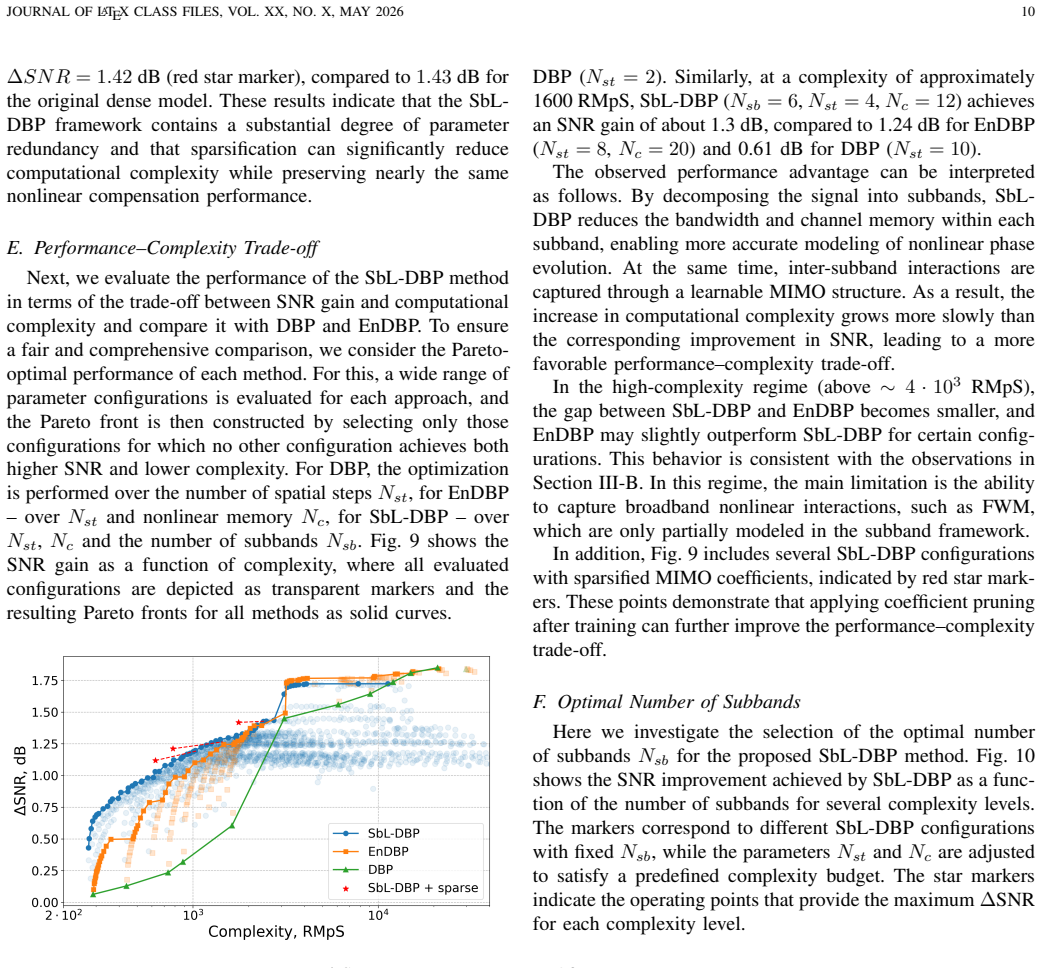
The central claim is that decomposing the received signal into multiple subbands, compensating chromatic dispersion per subband in the frequency domain, and correcting nonlinear intra- and inter-subband interactions via a jointly trained MIMO filtering structure yields a superior performance-complexity trade-off for wideband WDM transmission compared with standard digital backpropagation.
What carries the argument
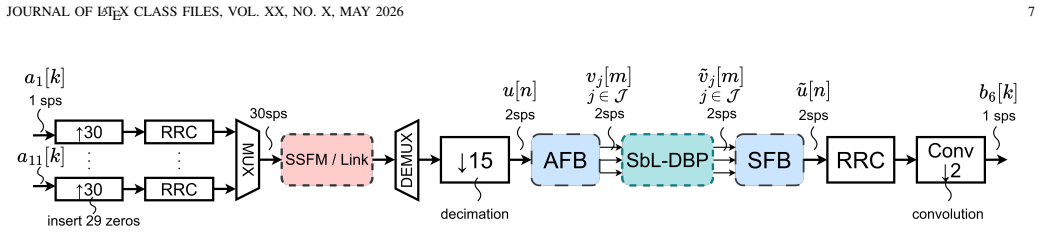
Subband decomposition followed by a trainable MIMO time-domain filter whose coefficients are optimized by end-to-end gradient descent.
Load-bearing premise
The combination of subband splitting and the learned MIMO structure captures the dominant nonlinear interactions without leaving large residual modeling errors when the same fiber or hardware conditions are used.
What would settle it
Applying the trained SbL-DBP filters to a transmission experiment that uses a different fiber type or measured hardware impairments and checking whether the reported SNR gains over conventional DBP still appear.
Figures





read the original abstract
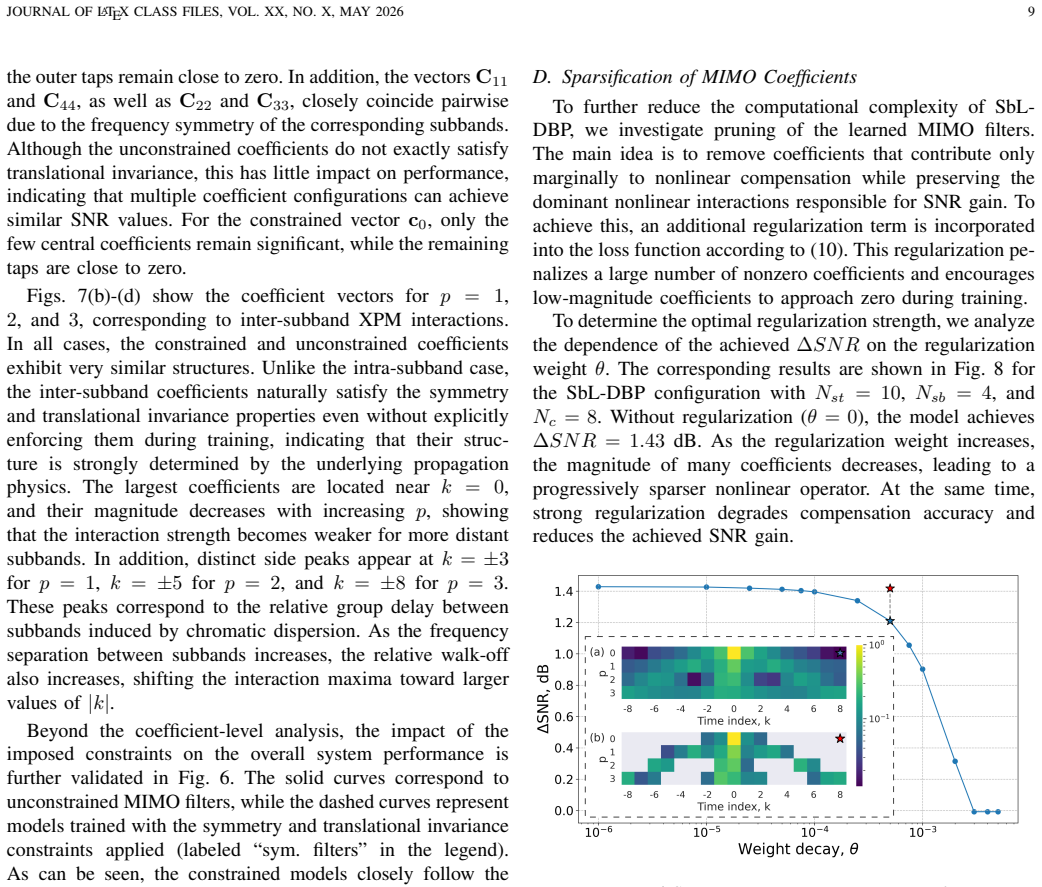
Digital backpropagation (DBP) is one of the most effective techniques for compensating nonlinear distortions in coherent optical fiber communication systems. However, its practical application to wideband transmission remains limited by high computational complexity caused by large channel memory and the requirement for fine spatial discretization. In this work, we propose a subband-based learned digital backpropagation (SbL-DBP) framework for wideband optical transmission systems. The received signal is decomposed into multiple subbands, enabling independent frequency-domain compensation of the chromatic dispersion with reduced effective channel memory and lower computational complexity. Nonlinear intra- and inter-subband interactions are addressed in the time domain using a trainable multi-input multi-output filtering structure. The parameters of the proposed framework are jointly optimized using end-to-end gradient-based learning. In addition, sparsification techniques are employed to remove insignificant coefficients and further reduce computational complexity. Numerical simulations of an 11$\times$40~Gbaud WDM RRC-16QAM 20$\times$100 km transmission system demonstrate that the proposed method provides a superior performance--complexity trade-off compared to conventional DBP and enhanced DBP. In the low- and medium-complexity regimes, SbL-DBP provides higher signal-to-noise ratio gains while requiring fewer propagation steps.
Editorial analysis
A structured set of objections, weighed in public.
Referee Report
Summary. The manuscript proposes a subband-based learned digital backpropagation (SbL-DBP) framework for nonlinearity compensation in wideband optical systems. The received signal is split into subbands for independent frequency-domain chromatic dispersion compensation with reduced memory, followed by trainable MIMO filters in the time domain to model intra- and inter-subband Kerr nonlinearities. Parameters are jointly optimized via end-to-end gradient descent, with sparsification applied to prune insignificant coefficients. Numerical simulations of an 11×40 Gbaud WDM RRC-16QAM system over 20×100 km spans demonstrate that SbL-DBP achieves higher SNR gains than conventional DBP and enhanced DBP at equivalent or lower complexity (measured in propagation steps and sparsified coefficients), particularly in low- and medium-complexity regimes.
Significance. If the simulation results hold under broader validation, the work offers a practical path to deploy DBP in wideband systems by mitigating the complexity barrier from large CD memory and fine discretization. The combination of subband decomposition, learned MIMO structures, and sparsification could enable higher spectral efficiency or extended reach in coherent optical networks without prohibitive DSP overhead.
major comments (3)
- [Numerical results] Numerical results section: The reported SNR gains are presented without error bars, confidence intervals, or details on the number of Monte Carlo realizations, making it difficult to assess statistical significance of the claimed superiority over enhanced DBP baselines.
- [Training and optimization] Section on training procedure: The end-to-end optimization is described at a high level, but the manuscript does not specify the training dataset size, exact split between training/validation/test sequences, or whether generalization was tested on fiber parameters (e.g., different dispersion or nonlinearity coefficients) outside the training distribution.
- [Complexity analysis] Complexity evaluation: While propagation steps and sparsified coefficients are used as metrics, the overhead introduced by the subband decomposition (filter banks, recombination) and the MIMO filter implementation is not quantified in equivalent real-multiplication counts, weakening the direct comparison to enhanced DBP.
minor comments (2)
- [Figures] Figure captions for the system diagram and complexity curves should explicitly state the number of subbands used and the sparsification threshold applied in each curve.
- [Method description] Notation for the MIMO filter coefficients should be introduced earlier and used consistently when describing the sparsification step.
Simulated Author's Rebuttal
We thank the referee for the constructive feedback and the recommendation for minor revision. The comments highlight important aspects of statistical rigor, training transparency, and complexity quantification that will strengthen the manuscript. We address each point below.
read point-by-point responses
-
Referee: [Numerical results] Numerical results section: The reported SNR gains are presented without error bars, confidence intervals, or details on the number of Monte Carlo realizations, making it difficult to assess statistical significance of the claimed superiority over enhanced DBP baselines.
Authors: We agree that error bars and details on Monte Carlo runs are necessary to establish statistical significance. In the revised manuscript, we will add error bars showing the standard deviation over 20 independent Monte Carlo realizations (different random seeds for data and noise), along with 95% confidence intervals. These additions confirm that the reported SNR gains over enhanced DBP remain statistically significant in the low- and medium-complexity regimes. revision: yes
-
Referee: [Training and optimization] Section on training procedure: The end-to-end optimization is described at a high level, but the manuscript does not specify the training dataset size, exact split between training/validation/test sequences, or whether generalization was tested on fiber parameters (e.g., different dispersion or nonlinearity coefficients) outside the training distribution.
Authors: We will revise the training section to specify that the dataset comprises 5000 symbol sequences per subband, using a 70/15/15 split for training/validation/test. The optimizer and learning-rate schedule will also be detailed. On generalization, the primary results use nominal fiber parameters; we will add a short study showing performance under ±10% variations in dispersion and nonlinearity coefficients, demonstrating robustness of the learned filters. This addresses the concern while noting that full out-of-distribution testing is beyond the current scope. revision: partial
-
Referee: [Complexity analysis] Complexity evaluation: While propagation steps and sparsified coefficients are used as metrics, the overhead introduced by the subband decomposition (filter banks, recombination) and the MIMO filter implementation is not quantified in equivalent real-multiplication counts, weakening the direct comparison to enhanced DBP.
Authors: We accept that a unified real-multiplication metric strengthens the comparison. In the revision we will add an explicit complexity table that counts real multiplications per symbol, incorporating the analysis/synthesis filter-bank overhead, recombination, and the cost of the sparsified MIMO filters. The enhanced DBP baseline will be expressed in the same units for direct comparison. This shows that the subband approach still yields a favorable trade-off at low and medium complexity. revision: yes
Circularity Check
No significant circularity in derivation chain
full rationale
The paper introduces a data-driven SbL-DBP framework that decomposes the signal into subbands for frequency-domain CD compensation, applies trainable MIMO filters for nonlinear interactions in the time domain, and optimizes all parameters end-to-end via gradient descent on simulated transmission data. Performance is evaluated via numerical simulations of an 11×40 Gbaud WDM system, reporting SNR gains versus conventional and enhanced DBP at given complexity (propagation steps and sparsified coefficients). No equation or claim reduces by construction to a fitted parameter renamed as prediction, no load-bearing self-citation chain is invoked to justify uniqueness, and the central results remain externally falsifiable against standard DBP benchmarks without tautological redefinition of inputs.
Axiom & Free-Parameter Ledger
free parameters (2)
- MIMO filter coefficients
- Sparsification thresholds
axioms (1)
- domain assumption Subband decomposition sufficiently isolates nonlinear interactions for the MIMO stage to correct
Lean theorems connected to this paper
-
IndisputableMonolith/Cost/FunctionalEquationwashburn_uniqueness_aczel unclear?
unclearRelation between the paper passage and the cited Recognition theorem.
The nonlinear update for the j-th subband is given by w_j[m] = v_j[m] · exp(i γ' η_s ∑_l∈J ∑_k=-Nc^Nc C_jlk |v_l[m+k]|^2 Δz) ... The coefficients C_jlk are treated as trainable parameters and optimized using the end-to-end learning framework
-
IndisputableMonolith/Foundation/RealityFromDistinctionreality_from_one_distinction unclear?
unclearRelation between the paper passage and the cited Recognition theorem.
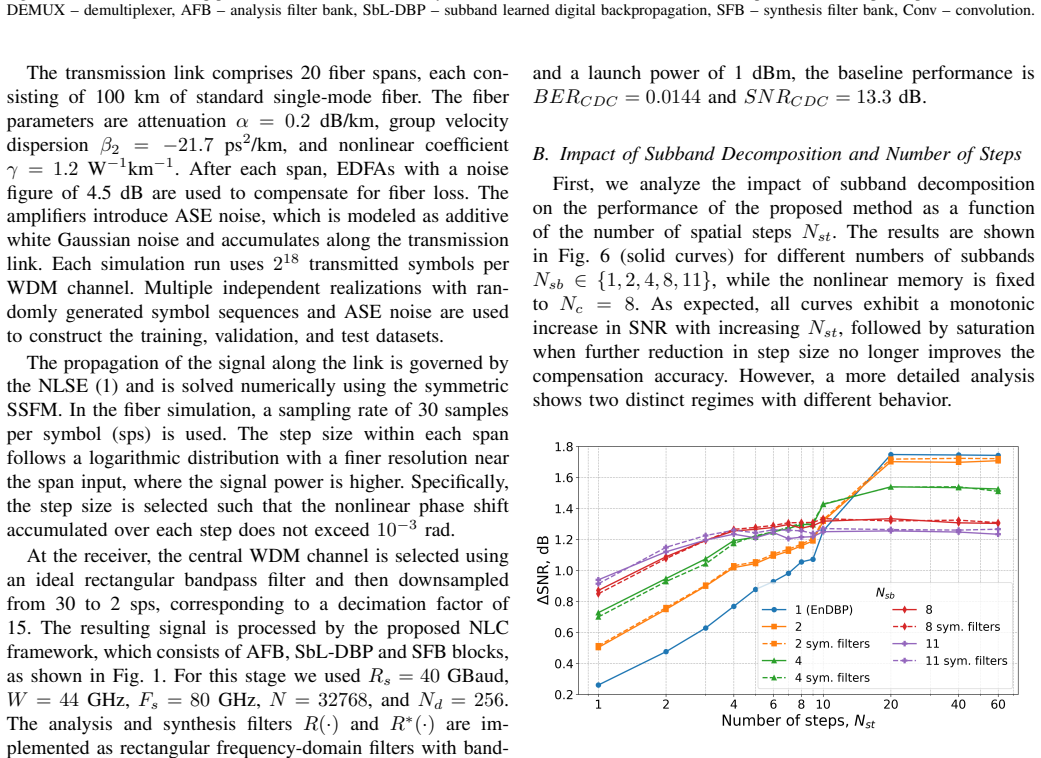
Numerical simulations of an 11×40 Gbaud WDM RRC-16QAM 20×100 km transmission system demonstrate that the proposed method provides a superior performance–complexity trade-off
What do these tags mean?
- matches
- The paper's claim is directly supported by a theorem in the formal canon.
- supports
- The theorem supports part of the paper's argument, but the paper may add assumptions or extra steps.
- extends
- The paper goes beyond the formal theorem; the theorem is a base layer rather than the whole result.
- uses
- The paper appears to rely on the theorem as machinery.
- contradicts
- The paper's claim conflicts with a theorem or certificate in the canon.
- unclear
- Pith found a possible connection, but the passage is too broad, indirect, or ambiguous to say the theorem truly supports the claim.
Reference graph
Works this paper leans on
-
[1]
Five AI trends impacting telecom in 2026,
D. Barnes, “Five AI trends impacting telecom in 2026,” Adtran Blog, Feb. 26, 2026. [Blog]. Accessed: Mar. 19, 2026. [Online]. Available: https://www.blog.adtran.com/en/five-ai-trends-impacting-telecom-in-2026
work page 2026
-
[2]
Roadmap on optical communications,
E. Agrell, M. Karlsson, F. Poletti, S. Namiki, X. Chen, L. A. Rusch, B. Puttnam, P. Bayvel, L. Schmalen, Z. Tao, F. R. Kschischang, A. Alvarado, B. Mukherjee, R. Casellas, X. Zhou, D. van Veen, G. Mohs, E. Wong, A. Mecozzi, M. Al-Slim, E. Diamanti, and M. Uysa, “Roadmap on optical communications,”Journal of Optics, vol. 26, no. 9, Art. 093001, 2024
work page 2024
-
[3]
Fiber-optic trans- mission and networking: the previous 20 and the next 20 years,
P. J. Winzer, D. T. Neilson, and A. R. Chraplyvy, “Fiber-optic trans- mission and networking: the previous 20 and the next 20 years,”Opt. Express, vol. 26, no. 18, pp. 24190–24239, 2018
work page 2018
-
[4]
A tutorial on fiber Kerr nonlinearity effect and its compensation in optical communication systems,
S. K. O. Soman, “A tutorial on fiber Kerr nonlinearity effect and its compensation in optical communication systems,”Journal of Optics, vol. 23, no. 12, Art. 123502, 2021
work page 2021
-
[5]
A Survey on Fiber Nonlinearity Compensation for 400 Gb/s and beyond Optical Communication Systems,
A. Amari, O. A. Dobre, R. Venkatesan, O. S. Sunish Kumar, P. Ciblat, and Y . Jaouen, “A Survey on Fiber Nonlinearity Compensation for 400 Gb/s and beyond Optical Communication Systems,”IEEE Communications Surveys & Tutorials, vol. 19, iss. 4, pp. 3097–3113, 2017
work page 2017
-
[6]
Digital coherent optical receivers: algorithms and subsys- tems,
S. Savory, “Digital coherent optical receivers: algorithms and subsys- tems,”IEEE J. Sel. Top. Quantum Electron., vol. 16, iss.5, pp. 1164–1179, 2010
work page 2010
-
[7]
Advanced DSP for coherent optical fiber communication,
J. Zhao, Y . Liu, and T. Xu, “Advanced DSP for coherent optical fiber communication,”Appl. Sci., vol. 9, iss. 19, Art. 4192, 2019
work page 2019
-
[8]
Compensation of nonlinear signal distortions in optical fiber communication systems,
A. Redyuk , O. Sidelnikov, and M. Fedoruk, “Compensation of nonlinear signal distortions in optical fiber communication systems,”Optics Com- munications, vol. 578, Art. 131418, 2025
work page 2025
-
[9]
Compensation of Dispersion and Nonlinear Impairments Using Digital Backpropagation,
E. Ip and J. M. Kahn, “Compensation of Dispersion and Nonlinear Impairments Using Digital Backpropagation,”J. Lightwave Technol., vol. 26, no. 20, pp. 3416–3425, 2008
work page 2008
-
[10]
Z. Xiao, Q. Zhuge, S. Fu, F. Zhang, M. Qiu, M. Tang, D. Liu, and D. V . Plant, “Low complexity split digital backpropagation for digital subcarrier-multiplexing optical transmissions,”Optics Express, vol. 25, iss. 22. pp., 27824–27833, 2017
work page 2017
-
[11]
Enhanced split-step Fourier method for digital backpropagation,
M. Secondini, D. Marsella, and E. Forestieri, “Enhanced split-step Fourier method for digital backpropagation,” inThe European Conference on Optical Communication (ECOC), Cannes, France, 2014, pp. 1–3
work page 2014
-
[12]
Correlated digital back propagation based on perturbation theory,
X. Liang and S. Kumar, “Correlated digital back propagation based on perturbation theory,” inOptics Express, vol. 23, iss. 11., pp. 14655–14665, 2015
work page 2015
-
[13]
ML-Enhanced Digital Back- propagation for Long-Reach Single-Span Systems,
D. Cellini, S. Civelli, and M. Secondini, “ML-Enhanced Digital Back- propagation for Long-Reach Single-Span Systems,” arXiv, 2026
work page 2026
-
[14]
A. Redyuk, E. Shevelev, V . Danilko, T. Bazarov, M. Senko, L. Samod- elkin, O. Nanii, V . Treshchikov, and M. Fedoruk, “Learned perturbation- based digital backpropagation with low complexity for nonlinearity compensation,”Opt. Continuum, vol. 4, no. 12, pp. 2896–2913, 2025
work page 2025
-
[15]
X. Lin, S. Luo, S. K. O. Soman, O. A. Dobre, L. Lampe, D. Chang, and C. Li, “Perturbation Theory-Aided Learned Digital Back-Propagation Scheme for Optical Fiber Nonlinearity Compensation,”J. Lightwave Technol., vol. 40, no. 7, pp. 1981–1988, 2022
work page 1981
-
[16]
O. Sidelnikov, A. Redyuk, S. Sygletos, M. Fedoruk, and S. Turitsyn, “Advanced Convolutional Neural Networks for Nonlinearity Mitigation in Long-Haul WDM Transmission Systems,”J. Lightwave Technol., vol. 39, no. 8, pp. 2397–2406, 2021
work page 2021
-
[17]
P. Freire, S. Srivallapanondh, B. Spinnler, A. Napoli, N. Costa, J. E. Prilepsky, and S. K. Turitsyn, “Computational Complexity Optimization of Neural Network-Based Equalizers in Digital Signal Processing: A Comprehensive Approach,”J. Lightwave Technol., vol. 42, no. 12, pp. 4177–4201, 2024
work page 2024
-
[18]
Deep Learning- Aided Perturbation Model-Based Fiber Nonlinearity Compensation,
S. Luo, S. K. O. Soman, L. Lampe, and J. Mitra, “Deep Learning- Aided Perturbation Model-Based Fiber Nonlinearity Compensation,”J. Lightwave Technol., vol. 41, no. 12, pp. 3976–3985, 2023
work page 2023
-
[19]
V . Oliari, S. Goossens, C. Hager, G. Liga, R. M. Butler, M. van den Hout, S. van der Heide, H. D. Pfister, C. Okonkwo, and A. Alvarado, “Revisiting Efficient Multi-Step Nonlinearity Compensation With Machine Learning: An Experimental Demonstration,”J. Lightwave Technol., vol. 38, no. 12, pp. 3114–3124, 2020
work page 2020
-
[20]
Physics-Based Deep Learning for Fiber- Optic Communication Systems,
C. H ¨ager and H. D. Pfister, “Physics-Based Deep Learning for Fiber- Optic Communication Systems,”IEEE J. Sel. Areas Commun., vol. 39, no. 1, pp. 280–294, 2021
work page 2021
-
[21]
Wideband Time-Domain Digital Back- propagation via Subband Processing and Deep Learning,
C. H ¨ager and H. D. Pfister, “Wideband Time-Domain Digital Back- propagation via Subband Processing and Deep Learning,” inEuropean Conference on Optical Communication (ECOC), 2018
work page 2018
-
[22]
Subband Processing for OQAM Digital-Subcarrier-Multiplexing Optical Coherent Systems,
Z. Fan, J. Luo, B. Zheng, Y . Cai, and J. Zhao, “Subband Processing for OQAM Digital-Subcarrier-Multiplexing Optical Coherent Systems,” J. Lightwave Technol., vol. 43, no. 9, pp. 4218–4232, 2025
work page 2025
-
[23]
W. Guo, H. Deng, X. Tang, Z. Fan, Y . Cai, and J. Zhao, “Perturbation- aided fiber nonlinear compensation based on subband decomposition and synthesis for optical coherent systems [Invited],”Chin. Opt. Lett., vol. 24, no. 3, Art. 030003, 2026
work page 2026
-
[24]
E. Ip, N. Bai, and T. Wang, “Complexity versus performance trade- off for fiber nonlinearity compensation using frequency-shaped, multi- subband backpropagation,” in Proc. Opt. Fiber Commun. Conf. Expo. (OFC/NFOEC), Los Angeles, CA, USA, Mar. 2011, pp. 1–3
work page 2011
-
[25]
A New Twist on Low-Complexity Digital Backpropagation,
S. Civelli, D. P. Jana, E. Forestieri, and M. Secondini, “A New Twist on Low-Complexity Digital Backpropagation,”J. Lightwave Technol., vol. 43, no. 10, pp. 4679–4692, 2025
work page 2025
-
[26]
G. Agrawal, “Nonlinear Fiber Optics”, Elsevier. Boston, MA, USA. 2013
work page 2013
-
[27]
Digital filters for coherent optical receivers,
S. J. Savory, “Digital filters for coherent optical receivers,”Opt. express, vol. 16, no. 2, pp. 804–817, 2008
work page 2008
discussion (0)
Sign in with ORCID, Apple, or X to comment. Anyone can read and Pith papers without signing in.