Recognition: 1 theorem link
· Lean TheoremAdmittance-Guided Inverter Dispatch Command Manipulation Attack: A Grid Stability-Oriented Approach
Pith reviewed 2026-05-15 01:44 UTC · model grok-4.3
The pith
Manipulating dispatch commands to one inverter can induce severe sub-synchronous oscillations in microgrids while staying inside normal bounds.
A machine-rendered reading of the paper's core claim, the machinery that carries it, and where it could break.
Core claim
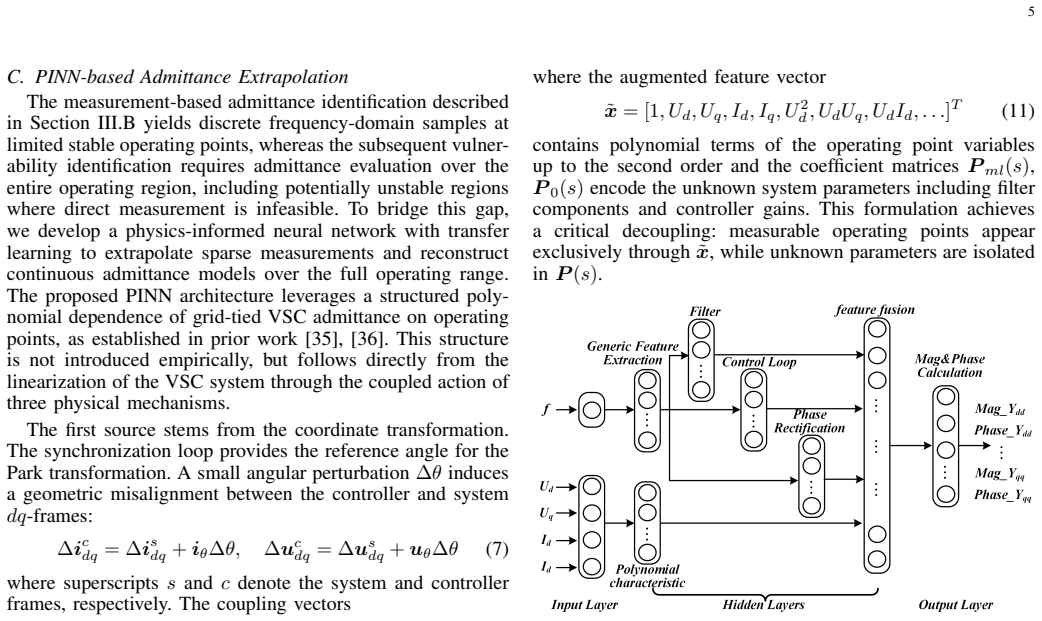
By using sparse harmonic perturbations from a compromised inverter to train a physics-informed neural network, the framework reconstructs the operating-point-dependent admittance of target inverters across the entire feasible dispatch region; a subsequent stability-margin optimization then identifies the most vulnerable inverter and the worst-case dispatch command that drives the microgrid into severe sub-synchronous oscillations, all while the command remains inside nominal bounds, as confirmed in controller hardware-in-the-loop tests on a five-inverter system.
What carries the argument
The admittance-guided optimization that reconstructs operating-point-dependent admittance via physics-informed neural network and then searches for the dispatch command minimizing stability margins.
Load-bearing premise
The physics-informed neural network accurately reconstructs each inverter's admittance across the full range of feasible dispatch points from only sparse harmonic measurements.
What would settle it
Direct measurement of actual admittance at many dispatch points in the same five-inverter microgrid would show whether the neural-network predictions deviate enough to change which command the optimizer selects as worst-case.
Figures





read the original abstract
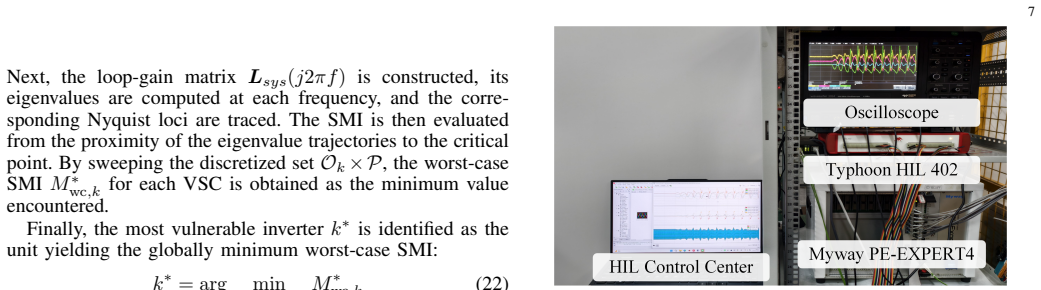
The high penetration of voltage source converters in modern smart microgrids enhances operational flexibility while introducing complex cyber-physical vulnerabilities. Existing cyber-attack studies either require detailed knowledge of system topology and controller dynamics or depend on repeated online interactions, which may compromise practicality by generating operationally infeasible or limit-violating commands. This article investigates a dispatch command manipulation attack and develops an admittance-guided framework to identify the vulnerable inverter and the worst-case dispatch command that most severely degrades system stability. A compromised inverter is utilized to inject controlled harmonic perturbations for sparse admittance measurement, and a physics-informed neural network is then employed to reconstruct the operating-point-dependent admittance of target inverters over the feasible dispatch region. Based on the reconstructed admittance, a stability-margin-oriented optimization is formulated to locate the most vulnerable inverter and the corresponding worst-case dispatch command. Controller hardware-in-the-loop experiments on a five-inverter microgrid demonstrate that the identified command can drive the system into severe sub-synchronous oscillations while remaining within nominal dispatch bounds, highlighting the need for stability-aware command screening beyond static limit checking.
Editorial analysis
A structured set of objections, weighed in public.
Referee Report
Summary. The manuscript proposes an admittance-guided framework to identify vulnerable inverters and worst-case dispatch commands for a manipulation attack in microgrids. A compromised inverter injects sparse harmonic perturbations to measure admittance; a physics-informed neural network reconstructs the operating-point-dependent admittance of target inverters across the feasible dispatch region; a stability-margin optimization then selects the most destabilizing command within nominal bounds. Controller hardware-in-the-loop experiments on a five-inverter microgrid are reported to induce severe sub-synchronous oscillations.
Significance. If the reconstruction accuracy holds, the result demonstrates a practical cyber-physical attack vector that exploits dispatch commands respecting static limits to degrade grid stability, underscoring the need for dynamic stability screening. The combination of sparse measurement, PINN surrogate modeling, and HIL validation constitutes a concrete contribution to inverter-based microgrid security analysis.
major comments (3)
- [PINN admittance reconstruction and validation] The central claim depends on the PINN producing an accurate operating-point-dependent admittance model over the entire feasible dispatch region from sparse harmonic injections. No quantitative error bounds, cross-validation scores, or comparison against ground-truth admittance (analytical or high-fidelity simulation) at held-out dispatch points are reported; without these, the optimized command could be an artifact of reconstruction error rather than a genuine stability vulnerability.
- [Optimization formulation] The stability-margin-oriented optimization is formulated using the reconstructed admittance, yet the manuscript provides neither the explicit objective function and constraints nor a sensitivity analysis showing how reconstruction errors propagate to the identified worst-case command and stability margin.
- [Controller hardware-in-the-loop experiments] The HIL experiments demonstrate oscillations under the identified command, but lack baseline comparisons (e.g., random feasible commands or analytically derived worst-case commands) and quantitative metrics of stability-margin reduction, making it difficult to confirm that the command is indeed the most severe within nominal bounds.
minor comments (2)
- [Introduction and Methods] Notation for the admittance matrix and operating-point dependence should be introduced with explicit equations early in the methods section to improve readability.
- [Abstract] The abstract states 'severe sub-synchronous oscillations' without specifying the frequency range or damping ratio; adding these quantitative descriptors would strengthen the claim.
Simulated Author's Rebuttal
We thank the referee for the constructive and detailed comments, which highlight important aspects of validation, formulation clarity, and experimental rigor. We agree that these elements require strengthening to fully support the claims. We address each major comment below and will incorporate the suggested revisions in the next version of the manuscript.
read point-by-point responses
-
Referee: [PINN admittance reconstruction and validation] The central claim depends on the PINN producing an accurate operating-point-dependent admittance model over the entire feasible dispatch region from sparse harmonic injections. No quantitative error bounds, cross-validation scores, or comparison against ground-truth admittance (analytical or high-fidelity simulation) at held-out dispatch points are reported; without these, the optimized command could be an artifact of reconstruction error rather than a genuine stability vulnerability.
Authors: We acknowledge the absence of comprehensive quantitative validation metrics in the current manuscript. In the revised version, we will add k-fold cross-validation scores across the dispatch region, L2 error bounds on admittance magnitude and phase, and direct comparisons against both analytical small-signal models and high-fidelity EMT simulations at multiple held-out operating points. These additions will demonstrate that reconstruction errors remain sufficiently small to preserve the identified stability vulnerability. revision: yes
-
Referee: [Optimization formulation] The stability-margin-oriented optimization is formulated using the reconstructed admittance, yet the manuscript provides neither the explicit objective function and constraints nor a sensitivity analysis showing how reconstruction errors propagate to the identified worst-case command and stability margin.
Authors: The optimization is described in Section IV, but we agree that greater mathematical explicitness is needed. We will insert the full problem statement (objective: minimize the smallest damping ratio of the closed-loop system; constraints: nominal dispatch bounds and power limits) together with a first-order sensitivity analysis that quantifies how bounded admittance reconstruction errors translate into bounded shifts in the worst-case command and stability margin. This will confirm that the identified attack remains valid within the reported error tolerances. revision: yes
-
Referee: [Controller hardware-in-the-loop experiments] The HIL experiments demonstrate oscillations under the identified command, but lack baseline comparisons (e.g., random feasible commands or analytically derived worst-case commands) and quantitative metrics of stability-margin reduction, making it difficult to confirm that the command is indeed the most severe within nominal bounds.
Authors: We will expand the experimental results section to include baseline comparisons against (i) randomly sampled feasible dispatch commands and (ii) commands obtained from a simplified analytical worst-case search. Quantitative metrics will be added, including measured reductions in damping ratio (via Prony analysis of HIL waveforms) and peak oscillation amplitude, to demonstrate that the identified command produces statistically larger stability degradation than the baselines while remaining inside nominal limits. revision: yes
Circularity Check
No significant circularity; derivation relies on external measurements and HIL validation
full rationale
The paper measures admittance via controlled harmonic perturbations from a compromised inverter, reconstructs operating-point-dependent admittance with a PINN, formulates a stability-margin optimization to select the worst-case dispatch command, and validates the result via independent controller hardware-in-the-loop experiments on a five-inverter microgrid. None of the load-bearing steps (measurement, reconstruction, optimization, or experimental demonstration) reduce by construction to a fitted parameter, self-citation chain, or self-defined quantity. The central claim is externally falsifiable through the HIL setup and does not rely on renaming known results or importing uniqueness theorems from the authors' prior work. This is a standard non-circular empirical pipeline.
Axiom & Free-Parameter Ledger
free parameters (1)
- physics-informed neural network weights
axioms (1)
- domain assumption Small-signal linearization around operating points remains valid for stability-margin assessment
Lean theorems connected to this paper
-
IndisputableMonolith/Foundation/RealityFromDistinction.leanreality_from_one_distinction unclear?
unclearRelation between the paper passage and the cited Recognition theorem.
physics-informed neural network ... reconstruct the operating-point-dependent admittance ... stability-margin-oriented optimization
What do these tags mean?
- matches
- The paper's claim is directly supported by a theorem in the formal canon.
- supports
- The theorem supports part of the paper's argument, but the paper may add assumptions or extra steps.
- extends
- The paper goes beyond the formal theorem; the theorem is a base layer rather than the whole result.
- uses
- The paper appears to rely on the theorem as machinery.
- contradicts
- The paper's claim conflicts with a theorem or certificate in the canon.
- unclear
- Pith found a possible connection, but the passage is too broad, indirect, or ambiguous to say the theorem truly supports the claim.
Reference graph
Works this paper leans on
-
[1]
Foundations and challenges of low-inertia systems (invited paper),
F. Milano, F. D ¨orfler, G. Hug, D. J. Hill, and G. Verbi ˇc, “Foundations and challenges of low-inertia systems (invited paper),” in2018 Power Systems Computation Conference (PSCC), 2018, pp. 1–25
2018
-
[2]
Grid-synchronization stability of converter-based resources—an overview,
X. Wang, M. G. Taul, H. Wu, Y . Liao, F. Blaabjerg, and L. Harne- fors, “Grid-synchronization stability of converter-based resources—an overview,”IEEE Open Journal of Industry Applications, vol. 1, pp. 115– 134, 2020
2020
-
[3]
Cyber security in control of grid-tied power electronic converters—challenges and vulnerabilities,
S. Sahoo, T. Dragi ˇcevi´c, and F. Blaabjerg, “Cyber security in control of grid-tied power electronic converters—challenges and vulnerabilities,” IEEE Journal of Emerging and Selected Topics in Power Electronics, vol. 9, no. 5, pp. 5326–5340, 2021
2021
-
[4]
The 2015 ukraine blackout: Implications for false data injection attacks,
G. Liang, S. R. Weller, J. Zhao, F. Luo, and Z. Y . Dong, “The 2015 ukraine blackout: Implications for false data injection attacks,”IEEE Transactions on Power Systems, vol. 32, no. 4, pp. 3317–3318, 2017
2015
-
[5]
Public history of solar energy cyberattacks and vulnerabilities,
DER Security Corp, “Public history of solar energy cyberattacks and vulnerabilities,” DER Security Corp, Tech. Rep., Nov 2024, accessed: Dec. 04, 2025. [Online]. Available: https://dersec.io/reports/
2024
-
[6]
I. Ilascu. (2017, Aug.) Hackers could cut power to thousands of homes in attack on photovoltaic in- stallations. Bitdefender. Accessed: Dec. 4, 2025. [On- line]. Available: https://www.bitdefender.com/en-us/blog/hotforsecurity/ hackers-cut-power-thousands-home-attack-photovoltaic-installations
2017
-
[7]
Smart cyber- attack diagnosis and mitigation in a wind farm network operator,
H. Badihi, S. Jadidi, Z. Yu, Y . Zhang, and N. Lu, “Smart cyber- attack diagnosis and mitigation in a wind farm network operator,”IEEE Transactions on Industrial Informatics, vol. 19, no. 9, pp. 9468–9478, 2023
2023
-
[8]
Destabilizing power grid and energy market by cyberattacks on smart inverters,
X. Hui, S. Karumba, S. C.-K. Chau, and M. Ahmed, “Destabilizing power grid and energy market by cyberattacks on smart inverters,” in Proceedings of the 16th ACM International Conference on Future and Sustainable Energy Systems, ser. E-Energy ’25. New York, NY , USA: Association for Computing Machinery, 2025, p. 136–151. [Online]. Available: https://doi.or...
-
[9]
Enhancing cyber-resiliency of der-based smart grid: A survey,
M. Liu, F. Teng, Z. Zhang, P. Ge, M. Sun, R. Deng, P. Cheng, and J. Chen, “Enhancing cyber-resiliency of der-based smart grid: A survey,” IEEE Transactions on Smart Grid, vol. 15, no. 5, pp. 4998–5030, 2024
2024
-
[10]
Cybersecurity of smart inverters in the smart grid: A survey,
Y . Li and J. Yan, “Cybersecurity of smart inverters in the smart grid: A survey,”IEEE Transactions on Power Electronics, vol. 38, no. 2, pp. 2364–2383, 2023
2023
-
[11]
Experimental cybersecurity evaluation of distributed solar inverters: Vulnerabilities and impacts on the australian grid,
A. S. Musleh, J. Ahmed, N. Ahmed, H. Xu, G. Chen, S. Kerr, and S. Jha, “Experimental cybersecurity evaluation of distributed solar inverters: Vulnerabilities and impacts on the australian grid,”IEEE Transactions on Smart Grid, vol. 15, no. 5, pp. 5139–5150, 2024
2024
-
[12]
Cyberattack on phase-locked loops in inverter-based energy resources,
A. Bamigbade, Y . Dvorkin, and R. Karri, “Cyberattack on phase-locked loops in inverter-based energy resources,”IEEE Transactions on Smart Grid, vol. 15, no. 1, pp. 821–833, 2024
2024
-
[13]
Hardware-assisted detection of firmware attacks in inverter-based cyberphysical microgrids,
A. P. Kuruvila, I. Zografopoulos, K. Basu, and C. Konstantinou, “Hardware-assisted detection of firmware attacks in inverter-based cyberphysical microgrids,”International Journal of Electrical Power & Energy Systems, vol. 132, p. 107150, 2021. [Online]. Available: https://www.sciencedirect.com/science/article/pii/S0142061521003896
2021
-
[14]
Hall spoofing: A Non-Invasive DoS attack on Grid-Tied solar inverter,
A. Barua and M. A. A. Faruque, “Hall spoofing: A Non-Invasive DoS attack on Grid-Tied solar inverter,” in29th USENIX Security Symposium (USENIX Security 20). USENIX Association, Aug. 2020, pp. 1273–1290. [Online]. Available: https://www.usenix.org/conference/ usenixsecurity20/presentation/barua
2020
-
[15]
A test bed for detecting false data injection attacks in systems with distributed energy resources,
H. M. Albunashee, C. Farnell, A. Suchanek, K. Haulmark, R. A. McCann, J. Di, and A. Mantooth, “A test bed for detecting false data injection attacks in systems with distributed energy resources,”IEEE Journal of Emerging and Selected Topics in Power Electronics, vol. 10, no. 1, pp. 1303–1315, 2022
2022
-
[16]
False data injection attacks against state estimation in multiphase and unbalanced smart distribution systems,
P. Zhuang, R. Deng, and H. Liang, “False data injection attacks against state estimation in multiphase and unbalanced smart distribution systems,”IEEE Transactions on Smart Grid, vol. 10, no. 6, pp. 6000– 6013, 2019
2019
-
[17]
False data injection attacks in power distribution systems considering the charac- teristics of distributed photovoltaic,
Y . Liu, M. Wen, H. Wen, R. Deng, S. Peng, and N. Guo, “False data injection attacks in power distribution systems considering the charac- teristics of distributed photovoltaic,”IEEE Transactions on Industrial Informatics, vol. 21, no. 3, pp. 2023–2032, 2025
2023
-
[18]
Design and defense of modal resonance-oriented cyber-attack against wide-area damping control,
Z. Wang and S. Bu, “Design and defense of modal resonance-oriented cyber-attack against wide-area damping control,”IEEE Transactions on Smart Grid, vol. 15, no. 2, pp. 2164–2178, 2024
2024
-
[19]
Distributed load sharing under false data injection attack in an inverter-based microgrid,
H. Zhang, W. Meng, J. Qi, X. Wang, and W. X. Zheng, “Distributed load sharing under false data injection attack in an inverter-based microgrid,” IEEE Transactions on Industrial Electronics, vol. 66, no. 2, pp. 1543– 1551, 2019
2019
-
[20]
False data injection attacks against synchronization systems in microgrids,
A. S. Mohamed, M. F. M. Arani, A. A. Jahromi, and D. Kundur, “False data injection attacks against synchronization systems in microgrids,” IEEE Transactions on Smart Grid, vol. 12, no. 5, pp. 4471–4483, 2021
2021
-
[21]
Cyber-secure global operation of grid forming inverters in pinning-based ac microgrid clusters,
S. Jena, A. Mishra, and N. P. Padhy, “Cyber-secure global operation of grid forming inverters in pinning-based ac microgrid clusters,”IEEE Transactions on Industry Applications, vol. 61, no. 2, pp. 2662–2677, 2025
2025
-
[22]
A reinforcement learning approach to undetectable attacks against automatic generation control,
E. Shereen, K. Kazari, and G. D ´an, “A reinforcement learning approach to undetectable attacks against automatic generation control,”IEEE Transactions on Smart Grid, vol. 15, no. 1, pp. 959–972, 2024
2024
-
[23]
Load frequency control based on reinforcement learning for microgrids under false data attacks,
S. I. Abouzeid, Y . Chen, M. Zaery, M. A. Abido, A. Raza, and E. H. Abdelhameed, “Load frequency control based on reinforcement learning for microgrids under false data attacks,”Computers and Electrical Engineering, vol. 123, p. 110093, 2025. [Online]. Available: https://www.sciencedirect.com/science/article/pii/S0045790625000369
2025
-
[24]
Destabilizing attack and robust defense for inverter-based microgrids by adversarial deep reinforcement learning,
Y . Wang and B. C. Pal, “Destabilizing attack and robust defense for inverter-based microgrids by adversarial deep reinforcement learning,” IEEE Transactions on Smart Grid, vol. 14, no. 6, pp. 4839–4850, 2023
2023
-
[25]
Vulnerability identification and remediation of fdi attacks in islanded dc microgrids using multiagent reinforcement learning,
A. J. Abianeh, Y . Wan, F. Ferdowsi, N. Mijatovic, and T. Dragi ˇcevi´c, “Vulnerability identification and remediation of fdi attacks in islanded dc microgrids using multiagent reinforcement learning,”IEEE Transactions on Power Electronics, vol. 37, no. 6, pp. 6359–6370, 2022
2022
-
[26]
Dynamic load altering attacks against power system stability: Attack models and protection schemes,
S. Amini, F. Pasqualetti, and H. Mohsenian-Rad, “Dynamic load altering attacks against power system stability: Attack models and protection schemes,”IEEE Transactions on Smart Grid, vol. 9, no. 4, pp. 2862– 2872, 2018
2018
-
[27]
Exploring smart grid vulnerability against intelligent inverter parameter tampering attack,
Z. Yu, M. Liu, and M. Sun, “Exploring smart grid vulnerability against intelligent inverter parameter tampering attack,”IEEE Transactions on Smart Grid, vol. 16, no. 6, pp. 5541–5555, 2025
2025
-
[28]
Online cyber-attack detection in smart grid: A reinforcement learning approach,
M. N. Kurt, O. Ogundijo, C. Li, and X. Wang, “Online cyber-attack detection in smart grid: A reinforcement learning approach,”IEEE Transactions on Smart Grid, vol. 10, no. 5, pp. 5174–5185, 2019
2019
-
[29]
CVE-2024-35783: Siemens SIMATIC PCS 7 and WinCC Arbitrary Code Execution,
National Vulnerability Database, “CVE-2024-35783: Siemens SIMATIC PCS 7 and WinCC Arbitrary Code Execution,” https://nvd.nist.gov/vuln/ detail/CVE-2024-35783, 2024, accessed: 2025-12-16
2024
-
[30]
CVE-2024-50694: Sungrow WiNet-S Communication Mod- ule Stack-based Buffer Overflow,
——, “CVE-2024-50694: Sungrow WiNet-S Communication Mod- ule Stack-based Buffer Overflow,” https://nvd.nist.gov/vuln/detail/ CVE-2024-50694, 2024, accessed: 2025-12-16
2024
-
[31]
CVE-2024-1086: Linux Kernel Netfilter Use-After-Free Vulnera- bility,
——, “CVE-2024-1086: Linux Kernel Netfilter Use-After-Free Vulnera- bility,” https://nvd.nist.gov/vuln/detail/CVE-2024-1086, 2024, accessed: 2025-12-16
2024
-
[32]
J. McCarthy, J. Marron, D. Faatz, D. Rebori-Carretero, J. Wiltberger, and N. Urlaub, “Cybersecurity for smart inverters: Guidelines for residential and light commercial solar energy systems,” National Institute of Standards and Technology, Gaithersburg, MD, NIST Interagency Report NIST IR 8498, Dec. 2024. [Online]. Available: https://doi.org/10.6028/NIST.IR.8498
-
[33]
Ieee standard for interconnection and interoperability of dis- tributed energy resources with associated electric power systems inter- faces,
IEEE, “Ieee standard for interconnection and interoperability of dis- tributed energy resources with associated electric power systems inter- faces,”IEEE Std 1547-2018 (Revision of IEEE Std 1547-2003), pp. 1– 138, 2018
2018
-
[34]
Impedance-based stability criterion for grid-connected invert- ers,
J. Sun, “Impedance-based stability criterion for grid-connected invert- ers,”IEEE Transactions on Power Electronics, vol. 26, no. 11, pp. 3075– 3078, 2011
2011
-
[35]
Physics-informed neural network based online impedance identification of voltage source converters,
M. Zhang, Q. Xu, and X. Wang, “Physics-informed neural network based online impedance identification of voltage source converters,” IEEE Transactions on Industrial Electronics, vol. 70, no. 4, pp. 3717– 3728, 2023
2023
-
[36]
Few-shot data-driven model- ing of unified grid tied vscs for multioperation impedance identification based on pinn,
H. Li, H. Nian, L. Zhan, B. Hu, and M. Li, “Few-shot data-driven model- ing of unified grid tied vscs for multioperation impedance identification based on pinn,”IEEE Transactions on Industrial Electronics, vol. 72, no. 7, pp. 6957–6968, 2025
2025
-
[37]
False data injection on state estimation in power systems—attacks, impacts, and defense: A survey,
R. Deng, G. Xiao, R. Lu, H. Liang, and A. V . Vasilakos, “False data injection on state estimation in power systems—attacks, impacts, and defense: A survey,”IEEE Transactions on Industrial Informatics, vol. 13, no. 2, pp. 411–423, 2017
2017
-
[38]
Small-signal impedance measurement of power-electronics-based ac power systems using line-to- line current injection,
J. Huang, K. A. Corzine, and M. Belkhayat, “Small-signal impedance measurement of power-electronics-based ac power systems using line-to- line current injection,”IEEE Transactions on Power Electronics, vol. 24, no. 2, pp. 445–455, 2009
2009
-
[39]
A nearly decoupled admittance model for grid-tied vscs under variable operating conditions,
W. Liu, X. Xie, J. Shair, and X. Li, “A nearly decoupled admittance model for grid-tied vscs under variable operating conditions,”IEEE Transactions on Power Electronics, vol. 35, no. 9, pp. 9380–9389, 2020
2020
-
[40]
Small-signal modeling and parameters design for virtual synchronous generators,
H. Wu, X. Ruan, D. Yang, X. Chen, W. Zhao, Z. Lv, and Q.-C. Zhong, “Small-signal modeling and parameters design for virtual synchronous generators,”IEEE Transactions on Industrial Electronics, vol. 63, no. 7, pp. 4292–4303, 2016
2016
-
[41]
Similarity of neural network representations revisited,
S. Kornblith, M. Norouzi, H. Lee, and G. Hinton, “Similarity of neural network representations revisited,” inProceedings of the 36th International Conference on Machine Learning, ser. Proceedings of Machine Learning Research, K. Chaudhuri and R. Salakhutdinov, Eds., vol. 97. PMLR, 09–15 Jun 2019, pp. 3519–3529. [Online]. Available: https://proceedings.mlr...
2019
-
[42]
Ieee standard for synchrophasor measurements for power sys- tems,
IEEE, “Ieee standard for synchrophasor measurements for power sys- tems,”IEEE Std C37.118.1-2011 (Revision of IEEE Std C37.118-2005), pp. 1–61, 2011
2011
discussion (0)
Sign in with ORCID, Apple, or X to comment. Anyone can read and Pith papers without signing in.