Recognition: 2 theorem links
· Lean TheoremMatrix-Product Belief Propagation for continuous-state-space variables
Pith reviewed 2026-05-15 01:19 UTC · model grok-4.3
The pith
Matrix-Product Belief Propagation extends to continuous variables through a Hilbert basis expansion.
A machine-rendered reading of the paper's core claim, the machinery that carries it, and where it could break.
Core claim
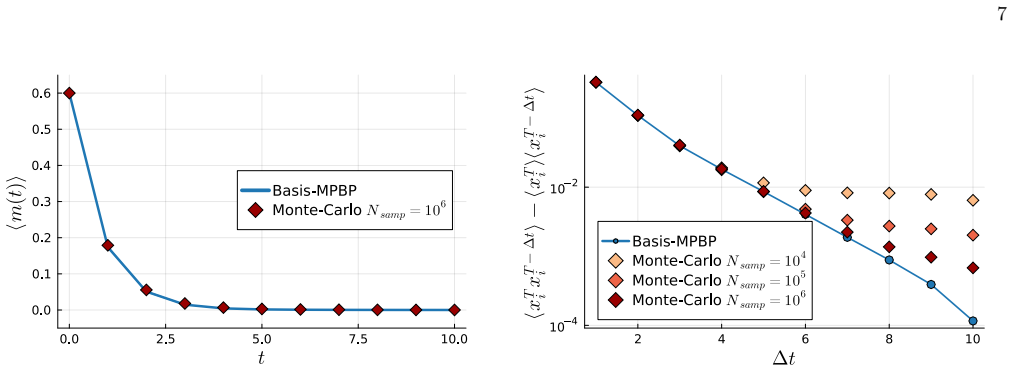
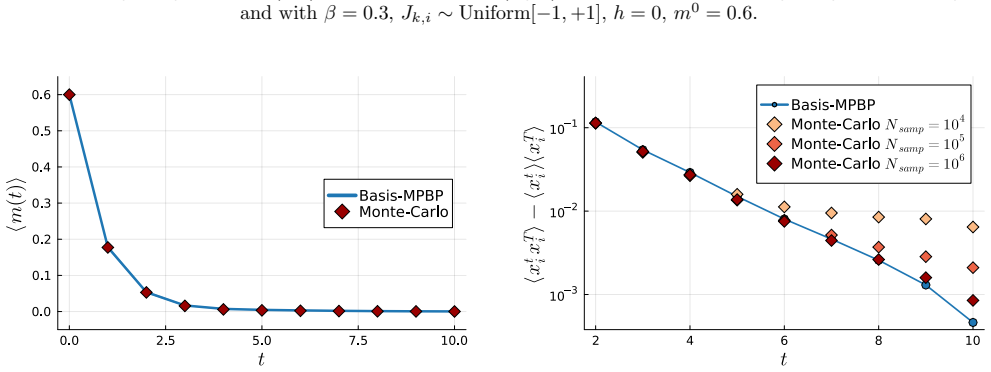
The paper establishes that by expanding continuous degrees of freedom in a Hilbert function basis and incorporating this into the matrix-product structure of belief propagation, one can estimate observables in large sparse networks with continuous or mixed variables. The cost is linear in network size with a prefactor set by basis and bond dimensions. Efficacy is shown for the kinetic Ising model treating intermediate local fields as continuous, with results for auto-correlations, energy, magnetization evolution, and magnetization large deviation functions verified against Monte Carlo.
What carries the argument
Hilbert function basis expansion integrated into the matrix-product belief propagation algorithm to handle continuous states.
If this is right
- Observables in conditioned dynamics on networks with continuous variables become computable semi-analytically.
- The error can be controlled by increasing the basis size or bond size.
- The method applies to mixed continuous/discrete models like kinetic Ising with real couplings.
- Large deviation functions can be estimated for magnetization at future times.
Where Pith is reading between the lines
- This approach might be combined with other basis expansions for better efficiency in specific problems.
- The linear scaling could make it practical for very large networks where Monte Carlo is too slow.
- Extensions could handle time-dependent bases or adaptive expansions for non-stationary dynamics.
Load-bearing premise
A finite number of terms in the Hilbert basis expansion suffices to represent the continuous variables with acceptably small error.
What would settle it
Compare the method's predictions for magnetization time evolution in the kinetic Ising model against exact Monte Carlo simulations for increasing basis sizes to see if the discrepancy decreases systematically.
Figures



read the original abstract
Computation of observables in discrete stochastic, possibly conditioned, dynamics over large sparse networks is at the basis of a myriad of applications. The Matrix-Product Belief Propagation method allows a semi-analytical estimation of such observables with a controlled error that depends on the size of the employed matrices, called bond size. Its computational cost is linear in the time horizon and the network size for a large family of models with discrete degrees of freedom. Here, a generalization of this method to models with continuous or mixed continuous/discrete degrees of freedom is presented, using a tunable expansion in a Hilbert function basis. The computational cost of the method is linear in the network size with a prefactor that depends on the basis size and the bond size. The method's efficacy is demonstrated by employing a Fourier basis for a mixed continuous/discrete representation of the Kinetic Ising dynamics with real-valued random couplings, where intermediate ``local fields'' are treated as continuous. The accuracy of the method is verified via comparison with Monte-Carlo simulations. For this model, we calculate time auto-correlations, time evolution of energy and magnetization, and finally we estimate the large deviation function of the magnetization at a given future time.
Editorial analysis
A structured set of objections, weighed in public.
Referee Report
Summary. The manuscript generalizes Matrix-Product Belief Propagation (MPBP) from discrete to continuous or mixed continuous/discrete state spaces by expanding messages in a tunable Hilbert function basis (e.g., Fourier for local fields). The resulting algorithm retains linear scaling in network size, with computational cost depending on bond dimension and basis size. The approach is demonstrated on the Kinetic Ising model with real-valued random couplings, where intermediate local fields are treated as continuous variables; observables computed include time autocorrelations, energy and magnetization evolution, and the large-deviation function of magnetization, with accuracy checked against Monte Carlo simulations.
Significance. If the truncation error remains controllable, the work meaningfully broadens MPBP to models with continuous degrees of freedom while preserving the linear-cost advantage that makes the discrete version useful. The numerical demonstration on a mixed-state Kinetic Ising instance with random couplings is a concrete strength, as is the explicit dependence of cost on basis size. However, the absence of any derivation or bound on how basis truncation error accumulates across BP iterations or network size limits the result to a promising but still heuristic extension.
major comments (2)
- [§3] §3 (Generalization to continuous variables): The central claim that error is 'controlled' by the basis size lacks any derivation or bound showing that Hilbert-basis truncation error remains controlled (or does not accumulate) over BP iterations, network size, or time horizon for arbitrary continuous distributions. The discrete MPBP error is bounded by bond dimension; the continuous case adds an independent truncation source whose propagation is not analyzed.
- [§5] §5 (Numerical demonstration): Verification is reported only for one specific model (Kinetic Ising with Fourier basis) via Monte Carlo comparison. No systematic study of convergence with increasing basis size, no a-priori error estimates, and no discussion of post-hoc basis-size selection are provided, leaving the broad applicability claim only moderately supported.
minor comments (2)
- The abstract states that the prefactor depends on basis size but does not indicate how the basis functions are chosen for a general continuous variable; a short paragraph on selection criteria would improve clarity.
- [§3] Notation for the Hilbert-space expansion (e.g., the inner-product definition and truncation operator) is introduced late; moving the definitions to the beginning of §3 would aid readability.
Simulated Author's Rebuttal
We thank the referee for the detailed and constructive report. The comments highlight important points regarding the rigor of error control and the scope of the numerical validation. We have revised the manuscript to address these by clarifying the heuristic aspects of the approximation and expanding the numerical section with convergence studies. Point-by-point responses follow.
read point-by-point responses
-
Referee: [§3] §3 (Generalization to continuous variables): The central claim that error is 'controlled' by the basis size lacks any derivation or bound showing that Hilbert-basis truncation error remains controlled (or does not accumulate) over BP iterations, network size, or time horizon for arbitrary continuous distributions. The discrete MPBP error is bounded by bond dimension; the continuous case adds an independent truncation source whose propagation is not analyzed.
Authors: We agree that a rigorous bound on truncation error accumulation would strengthen the presentation. Deriving such a general bound for arbitrary continuous distributions is technically challenging and lies beyond the scope of the present work, as it would depend on the specific message functions and network topology. In the revised manuscript we have updated Section 3 to state explicitly that error control is heuristic: the Hilbert basis is complete, so truncation error can be reduced by increasing basis size independently of bond dimension, and we have added a short discussion of the approximation's nature together with references to analogous tensor-network treatments of continuous variables. We have also removed any implication of a proven bound. revision: partial
-
Referee: [§5] §5 (Numerical demonstration): Verification is reported only for one specific model (Kinetic Ising with Fourier basis) via Monte Carlo comparison. No systematic study of convergence with increasing basis size, no a-priori error estimates, and no discussion of post-hoc basis-size selection are provided, leaving the broad applicability claim only moderately supported.
Authors: We accept that the original numerical section was limited. The revised manuscript now includes, in an expanded Section 5, a systematic convergence study for the Kinetic Ising model: we plot magnetization, energy, and autocorrelation observables versus Fourier basis size and demonstrate stabilization for the chosen parameters. We have also added a practical subsection on basis-size selection, recommending that the number of modes be increased until observables converge within a desired tolerance and that small-system Monte Carlo checks be used for validation. While a model-independent a-priori error formula is not supplied, the post-hoc convergence procedure is now described. revision: yes
- Derivation of a general, rigorous bound on the accumulation of Hilbert-basis truncation errors over BP iterations, network size, and time horizon for arbitrary continuous distributions
Circularity Check
No circularity: continuous MPBP generalization is self-contained
full rationale
The paper derives the continuous-state generalization of Matrix-Product Belief Propagation directly from the discrete formulation by introducing a tunable Hilbert-function-basis expansion (e.g., Fourier) whose truncation error is controlled by basis size. No equation reduces a claimed prediction to a fitted parameter, no load-bearing step collapses to a self-citation, and the numerical verification against Monte Carlo on the Kinetic Ising model is presented as external validation rather than a tautological fit. The derivation chain therefore remains independent of its own inputs.
Axiom & Free-Parameter Ledger
free parameters (2)
- bond size
- basis size
axioms (1)
- domain assumption Continuous variables can be represented accurately by a finite expansion in a chosen Hilbert basis such as Fourier.
Lean theorems connected to this paper
-
IndisputableMonolith/Cost/FunctionalEquation.leanwashburn_uniqueness_aczel unclear?
unclearRelation between the paper passage and the cited Recognition theorem.
a generalization of this method to models with continuous or mixed continuous/discrete degrees of freedom is presented, using a tunable expansion in a Hilbert function basis... Fourier basis for a mixed continuous/discrete representation of the Kinetic Ising dynamics
-
IndisputableMonolith/Foundation/DimensionForcing.leanalexander_duality_circle_linking unclear?
unclearRelation between the paper passage and the cited Recognition theorem.
The accuracy of the method is controlled by two parameters, namely the bond dimension d and the basis size K
What do these tags mean?
- matches
- The paper's claim is directly supported by a theorem in the formal canon.
- supports
- The theorem supports part of the paper's argument, but the paper may add assumptions or extra steps.
- extends
- The paper goes beyond the formal theorem; the theorem is a base layer rather than the whole result.
- uses
- The paper appears to rely on the theorem as machinery.
- contradicts
- The paper's claim conflicts with a theorem or certificate in the canon.
- unclear
- Pith found a possible connection, but the passage is too broad, indirect, or ambiguous to say the theorem truly supports the claim.
Reference graph
Works this paper leans on
-
[1]
N. Antulov-Fantulin, A. Lancic, H. Stefancic, M. Si- kic, and T. Smuc, Statistical Inference Framework for Source Detection of Contagion Processes on Arbitrary Network Structures, in2014 IEEE Eighth International Conference on Self-Adaptive and Self-Organizing Systems Workshops(2014) pp. 78–83
work page 2014
-
[2]
A. Braunstein, G. Catania, L. Dall’Asta, M. Mariani, and A. P. Muntoni, Inference in conditioned dynamics through causality restoration, Scientific Reports13, 7350 (2023)
work page 2023
-
[3]
E. Aurell, Dynamic mean-field and cavity methods for diluted Ising systems, Physical Review E85, 10.1103/PhysRevE.85.031119 (2012)
-
[4]
B. Karrer and M. E. J. Newman, Message passing ap- proach for general epidemic models, Physical Review E 82, 016101 (2010)
work page 2010
-
[5]
A. Braunstein, G. Catania, L. Dall’Asta, M. Mariani, F. Mazza, and M. Tarabolo, Small-coupling dynamic cav- ity: A Bayesian mean-field framework for epidemic infer- ence, Physical Review Research7, 023089 (2025)
work page 2025
-
[6]
E. Dom´ ınguez, D. Machado, and R. Mulet, The cavity master equation: average and fixed point of the ferro- magnetic model in random graphs, Journal of Statisti- cal Mechanics: Theory and Experiment2020, 073304 (2020)
work page 2020
-
[7]
M. Shrestha, S. V. Scarpino, and C. Moore, Message- passing approach for recurrent-state epidemic models on networks, Physical Review E92, 022821 (2015)
work page 2015
-
[8]
A. Y. Lokhov, M. M´ ezard, H. Ohta, and L. Zde- borov´ a, Inferring the origin of an epidemic with a dy- namic message-passing algorithm, Physical Review E90, 012801 (2014)
work page 2014
-
[9]
I. Neri and D. Boll´ e, The cavity approach to parallel dynamics of Ising spins on a graph, Journal of Statis- tical Mechanics: Theory and Experiment2009, P08009 (2009)
work page 2009
-
[10]
F. Altarelli, A. Braunstein, L. Dall’Asta, and R. Zecchina, Large deviations of cascade processes on graphs, Physical Review E87, 062115 (2013)
work page 2013
-
[11]
F. Altarelli, A. Braunstein, L. Dall’Asta, A. Lage- Castellanos, and R. Zecchina, Bayesian Inference of Epi- demics on Networks via Belief Propagation, Physical Re- view Letters112, 118701 (2014)
work page 2014
-
[12]
A. P. Muntoni, F. Mazza, A. Braunstein, G. Catania, and L. Dall’Asta, Effectiveness of probabilistic contact trac- ing in epidemic containment: The role of superspreaders and transmission path reconstruction, PNAS Nexus3, pgae377 (2024)
work page 2024
-
[13]
A. Braunstein, L. Budzynski, and M. Mariani, Statistical mechanics of inference in epidemic spreading, Physical Review E108, 064302 (2023)
work page 2023
-
[14]
S. Crotti and A. Braunstein, Matrix Product Belief Prop- agation for reweighted stochastic dynamics over graphs, Proceedings of the National Academy of Sciences120, e2307935120 (2023)
work page 2023
-
[15]
M. M´ ezard and A. Montanari,Information, physics, and computation, Oxford graduate texts (Oxford university press, Oxford, 2009)
work page 2009
-
[16]
Florio, FedericoFlorio/MatrixProductBP.jl (2025), original-date: 2024-04-11T09:05:16Z
F. Florio, FedericoFlorio/MatrixProductBP.jl (2025), original-date: 2024-04-11T09:05:16Z
work page 2025
- [17]
-
[18]
T. Barthel, C. De Bacco, and S. Franz, Matrix product algorithm for stochastic dynamics on networks applied to nonequilibrium Glauber dynamics, Physical Review E 97, 010104 (2018)
work page 2018
-
[19]
central” node Algorithm 3:Population dynamics forit∈1 :maxiterdo - Consider the “central
I. V. Oseledets, Tensor-Train Decomposition, SIAM Journal on Scientific Computing33, 2295 (2011). 10 Appendix A: Detailed calculation for MPBP update step under basis expansion The detailed calculation of the BP update equation under the basis-expanded-Matrix-Productansatzµ ki (xk, xi) =QT t=0 P αt k,αt i At ki[αt k, αt i]uαt k (xt k)u αt i (xt i) is show...
work page 2011
discussion (0)
Sign in with ORCID, Apple, or X to comment. Anyone can read and Pith papers without signing in.