Recognition: 2 theorem links
· Lean TheoremMitigating Mask Prior Drift and Positional Attention Collapse in Large Diffusion Vision-Language Models
Pith reviewed 2026-05-15 02:12 UTC · model grok-4.3
The pith
Mask token prior drift and positional attention misalignment cause repetitive generation and weak visual grounding in large diffusion vision-language models.
A machine-rendered reading of the paper's core claim, the machinery that carries it, and where it could break.
Core claim
Existing LDVLMs suffer from repetitive generation because generation tokens initialized as masks have hidden representations that progressively drift toward a shared prior direction, and from degraded visual grounding because positional attention biases misalign with the iterative unmasking process and therefore suppress attention to informative visual tokens. These two mechanisms are mitigated by Mask Prior Suppression, which counters the drift, and Monotonic RoPE Scaling, which restores attention to visual content across decoding steps.
What carries the argument
Mask Prior Suppression and Monotonic RoPE Scaling, applied at inference time to counteract mask-token prior accumulation and to realign positional attention with the unmasking schedule.
If this is right
- Repetition rates drop and visual grounding improves on general multimodal and long-form description tasks.
- The fixes require no retraining and can be added to any existing LDVLM architecture.
- Performance gains hold across diverse model sizes and training regimes.
- The interventions remain effective even as generation length increases.
- The same two mechanisms explain why current LDVLMs underperform autoregressive models on extended outputs.
Where Pith is reading between the lines
- Similar prior-drift effects may appear in other iterative diffusion generators that begin from a shared mask or noise state.
- Training objectives for diffusion VLMs could be revised to penalize mask-token convergence explicitly.
- The fixes might extend to non-vision diffusion models that use iterative unmasking or progressive revelation.
- Longer coherent multimodal outputs become feasible once these inference-time adjustments are standard.
Load-bearing premise
The observed repetition and grounding failures are driven primarily by mask prior drift and positional attention misalignment rather than by deeper problems in the training objective or model architecture.
What would settle it
Measure whether applying both Mask Prior Suppression and Monotonic RoPE Scaling to a baseline LDVLM measurably lowers repetition rate and raises visual grounding accuracy on long-form description benchmarks relative to the unmodified model.
Figures





read the original abstract
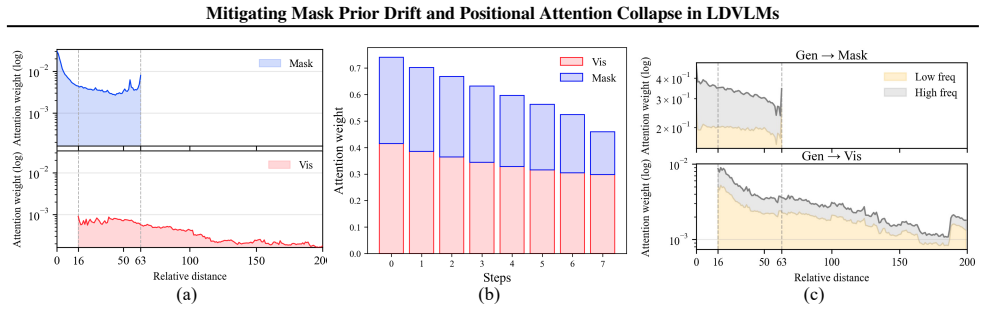
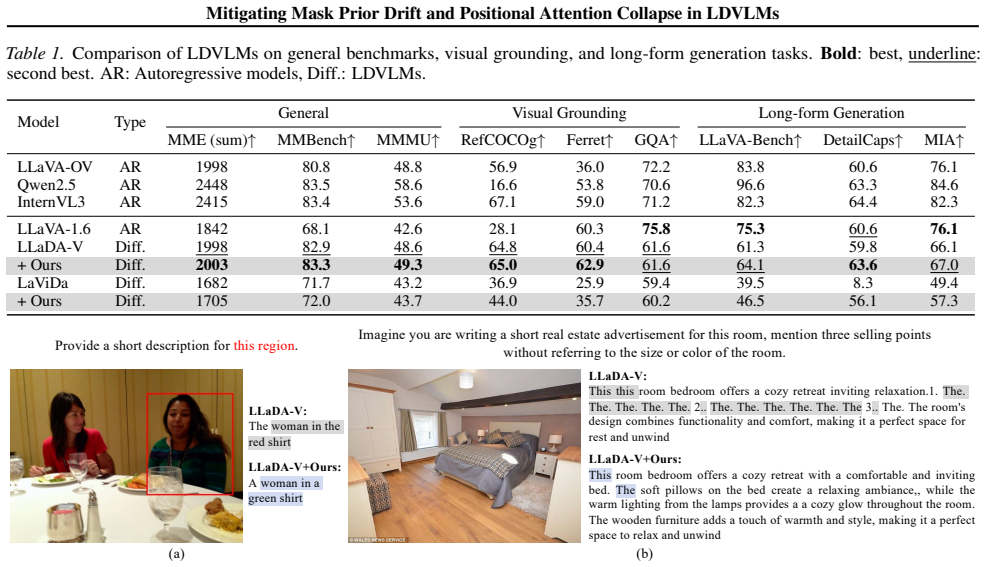
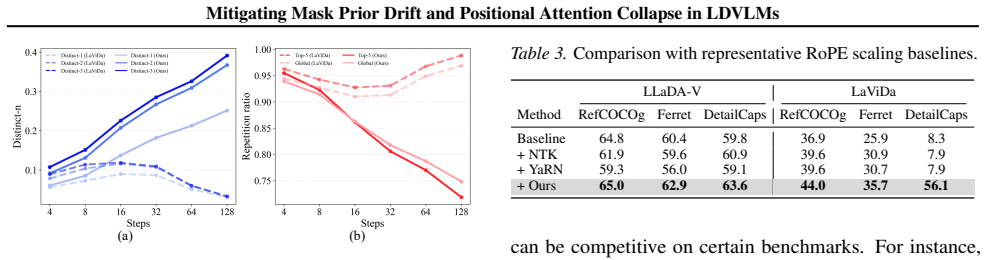
Large diffusion vision-language models (LDVLMs) have recently emerged as a promising alternative to autoregressive models, enabling parallel decoding for efficient inference and leveraging bidirectional attention for global context. Despite these advances, their behavior under long-form generation remains underexplored. In this work, we show that existing LDVLMs suffer from repetitive generation and degraded visual grounding, and identify two underlying causes. First, repetitive generation originates from a mask token prior: since generation tokens are initialized as mask tokens, their hidden representations progressively drift toward a shared prior direction over generation steps. Second, a fundamental misalignment between the positional attention bias and the iterative unmasking process suppresses attention toward informative visual tokens, degrading visual grounding. Based on these insights, we propose a training-free approach, introducing Mask Prior Suppression and Monotonic RoPE Scaling to mitigate mask prior drift and positional attention collapse during decoding. Experiments on general multimodal benchmarks and visual grounding tasks demonstrate improvements over baseline LDVLMs, with robust gains on long-form description benchmarks. Our results show that these failures can be effectively addressed with a lightweight, plug-and-play strategy that requires no additional training and generalizes across diverse LDVLM architectures.
Editorial analysis
A structured set of objections, weighed in public.
Referee Report
Summary. The paper claims that large diffusion vision-language models (LDVLMs) exhibit repetitive generation and degraded visual grounding during long-form decoding. It attributes repetitive generation to progressive drift of mask-token hidden states toward a shared prior direction, and grounding degradation to misalignment between positional attention biases (RoPE) and the iterative unmasking schedule. The authors introduce two training-free interventions—Mask Prior Suppression and Monotonic RoPE Scaling—to counteract these mechanisms and report improved performance on general multimodal and visual-grounding benchmarks, with larger gains on long-form description tasks.
Significance. If the proposed mechanisms are shown to be causal and the interventions robust, the work supplies a lightweight, architecture-agnostic decoding fix that avoids retraining. This would be practically valuable for deploying LDVLMs on extended multimodal outputs. The training-free character and claimed generalization across LDVLM families are notable strengths.
major comments (2)
- [§4] The central causal claim—that mask-token prior drift is the origin of repetitive generation—is supported only by correlation: the paper documents the drift and shows that Mask Prior Suppression reduces repetition, but does not report a controlled intervention that artificially induces equivalent drift (while fixing the diffusion schedule and other components) to verify that repetition increases. Without this isolation, drift could be a downstream symptom rather than the root driver (§4, experimental analysis of hidden-state trajectories).
- [Table 2, Figure 4] The effectiveness of Monotonic RoPE Scaling is presented as directly addressing positional attention collapse, yet the manuscript provides limited ablation isolating its contribution from Mask Prior Suppression and from changes in the unmasking schedule. Quantitative attention maps or grounding metrics before/after scaling alone would be needed to substantiate the misalignment diagnosis (Table 2 and Figure 4).
minor comments (2)
- [Abstract] The abstract states improvements on “general multimodal benchmarks” without naming the exact datasets or reporting absolute scores; adding these numbers would improve reproducibility.
- [§3] Notation for the mask-prior direction and the monotonic scaling factor is introduced without an explicit equation reference in the main text; a numbered equation would clarify the implementation.
Simulated Author's Rebuttal
We thank the referee for the constructive feedback. We address the two major comments below with point-by-point responses, indicating where revisions have been made or will be incorporated in the next version of the manuscript.
read point-by-point responses
-
Referee: [§4] The central causal claim—that mask-token prior drift is the origin of repetitive generation—is supported only by correlation: the paper documents the drift and shows that Mask Prior Suppression reduces repetition, but does not report a controlled intervention that artificially induces equivalent drift (while fixing the diffusion schedule and other components) to verify that repetition increases. Without this isolation, drift could be a downstream symptom rather than the root driver (§4, experimental analysis of hidden-state trajectories).
Authors: We agree that the evidence is primarily correlational and interventional via suppression rather than direct induction. Artificially inducing equivalent drift while strictly fixing the diffusion schedule and all other components is non-trivial, as the drift arises organically from the mask-token initialization and iterative unmasking dynamics. To strengthen the argument, we have expanded the analysis in §4 with additional hidden-state trajectory plots across multiple models and generation lengths, demonstrating that drift onset reliably precedes measurable increases in repetition. We also include a dose-response study varying the strength of Mask Prior Suppression, which shows a consistent monotonic relationship between residual drift magnitude and repetition rate. These additions provide stronger support for the proposed mechanism without requiring an artificial induction that would risk confounding the diffusion process itself. revision: partial
-
Referee: [Table 2, Figure 4] The effectiveness of Monotonic RoPE Scaling is presented as directly addressing positional attention collapse, yet the manuscript provides limited ablation isolating its contribution from Mask Prior Suppression and from changes in the unmasking schedule. Quantitative attention maps or grounding metrics before/after scaling alone would be needed to substantiate the misalignment diagnosis (Table 2 and Figure 4).
Authors: We acknowledge the need for clearer isolation of Monotonic RoPE Scaling. In the revised manuscript we have added a dedicated ablation that applies Monotonic RoPE Scaling in isolation (i.e., without Mask Prior Suppression) while keeping the original unmasking schedule fixed. The updated Table 2 now reports grounding metrics and repetition rates for this isolated setting, and we include new quantitative attention-map visualizations (added to Figure 4) that compare attention distributions toward visual tokens before and after scaling. These results show measurable improvements in visual grounding attributable to the scaling alone, thereby substantiating the positional misalignment diagnosis. revision: yes
Circularity Check
No significant circularity; derivation is observational and intervention-based
full rationale
The paper identifies mask prior drift and positional attention misalignment through direct observation of hidden-state behavior and attention patterns during iterative unmasking. It then introduces two training-free corrections (Mask Prior Suppression and Monotonic RoPE Scaling) as explicit countermeasures. No parameter is fitted to a data subset and then re-labeled as a prediction; no core premise reduces to a self-citation chain; no ansatz is smuggled via prior work; and no known empirical pattern is merely renamed. The derivation chain therefore remains independent of its own outputs and does not collapse by construction.
Axiom & Free-Parameter Ledger
axioms (2)
- domain assumption LDVLMs initialize generation tokens as mask tokens whose representations progressively drift toward a shared prior direction.
- domain assumption Positional attention bias remains fixed and misaligns with the iterative unmasking schedule.
Lean theorems connected to this paper
-
IndisputableMonolith/Cost/FunctionalEquation.leanwashburn_uniqueness_aczel unclear?
unclearRelation between the paper passage and the cited Recognition theorem.
Mask Prior Suppression ... projects deviation onto prior subspace U obtained by PCA on vocabulary-mean hidden states and attenuates components aligned with ûeL
-
IndisputableMonolith/Foundation/AlexanderDuality.leanalexander_duality_circle_linking unclear?
unclearRelation between the paper passage and the cited Recognition theorem.
Monotonic RoPE Scaling ... applies frequency-dependent scaling si = 1 + β γi with γi = σ(η(τi − τ0))
What do these tags mean?
- matches
- The paper's claim is directly supported by a theorem in the formal canon.
- supports
- The theorem supports part of the paper's argument, but the paper may add assumptions or extra steps.
- extends
- The paper goes beyond the formal theorem; the theorem is a base layer rather than the whole result.
- uses
- The paper appears to rely on the theorem as machinery.
- contradicts
- The paper's claim conflicts with a theorem or certificate in the canon.
- unclear
- Pith found a possible connection, but the passage is too broad, indirect, or ambiguous to say the theorem truly supports the claim.
Reference graph
Works this paper leans on
- [1]
-
[2]
Bai, S., Chen, K., Liu, X., Wang, J., Ge, W., Song, S., Dang, K., Wang, P., Wang, S., Tang, J., et al. Qwen2.5-vl technical report.arXiv preprint arXiv:2502.13923,
work page internal anchor Pith review Pith/arXiv arXiv
-
[3]
D., Dhariwal, P., Neelakantan, A., Shyam, P., Sastry, G., Askell, A., et al
Brown, T., Mann, B., Ryder, N., Subbiah, M., Kaplan, J. D., Dhariwal, P., Neelakantan, A., Shyam, P., Sastry, G., Askell, A., et al. Language models are few-shot learners. Advances in neural information processing systems, 33: 1877–1901,
work page 1901
-
[4]
H., Chen, S., Zhang, R., Chen, J., Wu, X., Zhang, Z., Chen, Z., Li, J., Wan, X., and Wang, B
Chen, G. H., Chen, S., Zhang, R., Chen, J., Wu, X., Zhang, Z., Chen, Z., Li, J., Wan, X., and Wang, B. Allava: Har- nessing gpt4v-synthesized data for lite vision-language models.arXiv preprint arXiv:2402.11684,
-
[5]
Dpad: Efficient diffusion language models with suffix dropout.arXiv preprint arXiv:2508.14148,
Chen, X., Huang, S., Guo, C., Wei, C., He, Y ., Zhang, J., Li, H., Chen, Y ., et al. Dpad: Efficient diffusion language models with suffix dropout.arXiv preprint arXiv:2508.14148,
-
[6]
Benchmarking and improving detail image caption
Dong, H., Li, J., Wu, B., Wang, J., Zhang, Y ., and Guo, H. Benchmarking and improving detail image caption. arXiv preprint arXiv:2405.19092,
-
[7]
Visualwebinstruct: Scaling up multimodal instruction data through web search
Jia, Y ., Li, J., Yue, X., Li, B., Nie, P., Zou, K., and Chen, W. Visualwebinstruct: Scaling up multimodal instruction data through web search. InProceedings of the 2025 Conference on Empirical Methods in Natural Language Processing (EMNLP),
work page 2025
-
[8]
Referitgame: Referring to objects in photographs of natu- ral scenes
10 Mitigating Mask Prior Drift and Positional Attention Collapse in LDVLMs Kazemzadeh, S., Ordonez, V ., Matten, M., and Berg, T. Referitgame: Referring to objects in photographs of natu- ral scenes. InProceedings of the 2014 conference on em- pirical methods in natural language processing (EMNLP), pp. 787–798,
work page 2014
-
[9]
Khoshnoodi, M., Jain, V ., Gao, M., Srikanth, M., and Chadha, A. A comprehensive survey of accelerated gener- ation techniques in large language models.arXiv preprint arXiv:2405.13019,
-
[10]
Li, H., Qin, Y ., Ou, B., Xu, L., and Xu, R. Hope: Hybrid of position embedding for length generalization in vision- language models.arXiv preprint arXiv:2505.20444, 2025a. Li, K., Patel, O., Vi ´egas, F., Pfister, H., and Wattenberg, M. Inference-time intervention: Eliciting truthful an- swers from a language model. InAdvances in Neural Information Proce...
-
[11]
A survey on diffusion language models,
Li, S., Kallidromitis, K., Bansal, H., Gokul, A., Kato, Y ., Kozuka, K., Kuen, J., Lin, Z., Chang, K.-W., and Grover, A. Lavida: A large diffusion model for vision-language understanding.Advances in neural information process- ing systems, 2025b. Li, T., Chen, M., Guo, B., and Shen, Z. A survey on diffu- sion language models.arXiv preprint arXiv:2508.1087...
-
[12]
Liu, H., Li, C., Li, Y ., Li, B., Zhang, Y ., Shen, S., and Lee, Y . J. Llava-next: Improved reason- ing, ocr, and world knowledge, January 2024a. URL https://llava-vl.github.io/blog/ 2024-01-30-llava-next/. Liu, X., Yan, H., An, C., Qiu, X., and Lin, D. Scaling laws of rope-based extrapolation. InInternational Conference on Learning Representations, volu...
work page 2024
-
[13]
Large Language Diffusion Models
Nie, S., Zhu, F., Du, C., Pang, T., Liu, Q., Zeng, G., Lin, M., and Li, C. Scaling up masked diffusion models on text. InThe Thirteenth International Conference on Learning Representations, 2025a. Nie, S., Zhu, F., You, Z., Zhang, X., Ou, J., Hu, J., Zhou, J., Lin, Y ., Wen, J.-R., and Li, C. Large language diffusion models.arXiv preprint arXiv:2502.09992...
work page internal anchor Pith review Pith/arXiv arXiv
-
[14]
Peng, B., Li, C., He, P., Galley, M., and Gao, J. Instruc- tion tuning with gpt-4.arXiv preprint arXiv:2304.03277,
work page internal anchor Pith review Pith/arXiv arXiv
-
[15]
A., Burns, K., Darrell, T., and Saenko, K
Rohrbach, A., Hendricks, L. A., Burns, K., Darrell, T., and Saenko, K. Object hallucination in image captioning. In Proceedings of the 2018 Conference on Empirical Meth- ods in Natural Language Processing (EMNLP),
work page 2018
-
[16]
LLaMA: Open and Efficient Foundation Language Models
Touvron, H., Lavril, T., Izacard, G., Martinet, X., Lachaux, M.-A., Lacroix, T., Rozi`ere, B., Goyal, N., Hambro, E., Azhar, F., et al. Llama: Open and efficient foundation lan- guage models.arXiv preprint arXiv:2302.13971,
work page internal anchor Pith review Pith/arXiv arXiv
-
[17]
Tschannen, M., Gritsenko, A., Wang, X., Naeem, M. F., Alabdulmohsin, I., Parthasarathy, N., Evans, T., Beyer, L., Xia, Y ., Mustafa, B., et al. Siglip 2: Multilingual vision-language encoders with improved semantic under- standing, localization, and dense features.arXiv preprint arXiv:2502.14786,
work page internal anchor Pith review Pith/arXiv arXiv
-
[18]
Wang, C., Guo, J., Li, H., Tian, Y ., Nie, Y ., Xu, C., and Han, K. Circle-rope: Cone-like decoupled rotary posi- tional embedding for large vision-language models.arXiv preprint arXiv:2505.16416, 2025a. Wang, J., Wang, Y ., Xu, G., Zhang, J., Gu, Y ., Jia, H., Yan, M., Zhang, J., and Sang, J. AMBER: An LLM-free multi-dimensional benchmark for MLLMs hallu...
-
[19]
Qwen2-VL: Enhancing Vision-Language Model's Perception of the World at Any Resolution
Wang, P., Bai, S., Tan, S., Wang, S., Fan, Z., Bai, J., Chen, K., Liu, X., Wang, J., Ge, W., et al. Qwen2-vl: Enhancing vision-language model’s perception of the world at any resolution.arXiv preprint arXiv:2409.12191,
work page internal anchor Pith review Pith/arXiv arXiv
-
[20]
Semantics-adaptive activation intervention for LLMs via dynamic steering vectors
Wang, W., Yang, J., and Peng, W. Semantics-adaptive activation intervention for LLMs via dynamic steering vectors. InThe Thirteenth International Conference on Learning Representations (ICLR), 2025b. Wang, X., Xu, C., Jin, Y ., Jin, J., Zhang, H., and Deng, Z. Diffusion llms can do faster-than-ar inference via dis- crete diffusion forcing.arXiv preprint a...
-
[21]
Xin, Y ., Qin, Q., Luo, S., Zhu, K., Yan, J., Tai, Y ., Lei, J., Cao, Y ., Wang, K., Wang, Y ., et al. Lumina- dimoo: An omni diffusion large language model for multi- modal generation and understanding.arXiv preprint arXiv:2510.06308,
-
[22]
Dream 7B: Diffusion Large Language Models
Ye, J., Xie, Z., Zheng, L., Gao, J., Wu, Z., Jiang, X., Li, Z., and Kong, L. Dream 7b: Diffusion large language models.arXiv preprint arXiv:2508.15487,
work page internal anchor Pith review Pith/arXiv arXiv
-
[23]
You, Z., Nie, S., Zhang, X., Hu, J., Zhou, J., Lu, Z., Wen, J.-R., and Li, C. Llada-v: Large language diffusion models with visual instruction tuning.arXiv preprint arXiv:2505.16933,
-
[24]
Zhu, J., Wang, W., Chen, Z., Liu, Z., Ye, S., Gu, L., Tian, H., Duan, Y ., Su, W., Shao, J., et al
URL https://arxiv.org/ abs/2407.12772. Zhu, J., Wang, W., Chen, Z., Liu, Z., Ye, S., Gu, L., Tian, H., Duan, Y ., Su, W., Shao, J., et al. Internvl3: Exploring advanced training and test-time recipes for open-source multimodal models.arXiv preprint arXiv:2504.10479,
-
[25]
AMBER is an LLM-free hallucination benchmark covering both generative (AMBER-G) 13 Mitigating Mask Prior Drift and Positional Attention Collapse in LDVLMs Table 6.Evaluation Setup.Evaluation splits, inference steps, and generation lengthLfor each benchmark. Dataset Split StepsL Dataset Split StepsL Dataset Split StepsL MME test 2 2 Ferret test 48 96 Detai...
work page 2024
-
[26]
For autoregressive baselines, including LLaV A-One-Vision-7B, Qwen2.5-VL-7B, InternVL3-8B, and LLaV A-1.6, we use the default evaluation setups provided by the same framework. To ensure a rigorous and fair comparison, we evaluate models under identical random seeds whenever reported results are unavailable. Notably, for LaViDa, we conduct a re-evaluation ...
work page 2024
-
[27]
introduces a piecewise frequency rescaling scheme that preserves high-frequency components while smoothly extrapolating to longer sequences. Subsequent methods further refine rotary scaling to enhance extrapolation stability and efficiency in LLMs (Ding et al., 2024). While these approaches are effective for extending context length under causal decoding,...
work page 2024
-
[28]
and an LLM backbone based on LLaDA-8B or Dream-7B (Ye et al., 2025). In our experiments, we use LaViDa-L only, as it shares the same language backbone as LLaDA-V , enabling a fair comparison. LaViDa introduces a complementary masking strategy during training. Instead of learning from a single masked version of a response, two complementary masked variants...
work page 2025
-
[29]
For MMaDA (Yang et al., 2025), we setλ= 0.1 , β= 0.4 , k= 3 , η= 8.0 , and τ0 = 0.6
under a consistent evaluation protocol. For MMaDA (Yang et al., 2025), we setλ= 0.1 , β= 0.4 , k= 3 , η= 8.0 , and τ0 = 0.6. For Lumina-DiMOO (Xin et al., 2025), we set λ= 0.1 , β= 0.4 , k= 3 , η= 12.0 , and τ0 = 0.6. In both cases, our method consistently outperforms the corresponding baselines, as shown in Table
work page 2025
discussion (0)
Sign in with ORCID, Apple, or X to comment. Anyone can read and Pith papers without signing in.