Recognition: 3 theorem links
· Lean TheoremLanguage Generation as Optimal Control: Closed-Loop Diffusion in Latent Control Space
Pith reviewed 2026-05-15 01:42 UTC · model grok-4.3
The pith
Reformulating language generation as stochastic optimal control lets flow matching approximate the HJB equation in latent space, yielding models with both high fidelity and parallel sampling.
A machine-rendered reading of the paper's core claim, the machinery that carries it, and where it could break.
Core claim
By reformulating language generation as a stochastic optimal control problem and approximating the solution to the Hamilton-Jacobi-Bellman equation with Flow Matching as the optimal trajectory solver within the rectified latent control space, Manta-LM with Global Integral Operator approximates the global vector field and thereby realizes a model that simultaneously achieves high-fidelity text generation and efficient, low-cost parallel sampling.
What carries the argument
Flow Matching acting as the optimal trajectory solver inside the rectified latent control space, with the Global Integral Operator in Manta-LM used to approximate the global vector field for the closed-loop controller.
If this is right
- The Efficiency-Fidelity Paradox, Irreversibility Error Propagation, and Optimization Tractability issues are bypassed.
- High-fidelity text generation becomes compatible with efficient, low-cost parallel sampling.
- Improved stability, efficiency, and controllability appear on language modeling and conditional generation tasks.
- Direct solution of the HJB PDE is avoided while still obtaining an optimal policy that acts as a closed-loop controller.
Where Pith is reading between the lines
- The same latent-control reformulation could be tested on non-text sequence tasks such as code or protein generation.
- The closed-loop controller structure may support real-time steering of generation outputs without retraining.
- If the global vector field approximation holds, similar flow-matching solvers could be tried on other intractable optimal-control problems in machine learning.
Load-bearing premise
That flow matching inside the rectified latent control space can reliably approximate the solution to the Hamilton-Jacobi-Bellman equation and thereby resolve trajectory singularity, adjoint state vanishing, and gradient absence.
What would settle it
An experiment in which parallel sampling with the trained Manta-LM model produces measurably lower fidelity than sequential baselines on the same language modeling or conditional generation benchmarks.
Figures




read the original abstract
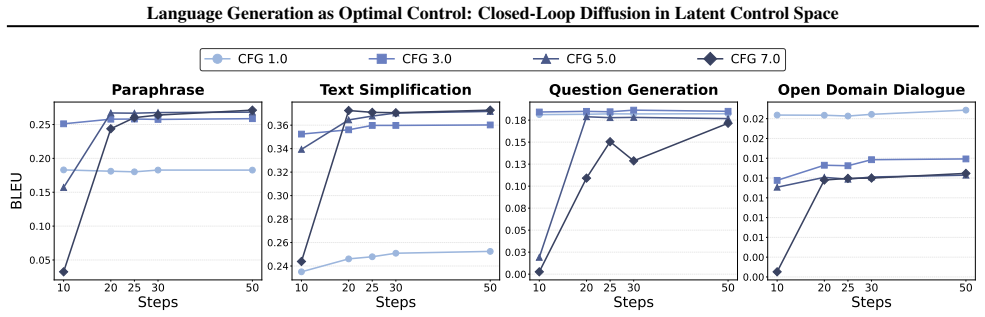
This work reformulates language generation as a stochastic optimal control problem, providing a unified theoretical perspective to analyze autoregressive and diffusion models and explain their limitations (Efficiency-Fidelity Paradox, Irreversibility Error Propagation, Optimization Tractability and Fidelity) in terms of combination of trajectory singularity, adjoint state vanishing, and gradient absence. To address these issues, we approximate the solution to the Hamilton-Jacobi-Bellman (HJB) equation, yielding an optimal policy that acts as a closed-loop controller. To bypass the intractability of directly solving the HJB PDE, we employ Flow Matching as the optimal trajectory solver within the rectified latent control space. This allows our Manta-LM with Global Integral Operator to approximate the global vector field, effectively realizing a model that simultaneously achieves high-fidelity text generation and efficient, low-cost parallel sampling. Empirically, our method achieves strong performance on language modeling and conditional generation tasks, while exhibiting improved stability, efficiency, and controllability.
Editorial analysis
A structured set of objections, weighed in public.
Referee Report
Summary. The paper reformulates language generation as a stochastic optimal control problem, using this lens to unify autoregressive and diffusion models and attribute their limitations (Efficiency-Fidelity Paradox, Irreversibility Error Propagation, Optimization Tractability and Fidelity) to trajectory singularity, adjoint state vanishing, and gradient absence. It approximates the Hamilton-Jacobi-Bellman equation via Flow Matching as the trajectory solver inside a rectified latent control space, introducing Manta-LM equipped with a Global Integral Operator to approximate the global vector field. The resulting closed-loop controller is claimed to deliver both high-fidelity generation and efficient parallel sampling, with supporting empirical results on language modeling and conditional generation tasks.
Significance. If the Flow Matching step in rectified latent space can be shown to approximate the HJB solution with quantifiable error and to preserve optimality of the resulting policy, the work would supply a principled control-theoretic unification of existing generative paradigms and a concrete route to simultaneous fidelity and sampling efficiency. The closed-loop formulation and latent rectification are technically interesting and could influence future controllable generation research, provided the central approximation is rigorously justified.
major comments (3)
- [§4] §4 (Method): No derivation is supplied that equates the Flow Matching objective (or its rectified latent variant) to the HJB value function, nor are error bounds or optimality guarantees provided for the resulting policy once the Global Integral Operator is introduced. The claim that this construction resolves trajectory singularity, adjoint vanishing, and gradient absence therefore rests on an unproven modeling assumption rather than a demonstrated reduction.
- [§3.2] §3.2 (Reformulation): The mapping from the standard autoregressive or diffusion training objective to the stochastic control problem and its associated HJB PDE is stated at a high level but not derived step-by-step; it is therefore unclear whether the three listed paradoxes are formally equivalent to the cited singularities or merely heuristically linked.
- [Experiments] Experiments section: Reported gains on language modeling and conditional generation are not accompanied by ablations that isolate the contribution of the HJB approximation from the latent rectification or the integral operator; without such controls it is impossible to verify that performance improvements stem from the claimed optimal-control mechanism.
minor comments (2)
- [§4.1] Notation for the Global Integral Operator and the rectified latent control space should be introduced with explicit equations before being used in the main claims.
- [Abstract] The abstract and introduction repeatedly use the phrase 'approximate the global vector field' without defining the vector field or the sense in which the approximation is global; a clarifying sentence or equation would improve readability.
Simulated Author's Rebuttal
We thank the referee for the constructive feedback. We address each major comment below with clarifications and commit to revisions that strengthen the theoretical derivations and experimental analysis without altering the core claims of the work.
read point-by-point responses
-
Referee: [§4] §4 (Method): No derivation is supplied that equates the Flow Matching objective (or its rectified latent variant) to the HJB value function, nor are error bounds or optimality guarantees provided for the resulting policy once the Global Integral Operator is introduced. The claim that this construction resolves trajectory singularity, adjoint vanishing, and gradient absence therefore rests on an unproven modeling assumption rather than a demonstrated reduction.
Authors: We agree that the connection between Flow Matching in rectified latent space and the HJB equation requires a more explicit derivation. In the revised manuscript we will add a dedicated subsection deriving the equivalence of the Flow Matching objective to the HJB value function under the rectified control-space formulation, including first-order error bounds on the approximation and a discussion of the conditions under which the resulting policy remains optimal. This will replace the current high-level statement with a rigorous reduction. revision: yes
-
Referee: [§3.2] §3.2 (Reformulation): The mapping from the standard autoregressive or diffusion training objective to the stochastic control problem and its associated HJB PDE is stated at a high level but not derived step-by-step; it is therefore unclear whether the three listed paradoxes are formally equivalent to the cited singularities or merely heuristically linked.
Authors: We will expand §3.2 with a complete step-by-step derivation that starts from the standard autoregressive and diffusion objectives, maps them onto the stochastic optimal control problem, and arrives at the associated HJB PDE. The revised text will explicitly show how the Efficiency-Fidelity Paradox, Irreversibility Error Propagation, and Optimization Tractability issues arise as direct consequences of trajectory singularity, adjoint vanishing, and gradient absence, thereby establishing formal rather than heuristic equivalence. revision: yes
-
Referee: [Experiments] Experiments section: Reported gains on language modeling and conditional generation are not accompanied by ablations that isolate the contribution of the HJB approximation from the latent rectification or the integral operator; without such controls it is impossible to verify that performance improvements stem from the claimed optimal-control mechanism.
Authors: We will add a new ablation study in the Experiments section that systematically disables the HJB approximation (replacing it with standard flow matching), removes latent rectification, and removes the Global Integral Operator while keeping all other components fixed. The revised results will report the isolated contribution of each element to perplexity, generation speed, and controllability metrics, allowing direct verification that the gains originate from the optimal-control formulation. revision: yes
Circularity Check
No significant circularity in the derivation chain
full rationale
The paper reformulates language generation as stochastic optimal control, identifies limitations via trajectory singularity/adjoint vanishing/gradient absence, and approximates the HJB solution by employing Flow Matching as trajectory solver inside a rectified latent control space together with the Global Integral Operator. No quoted step reduces a claimed prediction or optimality result to a quantity defined by the paper's own fitted parameters or by self-citation alone; the construction introduces new modeling elements (rectified latent space, integral operator) presented as external approximations rather than tautological redefinitions. The derivation therefore remains self-contained against external benchmarks and does not trigger any of the enumerated circularity patterns.
Axiom & Free-Parameter Ledger
axioms (1)
- standard math The Hamilton-Jacobi-Bellman equation provides the optimal policy for the stochastic control formulation of language generation.
invented entities (2)
-
Manta-LM
no independent evidence
-
Global Integral Operator
no independent evidence
Lean theorems connected to this paper
-
IndisputableMonolith/Cost/FunctionalEquation.leanwashburn_uniqueness_aczel contradicts?
contradictsCONTRADICTS: the theorem conflicts with this paper passage, or marks a claim that would need revision before publication.
J(u) = E[−log pθ(z1)] + λ ∫ E[½ ∥ut(zt)∥²] dt; u* = −∇z V(z,t) satisfying HJB
-
IndisputableMonolith/Foundation/BranchSelection.leanbranch_selection unclear?
unclearRelation between the paper passage and the cited Recognition theorem.
Flow Matching regression LCFM = E ∥vθ(zt,t) − (z1 − z0)∥² as Lagrangian surrogate for HJB
-
IndisputableMonolith/Foundation/AlexanderDuality.leanalexander_duality_circle_linking unclear?
unclearRelation between the paper passage and the cited Recognition theorem.
Rectified latent manifold via VAE to obtain control-friendly Euclidean geometry
What do these tags mean?
- matches
- The paper's claim is directly supported by a theorem in the formal canon.
- supports
- The theorem supports part of the paper's argument, but the paper may add assumptions or extra steps.
- extends
- The paper goes beyond the formal theorem; the theorem is a base layer rather than the whole result.
- uses
- The paper appears to rely on the theorem as machinery.
- contradicts
- The paper's claim conflicts with a theorem or certificate in the canon.
- unclear
- Pith found a possible connection, but the passage is too broad, indirect, or ambiguous to say the theorem truly supports the claim.
Reference graph
Works this paper leans on
-
[1]
D., Ho, J., Tarlow, M., and van den Berg, R
Austin, J., Johnson, D. D., Ho, J., Tarlow, M., and van den Berg, R. Structured denoising diffusion models in discrete state-spaces. In Advances in Neural Information Processing Systems, volume 34, pp.\ 17981--17993, 2021
work page 2021
-
[2]
Benamou, J.-D. and Brenier, Y. A computational fluid mechanics solution to the monge-kantorovich mass transfer problem. Numerische Mathematik, 84 0 (3): 0 375--393, 2000
work page 2000
-
[3]
Bertucci, C. Stochastic optimal transport and hamilton–jacobi–bellman equations on the set of probability measures. Annales de l'Institut Henri Poincar \'e C, Analyse non lin \'e aire , 2023. URL https://api.semanticscholar.org/CorpusID:259095954
work page 2023
-
[4]
D., Dhariwal, P., Neelakantan, A., Shyam, P., Sastry, G., Askell, A., et al
Brown, T., Mann, B., Ryder, N., Subbiah, M., Kaplan, J. D., Dhariwal, P., Neelakantan, A., Shyam, P., Sastry, G., Askell, A., et al. Language models are few-shot learners. In Advances in neural information processing systems, volume 33, pp.\ 1877--1901, 2020
work page 1901
-
[5]
Bullo, F. and Lewis, A. D. Geometric control of mechanical systems. 2004. URL https://api.semanticscholar.org/CorpusID:679624
work page 2004
-
[6]
Chelba, C., Mikolov, T., Schuster, M., Ge, Q., Brants, T., Koehn, P. T., and Robinson, T. One billion word benchmark for measuring progress in statistical language modeling. In Interspeech, 2013
work page 2013
-
[7]
Deep compression autoencoder for efficient high-resolution diffusion models
Chen, J., Cai, H., Chen, J., Xie, E., Yang, S., Tang, H., Li, M., Lu, Y., and Han, S. Deep compression autoencoder for efficient high-resolution diffusion models. arXiv preprint arXiv:2410.10733, 2024
-
[8]
Categorical flow matching on statistical manifolds
Cheng, C., Li, J., Peng, J., and Liu, G. Categorical flow matching on statistical manifolds. Advances in Neural Information Processing Systems, 37: 0 54787--54819, 2024
work page 2024
-
[9]
Training Verifiers to Solve Math Word Problems
Cobbe, K., Kosaraju, V., Bavarian, M., Chen, M., Jun, H., Kaiser, L., Plappert, M., Tworek, J., Hilton, J., Nakano, R., Hesse, C., and Schulman, J. Training verifiers to solve math word problems. arXiv preprint arXiv:2110.14168, 2021
work page internal anchor Pith review Pith/arXiv arXiv 2021
-
[10]
DataCanary, hilfialkaff, Jiang, L., Risdal, M., Dandekar, N., and tomtung. Quora question pairs. Kaggle Competition, 2017. https://kaggle.com/competitions/quora-question-pairs
work page 2017
-
[11]
Dhingra, B., Mazaitis, K., and Cohen, W. W. Quasar: Datasets for question answering by search and reading. arXiv preprint arXiv:1707.03904, 2017
work page internal anchor Pith review Pith/arXiv arXiv 2017
-
[12]
H., Doucet, A., Strudel, R., Dyer, C., Durkan, C., et al
Dieleman, S., Sartran, L., Roshannai, A., Savinov, N., Ganin, Y., Richemond, P. H., Doucet, A., Strudel, R., Dyer, C., Durkan, C., et al. Continuous diffusion for categorical data. arXiv preprint arXiv:2211.15089, 2022
-
[13]
Fleming, W. H. and Rishel, R. W. Deterministic and stochastic optimal control. Springer Science & Business Media, 2012
work page 2012
-
[14]
Gokaslan, A. and Cohen, V. Openwebtext corpus. http://Skylion007.github.io/OpenWebTextCorpus, 2019
work page 2019
-
[15]
Diffuseq-v2: Bridging discrete and continuous text spaces for accelerated seq2seq diffusion models
Gong, S., Li, M., Feng, J., Wu, Z., and Kong, L. Diffuseq-v2: Bridging discrete and continuous text spaces for accelerated seq2seq diffusion models. In The 2023 Conference on Empirical Methods in Natural Language Processing
work page 2023
-
[16]
Diffuseq: Sequence to sequence text generation with diffusion models
Gong, S., Li, M., Feng, J., Wu, Z., and Kong, L. Diffuseq: Sequence to sequence text generation with diffusion models. In International Conference on Learning Representations (ICLR 2023)(01/05/2023-05/05/2023, Kigali, Rwanda), 2023
work page 2023
-
[17]
Scaling diffusion language models via adaptation from autoregressive models
Gong, S., Agarwal, S., Zhang, Y., Ye, J., Zheng, L., Li, M., An, C., Zhao, P., Bi, W., Han, J., et al. Scaling diffusion language models via adaptation from autoregressive models. arXiv preprint arXiv:2410.17891, 2024
-
[18]
Gulrajani, I. and Hashimoto, T. B. Likelihood-based diffusion language models. Advances in Neural Information Processing Systems, 36: 0 16693--16715, 2023
work page 2023
-
[19]
Han, X., Kumar, S., and Tsvetkov, Y. Ssd-lm: Semi-autoregressive simplex-based diffusion language model for text generation and modular control. In Proceedings of the 61st Annual Meeting of the Association for Computational Linguistics (Volume 1: Long Papers), pp.\ 11575--11596, 2023
work page 2023
-
[20]
Argmax flows and multinomial diffusion: Learning categorical distributions
Hoogeboom, E., Nielsen, D., Jaini, P., Forr \'e , P., and Welling, M. Argmax flows and multinomial diffusion: Learning categorical distributions. Advances in neural information processing systems, 34: 0 12454--12465, 2021
work page 2021
-
[21]
K., Xu, W., Hao, J., Song, L., Xu, Y., Yang, J., Liu, J., Zhang, C., et al
Huang, S., Cheng, T., Liu, J. K., Xu, W., Hao, J., Song, L., Xu, Y., Yang, J., Liu, J., Zhang, C., et al. Opencoder: The open cookbook for top-tier code large language models. In Proceedings of the 63rd Annual Meeting of the Association for Computational Linguistics (Volume 1: Long Papers), pp.\ 33167--33193, 2025
work page 2025
-
[22]
Neural crf model for sentence alignment in text simplification
Jiang, C., Maddela, M., Lan, W., Zhong, Y., and Xu, W. Neural crf model for sentence alignment in text simplification. arXiv preprint arXiv:2005.02324, 2020
-
[23]
Jo, J. and Hwang, S. J. Continuous diffusion model for language modeling. In Neural Information Processing Systems, 2025
work page 2025
-
[24]
Infinity instruct: Scaling instruction selection and synthesis to enhance language models
Li, J., Du, L., Zhao, H., Zhang, B.-w., Wang, L., Gao, B., Liu, G., and Lin, Y. Infinity instruct: Scaling instruction selection and synthesis to enhance language models. arXiv preprint arXiv:2506.11116, 2025 a
-
[25]
Lavida-o: Elastic large masked diffusion models for unified multimodal understanding and generation
Li, S., Gu, J., Liu, K., Lin, Z., Wei, Z., Grover, A., and Kuen, J. Lavida-o: Elastic large masked diffusion models for unified multimodal understanding and generation. arXiv preprint arXiv:2509.19244, 2025 b
-
[26]
Li, X., Thickstun, J., Gulrajani, I., Liang, P. S., and Hashimoto, T. B. Diffusion-lm improves controllable text generation. Advances in neural information processing systems, 35: 0 4328--4343, 2022
work page 2022
-
[27]
T., Ben-Hamu, H., Nickel, M., and Le, M
Lipman, Y., Chen, R. T., Ben-Hamu, H., Nickel, M., and Le, M. Flow matching for generative modeling. In International Conference on Learning Representations, 2023
work page 2023
-
[28]
Discrete Diffusion Modeling by Estimating the Ratios of the Data Distribution
Lou, A., Meng, C., and Ermon, S. Discrete diffusion modeling by estimating the ratios of the data distribution. arXiv preprint arXiv:2310.16834, 2023
work page internal anchor Pith review Pith/arXiv arXiv 2023
-
[29]
K., Ivison, H., Tae, J., Henderson, J., Beltagy, I., Peters, M
Mahabadi, R. K., Ivison, H., Tae, J., Henderson, J., Beltagy, I., Peters, M. E., and Cohan, A. Tess: Text-to-text self-conditioned simplex diffusion. In Proceedings of the 18th Conference of the European Chapter of the Association for Computational Linguistics (Volume 1: Long Papers), pp.\ 2347--2361, 2024
work page 2024
-
[30]
Pointer sentinel mixture models, 2016
Merity, S., Xiong, C., Bradbury, J., and Socher, R. Pointer sentinel mixture models, 2016
work page 2016
-
[31]
Moshkov, I., Hanley, D., Sorokin, I., Toshniwal, S., Henkel, C., Schifferer, B., Du, W., and Gitman, I. Aimo-2 winning solution: Building state-of-the-art mathematical reasoning models with openmathreasoning dataset. arXiv preprint arXiv:2504.16891, 2025
-
[32]
Large language diffusion models
Nie, S., Zhu, F., You, Z., Zhang, X., Ou, J., Hu, J., Zhou, J., Lin, Y., Wen, J.-R., and Li, C. Large language diffusion models. In Neural Information Processing Systems, 2025 a
work page 2025
-
[33]
Large Language Diffusion Models
Nie, S., Zhu, F., You, Z., Zhang, X., Ou, J., Hu, J., Zhou, J., Lin, Y., Wen, J.-R., and Li, C. Large language diffusion models. arXiv preprint arXiv:2502.09992, 2025 b
work page internal anchor Pith review Pith/arXiv arXiv 2025
-
[34]
arXiv preprint arXiv:2406.03736 , year=
Ou, J., Nie, S., Xue, K., Zhu, F., Sun, J., Li, Z., and Li, C. Your absorbing discrete diffusion secretly models the conditional distributions of clean data. arXiv preprint arXiv:2406.03736, 2024
-
[35]
The lambada dataset: Word prediction requiring a broad discourse context
Paperno, D., Kruszewski, G., Lazaridou, A., Pham, N.-Q., Bernardi, R., Pezzelle, S., Baroni, M., Boleda, G., and Fern \'a ndez, R. The lambada dataset: Word prediction requiring a broad discourse context. In Proceedings of the 54th annual meeting of the association for computational linguistics (volume 1: Long papers), pp.\ 1525--1534, 2016
work page 2016
-
[36]
Language models are unsupervised multitask learners
Radford, A., Wu, J., Child, R., Luan, D., Amodei, D., Sutskever, I., et al. Language models are unsupervised multitask learners. OpenAI blog, 1 0 (8): 0 9, 2019
work page 2019
-
[37]
Simple and effective masked diffusion language models
Sahoo, S., Arriola, M., Schiff, Y., Gokaslan, A., Marroquin, E., Chiu, J., Rush, A., and Kuleshov, V. Simple and effective masked diffusion language models. Advances in Neural Information Processing Systems, 37: 0 130136--130184, 2024
work page 2024
-
[38]
Simplified and generalized masked diffusion for discrete data
Shi, J., Han, K., Wang, Z., Doucet, A., and Titsias, M. Simplified and generalized masked diffusion for discrete data. Advances in neural information processing systems, 37: 0 103131--103167, 2024
work page 2024
-
[39]
Deep unsupervised learning using nonequilibrium thermodynamics
Sohl-Dickstein, J., Weiss, E., Maheswaranathan, N., and Ganguli, S. Deep unsupervised learning using nonequilibrium thermodynamics. In International conference on machine learning, pp.\ 2256--2265. pmlr, 2015
work page 2015
-
[40]
Self-conditioned embedding diffusion for text generation
Strudel, R., Tallec, C., Altch \'e , F., Du, Y., Ganin, Y., Mensch, A., Grathwohl, W., Savinov, N., Dieleman, S., Sifre, L., et al. Self-conditioned embedding diffusion for text generation. arXiv preprint arXiv:2211.04236, 2022
-
[41]
arXiv preprint arXiv:2211.16750 , year=
Sun, H., Yu, L., Dai, B., Schuurmans, D., and Dai, H. Score-based continuous-time discrete diffusion models. arXiv preprint arXiv:2211.16750, 2022
-
[42]
Unified multimodal discrete diffusion
Swerdlow, A., Prabhudesai, M., Gandhi, S., Pathak, D., and Fragkiadaki, K. Unified multimodal discrete diffusion. arXiv preprint arXiv:2503.20853, 2025
-
[43]
LLaMA: Open and Efficient Foundation Language Models
Touvron, H., Lavril, T., Izacard, G., Martinet, X., Lachaux, M.-A., Lacroix, T., Rozi \`e re, B., Goyal, N., Hambro, E., Azhar, F., et al. Llama: Open and efficient foundation language models. arXiv preprint arXiv:2302.13971, 2023
work page internal anchor Pith review Pith/arXiv arXiv 2023
-
[44]
Yang, A., Yang, B., Hui, B., Zheng, B., Yu, B., Zhou, C., Li, C., Li, C., Liu, D., Huang, F., Dong, G., Wei, H., Lin, H., Tang, J., Wang, J., Yang, J., Tu, J., Zhang, J., Ma, J., Xu, J., Zhou, J., Bai, J., He, J., Lin, J., Dang, K., Lu, K., Chen, K.-Y., Yang, K., Li, M., Xue, M., Ni, N., Zhang, P., Wang, P., Peng, R., Men, R., Gao, R., Lin, R., Wang, S., ...
work page internal anchor Pith review Pith/arXiv arXiv 2024
-
[45]
Mmada: Multimodal large diffusion language models
Yang, L., Tian, Y., Li, B., Zhang, X., Shen, K., Tong, Y., and Wang, M. Mmada: Multimodal large diffusion language models. arXiv preprint arXiv:2505.15809, 2025
-
[46]
Dream 7B: Diffusion Large Language Models
Ye, J., Xie, Z., Zheng, L., Gao, J., Wu, Z., Jiang, X., Li, Z., and Kong, L. Dream 7b: Diffusion large language models. arXiv preprint arXiv:2508.15487, 2025
work page internal anchor Pith review Pith/arXiv arXiv 2025
-
[47]
Commonsense knowledge aware conversation generation with graph attention
Zhou, H., Young, T., Huang, M., Zhao, H., Xu, J., and Zhu, X. Commonsense knowledge aware conversation generation with graph attention. In IJCAI, volume 18, pp.\ 4623--4629, 2018
work page 2018
discussion (0)
Sign in with ORCID, Apple, or X to comment. Anyone can read and Pith papers without signing in.