Recognition: 2 theorem links
· Lean TheoremAnalysis of wireless network access logs for a hierarchical characterization of user mobility
Pith reviewed 2026-05-15 01:31 UTC · model grok-4.3
The pith
Wi-Fi access logs can be grouped hierarchically by location to build lower-complexity user mobility models that match observed transition patterns.
A machine-rendered reading of the paper's core claim, the machinery that carries it, and where it could break.
Core claim
The paper claims that recursively grouping Wi-Fi access points into a geospatial hierarchy allows construction of user mobility models via clustering that achieve good accuracy on transition matrices with lower complexity than a flat model.
What carries the argument
Recursive geospatial grouping of access points into hierarchy levels, combined with clustering-based user profiling that assigns transition matrices and time vectors to user types.
If this is right
- The hierarchical model reduces complexity for large-scale scenarios such as entire campuses.
- Transition matrices derived from the model closely match those computed directly from the connection data.
- The method supports simulation of user tracks as sequences of coverage areas in fog computing settings.
- One area per building with three levels produces lower complexity than a single area for the whole space.
Where Pith is reading between the lines
- Refining the time vector definition could involve adding time-of-day or day-of-week factors to improve stay-time accuracy.
- The same recursive grouping technique might apply to other wireless infrastructures such as cellular base stations.
- In fog scenarios the resulting tracks could be used directly for resource allocation without storing raw connection logs.
Load-bearing premise
That grouping access points solely by geospatial proximity creates levels that accurately reflect how users actually move between areas.
What would settle it
A direct comparison on the same dataset showing higher mean square error for transition matrices in the hierarchical model than in the flat model would falsify the accuracy claim.
Figures




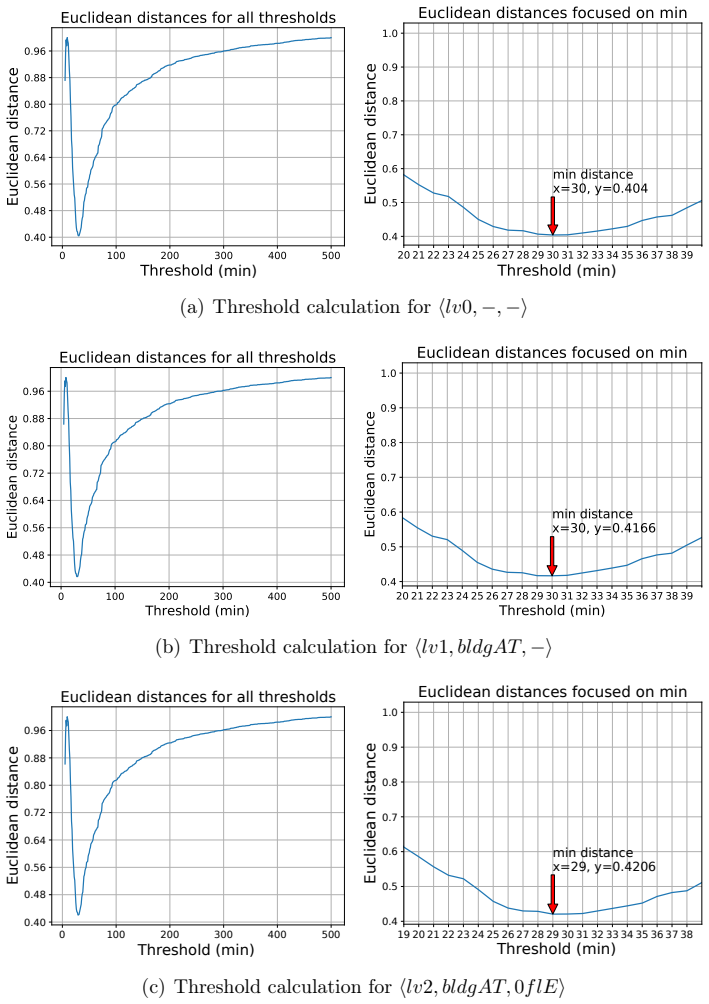
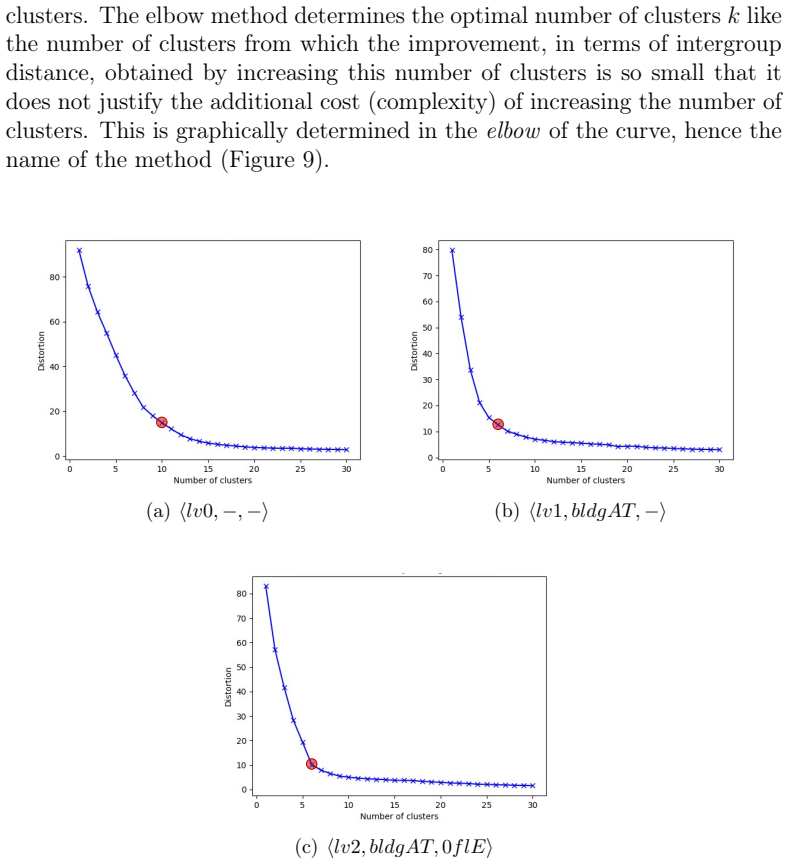
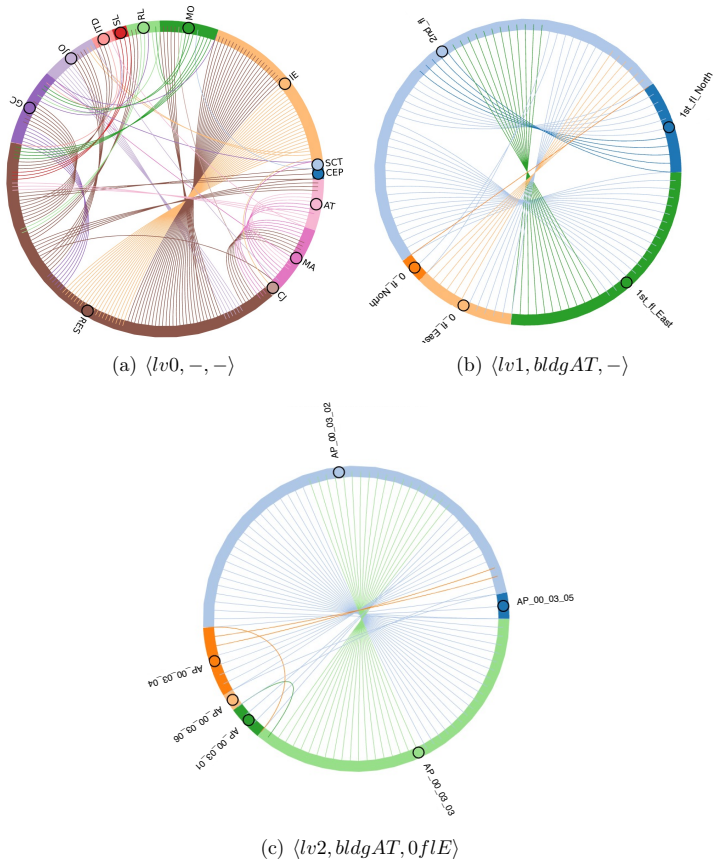

read the original abstract
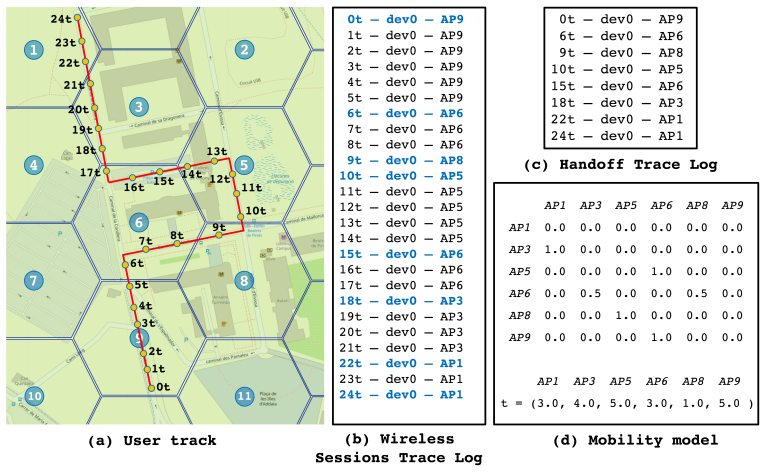
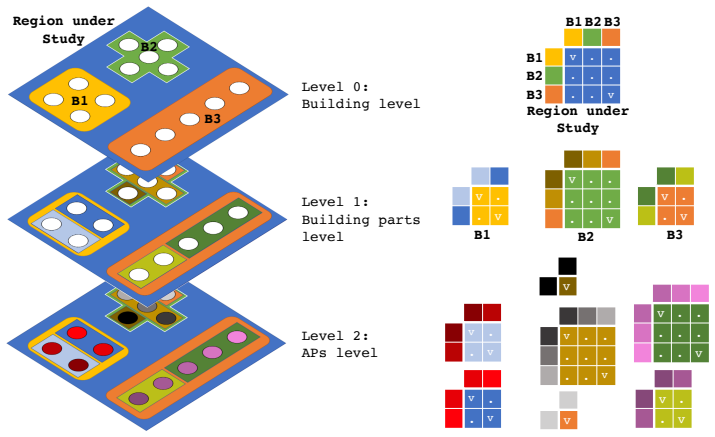
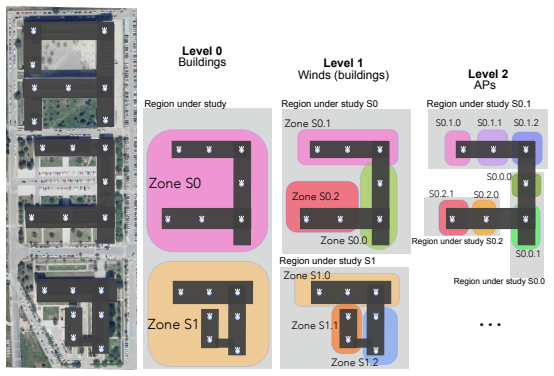
This paper presents a method that generates a hierarchical user mobility model from the analysis of the data available from Wi-Fi connections. The data obtained from the Wi-Fi infrastructure is defined in terms of the coverage areas of the access points that the users move through. These access points are recursively grouped into different levels of granularity based on their geospatial features. The track of a user is defined as a sequence of Wi-Fi access points, which is enough to simulate user mobility in, for example, fog scenarios. The hierarchical definition of the region under study is proposed to reduce the complexity of the model in high-scale scenarios and to increase the adaptability between scenarios with different geospatial features. The model creation is based on a user profiling method that uses a clustering algorithm and each user type is defined with a transition matrix between coverage areas and a time length vector for the areas. The method is applied to the case of the campus of the University of the Balearic Islands. From the analysis of the mean square error of the results, we determined that the proposed method obtains good results for the transition matrices, but that the time vector definition should be improved. The results also show lower complexity in the case of the hierarchical model, with one area for each building and three levels, in regard to a non-hierarchical model, with only one area and one level for the whole campus.
Editorial analysis
A structured set of objections, weighed in public.
Referee Report
Summary. The paper proposes a hierarchical user mobility model derived from Wi-Fi access logs by recursively grouping access points into geospatial hierarchy levels, clustering users, and fitting per-cluster transition matrices and time-length vectors. Evaluated on University of the Balearic Islands campus data, it claims lower model complexity for a three-level building-based hierarchy versus a flat single-level model, with acceptable MSE on the transition matrices but explicitly noting that the time-vector component requires improvement.
Significance. If the hierarchy can be shown to preserve mobility patterns beyond in-sample fitting, the approach could offer a practical, lower-complexity alternative for simulating user movement in large-scale wireless and fog-computing environments. The grounding in real Wi-Fi logs is a positive feature, though the partial validation of the full model (matrix plus vector) limits immediate impact.
major comments (3)
- Abstract: the claim of 'good results' for transition matrices rests on MSE values computed directly on the same connection sequences used to construct the hierarchy and clusters, with no reported baselines, error bars, cross-validation, or held-out trajectory fidelity metrics; this leaves the central claim of effective hierarchical characterization only partially supported.
- Abstract: the time-length vector is acknowledged to need improvement yet forms an integral part of the user-profiling method; without a concrete fix or alternative formulation, the model's utility for full mobility simulation remains incomplete.
- The recursive geospatial grouping is asserted to reduce complexity while preserving mobility patterns, but no out-of-sample validation, simulation fidelity test, or comparison against actual user trajectories is described to confirm that the three-level building hierarchy does not distort movement sequences.
minor comments (1)
- The abstract would benefit from stating the total number of users, duration of the logs, and exact number of access points to allow readers to assess scale.
Simulated Author's Rebuttal
We thank the referee for the constructive comments, which identify key areas where additional validation can strengthen the manuscript. We address each major comment below and will incorporate the suggested improvements in the revised version.
read point-by-point responses
-
Referee: Abstract: the claim of 'good results' for transition matrices rests on MSE values computed directly on the same connection sequences used to construct the hierarchy and clusters, with no reported baselines, error bars, cross-validation, or held-out trajectory fidelity metrics; this leaves the central claim of effective hierarchical characterization only partially supported.
Authors: We agree that the current MSE evaluation is performed on the same sequences used for model construction and lacks cross-validation, baselines, error bars, and held-out metrics. In the revision we will add 5-fold cross-validation on user trajectories, report standard deviations across folds as error bars, include a non-hierarchical baseline, and evaluate transition-matrix fidelity on held-out sequences to provide stronger support for the claim. revision: yes
-
Referee: Abstract: the time-length vector is acknowledged to need improvement yet forms an integral part of the user-profiling method; without a concrete fix or alternative formulation, the model's utility for full mobility simulation remains incomplete.
Authors: The manuscript already states that the time-vector component requires improvement. To address this, the revision will replace the current vector with an empirical cumulative distribution function derived directly from the observed connection durations per cluster; this formulation will be integrated into the user-profiling method and evaluated for simulation utility. revision: yes
-
Referee: The recursive geospatial grouping is asserted to reduce complexity while preserving mobility patterns, but no out-of-sample validation, simulation fidelity test, or comparison against actual user trajectories is described to confirm that the three-level building hierarchy does not distort movement sequences.
Authors: We acknowledge that the manuscript does not yet include out-of-sample validation or simulation fidelity tests. The revised version will add a held-out trajectory experiment: synthetic sequences generated from the three-level hierarchical model will be compared against real held-out user trajectories using sequence-edit distance and visit-frequency correlation to verify that mobility patterns are preserved while complexity is reduced. revision: yes
Circularity Check
No significant circularity in derivation chain
full rationale
The paper describes a data-driven construction: recursive geospatial grouping of access points into hierarchy levels, user clustering, and direct extraction of per-cluster transition matrices plus time vectors from the same Wi-Fi logs. The reported MSE analysis simply quantifies how closely these extracted matrices match the empirical frequencies in the input sequences, which is a standard in-sample fidelity check rather than any reduction of an output to its inputs by definition or self-citation. No equations, uniqueness theorems, ansatzes, or prior self-citations are invoked to force the result; the lower-complexity claim for the three-level building hierarchy follows directly from counting areas and levels after the grouping step. This is a descriptive modeling pipeline whose central claims remain independent of the circularity patterns.
Axiom & Free-Parameter Ledger
free parameters (2)
- number of hierarchy levels
- number of user clusters
axioms (2)
- domain assumption Access points can be recursively grouped by geospatial features into meaningful hierarchy levels that preserve mobility statistics.
- domain assumption User mobility sequences are adequately captured by first-order transition matrices plus independent stay-time vectors per cluster.
Lean theorems connected to this paper
-
IndisputableMonolith/Cost/FunctionalEquation.leanwashburn_uniqueness_aczel unclear?
unclearRelation between the paper passage and the cited Recognition theorem.
The model creation is based on a user profiling method that uses a clustering algorithm and each user type is defined with a transition matrix between coverage areas and a time length vector for the areas.
-
IndisputableMonolith/Foundation/DimensionForcing.leanalexander_duality_circle_linking unclear?
unclearRelation between the paper passage and the cited Recognition theorem.
hierarchical definition of the region under study is proposed to reduce the complexity of the model in high-scale scenarios
What do these tags mean?
- matches
- The paper's claim is directly supported by a theorem in the formal canon.
- supports
- The theorem supports part of the paper's argument, but the paper may add assumptions or extra steps.
- extends
- The paper goes beyond the formal theorem; the theorem is a base layer rather than the whole result.
- uses
- The paper appears to rely on the theorem as machinery.
- contradicts
- The paper's claim conflicts with a theorem or certificate in the canon.
- unclear
- Pith found a possible connection, but the passage is too broad, indirect, or ambiguous to say the theorem truly supports the claim.
Reference graph
Works this paper leans on
-
[1]
L. Eeckhout, K. de Bosschere, H. Neefs, Performance analysis through synthetic trace generation, in: 2000 IEEE International Symposium on Performance Analysis of Systems and Software. ISPASS (Cat. No.00EX422), 2000, pp. 1–6.doi:10.1109/ISPASS.2000.842273
-
[2]
A. Brogi, S. Forti, C. Guerrero, I. Lera, How to place your apps in the fog: State of the art and open challenges, Soft- ware: Practice and Experience 50 (5) 719–740.arXiv: https://onlinelibrary.wiley.com/doi/pdf/10.1002/spe.2766, doi:https://doi.org/10.1002/spe.2766. 36 URLhttps://onlinelibrary.wiley.com/doi/abs/10.1002/spe. 2766
-
[3]
S. O. Ogundoyin, I. A. Kamil, Optimization techniques and applications in fog computing: An exhaustive survey, Swarm and Evolutionary Computation 66 (2021) 100937.doi:https: //doi.org/10.1016/j.swevo.2021.100937. URLhttps://www.sciencedirect.com/science/article/pii/ S2210650221000985
-
[4]
E. Toch, B. Lerner, E. Ben Zion, I. Ben-Gal, Analyzing large-scale human mobility data: a survey of machine learning methods and ap- plications, Knowledge and Information Systems 58.doi:10.1007/ s10115-018-1186-x
-
[5]
M. Zonoozi, P. Dassanayake, User mobility modeling and characteriza- tion of mobility patterns, IEEE Journal on Selected Areas in Commu- nications 15 (7) (1997) 1239–1252.doi:10.1109/49.622908
-
[6]
H. Zhang, L. Dai, Mobility prediction: A survey on state-of-the-art schemes and future applications, IEEE Access 7 (2019) 802–822.doi: 10.1109/ACCESS.2018.2885821
-
[7]
A. Noulas, S. Scellato, N. Lathia, C. Mascolo, Mining user mobility features for next place prediction in location-based services, in: 2012 IEEE 12th International Conference on Data Mining, 2012, pp. 1038– 1043.doi:10.1109/ICDM.2012.113
-
[8]
M. S. Quessada, R. S. Pereira, W. Revejes, B. Sartori, E. N. Gotts- fritz, D. D. Lieira, M. A. da Silva, G. P. R. Filho, R. I. Meneguette, Itsmei: An intelligent transport system for monitoring traffic and event information, International Journal of Distributed Sensor Networks 16 (10) (2020) 1550147720963751.arXiv:https://doi.org/10.1177/ 1550147720963751...
-
[9]
S. Secci, P. Raad, P. Gallard, Linking virtual machine mobility to user mobility, IEEETransactionsonNetworkandServiceManagement13(4) (2016) 927–940.doi:10.1109/TNSM.2016.2592241. 37
-
[10]
L. F. Bittencourt, J. Diaz-Montes, R. Buyya, O. F. Rana, M. Parashar, Mobility-aware application scheduling in fog computing, IEEE Cloud Computing 4 (2) (2017) 26–35.doi:10.1109/MCC.2017.27
-
[11]
Z. Huang, P. Wang, F. Zhang, J. Gao, M. Schich, A mobility net- work approach to identify and anticipate large crowd gatherings, Transportation Research Part B: Methodological 114 (2018) 147–170. doi:https://doi.org/10.1016/j.trb.2018.05.016. URLhttps://www.sciencedirect.com/science/article/pii/ S0191261517310986
-
[12]
S. P. Hoogendoorn, P. H. L. Bovy, Pedestrian travel behavior modeling, Networks and Spatial Economics 5 (2) (2005) 193–216.doi:10.1007/ s11067-005-2629-y. URLhttps://doi.org/10.1007/s11067-005-2629-y
-
[13]
E. Meijles, M. de Bakker, P. Groote, R. Barske, Analysing hiker movement patterns using gps data: Implications for park man- agement, Computers, Environment and Urban Systems 47 (2014) 44–57, progress in Movement Analysis – Experiences with Real Data. doi:https://doi.org/10.1016/j.compenvurbsys.2013.07.005. URLhttps://www.sciencedirect.com/science/article...
-
[14]
I. Lera, T. Pérez, C. Guerrero, V. M. Eguíluz, C. Juiz, Analysing human mobility patterns of hiking activities through complex network theory, PLOS ONE 12 (5) (2017) 1–19.doi:10.1371/journal.pone.0177712. URLhttps://doi.org/10.1371/journal.pone.0177712
-
[15]
M. Luca, G. Barlacchi, B. Lepri, L. Pappalardo, A survey on deep learn- ing for human mobility, ACM Comput. Surv. 55 (1).doi:10.1145/ 3485125. URLhttps://doi.org/10.1145/3485125
-
[16]
A. Mimouna, I. Alouani, A. Ben Khalifa, Y. El Hillali, A. Taleb-Ahmed, A. Menhaj, A. Ouahabi, N. E. Ben Amara, Olimp: A heterogeneous multimodal dataset for advanced environment perception, Electronics 9 (4).doi:10.3390/electronics9040560. URLhttps://www.mdpi.com/2079-9292/9/4/560 38
-
[17]
H. Barbosa-Filho, M. Barthelemy, G. Ghoshal, C. James, M. Lenor- mand, T. Louail, R. P. de Menezes, J. J. Ramasco, F. Simini, M. Tomasini, Human mobility: Models and applications, Physics Re- ports 734 (2018) 1–74
work page 2018
-
[18]
H. Xie, E. Tanin, L. Kulik, P. Scheuermann, G. Trajcevski, M. Fanaeep- our, Euler histogram tree: A spatial data structure for aggregate range queries on vehicle trajectories, in: Proceedings of the 7th ACM SIGSPA- TIAL International Workshop on Computational Transportation Sci- ence, IWCTS ’14, Association for Computing Machinery, New York, NY, USA, 2014...
- [19]
-
[20]
L. Pappalardo, G. Barlacchi, R. Pellungrini, F. Simini, Human mobility from theory to practice:data, models and applications, in: Compan- ion Proceedings of The 2019 World Wide Web Conference, WWW ’19, Association for Computing Machinery, New York, NY, USA, 2019, p. 1311–1312.doi:10.1145/3308560.3320099. URLhttps://doi.org/10.1145/3308560.3320099
-
[21]
V. Kulkarni, B. Garbinato, 20 years of mobility modeling & prediction: Trends, shortcomings & perspectives, in: Proceedings of the 27th ACM SIGSPATIAL International Conference on Advances in Geographic In- formation Systems, SIGSPATIAL ’19, Association for Computing Ma- chinery, NewYork, NY,USA,2019, p.492–495.doi:10.1145/3347146. 3359110. URLhttps://doi....
- [22]
-
[23]
J. Wang, X. Kong, F. Xia, L. Sun, Urban human mobility: Data-driven modeling and prediction, SIGKDD Explor. Newsl. 21 (1) (2019) 1–19. 39 doi:10.1145/3331651.3331653. URLhttps://doi.org/10.1145/3331651.3331653
-
[24]
G. Solmaz, D. Turgut, A survey of human mobility models, IEEE Access 7 (2019) 125711–125731.doi:10.1109/ACCESS.2019.2939203
-
[25]
F. Thornton, K. E. McNamara, C. Farbotko, O. Dun, H. Ransan- Cooper, E. Chevalier, P. Lkhagvasuren, Human mobility and environ- mental change: a survey of perceptions and policy direction, Population and Environment 40 (2018) 239–256
work page 2018
-
[26]
A. Hess, K. A. Hummel, W. N. Gansterer, G. Haring, Data-driven hu- man mobility modeling: A survey and engineering guidance for mobile networking, ACM Comput. Surv. 48 (3).doi:10.1145/2840722. URLhttps://doi.org/10.1145/2840722
- [27]
- [28]
-
[29]
T. Wu, R. M. Rustamov, C. Goodall, Distributed learning of human mo- bility patterns from cellular network data, in: 2017 51st Annual Con- ference on Information Sciences and Systems (CISS), 2017, pp. 1–6. doi:10.1109/CISS.2017.7926085
-
[30]
E. Thuillier, L. Moalic, S. Lamrous, A. Caminada, Clustering weekly patterns of human mobility through mobile phone data, IEEE Transac- tions on Mobile Computing 17 (4) (2018) 817–830.doi:10.1109/TMC. 2017.2742953
work page doi:10.1109/tmc 2018
-
[31]
M. W. Traunmueller, N. Johnson, A. Malik, C. E. Kon- tokosta, Digital footprints: Using wifi probe and locational data to analyze human mobility trajectories in cities, Com- puters, Environment and Urban Systems 72 (2018) 4–12. 40 doi:https://doi.org/10.1016/j.compenvurbsys.2018.07.006. URLhttps://www.sciencedirect.com/science/article/pii/ S0198971517305914
-
[32]
M. Uras, R. Cossu, L. Atzori, Pma: a solution for people mobility mon- itoring and analysis based on wifi probes, in: 2019 4th International Conference on Smart and Sustainable Technologies (SpliTech), 2019, pp. 1–6.doi:10.23919/SpliTech.2019.8783040
-
[33]
L. Oliveira, D. Schneider, J. De Souza, W. Shen, Mobile device detection through wifi probe request analysis, IEEE Access 7 (2019) 98579–98588. doi:10.1109/ACCESS.2019.2925406
-
[34]
C. Balzotti, A. Bragagnini, M. Briani, E. Cristiani, Under- standing human mobility flows from aggregated mobile phone data, IFAC-PapersOnLine 51 (9) (2018) 25–30, 15th IFAC Symposium on Control in Transportation Systems CTS 2018. doi:https://doi.org/10.1016/j.ifacol.2018.07.005. URLhttps://www.sciencedirect.com/science/article/pii/ S2405896318307213
-
[35]
S. Hoteit, G. Chen, A. C. Viana, M. C. Fiore, Spatio-Temporal Comple- tion of Call Detail Records for Human Mobility Analysis, in: Rencontres Francophones sur la Conception de Protocoles, l’Évaluation de Perfor- mance et l’Expérimentation des Réseaux de Communication, Quiberon, France, 2017. URLhttps://hal.archives-ouvertes.fr/hal-01516717
work page 2017
-
[36]
W. Gao, G. Cao, Fine-grained mobility characterization: Steady and transient state behaviors, in: Proceedings of the Eleventh ACM Inter- national Symposium on Mobile Ad Hoc Networking and Computing, MobiHoc ’10, Association for Computing Machinery, New York, NY, USA, 2010, p. 61–70.doi:10.1145/1860093.1860103. URLhttps://doi.org/10.1145/1860093.1860103
-
[37]
D. Ashbrook, T. Starner, Learning significant locations and predicting user movement with gps, in: Proceedings. Sixth International Sympo- sium on Wearable Computers„ 2002, pp. 101–108.doi:10.1109/ISWC. 2002.1167224. 41
-
[38]
Y. Chon, H. Shin, E. Talipov, H. Cha, Evaluating mobility models for temporal prediction with high-granularity mobility data, in: 2012 IEEE International Conference on Pervasive Computing and Communications, 2012, pp. 206–212.doi:10.1109/PerCom.2012.6199868
-
[39]
W. Mathew, R. Raposo, B. Martins, Predicting future locations with hidden markov models, in: Proceedings of the 2012 ACM Conference on Ubiquitous Computing, UbiComp ’12, Association for Computing Ma- chinery, NewYork, NY,USA,2012, p.911–918.doi:10.1145/2370216. 2370421. URLhttps://doi.org/10.1145/2370216.2370421
-
[40]
A. Asahara, K. Maruyama, A. Sato, K. Seto, Pedestrian-movement pre- diction based on mixed markov-chain model, in: Proceedings of the 19th ACM SIGSPATIAL International Conference on Advances in Geo- graphic Information Systems, GIS ’11, Association for Computing Ma- chinery, New York, NY, USA, 2011, p. 25–33.doi:10.1145/2093973. 2093979. URLhttps://doi.or...
-
[41]
S. Gambs, M.-O. Killijian, M. N. n. del Prado Cortez, Next place prediction using mobility markov chains, in: Proceedings of the First Workshop on Measurement, Privacy, and Mobility, MPM ’12, Asso- ciation for Computing Machinery, New York, NY, USA, 2012.doi: 10.1145/2181196.2181199. URLhttps://doi.org/10.1145/2181196.2181199
-
[42]
N. A. Amirrudin, S. H. S. Ariffin, N. N. N. A. Malik, N. E. Ghaz- ali, User’s mobility history-based mobility prediction in lte femtocells network, in: 2013 IEEE International RF and Microwave Conference (RFM), 2013, pp. 105–110.doi:10.1109/RFM.2013.6757228
-
[43]
X.-Y. Yan, X.-P. Han, B.-H. Wang, T. Zhou, Diversity of individual mobility patterns and emergence of aggregated scaling laws, Scientific Reports 3 (1) (2013) 2678.doi:10.1038/srep02678. URLhttps://doi.org/10.1038/srep02678
-
[44]
S.-Z. Yu, H. Kobayashi, A hidden semi-markov model with missing data and multiple observation sequences for mobility tracking, Signal Processing 83 (2) (2003) 235–250.doi:https: 42 //doi.org/10.1016/S0165-1684(02)00378-X. URLhttps://www.sciencedirect.com/science/article/pii/ S016516840200378X
-
[45]
W. Zhu, C. Zhang, S. Yao, X. Gao, J. Han, A spherical hidden markov model for semantics-rich human mobility modeling, in: Proceedings of the AAAI Conference on Artificial Intelligence, Vol. 32, 2018
work page 2018
- [46]
-
[47]
J. Xie, Y. Wan, J. H. Kim, S. Fu, K. Namuduri, A survey and analysis of mobility models for airborne networks, IEEE Communications Surveys & Tutorials 16 (3) (2013) 1221–1238
work page 2013
-
[48]
D. A. Menasce, A. F. A. Virgilio, Scaling for E Business: Technologies, Models, Performance, and Capacity Planning, 1st Edition, Prentice Hall PTR, USA, 2000
work page 2000
-
[49]
C. Kurz, C. Guerrero, G. Haring, Extending tpc-w to allow for fine grained workload specification, WOSP ’05, Association for Comput- ing Machinery, New York, NY, USA, 2005, p. 167–174.doi:10.1145/ 1071021.1071039. URLhttps://doi.org/10.1145/1071021.1071039
-
[50]
K. Keramat Jahromi, M. Zignani, S. Gaito, G. P. Rossi, Simulating human mobility patterns in urban areas, Sim- ulation Modelling Practice and Theory 62 (2016) 137–156. doi:https://doi.org/10.1016/j.simpat.2015.12.002. URLhttps://www.sciencedirect.com/science/article/pii/ S1569190X15001732
-
[51]
A. Hardy, On the number of clusters, Computational Statis- tics and Data Analysis 23 (1) (1996) 83–96, classification. doi:https://doi.org/10.1016/S0167-9473(96)00022-9. URLhttps://www.sciencedirect.com/science/article/pii/ S0167947396000229
-
[52]
O. A. Abbas, Comparisons between data clustering algorithms., Inter- national Arab Journal of Information Technology (IAJIT) 5 (3). 43
-
[53]
C. Gouin-Vallerand, S. Rousseau, An indoor navigation platform for seeking internet of things devices in large indoor environment, GoodTechs ’19, Association for Computing Machinery, New York, NY, USA, 2019, p. 108–113.doi:10.1145/3342428.3342652. URLhttps://doi.org/10.1145/3342428.3342652
-
[54]
M. A. Syakur, B. K. Khotimah, E. M. S. Rochman, B. D. Satoto, Inte- gration k-means clustering method and elbow method for identification of the best customer profile cluster, IOP Conference Series: Materials Science and Engineering 336 (2018) 012017.doi:10.1088/1757-899x/ 336/1/012017. URLhttps://doi.org/10.1088/1757-899x/336/1/012017
-
[55]
H. Gupta, A. Vahid Dastjerdi, S. K. Ghosh, R. Buyya, ifogsim: A toolkit for modeling and simulation of resource management techniques in the internet of things, edge and fog computing environments, Software: Practice and Experience 47 (9) (2017) 1275–1296.arXiv: https://onlinelibrary.wiley.com/doi/pdf/10.1002/spe.2509, doi:https://doi.org/10.1002/spe.2509...
-
[56]
I. Lera, C. Guerrero, C. Juiz, Yafs: A simulator for iot scenarios in fog computing, IEEE Access 7 (2019) 91745–91758.doi:10.1109/ACCESS. 2019.2927895. 44
discussion (0)
Sign in with ORCID, Apple, or X to comment. Anyone can read and Pith papers without signing in.