Recognition: no theorem link
VerbalValue: A Socially Intelligent Virtual Host for Sales-Driven Live Commerce
Pith reviewed 2026-05-15 01:45 UTC · model grok-4.3
The pith
A fine-tuned language model on 1,475 live-commerce interactions creates a virtual host that delivers more informative and factually accurate sales responses than general-purpose LLMs.
A machine-rendered reading of the paper's core claim, the machinery that carries it, and where it could break.
Core claim
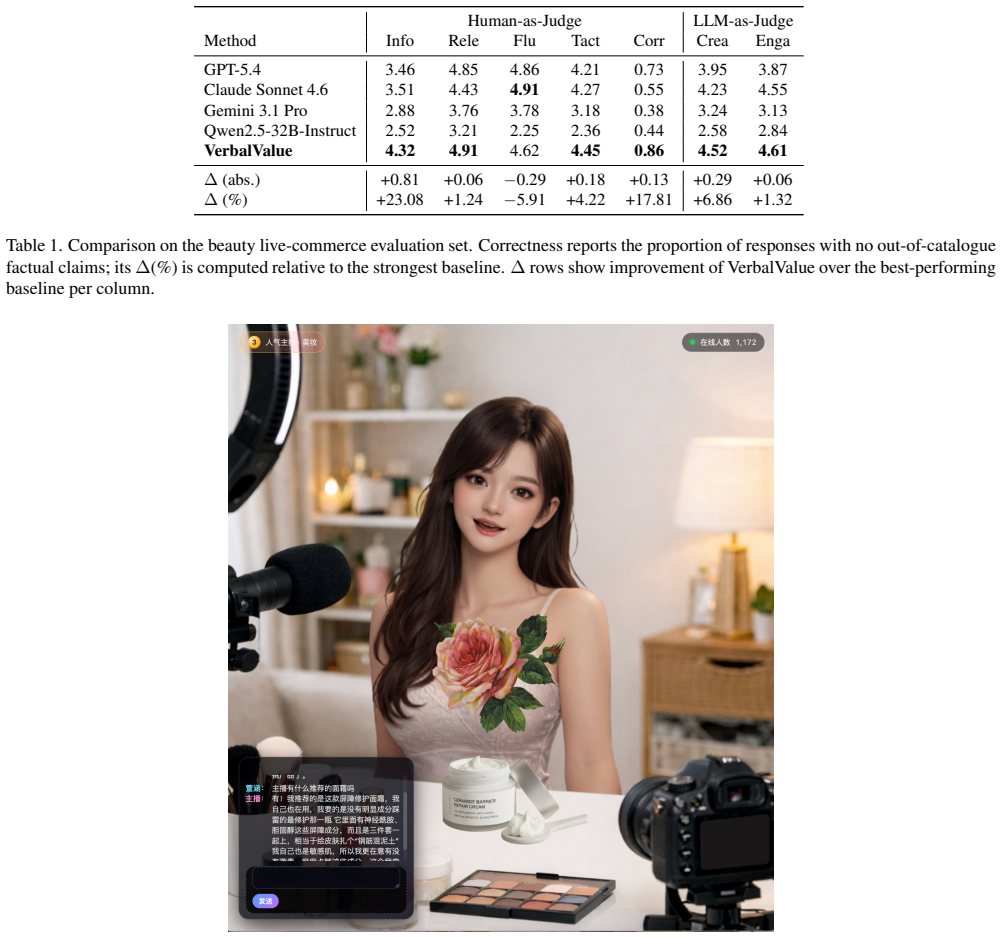
VerbalValue constructs a domain knowledge base of product specifications and a sales terminology lexicon, collects and annotates 1,475 live-commerce interactions across viewer intents, and fine-tunes a large language model to respond with empathetic amplification, evidence-backed rebuttal, and humor-mediated deflection. Experiments against GPT-5.4, Claude Sonnet 4.6, Gemini 3.1 Pro and other baselines show 23 percent gains on informativeness and 18 percent on factual correctness along with consistent advantages in tactfulness and viewer engagement.
What carries the argument
The fine-tuned large language model that adapts to viewer intent through empathetic amplification, evidence-backed rebuttal, and humor-mediated deflection, anchored in a verified product knowledge base and sales lexicon.
If this is right
- The model produces responses rated 23 percent higher on informativeness than current general-purpose LLMs.
- It achieves 18 percent higher factual correctness while maintaining advantages in tactfulness.
- Viewer engagement increases through the use of empathetic amplification, evidence-backed rebuttal, and humor-mediated deflection.
- The system converts viewer curiosity into purchase intent more effectively than conversational recommenders or untuned LLMs.
Where Pith is reading between the lines
- The same annotation and fine-tuning process could be extended to other real-time sales channels such as video shopping apps or in-app chat.
- Integration with live video cues or real-time sentiment detection could further improve response timing and relevance.
- Domain-specific knowledge bases paired with tactic-annotated data offer a practical route to reduce hallucination in commercial dialogue systems.
Load-bearing premise
The 1,475 annotated interactions represent real viewer intents and effective sales tactics from which the model can generalize without hallucinating product claims or reverting to generic templates.
What would settle it
A controlled live stream where the model replaces a human host and purchase conversion rates, viewer retention, and factual error counts are measured against both human hosts and baseline LLMs over multiple sessions.
Figures

read the original abstract
A skilled live-commerce host is not merely a narrator, but a sales agent who converts viewer curiosity into purchase intent through expert product knowledge, emotionally intelligent response tactics, and entertainment that serves as a vehicle for product exposure. Yet no existing AI system replicates this: conversational recommenders treat recommendation as a terminal act, while general-purpose LLMs hallucinate product claims and default to generic promotional templates that fail to engage or persuade. We present VerbalValue, a sales-conversion-oriented virtual host that turns exceptional verbal ability into real commercial value, built on three contributions. First, we construct a domain knowledge base of product specifications and a curated sales terminology lexicon that anchor product-related responses in verified expertise. Second, we collect and annotate 1,475 live-commerce interactions spanning diverse viewer intents. Third, we fine-tune a large language model on this data to deliver empathetic, commercially oriented responses, adapting to viewer intent through empathetic amplification, evidence-backed rebuttal, and humor-mediated deflection. Experiments against GPT-5.4, Claude Sonnet 4.6, Gemini 3.1 Pro, and other baselines demonstrate gains of 23% on informativeness and 18% on factual correctness, with consistent advantages in tactfulness and viewer engagement.
Editorial analysis
A structured set of objections, weighed in public.
Referee Report
Summary. The paper introduces VerbalValue, a sales-oriented virtual host for live commerce. It constructs a product knowledge base and sales lexicon, collects and annotates 1,475 live-commerce interactions, and fine-tunes a large language model to generate empathetic, evidence-backed responses that adapt to viewer intent via amplification, rebuttal, and humor. Experiments claim 23% gains on informativeness and 18% on factual correctness over GPT-5.4, Claude Sonnet 4.6, Gemini 3.1 Pro, and other baselines, plus advantages in tactfulness and engagement.
Significance. If the empirical results hold under a reproducible protocol, the work would demonstrate that targeted fine-tuning on domain-specific sales interactions can measurably improve factual grounding and commercial effectiveness in conversational recommenders, offering a concrete path from general LLMs to deployable sales agents.
major comments (2)
- [Abstract] Abstract: the central claims of 23% informativeness and 18% factual-correctness gains are presented without any description of the evaluation metrics, scoring rubrics, prompt templates used for the GPT-5.4 / Claude / Gemini baselines, train/test split of the 1,475 interactions, or statistical tests. These omissions render the numeric deltas unreproducible and prevent verification of the superiority claim.
- [Data collection] Data and annotation section (implied by the 1,475-interaction collection): no details are supplied on annotation guidelines, inter-annotator agreement, or how viewer intents and sales tactics were operationalized, leaving the representativeness assumption untested and the generalization risk to live settings unaddressed.
minor comments (1)
- [Abstract] Model names such as GPT-5.4, Claude Sonnet 4.6, and Gemini 3.1 Pro should be clarified (exact versions or release dates) to allow precise replication.
Simulated Author's Rebuttal
We are grateful to the referee for highlighting areas where the manuscript can be improved for better reproducibility and transparency. We will address both major comments through revisions to the abstract, experiments, and data sections.
read point-by-point responses
-
Referee: [Abstract] Abstract: the central claims of 23% informativeness and 18% factual-correctness gains are presented without any description of the evaluation metrics, scoring rubrics, prompt templates used for the GPT-5.4 / Claude / Gemini baselines, train/test split of the 1,475 interactions, or statistical tests. These omissions render the numeric deltas unreproducible and prevent verification of the superiority claim.
Authors: We concur with the referee that the abstract should provide more context on the evaluation methodology to support the reported performance gains. Accordingly, we will revise the abstract and add a new subsection in the Experiments section describing the evaluation metrics (informativeness and factual correctness), the scoring rubrics used by evaluators, the prompt templates for the baseline models (GPT-5.4, Claude Sonnet 4.6, Gemini 3.1 Pro), the train/test split of the 1,475 interactions, and the statistical tests performed. This will make the 23% and 18% improvements fully reproducible and verifiable. revision: yes
-
Referee: [Data collection] Data and annotation section (implied by the 1,475-interaction collection): no details are supplied on annotation guidelines, inter-annotator agreement, or how viewer intents and sales tactics were operationalized, leaving the representativeness assumption untested and the generalization risk to live settings unaddressed.
Authors: We appreciate this observation regarding the data and annotation process. In the revised manuscript, we will expand the relevant section to include the annotation guidelines, measures of inter-annotator agreement, and explicit operationalization of viewer intents and sales tactics. We will also discuss the selection criteria for the 1,475 interactions to demonstrate representativeness and address potential generalization to live commerce environments. revision: yes
Circularity Check
No circularity; standard supervised fine-tuning on collected data
full rationale
The paper's derivation consists of three explicit steps: building a product knowledge base and sales lexicon, collecting and annotating 1,475 live-commerce interactions, and applying standard supervised fine-tuning to an LLM. The reported gains in informativeness and factual correctness are framed as empirical outcomes of this pipeline evaluated against external baselines, with no equations, fitted parameters, or predictions that reduce to the inputs by construction. No self-citations, uniqueness theorems, or ansatzes are invoked as load-bearing elements. The approach is self-contained against external benchmarks and follows conventional ML practice without self-referential reduction.
Axiom & Free-Parameter Ledger
free parameters (1)
- fine-tuning hyperparameters
axioms (2)
- domain assumption The curated sales terminology lexicon and product specifications are complete and accurate enough to prevent hallucinations in responses.
- domain assumption Human annotations of viewer intents reliably identify effective sales tactics.
Reference graph
Works this paper leans on
-
[1]
Hotvcom: Generating buzzwor- thy comments for videos
Yuyan Chen, Songzhou Yan, Qingpei Guo, Jiyuan Jia, Zhixu Li, and Yanghua Xiao. Hotvcom: Generating buzzwor- thy comments for videos. InFindings of the Association for Computational Linguistics ACL 2024, pages 2198–2224, 2024
work page 2024
-
[2]
Xmecap: Meme caption generation with sub- image adaptability
Yuyan Chen, Songzhou Yan, Zhihong Zhu, Zhixu Li, and Yanghua Xiao. Xmecap: Meme caption generation with sub- image adaptability. InProceedings of the 32nd ACM Interna- tional Conference on Multimedia, pages 3352–3361, 2024
work page 2024
-
[3]
Yuyan Chen, Yifan Jiang, Li Zhou, Jinghan Cao, Yu Guan, Ming Yang, and Qingpei Guo. Engage for all: Making or- dinary image descriptions appealing again! InProceedings of the IEEE/CVF International Conference on Computer Vi- sion, pages 19342–19352, 2025
work page 2025
-
[4]
Hu, Yelong Shen, Phillip Wallis, Zeyuan Allen- Zhu, Yuanzhi Li, Shean Wang, Lu Wang, and Weizhu Chen
Edward J. Hu, Yelong Shen, Phillip Wallis, Zeyuan Allen- Zhu, Yuanzhi Li, Shean Wang, Lu Wang, and Weizhu Chen. LoRA: Low-rank adaptation of large language models. InIn- ternational Conference on Learning Representations, 2022
work page 2022
-
[5]
Lu Meng, Minglu Wei, and Tianyu Chen. Live streaming commerce: A review and research agenda.Journal of Inter- net Commerce, 23(1):1–34, 2024
work page 2024
-
[6]
Long Ouyang, Jeff Wu, Xu Jiang, Diogo Almeida, Car- roll L. Wainwright, Pamela Mishkin, Chong Zhang, Sand- hini Agarwal, Katarina Slama, Alex Ray, John Schulman, Jacob Hilton, Fraser Kelton, Luke E. Miller, Maddie Simens, Amanda Askell, Peter Welinder, Paul Christiano, Jan Leike, and Ryan Lowe. Training language models to follow instruc- tions with human ...
work page 2022
-
[7]
Livestream e-commerce market size, share and trends 2025–2034
Precedence Research. Livestream e-commerce market size, share and trends 2025–2034. Technical report, 2025
work page 2025
-
[8]
Qwen Team. Qwen2.5 technical report.arXiv preprint arXiv:2412.15115, 2024
work page internal anchor Pith review Pith/arXiv arXiv 2024
-
[9]
Inves- tigating LLM applications in e-commerce
Langdon Spiegel, Rohan Patel, and Bhuwan Dhingra. Inves- tigating LLM applications in e-commerce. InProceedings of the 5th Workshop on e-Commerce and NLP at ACL 2024, 2024
work page 2024
-
[10]
Towards unified conversational recommender systems via knowledge-enhanced prompt learning
Xiaolei Wang, Kun Zhou, Ji-Rong Wen, and Wayne Xin Zhao. Towards unified conversational recommender systems via knowledge-enhanced prompt learning. InProceedings of the 28th ACM SIGKDD Conference on Knowledge Discov- ery and Data Mining, pages 1929–1937, 2022
work page 1929
-
[11]
Xiaofeng Wang, Liang Chen, and Ziyuan Xu. Livestreaming as the next frontier of e-commerce: A bibliometric analysis and future research agenda.Electronic Commerce Research and Applications, 64:101371, 2024
work page 2024
-
[12]
V ASA-1: Lifelike audio-driven talking faces generated in real time
Sicheng Xu, Guojun Chen, Yu Guo, Jiaolong Yang, Chong Li, Zhenyu Zang, Yizhong Zhang, Xin Sun, and Xin Tong. V ASA-1: Lifelike audio-driven talking faces generated in real time. InAdvances in Neural Information Processing Systems, 2024
work page 2024
-
[13]
Shu Yan, Wei Zhang, and Hongcai Liu. Will the inclusion of AI anchors enhance the operational performance of live streaming e-commerce supply chains?PLOS ONE, 20(6): e0321995, 2025
work page 2025
-
[14]
A Survey of Large Language Models
Wayne Xin Zhao, Kun Zhou, Junyi Li, Tianyi Tang, Xiaolei Wang, Yupeng Hou, Yingqian Min, Beichen Zhang, Junjie Zhang, Zican Dong, Yifan Du, Chen Yang, Yushuo Chen, Zhipeng Chen, Jinhao Jiang, Ruiyang Ren, Yifan Li, Xinyu Tang, Zikang Liu, Peiyu Liu, Jian-Yun Nie, and Ji-Rong Wen. A survey of large language models.arXiv preprint arXiv:2303.18223, 2024. Ver...
work page internal anchor Pith review Pith/arXiv arXiv 2024
-
[15]
Improving conversational recommender systems via knowledge graph based semantic fusion
Kun Zhou, Wayne Xin Zhao, Shuqing Bian, Yuanhang Zhou, Ji-Rong Wen, and Jingsong Yu. Improving conversational recommender systems via knowledge graph based semantic fusion. InProceedings of the 26th ACM SIGKDD Interna- tional Conference on Knowledge Discovery and Data Min- ing, pages 1006–1014, 2020
work page 2020
discussion (0)
Sign in with ORCID, Apple, or X to comment. Anyone can read and Pith papers without signing in.