Recognition: 1 theorem link
· Lean TheoremSpectraFlow: Unifying Structural Pretraining and Frequency Adaptation for Medical Image Segmentation
Pith reviewed 2026-05-15 01:53 UTC · model grok-4.3
The pith
Aligning images and binary masks in a shared latent space through latent transport regression produces transferable structural representations that improve medical image segmentation accuracy and boundary precision in low-data regimes.
A machine-rendered reading of the paper's core claim, the machinery that carries it, and where it could break.
Core claim
The central claim is that coupling structure-aware encoder pretraining with boundary-oriented decoding, achieved by aligning images and binary masks in a shared latent space through latent transport regression where masks act as conditional structural guidance rather than prediction targets, yields task-agnostic representations that transfer effectively to downstream segmentation, and that further fine-tuning with Direct Attentional Fusion for adaptive cross-scale gating plus Frequency-Directional Dynamic Convolution for high-frequency boundary refinement produces consistent gains in accuracy, robustness under low data, and sharper boundaries on datasets such as ISIC-2016, Kvasir-SEG, and G1
What carries the argument
Mixed-Domain MeanFlow Pretraining, which aligns images and binary masks in a shared latent space through latent transport regression with masks serving as conditional structural guidance instead of prediction targets.
Load-bearing premise
That aligning images and binary masks through latent transport regression in a shared latent space produces task-agnostic structural representations that transfer effectively to downstream segmentation without bias from the mask generation or pretraining process.
What would settle it
An experiment showing that a randomly initialized encoder achieves equal or higher segmentation accuracy and boundary precision than the pretrained encoder on the same low-data splits of ISIC-2016, Kvasir-SEG, or GlaS would falsify the value of the structural pretraining stage.
Figures




read the original abstract
Medical image segmentation remains challenging in low-data regimes, where scarce annotations often yield poor generalization and ambiguous boundaries with missing fine structures. Recent self-supervised pretraining has improved transferability, but it often exhibits a texture bias. In contrast, accurate segmentation is inherently geometry-aware and depends on both topological consistency and precise boundary preservation. To address this problem, we propose a two-stage framework that couples structure-aware encoder pretraining with boundary-oriented decoding. In Stage-1, we aim to learn structure-aware representations for downstream segmentation in low-data regimes. To this end, we propose Mixed-Domain MeanFlow Pretraining, which aligns images and binary masks in a shared latent space through latent transport regression, where masks act as conditional structural guidance rather than prediction targets, making the pretraining task-agnostic. To further improve training stability under scarce supervision, we incorporate a lightweight Dispersive Loss to prevent representation collapse. In Stage-2, we fine-tune the pretrained encoder with a lightweight decoder that combines Direct Attentional Fusion for adaptive cross-scale gating and Frequency-Directional Dynamic Convolution for high-frequency boundary refinement under appearance variation. Experiments on ISIC-2016, Kvasir-SEG, and GlaS demonstrate consistent gains over state-of-the-art methods, with improved robustness in low-data settings and sharper boundary delineation.
Editorial analysis
A structured set of objections, weighed in public.
Referee Report
Summary. The paper proposes SpectraFlow, a two-stage framework for medical image segmentation in low-data regimes. In Stage-1, Mixed-Domain MeanFlow Pretraining aligns images and binary masks in a shared latent space via latent transport regression (masks serve as conditional structural guidance rather than targets) augmented by a Dispersive Loss to avoid collapse. Stage-2 fine-tunes the pretrained encoder using a lightweight decoder that integrates Direct Attentional Fusion for cross-scale gating and Frequency-Directional Dynamic Convolution for high-frequency boundary refinement. Experiments on ISIC-2016, Kvasir-SEG, and GlaS are reported to yield consistent gains over state-of-the-art methods, with improved low-data robustness and sharper boundaries.
Significance. If the quantitative results hold, the work offers a plausible route to reduce texture bias in self-supervised pretraining for geometry-sensitive tasks such as medical segmentation. The explicit separation of structure-aware pretraining from frequency-adaptive decoding, together with the task-agnostic framing of mask guidance, could improve transfer in annotation-scarce settings; the combination of latent transport regression and dispersive regularization is a concrete technical contribution worth evaluating.
major comments (2)
- [Abstract / Stage-1 Pretraining] Abstract and Stage-1 description: the claim that pretraining is task-agnostic because masks act only as 'conditional structural guidance' is not supported by the experimental design. Binary masks are generated from the identical ground-truth annotations later used for fine-tuning on ISIC-2016, Kvasir-SEG, and GlaS; latent transport regression can therefore embed dataset-specific topological priors (lesion shape distributions, boundary curvature statistics) rather than generic geometry. The Dispersive Loss prevents collapse but does not remove this source of leakage.
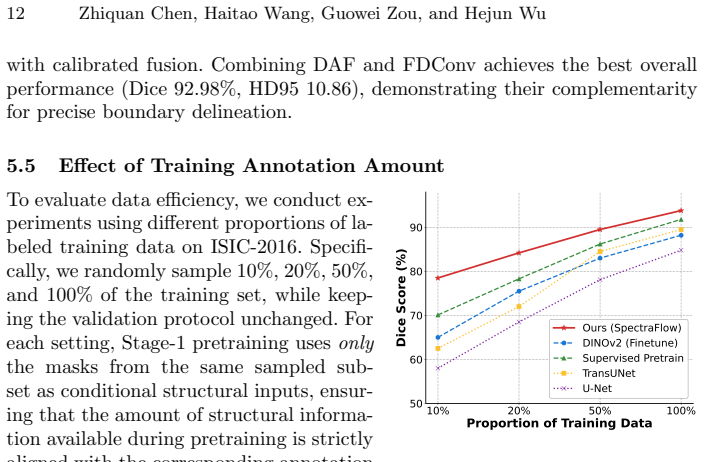
- [Abstract] Abstract: no quantitative metrics, baseline tables, statistical tests, error bars, or low-data protocol details are supplied. The central claim of 'consistent gains' and 'improved robustness in low-data settings' cannot be assessed for effect size or reproducibility from the provided information.
minor comments (2)
- [Stage-1] Clarify the precise form of the latent transport regression objective and the weighting schedule between the transport loss and Dispersive Loss; current notation leaves the optimization target ambiguous.
- [Stage-2] The terms 'Direct Attentional Fusion' and 'Frequency-Directional Dynamic Convolution' are introduced without equations or architectural diagrams; a single figure or pseudocode block would improve reproducibility.
Simulated Author's Rebuttal
We thank the referee for the constructive and insightful comments. We address each major point below and have revised the manuscript to improve clarity and support for our claims.
read point-by-point responses
-
Referee: [Abstract / Stage-1 Pretraining] Abstract and Stage-1 description: the claim that pretraining is task-agnostic because masks act only as 'conditional structural guidance' is not supported by the experimental design. Binary masks are generated from the identical ground-truth annotations later used for fine-tuning on ISIC-2016, Kvasir-SEG, and GlaS; latent transport regression can therefore embed dataset-specific topological priors (lesion shape distributions, boundary curvature statistics) rather than generic geometry. The Dispersive Loss prevents collapse but does not remove this source of leakage.
Authors: We appreciate the referee's observation on potential leakage. While the masks originate from the same annotations, they are used exclusively as conditional structural guidance within the latent transport regression objective, not as direct segmentation targets. This formulation encourages the encoder to capture transferable geometric and topological features rather than dataset-specific appearance patterns. The Dispersive Loss promotes representation diversity but does not fully eliminate domain-specific priors. To address this, we have revised the manuscript to qualify the 'task-agnostic' phrasing as 'structure-aware pretraining with in-domain mask guidance' and added an ablation using synthetic masks from external shape priors to quantify the contribution of dataset-specific topology. revision: partial
-
Referee: [Abstract] Abstract: no quantitative metrics, baseline tables, statistical tests, error bars, or low-data protocol details are supplied. The central claim of 'consistent gains' and 'improved robustness in low-data settings' cannot be assessed for effect size or reproducibility from the provided information.
Authors: We agree that the abstract should include concrete quantitative support. In the revised manuscript, we have updated the abstract to report key Dice and HD95 improvements on ISIC-2016, Kvasir-SEG, and GlaS under the 10% and 20% annotation regimes, along with a brief description of the low-data protocol and mention of statistical significance testing. Full tables with baselines, error bars, and detailed protocols remain in the experimental section. revision: yes
Circularity Check
Pretraining uses mask guidance by design without reducing gains to fitted inputs by construction
full rationale
The paper defines Mixed-Domain MeanFlow Pretraining as aligning image and binary-mask latents with masks as conditional guidance (not targets), explicitly labeling the setup task-agnostic. No equations or self-citations in the provided text equate the downstream segmentation gains or boundary improvements to quantities defined solely by the pretraining fit on the same annotations. The experimental claims on ISIC-2016, Kvasir-SEG, and GlaS remain independent empirical results rather than tautological renamings or self-referential predictions. This yields only a minor score for the inherent use of ground-truth masks in pretraining, which does not collapse the derivation chain.
Axiom & Free-Parameter Ledger
free parameters (2)
- Dispersive Loss weighting factor
- Network architecture hyperparameters
axioms (1)
- domain assumption Binary masks serve as effective conditional structural guidance for learning task-agnostic representations via latent transport regression
invented entities (4)
-
Mixed-Domain MeanFlow Pretraining
no independent evidence
-
Dispersive Loss
no independent evidence
-
Direct Attentional Fusion
no independent evidence
-
Frequency-Directional Dynamic Convolution
no independent evidence
Lean theorems connected to this paper
-
IndisputableMonolith/Cost/FunctionalEquationwashburn_uniqueness_aczel unclear?
unclearRelation between the paper passage and the cited Recognition theorem.
Mixed-Domain MeanFlow Pretraining, which aligns images and binary masks in a shared latent space through latent transport regression, where masks act as conditional structural guidance rather than prediction targets
What do these tags mean?
- matches
- The paper's claim is directly supported by a theorem in the formal canon.
- supports
- The theorem supports part of the paper's argument, but the paper may add assumptions or extra steps.
- extends
- The paper goes beyond the formal theorem; the theorem is a base layer rather than the whole result.
- uses
- The paper appears to rely on the theorem as machinery.
- contradicts
- The paper's claim conflicts with a theorem or certificate in the canon.
- unclear
- Pith found a possible connection, but the passage is too broad, indirect, or ambiguous to say the theorem truly supports the claim.
Reference graph
Works this paper leans on
-
[1]
Bao, H., Dong, L., Wei, F., Yuan, G., Zhang, H., Lin, L., Zhang, B.: Beit: Bert pre-training of image transformers. In: ICLR (2022) 2, 5
work page 2022
-
[2]
Cao, H., Wang, Y., Chen, J., Jiang, D., Zhang, X., Tian, Q., Wang, M.: Swin-unet: Unet-like pure transformer for medical image segmentation (2021) 2
work page 2021
- [3]
-
[4]
Chen, J., Lu, Y., Yu, Q., Luo, X., Adeli, E., Wang, Y., Lu, L., Yuille, A.L., Zhou, Y.: Transunet: Transformers make strong encoders for medical image segmentation. In: MICCAI. pp. 127–136 (2021) 1
work page 2021
- [5]
- [6]
- [7]
- [8]
-
[9]
Geirhos, R., Rubisch, P., Michaelis, C., Bethge, M., Wichmann, F.A.: Imagenet- trained cnns are biased towards texture; increasing shape bias improves accuracy and robustness. In: International Conference on Learning Representations (2019), https://openreview.net/forum?id=Bygh9j09KX4, 5
work page 2019
-
[10]
Geng, Z., Deng, M., Bai, X., Kolter, J.Z., He, K.: Mean flows for one-step generative modeling (2025) 5, 6
work page 2025
-
[11]
Guan, H., et al.: Domain adaptation for medical image analysis: A survey. IEEE Transactions on Biomedical Engineering (2022),https://www.ncbi.nlm.nih.gov/ pmc/articles/PMC9011180/4
work page 2022
- [12]
- [13]
- [14]
- [15]
-
[16]
arXiv preprint arXiv:1911.09071 (2019), https://arxiv.org/abs/1911.090714, 5
Hermann, K.L., Chen, T., Kornblith, S.: The origins and prevalence of texture bias in convolutional neural networks. arXiv preprint arXiv:1911.09071 (2019), https://arxiv.org/abs/1911.090714, 5
-
[17]
Hu, Z., Lai, C.H., Wu, G., Mitsufuji, Y., Ermon, S.: Meanflow transformers with representation autoencoders (2025) 5
work page 2025
-
[18]
Isensee, F., Jaeger, P.F., Kohl, S.A.A., Petersen, J., Maier-Hein, K.H.: nnu-net: A self-configuring method for deep learning-based biomedical image segmentation. Nat. Methods18(2), 203–211 (2021) 1, 4
work page 2021
-
[19]
Jha, D., Smedsrud, P.H., Riegler, M.A., Halvorsen, P., de Lange, T., Johansen, D., Johansen, H.D.: Kvasir-seg: A segmented polyp dataset. In: Int. Conf. Multimedia Modeling. pp. 451–462 (2020) 9
work page 2020
- [20]
-
[21]
Oktay, O., Schlemper, J., Le Folgoc, L., Lee, M., Heinrich, M., Misawa, K., Mori, K., McDonagh, S., Hammerla, N., Kainz, B., Glocker, B., Rueckert, D.: Attention u-net: Learning where to look for the pancreas (2018) 2
work page 2018
-
[22]
Oquab, M., Darcet, T., Moutakanni, T., Vo, H., Szafraniec, M., Khalidov, V., Fernandez, P., Haziza, D., Massa, F., El-Nouby, A., Assran, M., Ballas, N., Galuba, W., Howes, R., Huang, P.Y., Li, S.W., Misra, I., Rabbat, M., Sharma, V., Synnaeve, G., Xu, H., J´ egou, H., Mairal, J., Labatut, P., Joulin, A., Bojanowski, P.: Dinov2: Learning robust visual feat...
work page 2023
-
[23]
Ronneberger, O., Fischer, P., Brox, T.: U-net: Convolutional networks for biomed- ical image segmentation. In: MICCAI. pp. 234–241 (2015) 2, 4
work page 2015
-
[24]
Sirinukunwattana, K., et al.: Gland segmentation in colon histology images: The glas challenge contest and dataset. Sci. Rep.7, 12821 (2017) 9
work page 2017
-
[25]
arXiv preprint arXiv:2109.13230 (2021),https://arxiv.org/abs/2109.132304
Ugurlu, D., Puyol-Anton, E., et al.: The impact of domain shift on left and right ventricle segmentation in short axis cardiac mr images. arXiv preprint arXiv:2109.13230 (2021),https://arxiv.org/abs/2109.132304
-
[26]
Wang, R., He, K.: Diffuse and disperse: Image generation with representation reg- ularization (2025) 3, 7
work page 2025
- [27]
-
[28]
Zhao, W., Chen, J., Xu, Y., He, Y., Huang, Z., He, X.: Learning via flow dynamics for self-supervised representation. IEEE TPAMI (2023) 5
work page 2023
-
[29]
Zhou, Z., Siddiquee, M.M.R., Tajbakhsh, N., Liang, J.: Unet++: A nested u-net architecture for medical image segmentation. In: MICCAI. pp. 3–11 (2019) 4
work page 2019
-
[30]
Zhou, Z., Sodha, V., Rahman Siddiquee, M.M., Feng, R., Tajbakhsh, N., Gotway, M.B., Liang, J.: Models genesis: Generic autodidactic models for 3d medical image analysis. Med. Image Anal.67, 101840 (2021) 2 Title Suppressed Due to Excessive Length 17 0.2 0.4 0.6 0.8 1.0 Hyperparameter 0.0 0.2 0.4 0.6 0.8 1.0 Metric Score 0.851 0.859 0.848 0.845 0.841 0.912...
work page 2021
discussion (0)
Sign in with ORCID, Apple, or X to comment. Anyone can read and Pith papers without signing in.