Recognition: 2 theorem links
· Lean TheoremSagnac-Loop-Reflector Fabry-Perot Lattices for Modular 1D Topological Photonics
Pith reviewed 2026-05-15 01:26 UTC · model grok-4.3
The pith
A lattice of tunable Sagnac-loop-reflector Fabry-Perot resonators maps onto the Su-Schrieffer-Heeger model in the weak-coupling limit.
A machine-rendered reading of the paper's core claim, the machinery that carries it, and where it could break.
Core claim
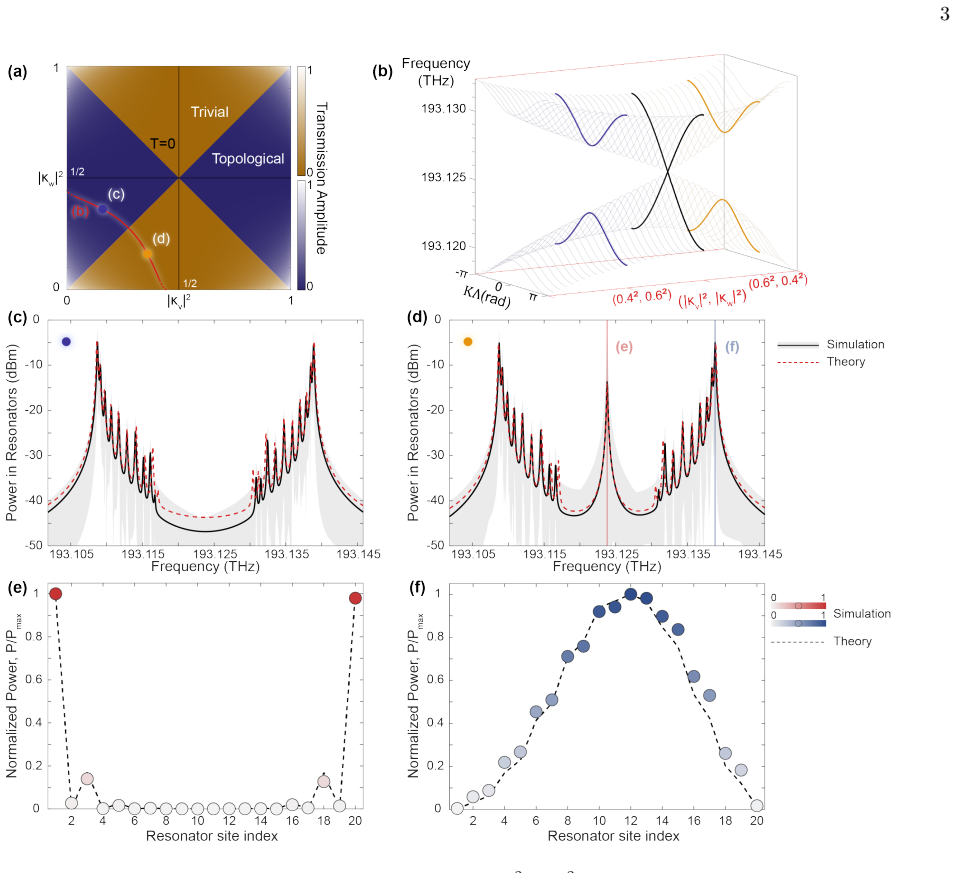
A modular silicon-photonic Fabry-Perot resonator lattice built from cascaded tunable Sagnac loop reflectors maps onto the Su-Schrieffer-Heeger model in the weak-coupling limit, producing an isolated midgap resonance with edge-localized power profiles that is robust against symmetry-preserving hopping perturbations.
What carries the argument
The Sagnac loop reflector tuned by one directional-coupler cross-coupling coefficient, which directly sets the effective hopping amplitude between adjacent Fabry-Perot sites.
If this is right
- Each lattice bond can be set independently by a single control parameter per reflector.
- The topological phase is diagnosed by the presence of an isolated mid-gap resonance localized at the boundaries.
- Edge localization survives moderate hopping disorder that preserves the underlying chiral symmetry.
- The same modular reflector unit can be cascaded to build longer chains without redesigning individual components.
Where Pith is reading between the lines
- The platform could be used to realize other one-dimensional topological models by choosing non-alternating sequences of reflector types.
- Active tuning of the directional couplers would allow real-time switching between trivial and topological phases on the same chip.
- Because each reflector is controlled by one parameter, the design may reduce the number of independent electrical controls needed for large-scale topological photonic circuits.
Load-bearing premise
The weak-coupling limit holds so that the transfer-matrix description reduces to the simple tight-binding Su-Schrieffer-Heeger Hamiltonian without significant higher-order couplings or losses.
What would settle it
Fabrication and S-parameter measurement of a twenty-site device that shows a mid-gap resonance whose spatial profile is localized at the chain ends only when the two reflector types produce the topological dimerization.
Figures


read the original abstract
We introduce a modular silicon-photonic Fabry-Perot resonator lattice based on cascaded tunable Sagnac loop reflectors. Each SLR is controlled by a single directional-coupler cross-coupling coefficient, enabling modular control of the effective lattice hoppings. As a representative example, alternating two SLR types maps the lattice onto the Su-Schrieffer-Heeger model in the weak-coupling limit. We derive the Bloch dispersion via a transfer-matrix formulation and obtain an effective tight-binding Hamiltonian in the weak-coupling limit. S-parameter simulations of a 20-site lattice show an isolated midgap resonance with edge-localized power profiles in the topological phase, and disorder tests show robustness against symmetry-preserving hopping perturbations. Our results establish SLR-based FP lattices as a complementary platform for on-chip topological photonics.
Editorial analysis
A structured set of objections, weighed in public.
Referee Report
Summary. The manuscript introduces a modular silicon-photonic platform consisting of cascaded Sagnac-loop-reflector Fabry-Perot (SLR-FP) resonators. Each SLR is tuned via a single directional-coupler cross-coupling coefficient, allowing modular control of effective lattice hoppings. Alternating two SLR types maps the system onto the Su-Schrieffer-Heeger (SSH) model in the weak-coupling limit. The authors derive the Bloch dispersion from a transfer-matrix formulation and obtain an effective tight-binding Hamiltonian. S-parameter simulations of a 20-site lattice demonstrate an isolated midgap resonance with edge-localized power profiles in the topological phase, together with robustness against symmetry-preserving hopping disorder.
Significance. If the weak-coupling mapping is quantitatively validated for the simulated parameters, the work provides a tunable, modular platform for realizing 1D topological photonics on silicon, complementary to existing waveguide or resonator lattices. The transfer-matrix derivation and direct S-parameter simulations of finite chains with disorder tests constitute reproducible evidence for the reported midgap edge resonance.
major comments (1)
- [S-parameter simulations and effective Hamiltonian derivation] The central mapping to the SSH model relies on the weak-coupling limit, yet the S-parameter simulations section provides no quantitative verification that higher-order couplings and non-nearest-neighbor terms remain negligible for the chosen directional-coupler cross-coupling coefficients. Without an explicit comparison (e.g., extracted hopping ratios or full transfer-matrix eigenvalues versus the effective Hamiltonian), the isolated midgap resonance and edge localization could arise from finite-size or parasitic effects rather than protected SSH topology.
minor comments (2)
- [Abstract] The abstract states the results but supplies no numerical values for the cross-coupling coefficient, lattice size error bars, or disorder strength, making it difficult to assess the robustness claims at a glance.
- [Methods/Simulations] Parameter tables listing the exact directional-coupler coefficients, propagation losses, and simulation frequency range are absent; these would allow direct reproduction of the 20-site S-parameter results.
Simulated Author's Rebuttal
We thank the referee for their positive assessment and constructive comment on our manuscript. We address the major comment below and will revise the manuscript to incorporate the requested quantitative validation.
read point-by-point responses
-
Referee: [S-parameter simulations and effective Hamiltonian derivation] The central mapping to the SSH model relies on the weak-coupling limit, yet the S-parameter simulations section provides no quantitative verification that higher-order couplings and non-nearest-neighbor terms remain negligible for the chosen directional-coupler cross-coupling coefficients. Without an explicit comparison (e.g., extracted hopping ratios or full transfer-matrix eigenvalues versus the effective Hamiltonian), the isolated midgap resonance and edge localization could arise from finite-size or parasitic effects rather than protected SSH topology.
Authors: We agree that explicit quantitative verification of the weak-coupling limit is necessary to strengthen the claim that the observed midgap resonance originates from SSH topology. In the revised manuscript we will add a direct comparison: we will extract the effective nearest-neighbor hopping amplitudes from the full transfer-matrix eigenvalues for the simulated directional-coupler coefficients, report the ratio of next-nearest-neighbor to nearest-neighbor hoppings (expected <0.05), and overlay the full transfer-matrix spectrum against the effective SSH Hamiltonian for the 20-site chain. This will confirm that higher-order terms remain negligible and that the edge-localized state is topologically protected rather than a finite-size artifact. revision: yes
Circularity Check
No significant circularity; derivation self-contained via transfer-matrix approximation and independent simulations
full rationale
The paper derives the Bloch dispersion and effective tight-binding Hamiltonian from the transfer-matrix formulation explicitly in the weak-coupling limit, then cross-validates topological signatures using separate S-parameter simulations of a 20-site lattice. No equations reduce by construction to fitted parameters, self-definitions, or self-citation chains. The weak-coupling limit is stated as an assumption without internal circularity, and simulations provide external numerical checks rather than tautological confirmation.
Axiom & Free-Parameter Ledger
free parameters (1)
- directional-coupler cross-coupling coefficient
axioms (2)
- standard math Transfer-matrix formulation accurately describes cascaded SLR Fabry-Perot resonators
- domain assumption Weak-coupling limit maps the lattice onto the Su-Schrieffer-Heeger tight-binding model
Lean theorems connected to this paper
-
IndisputableMonolith/Foundation/AlexanderDuality.leanalexander_duality_circle_linking unclear?
unclearRelation between the paper passage and the cited Recognition theorem.
We derive the Bloch dispersion via a transfer-matrix formulation and obtain an effective tight-binding Hamiltonian in the weak-coupling limit... maps the lattice onto the Su-Schrieffer-Heeger model
-
IndisputableMonolith/Cost/FunctionalEquation.leanwashburn_uniqueness_aczel unclear?
unclearRelation between the paper passage and the cited Recognition theorem.
S-parameter simulations of a 20-site lattice show an isolated midgap resonance with edge-localized power profiles
What do these tags mean?
- matches
- The paper's claim is directly supported by a theorem in the formal canon.
- supports
- The theorem supports part of the paper's argument, but the paper may add assumptions or extra steps.
- extends
- The paper goes beyond the formal theorem; the theorem is a base layer rather than the whole result.
- uses
- The paper appears to rely on the theorem as machinery.
- contradicts
- The paper's claim conflicts with a theorem or certificate in the canon.
- unclear
- Pith found a possible connection, but the passage is too broad, indirect, or ambiguous to say the theorem truly supports the claim.
Reference graph
Works this paper leans on
- [1]
-
[2]
W. Bogaerts, D. P´ erez, J. Capmany, D. A. Miller, J. Poon, D. Englund, F. Morichetti, and A. Melloni, Pro- grammable photonic circuits, Nature586, 207 (2020)
work page 2020
-
[3]
S. Shekhar, W. Bogaerts, L. Chrostowski, J. E. Bowers, M. Hochberg, R. Soref, and B. J. Shastri, Roadmapping the next generation of silicon photonics, Nature Commu- nications15, 751 (2024)
work page 2024
-
[4]
E. Pelucchi, G. Fagas, I. Aharonovich, D. Englund, E. Figueroa, Q. Gong, H. Hannes, J. Liu, C.-Y. Lu, N. Matsuda,et al., The potential and global outlook of integrated photonics for quantum technologies, Nature Reviews Physics4, 194 (2022)
work page 2022
-
[5]
D. Leykam and L. Yuan, Topological phases in ring res- onators: recent progress and future prospects, Nanopho- tonics9, 4473 (2020)
work page 2020
- [6]
- [7]
- [8]
-
[9]
H. Zhao, X. Qiao, T. Wu, B. Midya, S. Longhi, and L. Feng, Non-hermitian topological light steering, Science 365, 1163 (2019)
work page 2019
-
[10]
A. Hotte-Kilburn and P. Bianucci, Integrated topological photonics in one dimension, Advances in Physics: X10, 2476417 (2025)
work page 2025
-
[11]
Y. Su, Y. Zhang, C. Qiu, X. Guo, and L. Sun, Silicon photonic platform for passive waveguide devices: mate- rials, fabrication, and applications, Advanced Materials Technologies5, 1901153 (2020)
work page 2020
-
[12]
Y. Shen, I. B. Divliansky, D. N. Basov, and S. Mookher- jea, Electric-field-driven nano-oxidation trimming of sil- icon microrings and interferometers, Optics letters36, 2668 (2011)
work page 2011
- [13]
-
[14]
H. Jayatilleka, K. Murray, M. ´A. Guill´ en-Torres, M. Caverley, R. Hu, N. A. Jaeger, L. Chrostowski, and S. Shekhar, Wavelength tuning and stabilization of microring-based filters using silicon in-resonator photo- conductive heaters, Optics express23, 25084 (2015)
work page 2015
-
[15]
H. Arianfard, S. Juodkazis, D. J. Moss, and J. Wu, Sagnac interference in integrated photonics, Applied Physics Reviews10, 10.1063/5.0123236 (2023)
-
[16]
J. Wu, T. Moein, X. Xu, and D. J. Moss, Advanced pho- tonic filters based on cascaded sagnac loop reflector res- onators in silicon-on-insulator nanowires, APL Photonics 3, 10.1063/1.5025833 (2018)
-
[17]
Y. J. Park, M. J. Her, Y. Jeong, D. J. Choi, D. U. Kim, M. G. Lim, M. S. Hong, H. S. Kwon, K. Yu, and S. Han, Fully tunable fabry-p´ erot cavity based on mems sagnac loop reflector with ultra-low static power consumption, Microsystems & Nanoengineering10, 119 (2024)
work page 2024
-
[18]
X. Sun, L. Zhou, J. Xie, Z. Zou, L. Lu, H. Zhu, X. Li, and J. Chen, Tunable silicon fabry–perot comb filters formed by sagnac loop mirrors, Optics Letters38, 567 (2013)
work page 2013
-
[19]
W.-P. Su, J. R. Schrieffer, and A. J. Heeger, Solitons in polyacetylene, Physical review letters42, 1698 (1979)
work page 1979
-
[20]
J. K. Asb´ oth, L. Oroszl´ any, and A. P´ alyi,A short course on topological insulators, Vol. 919 (Springer, 2016)
work page 2016
-
[21]
J. K. Poon, J. Scheuer, S. Mookherjea, G. T. Paloczi, Y. Huang, and A. Yariv, Matrix analysis of microring coupled-resonator optical waveguides, Optics express12, 90 (2004)
work page 2004
-
[22]
W. Suh, Z. Wang, and S. Fan, Temporal coupled-mode theory and the presence of non-orthogonal modes in loss- less multimode cavities, IEEE Journal of Quantum Elec- tronics40, 1511 (2004)
work page 2004
-
[23]
B.-H. Chen and D.-W. Chiou, An elementary rigorous proof of bulk-boundary correspondence in the general- ized su-schrieffer-heeger model, Physics Letters A384, 126168 (2020)
work page 2020
-
[24]
D. L. Vitullo, S. Zaki, D. Jones, M. Sumetsky, and M. Brodsky, Coupling between waveguides and microres- onators: the local approach, Optics Express28, 25908 (2020)
work page 2020
-
[25]
Y. G. Liu, Y. Wei, O. Hemmatyar, G. G. Pyrialakos, P. S. Jung, D. N. Christodoulides, and M. Khajavikhan, Com- plex skin modes in non-hermitian coupled laser arrays, Light Science & Applications11, 336 (2022)
work page 2022
-
[26]
E. J. Bergholtz, J. C. Budich, and F. K. Kunst, Ex- ceptional topology of non-hermitian systems, Rev. Mod. Phys.93, 015005 (2021)
work page 2021
-
[27]
T. Dai, A. Ma, J. Mao, Y. Ao, X. Jia, Y. Zheng, C. Zhai, Y. Yang, Z. Li, B. Tang,et al., A programmable topo- logical photonic chip, Nature Materials23, 928 (2024)
work page 2024
-
[28]
M. B. On, F. Ashtiani, D. Sanchez-Jacome, D. Perez- Lopez, S. B. Yoo, and A. Blanco-Redondo, Pro- grammable integrated photonics for topological hamil- tonians, Nature Communications15, 629 (2024)
work page 2024
-
[29]
D. A. Steck, Quantum and atom optics (2007), available online
work page 2007
-
[30]
G. Liang and Y. Chong, Optical resonator analog of a two-dimensional topological insulator, Physical review letters110, 203904 (2013)
work page 2013
discussion (0)
Sign in with ORCID, Apple, or X to comment. Anyone can read and Pith papers without signing in.