Recognition: no theorem link
Quandle presentations of surface knots in 4-manifolds and bridge numbers
Pith reviewed 2026-05-15 01:14 UTC · model grok-4.3
The pith
Banded unlink diagrams give Wirtinger presentations for the fundamental quandle of any surface link in a 4-manifold.
A machine-rendered reading of the paper's core claim, the machinery that carries it, and where it could break.
Core claim
The fundamental quandle of a surface link in an arbitrary 4-manifold admits a Wirtinger-type presentation read directly from any banded unlink diagram of the link.
What carries the argument
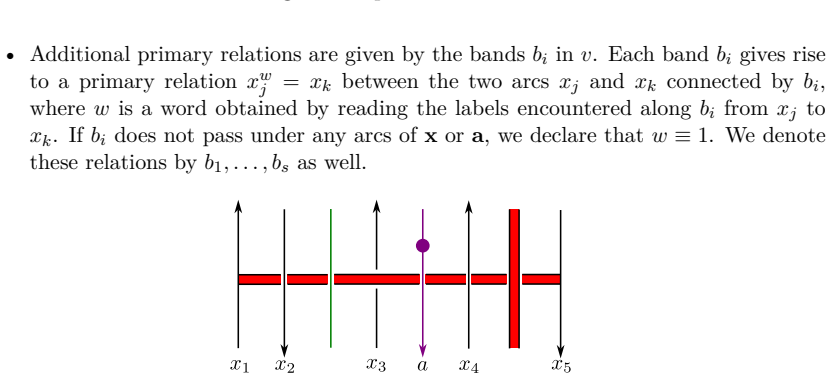
Banded unlink diagram, from which generators are assigned to the arcs and relations are imposed at crossings and band attachments to define the fundamental quandle.
If this is right
- For every b ≥ 4 and every m ≥ 0 there exist infinitely many pairwise non-local surface knots of bridge number b in CP^{2} # m CP^{2}-bar.
- Infinite families of surface knots with isomorphic knot groups become distinguishable by their fundamental quandles.
- Quandle invariants are now computable for surface links in any 4-manifold that admits a banded unlink diagram.
Where Pith is reading between the lines
- The same diagrams may be used to compute other quandle-derived invariants in manifolds beyond the 4-sphere.
- Bridge-number phenomena observed in the 4-sphere are expected to persist in connected sums of projective planes.
- Explicit presentations open the possibility of finding minimal-bridge representatives by exhaustive search over diagrams.
Load-bearing premise
Banded unlink diagrams capture all relations of the fundamental quandle without extra constraints coming from the topology of the ambient 4-manifold.
What would settle it
A concrete surface link in a 4-manifold whose topologically defined fundamental quandle fails to obey the relations read from one of its banded unlink diagrams.
Figures




read the original abstract
The fundamental quandle is an invariant for distinguishing surface knots, yet computable presentations have traditionally been limited to surfaces embedded in the $4$-sphere. Building on the framework of banded unlink diagrams introduced by Hughes, Kim, and Miller, we give a Wirtinger type presentation of the fundamental quandle of surface links in arbitrary $4$-manifolds. As applications, we extend the work of Sato and Tanaka to show that for any $b \geq 4$ and $m \geq 0$, there exist infinitely many pairwise non-local surface knots with bridge number $b$ in $\mathbb{C}P^2 \#m\overline{\mathbb{C}P^2}$, and we distinguish infinite families of surface knots with isomorphic knot groups, extending results of Tanaka and Taniguchi.
Editorial analysis
A structured set of objections, weighed in public.
Referee Report
Summary. The manuscript claims to extend the banded unlink diagrams of Hughes-Kim-Miller to obtain a Wirtinger-type presentation for the fundamental quandle of surface links in arbitrary closed 4-manifolds. It applies the construction to produce, for any b ≥ 4 and m ≥ 0, infinitely many pairwise non-local surface knots of bridge number b in CP² # m CPbar², and to distinguish infinite families of surface knots that have isomorphic knot groups.
Significance. If the presentation is rigorously established, the work supplies the first general computational tool for quandle invariants of surface links outside S⁴. The concrete applications to bridge numbers and to knots with isomorphic groups but non-isomorphic quandles furnish new families of examples that were previously unavailable, thereby strengthening the role of quandle theory in 4-dimensional knot theory.
major comments (1)
- [Main theorem and construction section] The central construction (presumably the statement and proof of the Wirtinger presentation in the section following the introduction) asserts that the generators and relations coming from arcs, crossings, and bands in a banded unlink diagram already encode the full quandle structure on the complement in an arbitrary 4-manifold M. This claim is load-bearing for the general statement, yet the derivation does not isolate or verify the contribution of π₁(M) to the quandle operation when M is not simply connected; the applications are confined to the simply-connected manifolds CP² # m CPbar², leaving the general case untested.
minor comments (2)
- [Abstract] The abstract and introduction would benefit from an explicit reference to the theorem number that states the Wirtinger presentation, rather than the informal phrase “we give a Wirtinger type presentation.”
- [Figures and diagrams] Figure captions and diagram descriptions should indicate which relations arise from the manifold’s topology versus the link diagram itself, to help readers track the general versus special cases.
Simulated Author's Rebuttal
We thank the referee for their thorough reading and for identifying a point that requires clarification in the presentation of the main theorem. We address the concern directly below and outline the revisions we will make.
read point-by-point responses
-
Referee: [Main theorem and construction section] The central construction (presumably the statement and proof of the Wirtinger presentation in the section following the introduction) asserts that the generators and relations coming from arcs, crossings, and bands in a banded unlink diagram already encode the full quandle structure on the complement in an arbitrary 4-manifold M. This claim is load-bearing for the general statement, yet the derivation does not isolate or verify the contribution of π₁(M) to the quandle operation when M is not simply connected; the applications are confined to the simply-connected manifolds CP² # m CPbar², leaving the general case untested.
Authors: We agree that the current write-up does not isolate the contribution of π₁(M) in a dedicated step, which makes the general claim harder to verify. The construction proceeds by lifting the banded unlink diagram to the universal cover of M and imposing the Wirtinger relations on the lifted arcs; the deck transformations of π₁(M) act by conjugation on the quandle generators, and this action is encoded implicitly through the relations coming from the 1-handles and the paths that connect the bands. However, we did not extract this action into a separate lemma or diagram chase that explicitly tracks how an element of π₁(M) modifies a quandle operation. The applications are restricted to simply-connected manifolds precisely because the resulting quandle is then free of this extra action, allowing direct comparison with known examples. We will revise the proof section by adding a short subsection that isolates the π₁(M)-action (via a commutative diagram relating the quandle of the cover to the quandle of M) and verifies that the presentation remains complete when π₁(M) is nontrivial. This will make the general statement fully rigorous while leaving the concrete applications unchanged. revision: partial
Circularity Check
No significant circularity in the quandle presentation derivation
full rationale
The paper constructs a Wirtinger-type presentation for the fundamental quandle of surface links in arbitrary 4-manifolds by extending the banded unlink diagrams of Hughes, Kim, and Miller. This is a direct topological construction rather than any reduction of a claimed result to a fitted parameter, self-definition, or self-citation chain. No equations or steps rename a known result as new unification, smuggle an ansatz via citation, or import uniqueness from the authors' prior work. Citations to Sato-Tanaka and Tanaka-Taniguchi supply context for applications but do not bear the load of the central claim. The derivation is therefore self-contained against external benchmarks.
Axiom & Free-Parameter Ledger
axioms (2)
- domain assumption The fundamental quandle is an invariant for surface knots
- domain assumption Banded unlink diagrams represent surface links in 4-manifolds
Reference graph
Works this paper leans on
-
[1]
Twisting spun knots , author=. Trans. Amer. Math. Soc. , volume=. 1965 , publisher=
work page 1965
-
[2]
2-knots with the same knot group but different knot quandles , author=. J. Math. Soc. Japan , volume=. 2026 , publisher=
work page 2026
-
[3]
Twist-spun torus knots , author=. Proc. Amer. Math. Soc. , volume=
-
[4]
On the 3-dimensional Brieskorn manifolds M (p, q, r) , author=. Knots, groups, and , volume=
-
[5]
Racks and links in codimension two , author=. J. Knot Theory Ramifications , volume=. 1992 , publisher=
work page 1992
- [6]
-
[7]
The bridge number of surface links and kei colorings , author=. Bull. Lond. Math. Soc. , volume=. 2022 , publisher=
work page 2022
-
[8]
Bridge trisections in rational surfaces , author=. J. Topol. Anal. , volume=. 2022 , publisher=
work page 2022
-
[9]
Isotopies of surfaces in 4--manifolds via banded unlink diagrams , author=. Geom. Topol. , volume=. 2020 , publisher=
work page 2020
-
[10]
Trisecting 4--manifolds , author=. Geom. Topol. , volume=. 2016 , publisher=
work page 2016
-
[11]
Bridge trisections of knotted surfaces in 4-manifolds , author=. Proc. Natl. Acad. Sci. USA , volume=. 2018 , publisher=
work page 2018
-
[12]
A classifying invariant of knots, the knot quandle , author =. J. Pure Appl. Algebra , volume =
-
[13]
Mathematics of the USSR-Sbornik , volume =
Distributive groupoids in knot theory , author =. Mathematics of the USSR-Sbornik , volume =. 1984 , note =
work page 1984
-
[14]
Computations of quandle cocycle invariants of surface-links using marked graph diagrams , author =. J. Knot Theory Ramifications , volume =
-
[15]
Calculating the fundamental biquandles of surface links from their ch-diagrams , author =. J. Knot Theory Ramifications , volume =
- [16]
-
[17]
Colorings of torus knots and their twist-spuns by Alexander quandles over finite fields , author=. J. Knot Theory Ramifications , volume=. 2009 , publisher=
work page 2009
-
[18]
Mathematics Lecture Series , volume=
Knots and links, Publish or Perish , author=. Mathematics Lecture Series , volume=
discussion (0)
Sign in with ORCID, Apple, or X to comment. Anyone can read and Pith papers without signing in.