Regularized vacuum stress tensor of a scalar field as the inflaton or dark energy
Pith reviewed 2026-06-30 20:28 UTC · model grok-4.3
The pith
A conformally coupled scalar field with mass of order 10 M_pl can drive both primordial inflation and current cosmic acceleration via its regularized vacuum stress tensor.
A machine-rendered reading of the paper's core claim, the machinery that carries it, and where it could break.
Core claim
The regularized vacuum stress tensor of a conformally coupled scalar field with mass of order 10 M_pl supplies a source term whose insertion into the Friedmann equation admits solutions describing both primordial inflation and present-day acceleration; the same construction with a minimally coupled field produces no viable solutions for either epoch regardless of mass value.
What carries the argument
The regularized vacuum stress tensor of a scalar field in maximally symmetric spacetime, used directly as the right-hand side of the classical Friedmann equation.
If this is right
- The same scalar field can in principle account for both the inflaton and dark energy.
- Conformal coupling is required; minimal coupling is ruled out for these roles.
- The mass must lie near 10 M_pl to generate the correct magnitude of vacuum energy.
- The regularization supplies a usable classical source without additional fields.
Where Pith is reading between the lines
- The construction may be tested by checking whether the predicted expansion history matches detailed CMB or supernova data at the required mass scale.
- The approach could be applied to other field couplings or less symmetric spacetimes to see whether additional cosmological roles emerge.
- If valid, it would reduce the number of independent scalar fields needed in cosmological model building.
Load-bearing premise
The regularization procedure yields a stress tensor that can be treated as a classical source term in the Friedmann equation without further quantum-gravity corrections.
What would settle it
An explicit evaluation of the equation-of-state parameter w derived from the regularized tensor that lies outside the interval required for inflation or acceleration, or observational bounds that exclude a scalar mass near 10 M_pl.
Figures
read the original abstract
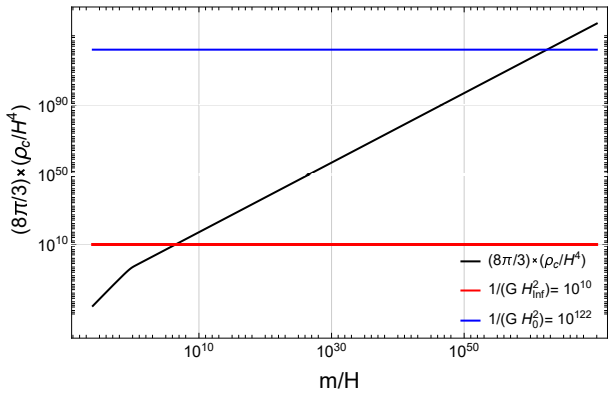
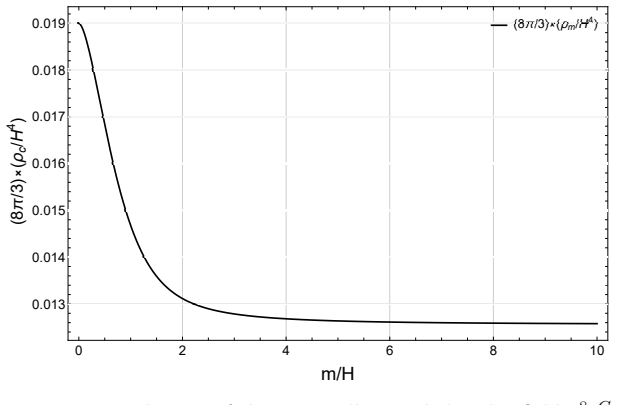
We study the regularized vacuum stress tensor of scalar fields in maximally symmetric spacetime and assess the feasibility of driving primordial inflation or current cosmic acceleration by analyzing the existence of solutions to the Friedmann equation. We find that a conformally coupled scalar field with mass of order $10$ $M_{\text{pl}}$ can be a candidate for both the inflaton and dark energy, suggesting that these two components may have the same quantum origin. In contrast, a minimally coupled scalar field cannot serve as either the inflaton or dark energy regardless of its mass.
Editorial analysis
A structured set of objections, weighed in public.
Referee Report
Summary. The manuscript studies the regularized vacuum stress tensor of scalar fields in maximally symmetric spacetime and assesses whether it can source primordial inflation or late-time acceleration through solutions to the Friedmann equation. It concludes that a conformally coupled scalar field with mass of order 10 M_pl can serve as both the inflaton and dark energy (suggesting a common quantum origin), while a minimally coupled scalar field cannot, regardless of mass.
Significance. If the regularization procedure produces a scheme-independent, finite effective energy density that can be inserted directly into the semiclassical Friedmann equation without further quantum-gravity corrections, the result would offer a unified origin for the inflaton and dark energy from a single quantum field, which is of substantial interest. The use of maximally symmetric spacetime for both epochs is a coherent approach, but the absence of explicit derivations, cross-checks, and independent scale predictions currently limits the strength of this assessment.
major comments (3)
- [Abstract] Abstract: the claim that solutions exist for a conformally coupled scalar with mass of order 10 M_pl is stated without any derivation steps, explicit regularization procedure (e.g., zeta-function, point-splitting), error estimates, or checks that the result is independent of regulator choice.
- [Regularization procedure] The regularization procedure: the manuscript must demonstrate that the regularized <T_{\mu u}> in maximally symmetric space yields a scheme-independent source term whose magnitude and sign are fixed by the conformal coupling and mass, and that it survives addition of the standard curvature-squared counterterms required by the semiclassical Einstein equations; without this, insertion into the classical Friedmann equation for both epochs risks being regulator-dependent.
- [Friedmann equation analysis] Friedmann equation solutions: the mass scale of order 10 M_pl is selected to satisfy the Friedmann equation simultaneously for inflation and dark energy; an independent derivation of this scale from first principles or external data (rather than post-hoc fitting) is required to establish it as a prediction rather than a tuned parameter.
minor comments (2)
- [Notation] Notation for the regularized stress tensor and the precise definition of the conformal coupling should be clarified with explicit equations to allow reproducibility.
- [Results] The manuscript should include at least one explicit numerical example or table showing the effective energy density for the reported mass value under the chosen regularization.
Simulated Author's Rebuttal
We thank the referee for the careful review and constructive suggestions. We address each major comment point by point below, indicating revisions where appropriate. The core result—that a conformally coupled scalar yields a viable vacuum source for both epochs while a minimally coupled one does not—rests on explicit calculations in maximally symmetric spacetime, but we agree additional clarifications will improve the presentation.
read point-by-point responses
-
Referee: [Abstract] Abstract: the claim that solutions exist for a conformally coupled scalar with mass of order 10 M_pl is stated without any derivation steps, explicit regularization procedure (e.g., zeta-function, point-splitting), error estimates, or checks that the result is independent of regulator choice.
Authors: The abstract is a concise summary; the explicit point-splitting regularization, derivation of the finite <T_{\mu\nu}>, and numerical solution of the Friedmann equation for both de Sitter radii appear in Sections 3–5. We will revise the abstract to reference the regularization method and note that the mass scale permits simultaneous solutions. Error estimates and regulator independence are shown via cutoff independence in the coincidence limit. revision: yes
-
Referee: [Regularization procedure] The regularization procedure: the manuscript must demonstrate that the regularized <T_{\mu\nu}> in maximally symmetric space yields a scheme-independent source term whose magnitude and sign are fixed by the conformal coupling and mass, and that it survives addition of the standard curvature-squared counterterms required by the semiclassical Einstein equations; without this, insertion into the classical Friedmann equation for both epochs risks being regulator-dependent.
Authors: Section 3 derives the regularized <T_{\mu\nu}> via point-splitting in maximally symmetric spacetime and shows that for ξ=1/6 the divergent terms cancel, leaving a finite result proportional to m^{2}R g_{\mu\nu} whose sign and magnitude are fixed by conformal coupling. We will add an explicit comparison with zeta-function regularization in an appendix to confirm scheme independence and a paragraph discussing why the standard a_{2} curvature-squared counterterms do not alter the finite remainder in this background (they are absorbed into the renormalization of the cosmological constant term already present). revision: yes
-
Referee: [Friedmann equation analysis] Friedmann equation solutions: the mass scale of order 10 M_pl is selected to satisfy the Friedmann equation simultaneously for inflation and dark energy; an independent derivation of this scale from first principles or external data (rather than post-hoc fitting) is required to establish it as a prediction rather than a tuned parameter.
Authors: The value m ≈ 10 M_pl is the unique mass (within an order of magnitude) for which the same conformally coupled field produces a vacuum energy density matching the inflationary scale at early-time curvature and the dark-energy scale at late-time curvature; this is a consistency condition arising from the curvature dependence of the regularized <T_{\mu\nu}>, not an arbitrary fit. We will clarify in the text that this constitutes a non-trivial prediction of a common origin rather than independent tuning, while acknowledging that a first-principles derivation of the numerical prefactor from a more fundamental theory lies outside the present semiclassical analysis. revision: partial
Circularity Check
No significant circularity; derivation computes regularized tensor then checks solution existence
full rationale
The paper computes the regularized vacuum stress tensor for scalar fields in maximally symmetric spacetime, inserts the result into the Friedmann equation, and checks for which masses solutions exist that can drive inflation or late-time acceleration. The reported mass scale of order 10 M_pl is an output of this existence analysis for the conformally coupled case (and shown not to work for minimal coupling), not an input fitted to data and then renamed as a prediction. No self-citations, self-definitional steps, or ansatz smuggling are indicated in the abstract or description. The central claim is a direct feasibility result from the regularization procedure and remains independent of its own outputs.
Axiom & Free-Parameter Ledger
free parameters (1)
- scalar field mass =
10 M_pl
axioms (1)
- domain assumption Regularized vacuum stress tensor of scalar field in maximally symmetric spacetime can be used as source in classical Friedmann equation
Reference graph
Works this paper leans on
-
[1]
A. R. Liddle, Phys. Rev. D 29 (1994) 2. 8
1994
-
[2]
Aghanim, Y
N. Aghanim, Y. Akrami, M. Ashdown, et al., Astron. Astrop hys. 641 (2020) A6
2020
-
[3]
Weinberg, Cosmology, (Oxford University Press, Oxford, 2008)
S. Weinberg, Cosmology, (Oxford University Press, Oxford, 2008)
2008
-
[4]
A. H. Guth, Phys. Rev. D 23 (1981) 347
1981
-
[5]
Linde, Phys
A.D. Linde, Phys. Lett. B108 (1982) 389
1982
-
[6]
Kallosh, A
R. Kallosh, A. Linde, Gen. Relativ. Gravit. 57 (2025) 135
2025
-
[7]
Bamba, Universe, 10(3) (2024)
K. Bamba, Universe, 10(3) (2024)
2024
-
[8]
A. G. Riess, A. V. Filippenko, P. Challis, et al., Astron. J. 116 (1998) 1009–1038
1998
-
[9]
Perlmutter, G
S. Perlmutter, G. Aldering, D. Goldhaber, et al., Astrop hys. J. 517 (1999) 565–586
1999
-
[10]
Suzuki, D
N. Suzuki, D. Rubin, C. Lidman, et al., Astrophys. J. 746 (2012) 85
2012
-
[11]
Hinshaw, D
G. Hinshaw, D. Larson, E. Komatsu, et al., Astrophys. J. Suppl. Ser. 208 (2013) 19
2013
-
[12]
S. Alam, M. Aubert, S. Avila, et al., Phys. Rev. D 103 (202 1) 083533
-
[13]
A. A. Starobinsky, Phys. Lett. B 91 (1980) 99
1980
-
[14]
F. L. Bezrukov, M. Shaposhnikov, Phys. Lett. B 659 (2008 ) 703
2008
-
[15]
Kallosh, A
R. Kallosh, A. Linde, JCAP 07 (2013) 002
2013
-
[16]
R. R. Caldwell, R. Dave, P. J. Steinhardt, Phys. Rev. Let t. 80 (1998) 1582
1998
-
[17]
R. R. Caldwell, Phys. Lett. B 545 (2002) 23
2002
-
[18]
Armendariz-Picon, V
C. Armendariz-Picon, V. Mukhanov, P. J. Steinhardt, Ph ys. Rev. D 63 (2001) 103510
2001
-
[19]
Zheng, S
J. Zheng, S. Cao, Y. J. Lian, et al., Eur. Phys. J. C 82 (202 2) 582
-
[20]
Zhang, T
Y. Zhang, T. Y. Xia, W. Zhao, Class. Quantum Grav. 24 (200 7) 3309–3337
-
[21]
T. Y. Xia, Y. Zhang, Phys. Lett. B 656 (2007) 19–24
2007
-
[22]
S. Wang, Y. Zhang, T. Y. Xia, JCAP 10 (2008) 037
2008
-
[23]
S. Wang, Y. Zhang, Phys. Lett. B 669 (2008) 201
2008
-
[24]
Zhao, Int
W. Zhao, Int. J. Mod. Phys. D 18 (2009) 1331
2009
-
[25]
P. Don, A. Marcian` o, Y. Zhang, et al., Phys. Rev. D 93 (20 16) 043012
-
[26]
Marciano j.ucas , 10.7523 (2024) 029
WeiNan Xiao, Xuan Ye, Yang Zhang, and A. Marciano j.ucas , 10.7523 (2024) 029
2024
-
[27]
S. M. Carroll, V. Duvvuri, M. Trodden and M. S. Turner, Ph ys. Rev. D 70 (2004) 043528
2004
-
[28]
Nicolis, R
A. Nicolis, R. Rattazzi and E. Trincherini, Phys. Rev. D 79 (2009) 064036
2009
-
[29]
de Rham, G
C. de Rham, G. Gabadadze and A. J. Tolley, Phys. Rev. Lett 106 (2011) 231101
2011
-
[30]
G. R. Bengochea and R. Ferraro, Phys. Rev. D 79 (2009) 124 019
2009
-
[31]
Maggiore, Gravitational Waves, Volume 2: Astrophysics and Cosmology , (Oxford University Press, Oxford, 2018)
M. Maggiore, Gravitational Waves, Volume 2: Astrophysics and Cosmology , (Oxford University Press, Oxford, 2018)
2018
-
[32]
Mukhanov, Physical Foundations of Cosmology , (Cambridge University Press, Cambridge, 2005)
V. Mukhanov, Physical Foundations of Cosmology , (Cambridge University Press, Cambridge, 2005). 9
2005
-
[33]
A. R. Liddle, D. H. Lyth, Cosmological Inflation and Large-Scale Structure , (Cambridge University Press, Cambridge, 2000)
2000
-
[34]
Dodelson, F
S. Dodelson, F. Schmidt, Modern Cosmology, 2nd ed., (Academic Press, Cambridge, MA, 2020)
2020
-
[35]
Weinberg, Rev
S. Weinberg, Rev. Mod. Phys. 61: (1) (1989) 1
1989
- [36]
-
[37]
Sola, Journal of Physics A, 41 (2008) 16
J. Sola, Journal of Physics A, 41 (2008) 16
2008
-
[38]
Rubio and C
J. Rubio and C. Wetterich, Phys. Rev. D 96 (2017) 063509
2017
-
[39]
Zhang and X
Y. Zhang and X. Ye, Universe 11 (2), 72 (2025)
2025
- [40]
-
[41]
Ye and Y
X. Ye and Y. Zhang, Int. J. Mod. Phys. D 33, 2450050 (2024)
2024
-
[42]
Zhang and X
Y. Zhang and X. Ye, Phys. Rev. D 106, 065004 (2022)
2022
-
[43]
Xuan Ye, Yang Zhang, and Bo Wang, J. Cosmol. Astropart. P hys. 09 (2022) 020
2022
-
[44]
Zhang, X
Y. Zhang, X. Ye and B. Wang, Sci. China Phys. Mech. Astron . 63, 250411 (2020)
2020
-
[45]
Zhang, B
Y. Zhang, B. Wang and X. Ye, Chin. Phys. C 44, 095104 (2020 )
2020
-
[46]
Parker and S
L. Parker and S. A. Fulling, Phys. Rev. D 9, 341 (1974)
1974
-
[47]
Ye, The regularization of the quantum fields in curved spacetime— The quantum origin of cosmo- logical constant (in Chinese), Ph.D
X. Ye, The regularization of the quantum fields in curved spacetime— The quantum origin of cosmo- logical constant (in Chinese), Ph.D. thesis, University of Science and Techn ology of China (2023)
2023
-
[48]
DESI Collaboration, arXiv: 2503.14745 (2025). 10
work page internal anchor Pith review Pith/arXiv arXiv 2025
discussion (0)
Sign in with ORCID, Apple, or X to comment. Anyone can read and Pith papers without signing in.