The Racial Character of Computer Graphics Research
Pith reviewed 2026-06-30 20:08 UTC · model grok-4.3
The pith
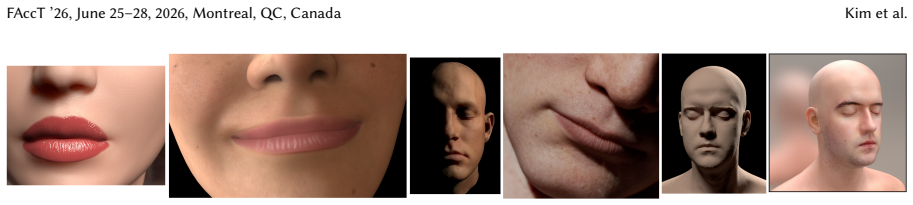
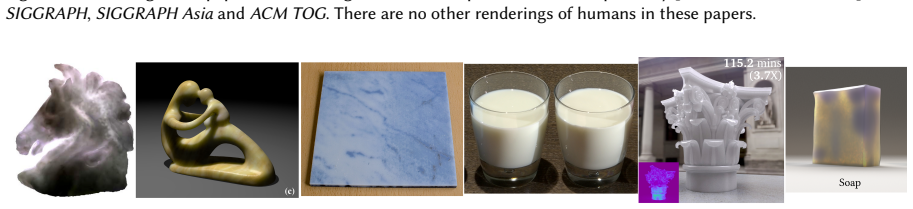
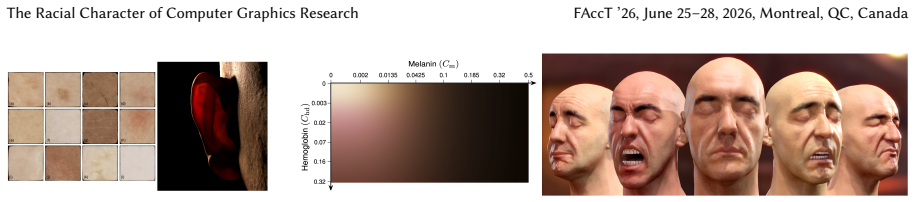
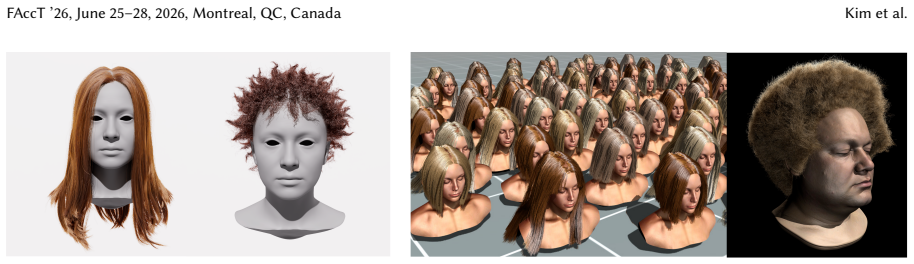
Computer graphics algorithms for human skin and hair are formulated for white skin and straight hair, not as generic models.
A machine-rendered reading of the paper's core claim, the machinery that carries it, and where it could break.
Core claim
A systematic review of SIGGRAPH and ACM Transactions on Graphics papers confirms that algorithms claiming generic applicability to human skin are designed for high-albedo translucent materials typical of white skin, and those claiming generic applicability to human hair are designed for rods, wires, and threads analogous to straight hair. The review identifies conceptual binarization in which white skin math serves as the substrate for all skin, and notes that the first examples of computer-generated Type 4 hair appear only after 2020. The paper introduces the labels McDaniels Methods for algorithms that reinforce racial hierarchy under a false cover of diversity and Durald Methods for algor
What carries the argument
The systematic review of skin and hair rendering papers in SIGGRAPH and ACM Transactions on Graphics that uncovers binarization treating white skin math as substrate for all skin, together with the new conceptual labels McDaniels Methods and Durald Methods.
If this is right
- Skin rendering research must develop models for diverse albedo and translucency values without using white skin math as the base case.
- Hair simulation research must incorporate explicit support for curly and coily textures rather than treating them as later extensions.
- Algorithms should be evaluated for embedded racial assumptions instead of being treated as universal by default.
- Future work should prioritize Durald Methods that involve direct collaboration with the communities being depicted.
Where Pith is reading between the lines
- The same pattern of default assumptions may appear in downstream tools such as AI image generators trained on graphics outputs.
- Repeating the review on papers published after 2020 would test whether the identified patterns have shifted.
- Parallel systematic reviews in adjacent fields such as computer vision could reveal comparable default assumptions about human appearance.
Load-bearing premise
The authors' reading of algorithm intent in the selected papers accurately reflects original design goals and the reviewed set represents the broader field without selection effects.
What would settle it
A pre-2020 SIGGRAPH or ACM Transactions on Graphics paper that presents a skin rendering algorithm explicitly formulated for low-albedo high-melanin materials without deriving from white skin physics, or a hair algorithm for Type 4 hair before 2020.
Figures



read the original abstract
Computer graphics algorithms for generating photorealistic imagery are widely perceived to be universal, and capable of conjuring anything that a filmmaker or game designer can imagine. However, recent works have suggested that 3D algorithms for depicting synthetic humans are far from generic, and instead favor historically hegemonic characteristics. We present the first systematic review of human depiction in the top computer graphics conference and the journal of record (SIGGRAPH and ACM Transactions on Graphics) that confirms previous hypotheses. Algorithms that claim to be generically rendering "human skin'' are in fact imagined and formulated for translucent, "high albedo" materials such as white skin. Algorithms claiming to apply generically to "human hair" are formulated for "rods", "wires" and "threads" which are analogous to straight hair. Our analysis reveals conceptual binarization, where algorithms for white skin are treated as computational substrate for "all" skin, imposing a hierarchical assumption that all skin descends from the math and physics of white skin. Hair algorithms follow a similar historical pattern, with the first examples of computer-generated Type 4 hair only appearing after the murder of George Floyd in 2020. We offer a new conceptual label, McDaniels Methods, for characterizing and critiquing computer graphics algorithms that reinforce racial hierarchy under a false cover of diversity. We also offer an inverse label, Durald Methods, for algorithms that were closely co-designed with the people being depicted. Our analysis points the way towards several neglected avenues for future research.
Editorial analysis
A structured set of objections, weighed in public.
Referee Report
Summary. The paper presents what it describes as the first systematic review of algorithms for depicting synthetic humans in SIGGRAPH and ACM Transactions on Graphics. It argues that skin-rendering methods claiming generality are in fact formulated for high-albedo, translucent materials characteristic of white skin, while hair-rendering methods are formulated for rod-, wire-, and thread-like structures analogous to straight hair. The analysis identifies a pattern of 'conceptual binarization' in which white-skin mathematics is treated as the computational substrate for all skin, and reports that the first examples of Type 4 hair appear only after 2020. The authors introduce two new labels—'McDaniels Methods' for algorithms that reinforce racial hierarchy under a false cover of diversity and 'Durald Methods' for algorithms co-designed with the people depicted—and conclude by identifying neglected research directions.
Significance. If the review methodology were shown to be exhaustive and the interpretive claims were grounded in explicit technical counter-examples from the source papers, the work would draw attention to an under-examined dimension of graphics research and could usefully prompt re-examination of parameter choices and example selection in rendering literature. The introduction of named categories for critiquing implicit assumptions is a novel framing device, though its utility depends on whether the categories can be applied reproducibly by other readers.
major comments (4)
- [Abstract] Abstract and opening paragraphs: the claim to have performed 'the first systematic review' is not accompanied by any statement of search protocol, database queries, inclusion/exclusion criteria, total number of papers examined, or inter-rater reliability measures. Without these details the representativeness of the selected SIGGRAPH/TOG corpus cannot be evaluated and the central empirical claim remains unsupported.
- [Abstract] Abstract, paragraph on skin and hair algorithms: the inference that algorithms 'claiming to be generically rendering human skin' were 'imagined and formulated for' white skin rests on the authors' reading of parameter choices and early examples rather than on any demonstration that the original papers stated or assumed racial specificity. This interpretive step is load-bearing for the binarization thesis yet is presented without direct quotation or technical counter-example from the reviewed works.
- [Abstract] Abstract, hair timeline claim: the assertion that 'the first examples of computer-generated Type 4 hair only appearing after the murder of George Floyd in 2020' requires a specific citation list or table showing the publication dates and hair-type coverage of all reviewed hair papers; absent such evidence the chronological claim cannot be verified and risks post-hoc framing.
- [Abstract] Abstract, new conceptual labels: 'McDaniels Methods' and 'Durald Methods' are defined by applying the authors' own interpretive categories back to the same corpus from which the categories were derived. This circular construction is acknowledged in the reader's circularity score and weakens the analytical framework unless an independent validation set or external coding protocol is supplied.
minor comments (1)
- [Abstract] The abstract uses scare quotes around 'human skin' and 'human hair' without first defining the precise technical scope the authors attribute to those phrases in the source literature.
Simulated Author's Rebuttal
We thank the referee for their detailed and constructive comments. We address each major comment point by point below, indicating where we will revise the manuscript.
read point-by-point responses
-
Referee: [Abstract] Abstract and opening paragraphs: the claim to have performed 'the first systematic review' is not accompanied by any statement of search protocol, database queries, inclusion/exclusion criteria, total number of papers examined, or inter-rater reliability measures. Without these details the representativeness of the selected SIGGRAPH/TOG corpus cannot be evaluated and the central empirical claim remains unsupported.
Authors: We agree that the abstract and opening paragraphs should explicitly state the search protocol, database queries, inclusion/exclusion criteria, total number of papers examined, and any reliability measures to support the systematic review claim. The full manuscript describes the corpus in the methods section, but we will revise the abstract and introduction to include these details. revision: yes
-
Referee: [Abstract] Abstract, paragraph on skin and hair algorithms: the inference that algorithms 'claiming to be generically rendering human skin' were 'imagined and formulated for' white skin rests on the authors' reading of parameter choices and early examples rather than on any demonstration that the original papers stated or assumed racial specificity. This interpretive step is load-bearing for the binarization thesis yet is presented without direct quotation or technical counter-example from the reviewed works.
Authors: The inference draws from the specific parameter ranges (e.g., albedo and translucency values) and example imagery in the source papers, which align with high-albedo light skin characteristics. We will add explicit technical counter-examples and direct quotations from the reviewed works to better ground this analysis in the revised manuscript. revision: partial
-
Referee: [Abstract] Abstract, hair timeline claim: the assertion that 'the first examples of computer-generated Type 4 hair only appearing after the murder of George Floyd in 2020' requires a specific citation list or table showing the publication dates and hair-type coverage of all reviewed hair papers; absent such evidence the chronological claim cannot be verified and risks post-hoc framing.
Authors: We agree that a table or list of reviewed hair papers with publication dates and hair-type coverage is needed to verify the timeline. We will include this in the revised manuscript. revision: yes
-
Referee: [Abstract] Abstract, new conceptual labels: 'McDaniels Methods' and 'Durald Methods' are defined by applying the authors' own interpretive categories back to the same corpus from which the categories were derived. This circular construction is acknowledged in the reader's circularity score and weakens the analytical framework unless an independent validation set or external coding protocol is supplied.
Authors: The labels are conceptual tools derived from observed patterns to enable critique of assumptions in the literature. We will revise the definitions section to clarify their scope and provide guidance for application beyond the current corpus. revision: partial
Circularity Check
No significant circularity; interpretive review with independent external inputs.
full rationale
This is a literature review paper whose claims rest on close reading of external SIGGRAPH/TOG publications rather than any derivation, equation, fitted parameter, or self-referential prediction. The new labels McDaniels Methods and Durald Methods are outputs of the analysis, not inputs that force the classification of the reviewed papers. No self-citation chains, uniqueness theorems, or ansatzes appear in the abstract or described structure. The central interpretive steps (algorithm scope, historical timing, binarization) are presented as conclusions drawn from the cited corpus, not as tautologies that reduce to the paper's own definitions by construction. This meets the default expectation of a non-circular analysis.
Axiom & Free-Parameter Ledger
axioms (1)
- domain assumption Algorithms described as generic for human skin or hair are intended to apply universally but instead encode assumptions favoring historically hegemonic traits.
invented entities (2)
-
McDaniels Methods
no independent evidence
-
Durald Methods
no independent evidence
Reference graph
Works this paper leans on
-
[1]
2006.Artificial knowing: Gender and the thinking machine
Alison Adam. 2006.Artificial knowing: Gender and the thinking machine. Routledge
2006
-
[2]
Abby Aguirre. 2020. Simone Biles on Overcoming Abuse, the Postponed Olympics, and Training During a Pandemic.Vogue(2020)
2020
-
[3]
Matt Aitken, Greg Butler, Dan Lemmon, Eric Saindon, Dana Peters, and Guy Williams. 2004. The Lord of the Rings: the visual effects that brought middle earth to the screen. InACM SIGGRAPH Courses. 11–es
2004
-
[4]
O Alexander, M Rogers, W Lambeth, J Chiang, W Ma, C Wang, and P Debevec. 2009. The digital emily project: Achieving a photoreal digital actor.IEEE Computer Graphics and Applications30 (2009)
2009
-
[5]
Carlos Aliaga, Mengqi Xia, Hao Xie, Adrian Jarabo, Gustav Braun, and Christophe Hery. 2023. A Hyperspectral Space of Skin Tones for Inverse Rendering of Biophysical Skin Properties.Computer Graphics Forum(2023). doi:10.1111/cgf.14887
-
[6]
1949.Painting with light
John Alton. 1949.Painting with light. Macmillan. The Racial Character of Computer Graphics Research FAccT ’26, June 25–28, 2026, Montreal, QC, Canada
1949
-
[7]
Shivangi Aneja, Justus Thies, Angela Dai, and Matthias Nießner. 2023. Clipface: Text-guided editing of textured 3d morphable models. InACM SIGGRAPH 2023 Conference Proceedings. 1–11
2023
-
[8]
Ken-ichi Anjyo, Yoshiaki Usami, and Tsuneya Kurihara. 1992. A simple method for extracting the natural beauty of hair. InProceedings of SIGGRAPH. 111–120
1992
-
[9]
Jonghee Back, Binh-Son Hua, Toshiya Hachisuka, and Bochang Moon. 2022. Self-supervised post-correction for Monte Carlo denoising. InACM SIGGRAPH 2022 Conference Proceedings. 1–8
2022
-
[10]
Kelian Baert, Shrisha Bharadwaj, Fabien Castan, Benoit Maujean, Marc Christie, Victoria Abrevaya, and Adnane Boukhayma. 2024. SPARK: Self-supervised Personalized Real-time Monocular Face Capture. InSIGGRAPH Asia 2024 Conference Papers(Tokyo, Japan)(SA ’24). Association for Computing Machinery, New York, NY, USA, Article 113, 12 pages. doi:10.1145/3680528.3687704
-
[11]
Shaojie Bai, Te-Li Wang, Chenghui Li, Akshay Venkatesh, Tomas Simon, Chen Cao, Gabriel Schwartz, Jason Saragih, Yaser Sheikh, and Shih-En Wei. 2024. Universal Facial Encoding of Codec Avatars from VR Headsets.ACM Trans. Graph. (TOG)43, 4 (2024), 1–22
2024
-
[12]
Arthur E Balbao and Marcelo Walter. 2022. A Biologically Inspired Hair Aging Model.ACM Trans. Graph. (TOG)41, 6 (2022), 1–9
2022
-
[13]
Brent Bambury. 2025. Realistic animation of Black hair has lagged far behind other hair types for years. This artist has a plan for how to fix that.CBC, Day 6(2025)
2025
-
[14]
David C Banks. 1994. Illumination in diverse codimensions. InProceedings of the 21st annual conference on Computer graphics and interactive techniques. 327–334
1994
-
[15]
Linchao Bao, Xiangkai Lin, Yajing Chen, Haoxian Zhang, Sheng Wang, Xuefei Zhe, Di Kang, Haozhi Huang, Xinwei Jiang, Jue Wang, et al. 2021. High-fidelity 3d digital human head creation from rgb-d selfies.ACM Trans. Graph. (TOG)41, 1 (2021), 1–21
2021
-
[16]
David Baraff and Andrew Witkin. 1998. Large steps in cloth simulation. InProceedings of SIGGRAPH. 43–54
1998
-
[17]
Rasmus Barringer and Tomas Akenine-Möller. 2013. A4: asynchronous adaptive anti-aliasing using shared memory.ACM Trans. Graph. (TOG)32, 4 (2013), 1–10
2013
-
[18]
Rasmus Barringer, Carl Johan Gribel, and Tomas Akenine-Möller. 2012. High-quality curve rendering using line sampled visibility. ACM Trans. Graph. (TOG)31, 6 (2012), 1–10
2012
-
[19]
Christopher Batty, Andres Uribe, Basile Audoly, and Eitan Grinspun. 2012. Discrete viscous sheets.ACM Trans. Graph. (TOG)31, 4 (2012), 1–7
2012
-
[20]
Thabo Beeler, Bernd Bickel, Paul Beardsley, Bob Sumner, and Markus Gross. 2010. High-quality single-shot capture of facial geometry. ACM Trans. Graph.29, 4 (2010), 1–9
2010
-
[21]
Thabo Beeler, Bernd Bickel, Gioacchino Noris, Paul Beardsley, Steve Marschner, Robert W Sumner, and Markus Gross. 2012. Coupled 3D reconstruction of sparse facial hair and skin.ACM Trans. Graph. (ToG)31, 4 (2012), 1–10
2012
-
[22]
Thabo Beeler and Derek Bradley. 2014. Rigid stabilization of facial expressions.ACM Trans. Graph. (TOG)33, 4 (2014), 1–9
2014
-
[23]
Thabo Beeler, Fabian Hahn, Derek Bradley, Bernd Bickel, Paul A Beardsley, Craig Gotsman, Robert W Sumner, and Markus H Gross
-
[24]
Graph.30, 4 (2011), 75
High-quality passive facial performance capture using anchor frames.ACM Trans. Graph.30, 4 (2011), 75
2011
-
[25]
2019.Race After Technology: Abolitionist Tools for the New Jim Code
Ruha Benjamin. 2019.Race After Technology: Abolitionist Tools for the New Jim Code. John Wiley & Sons
2019
-
[26]
Miklós Bergou, Basile Audoly, Etienne Vouga, Max Wardetzky, and Eitan Grinspun. 2010. Discrete viscous threads.ACM Trans. Graph. (TOG)29, 4 (2010), 1–10
2010
-
[27]
Miklós Bergou, Max Wardetzky, Stephen Robinson, Basile Audoly, and Eitan Grinspun. 2008. Discrete Elastic Rods.ACM Trans. Graph. 27, 3 (aug 2008), 63:1–63:12
2008
-
[28]
Amit Bermano, Thabo Beeler, Yeara Kozlov, Derek Bradley, Bernd Bickel, and Markus Gross. 2015. Detailed spatio-temporal recon- struction of eyelids.ACM Trans. Graph. (TOG)34, 4 (2015), 1–11
2015
-
[29]
Amit Bermano, Philipp Brüschweiler, Anselm Grundhöfer, Daisuke Iwai, Bernd Bickel, and Markus Gross. 2013. Augmenting physical avatars using projector-based illumination.ACM Trans. Graph. (TOG)32, 6 (2013), 1–10
2013
-
[30]
Amit H Bermano, Derek Bradley, Thabo Beeler, Fabio Zund, Derek Nowrouzezahrai, Ilya Baran, Olga Sorkine-Hornung, Hanspeter Pfister, Robert W Sumner, Bernd Bickel, et al. 2014. Facial performance enhancement using dynamic shape space analysis.ACM Trans. Graph. (TOG)33, 2 (2014), 1–12
2014
-
[31]
Florence Bertails, Basile Audoly, Marie-Paule Cani, Bernard Querleux, Frédéric Leroy, and Jean-Luc Lévêque. 2006. Super-helices for predicting the dynamics of natural hair.ACM Trans. Graph.25, 3 (jul 2006), 1180–1187
2006
-
[32]
Florence Bertails, Basile Audoly, Bernard Querleux, Frédéric Leroy, Jean-Luc Lévêque, and Marie-Paule Cani. 2005. Predicting natural hair shapes by solving the statics of flexible rods. InEurographics short papers. Eurographics
2005
-
[33]
Florence Bertails-Descoubes, Florent Cadoux, Gilles Daviet, and Vincent Acary. 2011. A nonsmooth Newton solver for capturing exact Coulomb friction in fiber assemblies.ACM Trans. Graph. (TOG)30, 1 (2011), 1–14
2011
-
[34]
Shrisha Bharadwaj, Yufeng Zheng, Otmar Hilliges, Michael J Black, and Victoria Fernández Abrevaya. 2023. FLARE: Fast Learning of Animatable and Relightable Mesh Avatars.ACM Trans. Graph.42, 6 (2023), 204
2023
-
[35]
Gaurav Bhokare, Eisen Montalvo, Elie Diaz, and Cem Yuksel. 2024. Real-time hair rendering with hair meshes. InProceedings of SIGGRAPH. 1–10. FAccT ’26, June 25–28, 2026, Montreal, QC, Canada Kim et al
2024
-
[36]
Sai Bi, Stephen Lombardi, Shunsuke Saito, Tomas Simon, Shih-En Wei, Kevyn Mcphail, Ravi Ramamoorthi, Yaser Sheikh, and Jason Saragih. 2021. Deep relightable appearance models for animatable faces.ACM Trans. Graph. (ToG)40, 4 (2021), 1–15
2021
-
[37]
Bernd Bickel, Mario Botsch, Roland Angst, Wojciech Matusik, Miguel Otaduy, Hanspeter Pfister, and Markus Gross. 2007. Multi-scale capture of facial geometry and motion.ACM Trans. Graph. (TOG)26, 3 (2007), 33–es
2007
-
[38]
Bernd Bickel, Peter Kaufmann, Mélina Skouras, Bernhard Thomaszewski, Derek Bradley, Thabo Beeler, Phil Jackson, Steve Marschner, Wojciech Matusik, and Markus Gross. 2012. Physical face cloning.ACM Trans. Graph. (TOG)31, 4 (2012), 1–10
2012
-
[39]
Abeba Birhane, Pratyusha Kalluri, Dallas Card, William Agnew, Ravit Dotan, and Michelle Bao. 2022. The values encoded in machine learning research. InProceedings of the 2022 ACM conference on fairness, accountability, and transparency. 173–184
2022
-
[40]
James F Blinn. 1982. Light reflection functions for simulation of clouds and dusty surfaces.Proceedings of SIGGRAPH16, 3 (1982), 21–29
1982
-
[41]
Eduardo Bonilla-Silva. 2004. From bi-racial to tri-racial: Towards a new system of racial stratification in the USA.Ethnic and racial studies27, 6 (2004), 931–950
2004
-
[42]
2017.Racism without Racists: Color-Blind Racism and the Persistence of Racial Inequality in America(6th ed.)
Eduardo Bonilla-Silva. 2017.Racism without Racists: Color-Blind Racism and the Persistence of Racial Inequality in America(6th ed.). Rowman & Littlefield, Lanham, MD
2017
-
[43]
2000.Sorting things out: Classification and its consequences
Geoffrey C Bowker and Susan Leigh Star. 2000.Sorting things out: Classification and its consequences. MIT press
2000
-
[44]
Derek Bradley, Wolfgang Heidrich, Tiberiu Popa, and Alla Sheffer. 2010. High resolution passive facial performance capture.ACM Trans. Graph.29, 4 (2010), 41
2010
-
[45]
Virginia Braun and Victoria Clarke. 2006. Using thematic analysis in psychology.Qualitative research in psychology3, 2 (2006), 77–101
2006
-
[46]
Alan Brunton, Can Ates Arikan, Tejas Madan Tanksale, and Philipp Urban. 2018. 3D printing spatially varying color and translucency. ACM Trans. Graph. (TOG)37, 4 (2018), 1–13
2018
-
[47]
Marcel C Buehler, Gengyan Li, Erroll Wood, Leonhard Helminger, Xu Chen, Tanmay Shah, Daoye Wang, Stephan Garbin, Sergio Orts-Escolano, Otmar Hilliges, et al. 2024. Cafca: High-quality novel view synthesis of expressive faces from casual few-shot captures. InSIGGRAPH Asia 2024 Conference Papers. 1–12
2024
-
[48]
Joy Buolamwini and Timnit Gebru. 2018. Gender shades: Intersectional accuracy disparities in commercial gender classification. In Conference on fairness, accountability and transparency. PMLR, 77–91
2018
-
[49]
Brent Burley, David Adler, Matt Jen-Yuan Chiang, Hank Driskill, Ralf Habel, Patrick Kelly, Peter Kutz, Yining Karl Li, and Daniel Teece
-
[50]
The design and evolution of disney’s hyperion renderer.ACM Trans. Graph. (TOG)37, 3 (2018), 1–22
2018
-
[51]
Chen Cao, Vasu Agrawal, Fernando De La Torre, Lele Chen, Jason Saragih, Tomas Simon, and Yaser Sheikh. 2021. Real-time 3D neural facial animation from binocular video.ACM Trans. Graph. (TOG)40, 4 (2021), 1–17
2021
-
[52]
Chen Cao, Derek Bradley, Kun Zhou, and Thabo Beeler. 2015. Real-time high-fidelity facial performance capture.ACM Trans. Graph. (ToG)34, 4 (2015), 1–9
2015
-
[53]
Chen Cao, Menglei Chai, Oliver Woodford, and Linjie Luo. 2018. Stabilized real-time face tracking via a learned dynamic rigidity prior. ACM Trans. Graph. (TOG)37, 6 (2018), 1–11
2018
-
[54]
Chen Cao, Tomas Simon, Jin Kyu Kim, Gabe Schwartz, Michael Zollhoefer, Shunsuke Saito, Stephen Lombardi, Shih-En Wei, Danielle Belko, Shoou-I Yu, et al. 2022. Authentic volumetric avatars from a phone scan.ACM Trans. Graph. (TOG)41, 4 (2022), 1–19
2022
-
[55]
Chen Cao, Hongzhi Wu, Yanlin Weng, Tianjia Shao, and Kun Zhou. 2016. Real-time facial animation with image-based dynamic avatars. ACM Trans. Graph.35, 4 (2016)
2016
-
[56]
Edoardo Carra and Fabio Pellacini. 2019. SceneGit: a practical system for diffing and merging 3D environments.ACM Trans. Graph. (TOG)38, 6 (2019), 1–15
2019
-
[57]
Romain Casati and Florence Bertails-Descoubes. 2013. Super space clothoids.ACM Trans. Graph. (TOG)32, 4 (2013), 1–12
2013
-
[58]
Menglei Chai, Linjie Luo, Kalyan Sunkavalli, Nathan Carr, Sunil Hadap, and Kun Zhou. 2015. High-quality hair modeling from a single portrait photo.ACM Trans. Graph.34, 6 (2015), 204–1
2015
-
[59]
Menglei Chai, Tianjia Shao, Hongzhi Wu, Yanlin Weng, and Kun Zhou. 2016. AutoHair: fully automatic hair modeling from a single image.ACM Trans. Graph., Article 116 (July 2016), 12 pages
2016
-
[60]
Menglei Chai, Lvdi Wang, Yanlin Weng, Yizhou Yu, Baining Guo, and Kun Zhou. 2012. Single-view hair modeling for portrait manipulation.ACM Trans. Graph. (TOG)31, 4 (2012), 1–8
2012
-
[61]
Menglei Chai, Changxi Zheng, and Kun Zhou. 2014. A reduced model for interactive hairs.ACM Trans. Graph. (TOG)33, 4 (2014), 1–11
2014
-
[62]
Prashanth Chandran, Sebastian Winberg, Gaspard Zoss, Jérémy Riviere, Markus Gross, Paulo Gotardo, and Derek Bradley. 2021. Rendering with style: combining traditional and neural approaches for high-quality face rendering.ACM Trans. Graph. (ToG)40, 6 (2021), 1–14
2021
-
[63]
Tenn F Chen, Gladimir VG Baranoski, Bradley W Kimmel, and Erik Miranda. 2015. Hyperspectral modeling of skin appearance.ACM Trans. Graph. (TOG)34, 3 (2015), 1–14
2015
-
[64]
Xiao-Song Chen, Chen-Feng Li, Geng-Chen Cao, Yun-Tao Jiang, and Shi-Min Hu. 2020. A moving least square reproducing kernel particle method for unified multiphase continuum simulation.ACM Trans. Graph. (TOG)39, 6 (2020), 1–15. The Racial Character of Computer Graphics Research FAccT ’26, June 25–28, 2026, Montreal, QC, Canada
2020
-
[65]
Yufan Chen, Lizhen Wang, Qijing Li, Hongjiang Xiao, Shengping Zhang, Hongxun Yao, and Yebin Liu. 2024. Monogaussianavatar: Monocular gaussian point-based head avatar. InACM SIGGRAPH 2024 Conference Papers. 1–9
2024
-
[66]
Per Christensen, Julian Fong, Jonathan Shade, Wayne Wooten, Brenden Schubert, Andrew Kensler, Stephen Friedman, Charlie Kilpatrick, Cliff Ramshaw, Marc Bannister, et al. 2018. Renderman: An advanced path-tracing architecture for movie rendering.ACM Trans. Graph. (TOG)37, 3 (2018), 1–21
2018
-
[67]
Nelson S-H Chu and Chiew-Lan Tai. 2005. Moxi: real-time ink dispersion in absorbent paper.ACM Trans. Graph. (TOG)24, 3 (2005), 504–511
2005
-
[68]
Robert L Cook, John Halstead, Maxwell Planck, and David Ryu. 2007. Stochastic simplification of aggregate detail.ACM Trans. Graph. (TOG)26, 3 (2007), 79–es
2007
-
[69]
2019.Thick: And other essays
Tressie McMillan Cottom. 2019.Thick: And other essays. The New Press
2019
-
[70]
Kate Crawford and Trevor Paglen. 2021. Excavating AI: The politics of images in machine learning training sets.Ai & Society36, 4 (2021), 1105–1116
2021
-
[71]
2019.Seeing race again: Countering colorblindness across the disciplines
Kimberlé Williams Crenshaw, Luke Charles Harris, Daniel Martinez HoSang, and George Lipsitz. 2019.Seeing race again: Countering colorblindness across the disciplines. Univ of California Press
2019
-
[72]
Octave Crespel, Emile Hohnadel, Thibaut Métivet, and Florence Bertails-Descoubes. 2024. Contact detection between curved fibres: high order makes a difference. InProceedings of SIGGRAPH
2024
-
[73]
2014.Hair Type Chart: How to Find Your Curl Pattern with Pictures
CurlCentric. 2014.Hair Type Chart: How to Find Your Curl Pattern with Pictures. https://www.curlcentric.com/hair-typing-system/
2014
-
[74]
Darke, Isaac Olander, and Theodore Kim
A.M. Darke, Isaac Olander, and Theodore Kim. 2024. More Than Killmonger Locs: A Style Guide for Black Hair (in Computer Graphics). InACM SIGGRAPH Courses(Denver, CO, USA)(SIGGRAPH Courses). Article 18, 251 pages
2024
-
[75]
Gilles Daviet. 2020. Simple and scalable frictional contacts for thin nodal objects.ACM Trans. Graph.39, 4 (2020), 61–1
2020
-
[76]
Gilles Daviet. 2023. Interactive Hair Simulation on the GPU using ADMM. InProceeindgs of SIGGRAPH. 1–11
2023
-
[77]
Gilles Daviet, Florence Bertails-Descoubes, and Laurence Boissieux. 2011. A hybrid iterative solver for robustly capturing coulomb friction in hair dynamics.ACM Trans. Graph.30, 6 (2011), 1–12
2011
-
[78]
Edilson de Aguiar, Carsten Stoll, Christian Theobalt, Naveed Ahmed, Hans-Peter Seidel, and Sebastian Thrun. 2008. Performance capture from sparse multi-view video.ACM Trans. Graph.27, 3 (2008), 1–10
2008
-
[79]
De La Mettrie, D
R. De La Mettrie, D. Saint-Léger, G. Loussouarn, A. Garcel, C. Porter, and A. Langaney. 2007. Shape variability and classification of human hair: a worldwide approach.Human biology79, 3 (2007), 265–281
2007
-
[80]
Paul Debevec, Tim Hawkins, Chris Tchou, Haarm-Pieter Duiker, Westley Sarokin, and Mark Sagar. 2000. Acquiring the reflectance field of a human face. InProceedings of SIGGRAPH. 145–156
2000
discussion (0)
Sign in with ORCID, Apple, or X to comment. Anyone can read and Pith papers without signing in.