Recognition: 2 theorem links
· Lean TheoremString Solving with Stabilization and Transducers (Technical Report)
Pith reviewed 2026-05-15 03:01 UTC · model grok-4.3
The pith
Generalizing stabilization to transducers handles relational string constraints efficiently by reducing costly length operations.
A machine-rendered reading of the paper's core claim, the machinery that carries it, and where it could break.
Core claim
The stabilization method is generalized to finite-state transducers for relational constraints, with reductions that lessen the reliance on concatenation elimination for length constraints, supplemented by heuristics that improve solving efficiency in practice.
What carries the argument
Finite-state transducers integrated into the stabilization-based automata approach for modeling relational string operations, paired with length constraint reductions that avoid full concatenation elimination.
If this is right
- Relational operations such as replaceAll become practically solvable in automata-based string solvers.
- Fewer calls to concatenation elimination lead to better scaling on large or complex length constraints.
- Heuristics yield measurable reductions in runtime on standard benchmark suites.
- The solver now covers more instances with relational constraints than previous tools.
Where Pith is reading between the lines
- The transducer approach could be extended to additional string operations by composing more complex transducers without changing the core stabilization loop.
- Similar length reductions might apply to other automata-based solvers outside the stabilization family.
- Performance gains on relational benchmarks suggest that transducer encodings could become a standard building block for SMT string theories.
- Composing multiple transducers before stabilization might further cut the cost of relational chains.
Load-bearing premise
The transducer encodings and length constraint reductions preserve soundness and completeness while the heuristics do not miss solutions on realistic inputs.
What would settle it
A concrete relational string constraint instance on which the new solver returns an incorrect satisfiability result or solution that a sound reference solver would refute.
Figures



read the original abstract
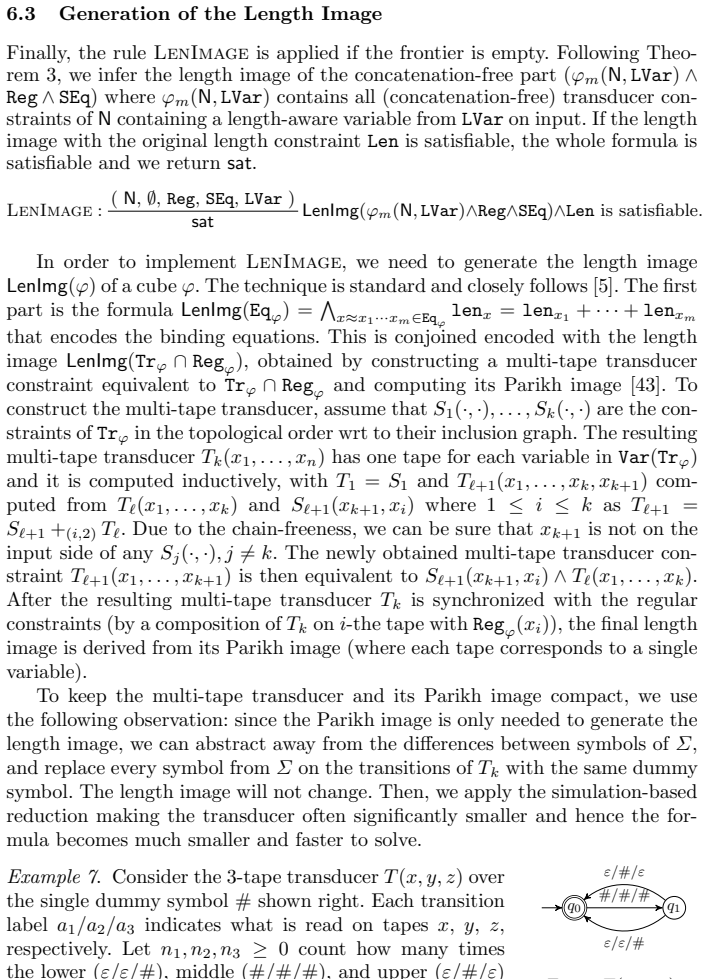
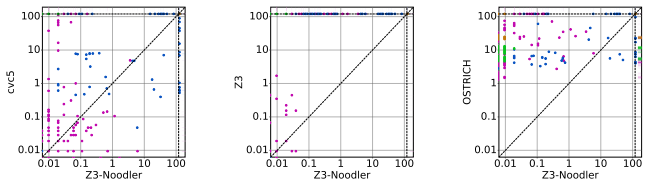
We generalize an efficient automata-based approach to string constraint solving, the stabilization-based method behind the solver Z3-Noodler, to support relational constraints represented by finite-state transducers (useful, for example, for modeling replaceAll constraints). We focus on an efficient treatment of length constraints by reducing the need for expensive concatenation elimination, which is a major bottleneck in automata-based string solving. We also propose powerful heuristics that significantly improve performance in practice. Implemented on top of Z3-Noodler, our method vastly outperforms existing solvers on benchmarks with relational constraints. It solves more instances and runs orders of magnitude faster.
Editorial analysis
A structured set of objections, weighed in public.
Referee Report
Summary. The paper generalizes the stabilization-based string constraint solving technique from Z3-Noodler to handle relational constraints encoded by finite-state transducers. It reduces reliance on expensive concatenation elimination through specialized length-constraint handling and introduces new heuristics, claiming that the resulting implementation solves more instances and runs orders of magnitude faster than existing solvers on benchmarks containing relational constraints.
Significance. If the transducer reductions and heuristics preserve soundness and completeness, the work would constitute a meaningful practical advance in automata-based string solving by extending an already efficient stabilization framework to a broader class of constraints (e.g., replaceAll) while mitigating a known bottleneck. The direct implementation on top of Z3-Noodler and the focus on length constraints are concrete strengths that could translate into improved performance for verification and program-analysis applications.
major comments (2)
- [Abstract] Abstract and the description of the transducer encoding: the central performance claim rests on the assertion that the new transducer handling and length-constraint reductions preserve all solutions. No soundness or completeness argument is supplied for the combined system; if the length reductions implicitly rely on bounds that fail for certain transducer compositions, or if the heuristics discard feasible paths, the solver could return incorrect unsat answers. This directly undermines the claim that the method 'vastly outperforms ... while remaining correct.'
- [Length-constraint handling] The section on length-constraint reductions: the paper states that these reductions avoid concatenation elimination, yet provides no formal argument or invariant showing that the reductions are equivalence-preserving when transducers are present. Without such an argument the experimental superiority cannot be interpreted as evidence of a correct algorithm.
minor comments (2)
- [Abstract] The abstract refers to 'powerful heuristics' without naming them or indicating their scope; a brief enumeration in the abstract or introduction would improve readability.
- [Experimental evaluation] Benchmark results are summarized qualitatively ('orders of magnitude faster') but lack any table or figure reference in the provided text; explicit cross-references to experimental tables would strengthen the presentation.
Simulated Author's Rebuttal
We thank the referee for the careful review and for identifying the need to make the soundness arguments more explicit. We address the two major comments point by point below. In both cases we agree that additional formal material is required and will incorporate it in the revision.
read point-by-point responses
-
Referee: [Abstract] Abstract and the description of the transducer encoding: the central performance claim rests on the assertion that the new transducer handling and length-constraint reductions preserve all solutions. No soundness or completeness argument is supplied for the combined system; if the length reductions implicitly rely on bounds that fail for certain transducer compositions, or if the heuristics discard feasible paths, the solver could return incorrect unsat answers. This directly undermines the claim that the method 'vastly outperforms ... while remaining correct.'
Authors: The transducer encoding is realized by synchronous composition of the input transducer with the stabilized automata; because both the original stabilization procedure and the transducer operations are language-preserving, the set of solutions is unchanged. Length bounds are obtained by projecting the length automaton through the same composition, inheriting the tightness guarantees of the base method. The heuristics only reorder reduction steps and never prune feasible paths; any path that would be explored in the unguided algorithm remains reachable. We acknowledge that the manuscript does not contain a self-contained proof of these facts and will add a dedicated subsection (with lemmas) establishing language equivalence and length preservation for the combined system. The abstract will be revised to reference this argument. revision: yes
-
Referee: [Length-constraint handling] The section on length-constraint reductions: the paper states that these reductions avoid concatenation elimination, yet provides no formal argument or invariant showing that the reductions are equivalence-preserving when transducers are present. Without such an argument the experimental superiority cannot be interpreted as evidence of a correct algorithm.
Authors: The length reductions operate on the minimal and maximal lengths extracted from the product automaton obtained after transducer composition. Because the product construction preserves the exact set of strings (and therefore their lengths), the extracted bounds remain equivalent to those of the original constraint. We agree that an explicit invariant relating the reduced length constraints to the original transducer-augmented formula is missing from the current text. In the revision we will insert a short invariant statement together with a proof sketch that the reductions are satisfiability-preserving, relying only on standard properties of automata projection and the stabilization fixed-point. revision: yes
Circularity Check
No significant circularity in the algorithmic derivation
full rationale
The paper describes an extension of the prior stabilization method (from Z3-Noodler) to transducers for relational constraints, plus length-constraint reductions and heuristics. Performance claims rest on empirical benchmark results rather than any mathematical derivation, equation, or prediction that reduces by construction to the paper's own inputs, fitted parameters, or self-referential definitions. The stabilization reference is external prior work; the new transducer encodings, concatenation-elimination reductions, and heuristics are presented as independent additions without load-bearing self-citation chains or ansatzes smuggled via citation. This is a standard implementation paper whose central claims are falsifiable via benchmarks and do not collapse to tautology.
Axiom & Free-Parameter Ledger
axioms (1)
- standard math Standard closure and decision properties of finite automata and transducers
Lean theorems connected to this paper
-
IndisputableMonolith/Foundation/RealityFromDistinction.leanreality_from_one_distinction unclear?
unclearRelation between the paper passage and the cited Recognition theorem.
We generalize an efficient automata-based approach to string constraint solving—the stabilization-based method behind the solver Z3-Noodler—to support relational constraints represented by finite-state transducers
-
IndisputableMonolith/Cost/FunctionalEquation.leanwashburn_uniqueness_aczel unclear?
unclearRelation between the paper passage and the cited Recognition theorem.
The length image LenImg(ψ) of a formula ψ is a LIA formula over variables {len x | x ∈ Var(ψ)} that characterizes the lengths of the solutions of ψ
What do these tags mean?
- matches
- The paper's claim is directly supported by a theorem in the formal canon.
- supports
- The theorem supports part of the paper's argument, but the paper may add assumptions or extra steps.
- extends
- The paper goes beyond the formal theorem; the theorem is a base layer rather than the whole result.
- uses
- The paper appears to rely on the theorem as machinery.
- contradicts
- The paper's claim conflicts with a theorem or certificate in the canon.
- unclear
- Pith found a possible connection, but the passage is too broad, indirect, or ambiguous to say the theorem truly supports the claim.
Reference graph
Works this paper leans on
-
[1]
SMT-COMP QF Strings, 2024 (2024),https://smt-comp.github.io/2024/ results/qf_strings-single-query/,https://smt-comp.github.io/2024/ results/qf_strings-single-query/
work page 2024
-
[2]
SMT-COMP QF Strings, 2025 (2025),https://smt-comp.github.io/2025/ results/qf_slia-single-query/,https://smt-comp.github.io/2025/ results/qf_slia-single-query/
work page 2025
-
[3]
Abdulla, P.A., Atig, M.F., Chen, Y., Diep, B.P., Hol´ ık, L., Rezine, A., R¨ ummer, P.: Flatten and conquer: a framework for efficient analysis of string constraints. In: Co- hen, A., Vechev, M.T. (eds.) Proceedings of the 38th ACM SIGPLAN Conference on Programming Language Design and Implementation, PLDI 2017, Barcelona, Spain, June 18-23, 2017. pp. 602–...
-
[4]
Abdulla, P.A., Atig, M.F., Chen, Y., Hol´ ık, L., Rezine, A., R¨ ummer, P., Sten- man, J.: String constraints for verification. In: Biere, A., Bloem, R. (eds.) Com- puter Aided Verification - 26th International Conference, CAV 2014, Held as Part of the Vienna Summer of Logic, VSL 2014, Vienna, Austria, July 18- 22, 2014. Proceedings. Lecture Notes in Comp...
work page 2014
-
[5]
Springer (2014).https://doi.org/10.1007/978-3-319-08867-9_10,https: //doi.org/10.1007/978-3-319-08867-9_10
-
[6]
In: Chen, Y., Cheng, C., Esparza, J
Abdulla, P.A., Atig, M.F., Diep, B.P., Hol´ ık, L., Jank˚ u, P.: Chain-free string constraints. In: Chen, Y., Cheng, C., Esparza, J. (eds.) Automated Technol- ogy for Verification and Analysis - 17th International Symposium, ATVA 2019, Taipei, Taiwan, October 28-31, 2019, Proceedings. Lecture Notes in Computer Science, vol. 11781, pp. 277–293. Springer (2...
-
[7]
In: 2018 Formal Methods in Computer Aided Design (FMCAD)
Backes, J., Bolignano, P., Cook, B., Dodge, C., Gacek, A., Luckow, K., Rungta, N., Tkachuk, O., Varming, C.: Semantic-based automated reasoning for aws access policies using smt. In: 2018 Formal Methods in Computer Aided Design (FMCAD). pp. 1–9 (2018).https://doi.org/10.23919/FMCAD.2018.8602994
-
[8]
Barbosa, H., Barrett, C., Brain, M., Kremer, G., Lachnitt, H., Mann, M., Mo- hamed, A., Mohamed, M., Niemetz, A., N¨ otzli, A., Ozdemir, A., Preiner, M., 24 Reynolds, A., Sheng, Y., Tinelli, C., Zohar, Y.: cvc5: A versatile and industrial- strength smt solver. In: Fisman, D., Rosu, G. (eds.) Tools and Algorithms for the Construction and Analysis of System...
work page 2022
-
[9]
Barrett, C., Fontaine, P., Tinelli, C.: The Satisfiability Modulo Theories Li- brary (SMT-LIB): Strings.https://smt-lib.org/theories-UnicodeStrings. shtml(2025)
work page 2025
-
[10]
Berzish, M., Day, J.D., Ganesh, V., Kulczynski, M., Manea, F., Mora, F., Nowotka, D.: Towards more efficient methods for solving regular-expression heavy string constraints. Theor. Comput. Sci.943, 50–72 (2023).https://doi.org/10.1016/ j.tcs.2022.12.009,https://doi.org/10.1016/j.tcs.2022.12.009
-
[11]
In: Stewart, D., Weissenbacher, G
Berzish, M., Ganesh, V., Zheng, Y.: Z3str3: A string solver with theory-aware heuristics. In: 2017 Formal Methods in Computer Aided Design (FMCAD). pp. 55–59 (2017).https://doi.org/10.23919/FMCAD.2017.8102241
-
[12]
Berzish, M., Kulczynski, M., Mora, F., Manea, F., Day, J.D., Nowotka, D., Ganesh, V.: An SMT solver for regular expressions and linear arithmetic over string length. In: Silva, A., Leino, K.R.M. (eds.) Computer Aided Verification - 33rd Interna- tional Conference, CAV 2021, Virtual Event, July 20-23, 2021, Proceedings, Part II. Lecture Notes in Computer S...
-
[13]
Berzish, Murphy: Z3str4: A Solver for Theories over Strings. Ph.D. thesis (2021), http://hdl.handle.net/10012/17102
work page 2021
-
[14]
In: Chechik, M., Ka- toen, J.P., Leucker, M
Blahoudek, F., Chen, Y.F., Chocholat´ y, D., Havlena, V., Hol´ ık, L., Leng´ al, O., S´ ıˇ c, J.: Word equations in synergy with regular constraints. In: Chechik, M., Ka- toen, J.P., Leucker, M. (eds.) Formal Methods. pp. 403–423. Springer International Publishing, Cham (2023)
work page 2023
-
[15]
Blahoudek, F., Chen, Y.F., Chocholat´ y, D., Havlena, V., Hol´ ık, L., Leng´ al, O., S´ ıˇ c, J.: Word equations in synergy with regular constraints (extended ver- sion). Constraints (May 2025).https://doi.org/10.1007/s10601-025-09379-w, https://doi.org/10.1007/s10601-025-09379-w
-
[16]
Chen, T., Chen, Y., Hague, M., Lin, A.W., Wu, Z.: What is decidable about string constraints with the replaceall function. Proc. ACM Program. Lang.2(POPL), 3:1–3:29 (2018).https://doi.org/10.1145/3158091,https://doi.org/10.1145/ 3158091
-
[17]
Chen, T., Flores-Lamas, A., Hague, M., Han, Z., Hu, D., Kan, S., Lin, A.W., R¨ ummer, P., Wu, Z.: Solving string constraints with regex-dependent functions through transducers with priorities and variables. Proc. ACM Program. Lang. 6(POPL), 1–31 (2022).https://doi.org/10.1145/3498707,https://doi.org/ 10.1145/3498707
-
[18]
Chen, T., Hague, M., He, J., Hu, D., Lin, A.W., R¨ ummer, P., Wu, Z.: A decision procedure for path feasibility of string manipulating programs with integer data type. In: Hung, D.V., Sokolsky, O. (eds.) Automated Technology for Verification and Analysis - 18th International Symposium, ATVA 2020, Hanoi, Vietnam, Oc- tober 19-23, 2020, Proceedings. Lecture...
-
[19]
Chen, T., Hague, M., Lin, A.W., R¨ ummer, P., Wu, Z.: Decision procedures for path feasibility of string-manipulating programs with complex operations. Proc. ACM Program. Lang.3(POPL), 49:1–49:30 (2019).https://doi.org/10.1145/ 3290362,https://doi.org/10.1145/3290362 25
-
[20]
In: Finkbeiner, B., Kov´ acs, L
Chen, Y.F., Chocholat´ y, D., Havlena, V., Hol´ ık, L., Leng´ al, O., S´ ıˇ c, J.: Z3-Noodler: An automata-based string solver. In: Finkbeiner, B., Kov´ acs, L. (eds.) Tools and Algorithms for the Construction and Analysis of Systems. pp. 24–33. Springer Nature Switzerland, Cham (2024)
work page 2024
-
[21]
Chen, Y.F., Chocholat´ y, D., Havlena, V., Heˇ cko, M., Hol´ ık, L., Leng´ al, O., S´ ıˇ c, J.: Z3-noodler: An automata-based smt string solver.https://github.com/VeriFIT/ z3-noodler(2026)
work page 2026
-
[22]
Chen, Y.F., Chocholat´ y, D., Havlena, V., Hol´ ık, L., Leng´ al, O., S´ ıˇ c, J.: Solv- ing string constraints with lengths by stabilization. Proc. ACM Program. Lang. 7(OOPSLA2) (oct 2023).https://doi.org/10.1145/3622872
-
[23]
In: Tools and Algorithms for the Construction and Analysis of Systems
Chocholat´ y, D., Havlena, V., Hol´ ık, L., Hraniˇ cka, J., Leng´ al, O., S´ ıˇ c, J.: Z3-Noodler 1.3: Shepherding decision procedures for strings with model generation. In: Tools and Algorithms for the Construction and Analysis of Systems. Springer Nature Switzerland, Cham (2025)
work page 2025
-
[24]
org/10.5281/zenodo.19814331,https://doi.org/10.5281/zenodo.19814331
Chocholat´ y, D., Havlena, V., Hol´ ık, L., S´ ıˇ c, J.,ˇSed´ y, M.: Artifact for the cav’26 pa- per ”string solving with stabilization and transducers” (Apr 2026).https://doi. org/10.5281/zenodo.19814331,https://doi.org/10.5281/zenodo.19814331
-
[25]
In: Filiot, E., Jungers, R.M., Potapov, I
Day, J.D., Ehlers, T., Kulczynski, M., Manea, F., Nowotka, D., Poulsen, D.B.: On solving word equations using SAT. In: Filiot, E., Jungers, R.M., Potapov, I. (eds.) Reachability Problems - 13th International Conference, RP 2019, Brus- sels, Belgium, September 11-13, 2019, Proceedings. Lecture Notes in Computer Science, vol. 11674, pp. 93–106. Springer (20...
-
[26]
Day, J.D., Ganesh, V., Grewal, N., Manea, F.: On the expressive power of string constraints. Proc. ACM Program. Lang.7(POPL), 278–308 (2023).https://doi. org/10.1145/3571203,https://doi.org/10.1145/3571203
-
[27]
Eisenhofer, C., Seiser, T., Bjørner, N., Kov´ acs, L.: On solving string equations via powers and parikh images. In: Pozzato, G.L., Uustalu, T. (eds.) Automated Reasoning with Analytic Tableaux and Related Methods. pp. 120–138. Springer Nature Switzerland, Cham (2026)
work page 2026
-
[28]
Fu, X., Li, C.: Modeling regular replacement for string constraint solving. In: Mu˜ noz, C.A. (ed.) Second NASA Formal Methods Symposium - NFM 2010, Wash- ington D.C., USA, April 13-15, 2010. Proceedings. NASA Conference Proceedings, vol. NASA/CP-2010-216215, pp. 67–76 (2010)
work page 2010
-
[29]
Hague, M., Hu, D., Je˙ z, A., Lin, A.W., Markgraf, O., R¨ ummer, P., Wu, Z.: OSTRICH2: Solver for complex string constraints. In: Irfan, A., Kaufmann, D. (eds.) Proceedings of the 25th Conference on Formal Methods in Computer- Aided Design – FMCAD 2025. pp. 145–158. TU Wien Academic Press (2025). https://doi.org/10.34727/2025/isbn.978-3-85448-084-6_21
-
[30]
Hague, M., Je˙ z, A., Lin, A.W., Markgraf, O., R¨ ummer, P.: The power of regular constraint propagation. Proc. ACM Program. Lang.9(OOPSLA2) (Oct 2025). https://doi.org/10.1145/3763165,https://doi.org/10.1145/3763165
-
[31]
In: Chakraborty, S., Jiang, J.H.R
Havlena, V., Hol´ ık, L., Leng´ al, O., S´ ıˇ c, J.: Cooking String-Integer Conversions with Noodles. In: Chakraborty, S., Jiang, J.H.R. (eds.) 27th International Con- ference on Theory and Applications of Satisfiability Testing (SAT 2024). Leib- niz International Proceedings in Informatics (LIPIcs), vol. 305, pp. 14:1–14:19. Schloss Dagstuhl – Leibniz-Ze...
-
[32]
Hol´ ık, L., Jank˚ u, P., Lin, A.W., R¨ ummer, P., Vojnar, T.: String constraints with concatenation and transducers solved efficiently. Proc. ACM Program. Lang. 2(POPL), 4:1–4:32 (2018).https://doi.org/10.1145/3158092,https://doi. org/10.1145/3158092
-
[33]
In: Piskac, R., Rakamari´ c, Z
Jiang, H., Lin, A.W., Markgraf, O., R¨ ummer, P., Stan, D.: HornStr: Invariant synthesis for regular model checking as constrained horn clauses. In: Piskac, R., Rakamari´ c, Z. (eds.) Computer Aided Verification. pp. 200–214. Springer Nature Switzerland, Cham (2025)
work page 2025
-
[34]
Lin, A.W., Barcel´ o, P.: String solving with word equations and transducers: to- wards a logic for analysing mutation XSS. In: Bod´ ık, R., Majumdar, R. (eds.) Pro- ceedings of the 43rd Annual ACM SIGPLAN-SIGACT Symposium on Principles of Programming Languages, POPL 2016, St. Petersburg, FL, USA, January 20 - 22, 2016. pp. 123–136. ACM (2016).https://doi...
-
[35]
Lorentz, R.J.: Creating difficult instances of the post correspondence problem. In: Marsland, T., Frank, I. (eds.) Computers and Games. pp. 214–228. Springer Berlin Heidelberg, Berlin, Heidelberg (2001)
work page 2001
-
[36]
Lotz, K., Goel, A., Dutertre, B., Kiesl-Reiter, B., Kong, S., Majumdar, R., Nowotka, D.: Solving string constraints using sat. In: CAV’23. pp. 187–208. Springer, Cham (2023)
work page 2023
-
[37]
Lotz, K., Kulczynski, M., Nowotka, D.: s2s: An eager SMT solver for strings. In: Irfan, A., Kaufmann, D. (eds.) Proceedings of the 25th Conference on Formal Meth- ods in Computer-Aided Design – FMCAD 2025. pp. 133–138. TU Wien Academic Press (2025).https://doi.org/10.34727/2025/isbn.978-3-85448-084-6_19
-
[38]
Markgraf, O.: 4 different benchmark sets focused around str.replace all (2025), https://github.com/SMT-LIB/benchmark-submission/pull/7, GitHub pull re- quest
work page 2025
-
[39]
Morvan, C.: On rational graphs. In: Tiuryn, J. (ed.) Foundations of Software Sci- ence and Computation Structures. pp. 252–266. Springer Berlin Heidelberg, Berlin, Heidelberg (2000)
work page 2000
-
[40]
de Moura, L.M., Bjørner, N.: Z3: an efficient SMT solver. In: TACAS’08. LNCS, vol. 4963, pp. 337–340. Springer (2008),https://doi.org/10.1007/ 978-3-540-78800-3_24
work page 2008
-
[41]
Myreen, M., Leng´ al, O.: Cav 2026 artifact evaluation vm - ubuntu 24.04.4 lts (Mar 2026).https://doi.org/10.5281/zenodo.19184839,https://doi.org/10.5281/ zenodo.19184839
-
[42]
N¨ otzli, A., Reynolds, A., Barbosa, H., Barrett, C., Tinelli, C.: Even faster conflicts and lazier reductions for string solvers. In: Shoham, S., Vizel, Y. (eds.) Computer Aided Verification. pp. 205–226. Springer International Publishing, Cham (2022)
work page 2022
-
[43]
In: Proceedings of the 14th ACM SIGPLAN International Conference on Certified Programs and Proofs
Omori, A., Minamide, Y.: Further tackling post correspondence problem and proof generation. In: Proceedings of the 14th ACM SIGPLAN International Conference on Certified Programs and Proofs. p. 231–242. CPP ’25, Association for Comput- ing Machinery, New York, NY, USA (2025).https://doi.org/10.1145/3703595. 3705886,https://doi.org/10.1145/3703595.3705886
-
[44]
Parikh, R.J.: On context-free languages. J. ACM13(4), 570–581 (oct 1966).https: //doi.org/10.1145/321356.321364,https://doi.org/10.1145/321356.321364
-
[45]
Preiner, M., Schurr, H.J., Barrett, C., Fontaine, P., Niemetz, A., Tinelli, C.: SMT- LIB release 2025 (non-incremental benchmarks) (Aug 2025).https://doi.org/ 10.5281/zenodo.16740866,https://doi.org/10.5281/zenodo.16740866 27
-
[46]
Rungta, N.: A billion SMT queries a day (invited paper). In: Shoham, S., Vizel, Y. (eds.) Computer Aided Verification - 34th International Conference, CAV 2022, Haifa, Israel, August 7-10, 2022, Proceedings, Part I. Lecture Notes in Com- puter Science, vol. 13371, pp. 3–18. Springer (2022).https://doi.org/10.1007/ 978-3-031-13185-1_1,https://doi.org/10.10...
-
[47]
Stanford, C., Veanes, M., Bjørner, N.: Symbolic boolean derivatives for effi- ciently solving extended regular expression constraints. In: Proceedings of the 42nd ACM SIGPLAN International Conference on Programming Language Design and Implementation. p. 620–635. PLDI 2021, Association for Computing Machin- ery, New York, NY, USA (2021).https://doi.org/10....
-
[48]
Trinh, M., Chu, D., Jaffar, J.: S3: A symbolic string solver for vulnerability de- tection in web applications. In: CCS. pp. 1232–1243. ACM Trans. Comput. Log. (2014)
work page 2014
-
[49]
Trinh, M., Chu, D., Jaffar, J.: Progressive reasoning over recursively-defined strings. In: CAV’16. LNCS, vol. 9779, pp. 218–240. Springer (2016)
work page 2016
-
[50]
Yu, F., Alkhalaf, M., Bultan, T.: Stranger: An automata-based string analysis tool for PHP. In: TACAS’10. LNCS, vol. 6015, pp. 154–157. Springer (2010) 28 A Proof of Lemma 1 Lemma 1.Our definition of a chain-free cube is equivalent to the definition of a positive chain-free cube in [5]. Proof (sketch).The equivalence of the chain-free definition using an ...
work page 2010
discussion (0)
Sign in with ORCID, Apple, or X to comment. Anyone can read and Pith papers without signing in.