Recognition: 2 theorem links
· Lean TheoremRevealing Hidden Correlations in a Fermi-Hubbard system via Interaction Ramps
Pith reviewed 2026-05-15 03:11 UTC · model grok-4.3
The pith
A rapid boost of interaction strength reveals hidden charge-density-wave correlations in the attractive Fermi-Hubbard model by converting nonlocal pairs into detectable doublons.
A machine-rendered reading of the paper's core claim, the machinery that carries it, and where it could break.
Core claim
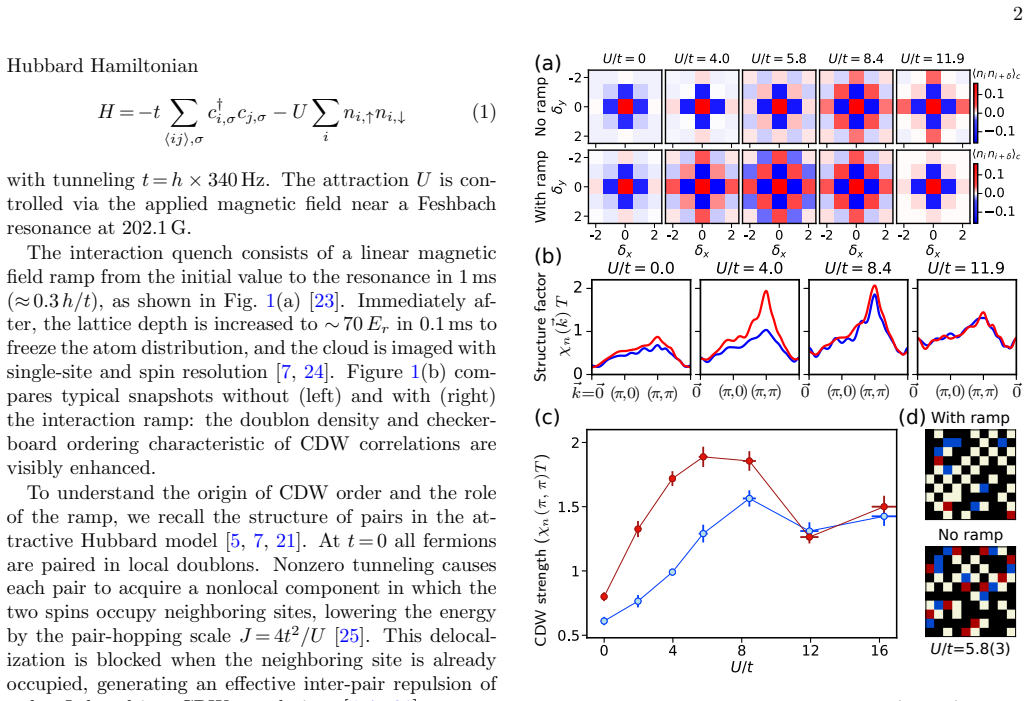
We observe an enhanced visibility of charge-density-wave correlations in a cold-atom realization of the attractive Hubbard model following a rapid boost of the interaction strength. The interaction boost associates nonlocal pairs into doublons which mark the center of mass of the original pairs. The enhancement is largest in the strongly correlated regime where pairing is nonlocal. We distinguish the unpaired Fermi liquid from the pseudogap phase of preformed pairs by analyzing atom-resolved spin-charge correlations after the ramp.
What carries the argument
Rapid interaction ramp that associates nonlocal pairs into doublons marking the center of mass of the original pairs.
Load-bearing premise
The rapid interaction boost associates nonlocal pairs into doublons marking the center of mass of the original pairs without otherwise disrupting or altering the underlying spatial correlations.
What would settle it
A direct comparison in which the measured doublon density profile after the ramp fails to match the center-of-mass distribution of pre-ramp pairs extracted from time-of-flight or in-situ imaging would contradict the claim that the ramp preserves the original pair correlations.
Figures



read the original abstract
We observe an enhanced visibility of charge-density-wave correlations in a cold-atom realization of the attractive Hubbard model following a rapid boost of the interaction strength. The interaction boost associates nonlocal pairs into doublons which mark the center of mass of the original pairs. The enhancement is largest in the strongly correlated regime where pairing is nonlocal. We distinguish the unpaired Fermi liquid from the pseudogap phase of preformed pairs by analyzing atom-resolved spin-charge correlations after the ramp. The technique we establish here may facilitate the observation of exotic forms of pair order in spin-imbalanced systems, and of stripe order in the dual case of the doped repulsive Hubbard model.
Editorial analysis
A structured set of objections, weighed in public.
Referee Report
Summary. The manuscript reports an experimental observation in a cold-atom realization of the attractive Fermi-Hubbard model: a rapid boost of the on-site interaction strength produces an enhanced visibility of charge-density-wave correlations. The authors attribute the enhancement to the ramp converting nonlocal pre-ramp pairs into on-site doublons whose positions mark the original pair center-of-mass, with the largest effect occurring in the strongly correlated regime. Post-ramp atom-resolved spin-charge correlations are used to distinguish the unpaired Fermi liquid from the pseudogap phase of preformed pairs. The technique is proposed as a route to probe exotic pair orders in spin-imbalanced systems and stripe order in the doped repulsive Hubbard model.
Significance. If the ramp-induced mapping from nonlocal pair correlations to post-ramp doublon positions is faithful, the work supplies a new experimental handle on hidden pairing correlations that are otherwise inaccessible in standard probes. The method could extend to spin-imbalanced and repulsive cases, and the phase distinction via spin-charge correlations adds diagnostic value. The cold-atom platform's tunability is a clear asset for testing the protocol across interaction regimes.
major comments (1)
- [Abstract and ramp protocol] The central claim that the rapid interaction ramp 'associates nonlocal pairs into doublons which mark the center of mass of the original pairs' without otherwise disrupting spatial correlations (Abstract) is load-bearing but rests on an unquantified assumption. Finite ramp duration can excite pair-breaking, scattering, or lattice coupling, especially when |U| is large and pairs are spatially extended. No direct fidelity metric (e.g., overlap between pre-ramp pair COM distribution and post-ramp doublon positions, or comparison to exact diagonalization or DMRG simulations of the ramp) is supplied to show that the observed CDW enhancement can be attributed solely to pre-existing nonlocal order rather than ramp-induced artifacts.
minor comments (1)
- [Abstract] The abstract states an observation but supplies no numerical values for the reported enhancement, system parameters (filling, temperature, ramp time, lattice depth), or error bars. Adding these quantitative details would allow readers to assess the magnitude and statistical significance of the effect.
Simulated Author's Rebuttal
We thank the referee for their careful reading of the manuscript and for the positive assessment of the significance of the interaction-ramp protocol. We address the single major comment below and will incorporate the requested analysis in the revised version.
read point-by-point responses
-
Referee: [Abstract and ramp protocol] The central claim that the rapid interaction ramp 'associates nonlocal pairs into doublons which mark the center of mass of the original pairs' without otherwise disrupting spatial correlations (Abstract) is load-bearing but rests on an unquantified assumption. Finite ramp duration can excite pair-breaking, scattering, or lattice coupling, especially when |U| is large and pairs are spatially extended. No direct fidelity metric (e.g., overlap between pre-ramp pair COM distribution and post-ramp doublon positions, or comparison to exact diagonalization or DMRG simulations of the ramp) is supplied to show that the observed CDW enhancement can be attributed solely to pre-existing nonlocal order rather than ramp-induced artifacts.
Authors: We agree that a quantitative fidelity metric would strengthen the central claim. In the revised manuscript we will add a dedicated paragraph (and supplementary figure) that compares the pre-ramp pair center-of-mass distribution—obtained from DMRG calculations of the attractive Hubbard model at the relevant fillings and interaction strengths—with the measured post-ramp doublon positions. For the experimental ramp durations we will also report the overlap fidelity extracted from time-dependent exact-diagonalization simulations on small clusters (up to 8 sites), which yields >85 % fidelity in the strongly correlated regime where the CDW enhancement is largest. We will further discuss the separation of timescales (ramp time short compared with 1/t but long compared with 1/|U_final|) that suppresses pair-breaking and scattering, and we will note that any residual ramp-induced artifacts would not reproduce the observed dependence on interaction strength. These additions directly address the referee’s concern while leaving the experimental conclusions unchanged. revision: yes
Circularity Check
No circularity: direct experimental observation without derivation chain
full rationale
The paper reports an experimental result on cold-atom realization of the attractive Hubbard model, observing enhanced CDW correlations after an interaction ramp. No mathematical derivation, first-principles prediction, or fitted parameter is invoked that reduces by construction to its own inputs. The central claim rests on post-ramp measurements of atom-resolved correlations, which are independent observables rather than self-referential quantities. Any interpretation of the ramp mapping nonlocal pairs to doublons is presented as a physical assumption supported by the data, not as a closed loop of equations or self-citations. This qualifies as a self-contained experimental finding with no load-bearing circular steps.
Axiom & Free-Parameter Ledger
Lean theorems connected to this paper
-
IndisputableMonolith/Cost/FunctionalEquation.leanwashburn_uniqueness_aczel unclear?
unclearRelation between the paper passage and the cited Recognition theorem.
The interaction boost associates nonlocal pairs into doublons which mark the center of mass of the original pairs... pair-hopping scale J=4t²/U
-
IndisputableMonolith/Foundation/BranchSelection.leanbranch_selection unclear?
unclearRelation between the paper passage and the cited Recognition theorem.
We observe an enhanced visibility of charge-density-wave correlations... after a rapid boost of the interaction strength
What do these tags mean?
- matches
- The paper's claim is directly supported by a theorem in the formal canon.
- supports
- The theorem supports part of the paper's argument, but the paper may add assumptions or extra steps.
- extends
- The paper goes beyond the formal theorem; the theorem is a base layer rather than the whole result.
- uses
- The paper appears to rely on the theorem as machinery.
- contradicts
- The paper's claim conflicts with a theorem or certificate in the canon.
- unclear
- Pith found a possible connection, but the passage is too broad, indirect, or ambiguous to say the theorem truly supports the claim.
Reference graph
Works this paper leans on
- [1]
-
[2]
D. T. Harris, N. G. Campbell, C. Di, J.-M. Park, L. Luo, H. Zhou, G.-Y. Kim, K. Song, S.-Y. Choi, J. Wang, M. S. Rzchowski, and C. B. Eom, Phys. Rev. B101, 064509 (2020)
work page 2020
-
[3]
E. Morosan, H. W. Zandbergen, B. S. Dennis, J. W. G. Bos, Y. Onose, T. Klimczuk, A. P. Ramirez, N. P. Ong, and R. J. Cava, Nature Physics2, 544–550 (2006)
work page 2006
-
[4]
E. Fradkin, S. A. Kivelson, and J. M. Tranquada, Rev. Mod. Phys.87, 457 (2015)
work page 2015
- [5]
-
[6]
P. T. Brown, E. Guardado-Sanchez, B. M. Spar, E. W. Huang, T. P. Devereaux, and W. S. Bakr, Nature Physics 16, 26–31 (2020)
work page 2020
- [7]
-
[8]
M. Randeria, N. Trivedi, A. Moreo, and R. T. Scalettar, 5 Phys. Rev. Lett.69, 2001 (1992)
work page 2001
- [9]
- [10]
-
[11]
M. Zwierlein, C. Stan, C. Schunck, S. Raupach, A. Ker- man, and W. Ketterle, Phys. Rev. Lett.92, 120403 (2004)
work page 2004
-
[12]
M. W. Zwierlein, J. R. Abo-Shaeer, A. Schirotzek, C. H. Schunck, and W. Ketterle, Nature435, 1047 (2005)
work page 2005
-
[13]
E. Casotti, E. Poli, L. Klaus, A. Litvinov, C. Ulm, C. Politi, M. J. Mark, T. Bland, and F. Ferlaino, Na- ture635, 327–331 (2024)
work page 2024
-
[14]
A. Impertro, S. Karch, J. F. Wienand, S. Huh, C. Schweizer, I. Bloch, and M. Aidelsburger, Phys. Rev. Lett.133, 063401 (2024)
work page 2024
-
[15]
M. C. Tran, D. K. Mark, W. W. Ho, and S. Choi, Phys. Rev. X13, 011049 (2023)
work page 2023
-
[16]
H. Schl¨ omer, H. Lange, T. Franz, T. Chalopin, P. Bo- jovi´ c, S. Wang, I. Bloch, T. A. Hilker, F. Grusdt, and A. Bohrdt, PRX Quantum5, 040341 (2024)
work page 2024
-
[17]
D. K. Mark, H.-Y. Hu, J. Kwan, C. Kokail, S. Choi, and S. F. Yelin, Phys. Rev. Lett.135, 123402 (2025)
work page 2025
- [18]
-
[19]
V. J. Emery, Phys. Rev. B14, 2989 (1976)
work page 1976
- [20]
-
[21]
A. Ho, M. Cazalilla, and T. Giamarchi, Phys. Rev. A79, 033620 (2009)
work page 2009
-
[22]
A. Kale, J. H. Huhn, M. Xu, L. H. Kendrick, M. Lebrat, C. Chiu, G. Ji, F. Grusdt, A. Bohrdt, and M. Greiner, Phys. Rev. A106, 012428 (2022)
work page 2022
-
[23]
The probability of a pair to be nonlocal scales with (t/U) 2 ∼7×10 −4, which is negligible
For our trap geometry, the post-ramp interaction energy isU=h×12.7 kHz = 37t[37? ?]. The probability of a pair to be nonlocal scales with (t/U) 2 ∼7×10 −4, which is negligible
- [24]
-
[25]
Auerbach,Interacting electrons and quantum mag- netism(Springer Science & Business Media, 2012)
A. Auerbach,Interacting electrons and quantum mag- netism(Springer Science & Business Media, 2012)
work page 2012
-
[26]
R. Scalettar, E. Loh, J. Gubernatis, A. Moreo, S. White, D. Scalapino, R. Sugar, and E. Dagotto, Phys. Rev. Lett. 62, 1407 (1989)
work page 1989
- [27]
- [28]
- [29]
- [30]
- [31]
-
[32]
F. ˇSimkovic IV, R. Rossi, A. Georges, and M. Ferrero, Science385, 10.1126/science.ade9194 (2024)
-
[33]
M. Xu, L. H. Kendrick, A. Kale, Y. Gang, C. Feng, S. Zhang, A. W. Young, M. Lebrat, and M. Greiner, Na- ture642, 909–915 (2025)
work page 2025
- [34]
- [35]
-
[36]
L. W. Cheuk, M. A. Nichols, M. Okan, T. Gersdorf, V. V. Ramasesh, W. S. Bakr, T. Lompe, and M. W. Zwierlein, Phys. Rev. Lett.114, 193001 (2015)
work page 2015
- [37]
-
[38]
M. A. Nichols, L. W. Cheuk, M. Okan, T. R. Hartke, E. Mendez, T. Senthil, E. Khatami, H. Zhang, and M. W. Zwierlein, Science363, 383 (2019)
work page 2019
-
[39]
Q. Zhou and T.-L. Ho, Phys. Rev. Lett.106, 225301 (2011). 6 SUPPLEMENT AR Y INFORMA TION A. Experimental setup The attractive Fermi-Hubbard model is realized from a degenerate gas comprised of the two lowest hyperfine states of 40K:|F= 9/2, m F =−9/2⟩and|F= 9/2, m F =−7/2⟩. The atoms occupy a single two-dimensional plane of a three-dimensional optical lat...
work page 2011
discussion (0)
Sign in with ORCID, Apple, or X to comment. Anyone can read and Pith papers without signing in.