Not All Symbols Are Equal: Importance-Aware Constellation Design for Semantic Communication
Pith reviewed 2026-06-30 20:51 UTC · model grok-4.3
The pith
A learned semantic-aware constellation protects task-critical symbols far better than standard Gray-coded M-QAM by placing them according to importance and co-occurrence statistics.
A machine-rendered reading of the paper's core claim, the machinery that carries it, and where it could break.
Core claim
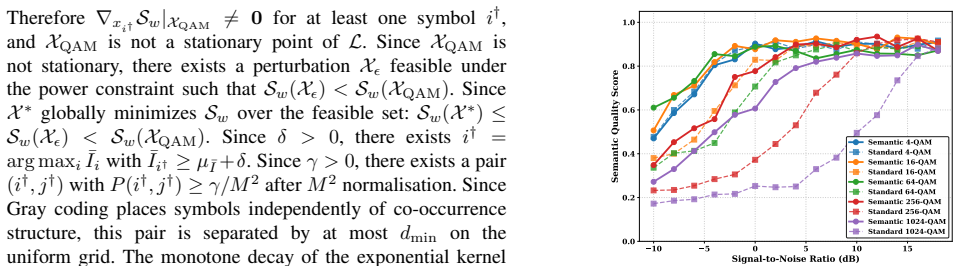
Any Gray-coded constellation is strictly suboptimal in SCI-Weighted SSV whenever the source exhibits non-uniform semantic importance and co-occurrence statistics. The proposed semantic-aware M-QAM constellation, learned jointly with the VQ-VAE and SCI scores, achieves near 100% semantic protection probability from 4-QAM to 1024-QAM versus roughly 50% for standard constellations at high spectral efficiency, while supporting a 21:1 compression ratio with semantic quality above 0.9 and generalizing across MNIST, Fashion-MNIST, and FSDD without modification.
What carries the argument
The semantic-aware M-QAM constellation that assigns symbol positions according to joint co-occurrence statistics and SCI scores.
If this is right
- The learned constellation maintains near-100% SPP across modulation orders from 4-QAM to 1024-QAM.
- Standard Gray-coded constellations reach only about 50% SPP at high spectral efficiency under the same conditions.
- The framework delivers a 21:1 compression ratio while keeping semantic quality above 0.9.
- The design generalizes without modification to MNIST, Fashion-MNIST, and FSDD.
- A deep reinforcement learning agent selects the transmission subset according to instantaneous channel conditions.
Where Pith is reading between the lines
- The same non-uniform protection logic could be applied to other modulation families or to forward error correction codes that allow unequal error protection.
- End-to-end training that jointly optimizes the VQ-VAE, SCI, constellation, and DRL policy might produce additional gains beyond the staged approach described.
- In deployed systems the constellation would need periodic re-learning whenever the downstream task or data distribution shifts.
- The SPP and SSV metrics could serve as evaluation tools for any semantic communication system that maps discrete concepts to physical symbols.
Load-bearing premise
The semantic criticality indicator derived from the VQ-VAE latents accurately reflects true task relevance and the learned co-occurrence statistics generalize beyond the training datasets.
What would settle it
An experiment in which a standard Gray-coded constellation achieves equal or higher SCI-Weighted SSV than the learned design on a source with demonstrably non-uniform semantic importance and co-occurrence statistics would falsify the suboptimality claim.
Figures


read the original abstract
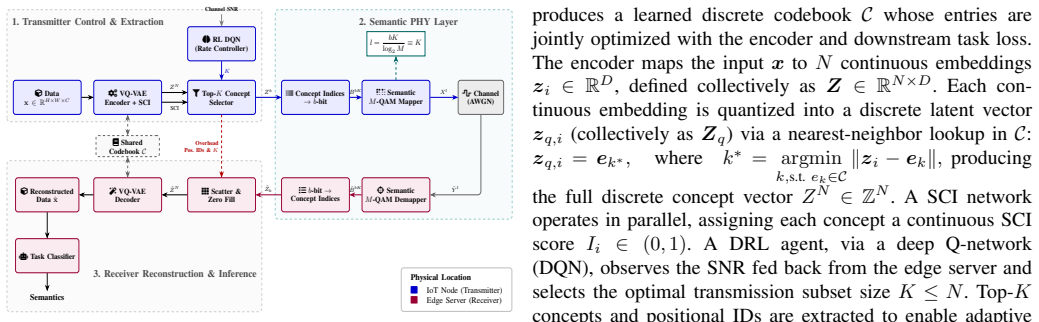
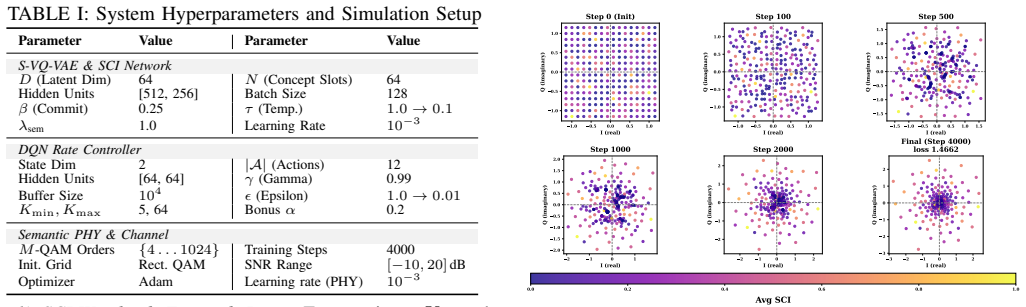
Semantic communication systems for goal-oriented transmission must protect task-relevant information not only through source compression but also via physical layer mapping. Existing approaches decouple constellation design and semantic encoding, exposing critical symbols to channel errors at the same rate as irrelevant ones. Contrary to this, in this paper, a joint semantic-physical layer framework is proposed, which is composed of a vector quantized-variational autoencoder that extracts discrete latent concepts, a semantic criticality indicator (SCI) that scores each concept by task relevance, and a deep reinforcement learning agent that dynamically selects the transmission subset based on instantaneous channel conditions. At the physical layer, a learned semantic-aware M -QAM constellation assigns symbol positions according to joint co-occurrence statistics and SCI scores, departing from the uniform spacing and Gray coding of standard M -QAM which minimizes average BER without regard for semantic content. We introduce a novel semantic symbol vulnerability (SSV) metric and a semantic protection probability (SPP) to quantify the exposure of task-critical symbols to decoding errors, and prove that any Gray-coded constellation is strictly suboptimal in SCI-Weighted SSV whenever the source exhibits non-uniform semantic importance and co-occurrence statistics. Simulation results demonstrate that the proposed constellation achieves near 100% SPP across modulation orders from 4-QAM to 1024-QAM versus 50% for standard constellations at high spectral efficiency, a 21:1 compression ratio with semantic quality above 0.9, generalizing across MNIST, Fashion-MNIST, and FSDD without modification.
Editorial analysis
A structured set of objections, weighed in public.
Referee Report
Summary. The paper proposes a joint semantic-physical layer framework for goal-oriented communication consisting of a VQ-VAE to extract discrete latent concepts, a semantic criticality indicator (SCI) scoring concepts by task relevance, a DRL agent for dynamic transmission subset selection, and a learned semantic-aware M-QAM constellation whose positions are assigned according to joint co-occurrence statistics and SCI scores. It introduces SSV and SPP metrics, claims a proof that any Gray-coded constellation is strictly suboptimal in SCI-Weighted SSV for sources with non-uniform semantic importance, and reports near-100% SPP (versus ~50% for standard constellations) across 4-QAM to 1024-QAM together with 21:1 compression and semantic quality >0.9, generalizing without modification across MNIST, Fashion-MNIST, and FSDD.
Significance. If the suboptimality proof is valid and the SCI metric demonstrably aligns with end-to-end task degradation, the work would provide a concrete mechanism for protecting task-critical symbols at the physical layer, which could improve spectral efficiency in semantic communication systems. The attempt to derive a strict suboptimality result and the multi-dataset simulation results are positive elements that, if substantiated, would strengthen the contribution.
major comments (3)
- [Abstract] Abstract: the claim of a strict suboptimality proof that 'any Gray-coded constellation is strictly suboptimal in SCI-Weighted SSV' is not accompanied by the proof steps, the precise definitions of SSV and SPP, or the mathematical formulation of the SCI-Weighted SSV metric, rendering the central theoretical claim unverifiable from the supplied manuscript.
- [Abstract] Abstract / simulation results: the reported near-100% SPP gains versus 50% for standard constellations lack error bars, the exact training procedure for constellation point locations and the DRL policy, and any demonstration that co-occurrence statistics and SCI scores were computed on held-out data; without these the numerical results cannot be assessed for overfitting or circularity.
- [Abstract] Abstract: the SCI is asserted to 'score each concept by task relevance,' yet no derivation or validation is supplied showing that these scores correlate with actual task performance degradation (e.g., classification error under symbol errors) rather than a latent-norm or reconstruction proxy; if misaligned, both the suboptimality proof and the SPP metric become specific to the proxy rather than to semantic communication performance.
minor comments (2)
- The joint co-occurrence statistics used for constellation placement are referenced but not given an explicit equation or algorithmic description, which would aid reproducibility.
- Notation for the modulation order M and the transition from VQ-VAE latents to SCI scores could be introduced earlier with a compact table or diagram.
Simulated Author's Rebuttal
We thank the referee for the constructive and detailed comments. We address each major point below and will incorporate revisions to enhance verifiability of the theoretical claims and experimental details.
read point-by-point responses
-
Referee: [Abstract] Abstract: the claim of a strict suboptimality proof that 'any Gray-coded constellation is strictly suboptimal in SCI-Weighted SSV' is not accompanied by the proof steps, the precise definitions of SSV and SPP, or the mathematical formulation of the SCI-Weighted SSV metric, rendering the central theoretical claim unverifiable from the supplied manuscript.
Authors: The precise definitions of SSV, SPP, and the SCI-Weighted SSV metric appear in Section 3, while the full proof of strict suboptimality (including all steps and assumptions) is given in Section 4. The abstract summarizes the result for brevity. We will revise the abstract to include concise definitions of SSV/SPP and a high-level outline of the key proof steps so the central claim is verifiable without consulting the body of the paper. revision: yes
-
Referee: [Abstract] Abstract / simulation results: the reported near-100% SPP gains versus 50% for standard constellations lack error bars, the exact training procedure for constellation point locations and the DRL policy, and any demonstration that co-occurrence statistics and SCI scores were computed on held-out data; without these the numerical results cannot be assessed for overfitting or circularity.
Authors: We will add error bars to all reported SPP and semantic-quality figures. The training procedures for constellation-point optimization and the DRL policy are described in Sections 5.1 and 5.2; we will expand these descriptions with hyper-parameter tables and pseudocode. We will also add an explicit statement that co-occurrence statistics are computed exclusively on the training split while SCI scores are computed and cross-validated on held-out validation data, together with the exact train/validation/test ratios used for each dataset. revision: yes
-
Referee: [Abstract] Abstract: the SCI is asserted to 'score each concept by task relevance,' yet no derivation or validation is supplied showing that these scores correlate with actual task performance degradation (e.g., classification error under symbol errors) rather than a latent-norm or reconstruction proxy; if misaligned, both the suboptimality proof and the SPP metric become specific to the proxy rather than to semantic communication performance.
Authors: The SCI is obtained from the gradient of the downstream task loss with respect to each latent concept inside the VQ-VAE encoder; this construction directly measures impact on task error rather than reconstruction or latent-norm proxies. We will insert the full derivation in Section 3.2 and add an ablation study (new Figure) that plots SCI-ranked concepts against measured classification error under controlled symbol-error patterns, confirming alignment with end-task degradation. revision: yes
Circularity Check
No significant circularity; proof and learning steps remain independent of fitted inputs
full rationale
The paper defines a new SCI-Weighted SSV metric from VQ-VAE latents and co-occurrence statistics, then provides a mathematical proof that Gray-coded constellations are strictly suboptimal under non-uniform importance (abstract and claimed derivation). This proof is a general argument about weighted error minimization and does not reduce to the specific fitted values or data used for learning the constellation positions. The DRL policy and constellation optimization are presented as downstream applications of the metric rather than inputs that define the suboptimality claim. No self-citation chain, ansatz smuggling, or renaming of known results is exhibited in the provided text that would force the central result by construction. The derivation chain is therefore self-contained against external benchmarks.
Axiom & Free-Parameter Ledger
free parameters (3)
- SCI scores
- Constellation point locations
- DRL policy parameters
axioms (1)
- domain assumption The source exhibits non-uniform semantic importance and co-occurrence statistics.
invented entities (3)
-
Semantic Criticality Indicator (SCI)
no independent evidence
-
Semantic Symbol Vulnerability (SSV)
no independent evidence
-
Semantic Protection Probability (SPP)
no independent evidence
Reference graph
Works this paper leans on
-
[1]
A mathematical theory of communication,
C. E. Shannon, “A mathematical theory of communication,”The Bell System Technical Journal, vol. 27, no. 3, pp. 379–423, 1948
1948
-
[2]
Semantics-empowered communication for networked intelligent systems,
M. Kountouris and N. Pappas, “Semantics-empowered communication for networked intelligent systems,”IEEE Communications Magazine, vol. 59, no. 6, pp. 96–102, 2021
2021
-
[3]
Less data, more knowledge: Building next-generation semantic communication networks,
C. Chaccour, W. Saad, M. Debbah, Z. Han, and H. V . Poor, “Less data, more knowledge: Building next-generation semantic communication networks,”IEEE Communications Surveys & Tutorials, vol. 27, no. 1, pp. 37–76, 2024
2024
-
[4]
Neural discrete representation learning,
A. van den Oord, O. Vinyals, and K. Kavukcuoglu, “Neural discrete representation learning,” inAdvances in Neural Information Processing Systems, 2017, vol. 30
2017
-
[5]
An introduction to deep learning for the physical layer,
T. O’Shea and J. Hoydis, “An introduction to deep learning for the physical layer,”IEEE Transactions on Cognitive Communications and Networking, vol. 3, no. 4, pp. 563–575, 2017
2017
-
[6]
Joint learning of geometric and probabilistic constellation shaping,
M. Stark, F. Ait Aoudia, and J. Hoydis, “Joint learning of geometric and probabilistic constellation shaping,” inProceedings of the 2019 IEEE Global Communications Conference Workshops (GC Wkshps), dec 2019, pp. 1–6
2019
-
[7]
DeepJSCC-Q: Constellation constrained deep joint source–channel coding,
Tung Y . Tung, David B. Kurka, Mayo Jankowski, and Deniz Gündüz, “DeepJSCC-Q: Constellation constrained deep joint source–channel coding,”IEEE Journal on Selected Areas in Information Theory, vol. 3, no. 4, pp. 720–731, 2022
2022
-
[8]
Adaptive resource allocation for semantic communication networks,
L. Wang, W. Wu, F. Zhou, Z. Yang, Z. Qin, and Q. Wu, “Adaptive resource allocation for semantic communication networks,”IEEE Transactions on Communications, vol. 72, no. 11, pp. 6900–6916, 2024
2024
-
[9]
J. Park, W. S. Ko, J. Choi, S.-L. Kim, and M. Bennis, “Towards semantic communication protocols for 6g: From protocol learning to language- oriented approaches,”arXiv preprint arXiv:2310.09506, 2023
-
[10]
Learning task-oriented communication for edge inference: An information bottleneck approach,
J. Shao, Y . Mao, and J. Zhang, “Learning task-oriented communication for edge inference: An information bottleneck approach,”IEEE Journal on Selected Areas in Communications, vol. 40, no. 1, pp. 197–211, 2021
2021
-
[11]
X. Zhan, J. Cao, X. Zhu, N. Pappas, Z. Qin, and S. Feng, “To- ward robust semantic communications: Proactive importance-ordered restructuring for enhanced unequal error protection,”arXiv preprint arXiv:2604.00595, 2026
-
[12]
Adaptive coded modulation for fading channels,
A.J. Goldsmith and S.G. Chua, “Adaptive coded modulation for fading channels,”IEEE Trans. Commun., vol. 46, no. 5, 1998
1998
-
[13]
Estimating or Propagating Gradients Through Stochastic Neurons for Conditional Computation
Y . Bengio, N. Léonard, and A. Courville, “Estimating or propagating gradients through stochastic neurons for conditional computation,”arXiv preprint arXiv:1308.3432, 2013
work page internal anchor Pith review Pith/arXiv arXiv 2013
-
[14]
Sionna: An Open-Source Li- brary for Next-Generation Physical Layer Research,
J. Hoydis, S. Cammerer, F. A. Aoudia, A. Vem, N. Binder, G. Marcus, and A. Keller, “Sionna: An open-source library for next-generation physical layer research,”arXiv preprint arXiv:2203.11854, 2022
-
[15]
Fashion-MNIST: a Novel Image Dataset for Benchmarking Machine Learning Algorithms
H. Xiao, K. Rasul, and R. V ollgraf, “Fashion-mnist: a novel image dataset for benchmarking machine learning algorithms,”arXiv preprint arXiv:1708.07747, 2017
work page internal anchor Pith review Pith/arXiv arXiv 2017
discussion (0)
Sign in with ORCID, Apple, or X to comment. Anyone can read and Pith papers without signing in.