Recognition: 2 theorem links
· Lean TheoremA developmental switch from capillary rectification to elastic catapult enables honeydew ejection in the spotted lanternfly
Pith reviewed 2026-05-15 02:48 UTC · model grok-4.3
The pith
Spotted lanternfly nymphs eject honeydew using a capillary rectifier while adults use an elastic catapult.
A machine-rendered reading of the paper's core claim, the machinery that carries it, and where it could break.
Core claim
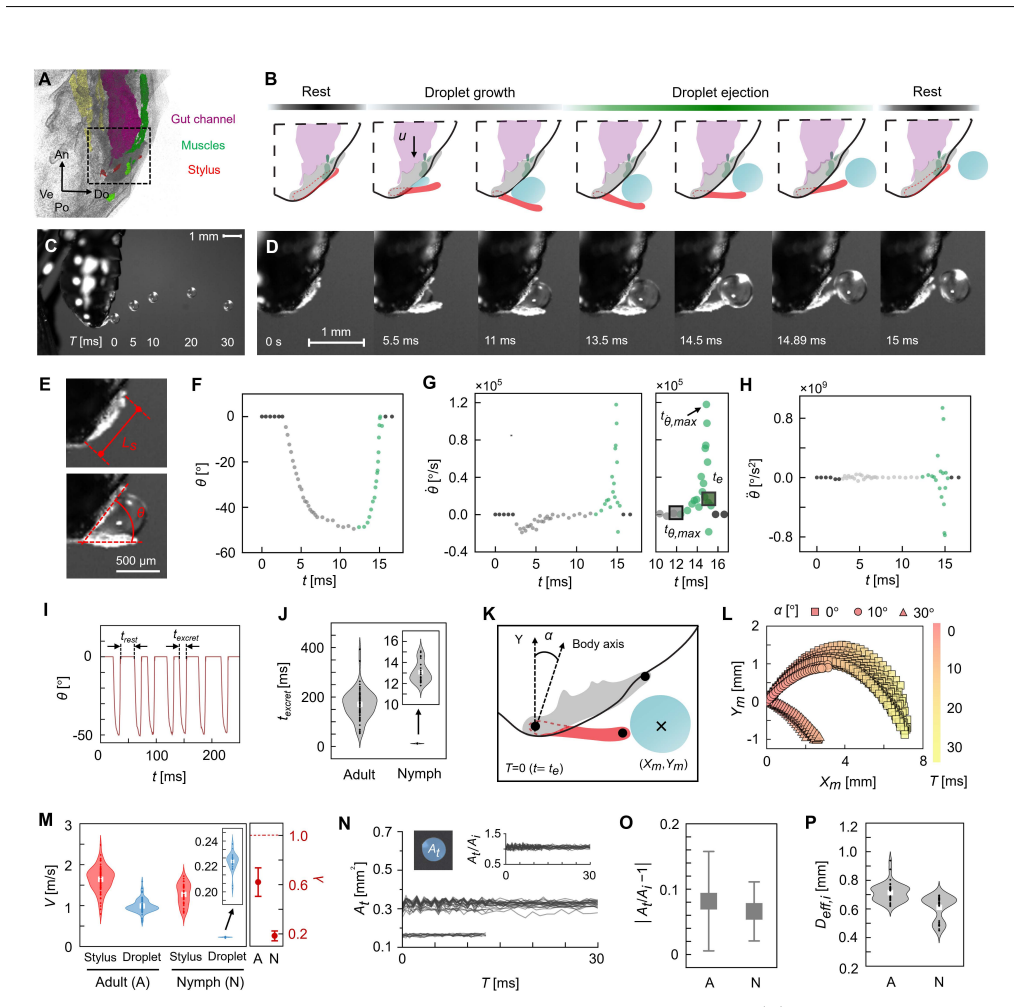
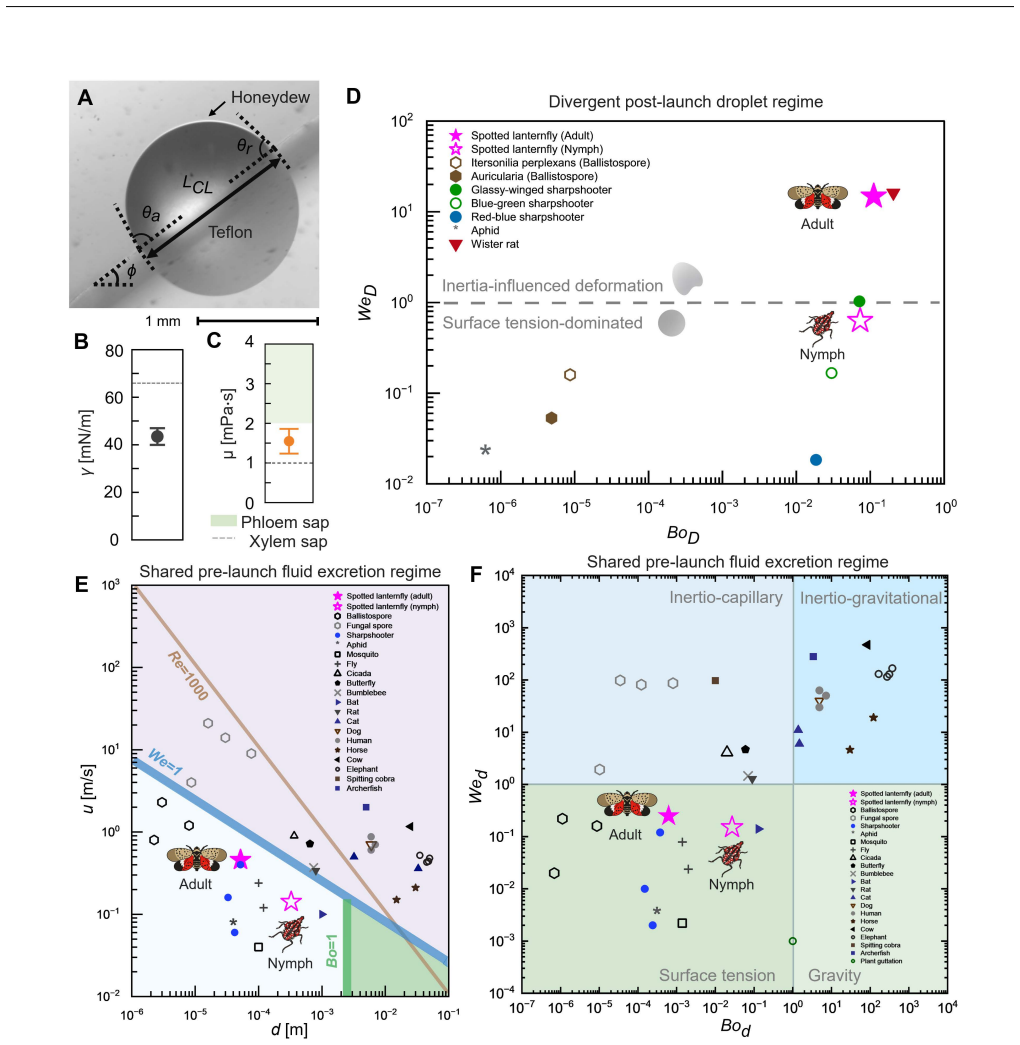
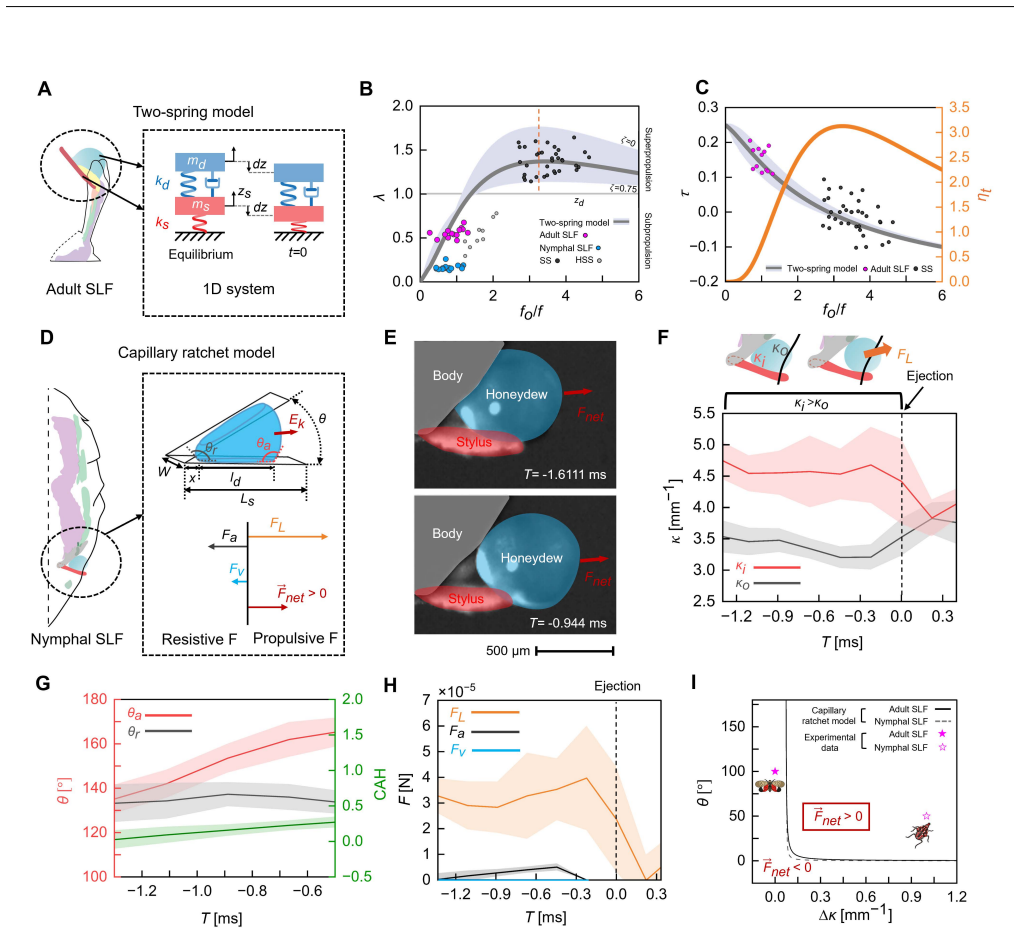
We show that the spotted lanternfly (Lycorma delicatula) uses distinct release mechanics across ontogeny. Nymphs release honeydew with an anal stylus that acts as a capillary rectifier, imposing a curvature asymmetry that biases the attached droplet toward detachment through a Laplace-pressure difference. Adults use a longer stylus associated with an elastic basal region, maintain stylus-droplet contact through a finite compression phase, and release droplets with greater translational and rotational momentum. Development therefore maintains waste clearance across ontogeny under the same outlet-scale capillary constraint by changing how stylus motion is coupled to the droplet at release.
What carries the argument
The anal stylus, acting as a capillary rectifier through curvature asymmetry in nymphs and as part of an elastic catapult through basal compression in adults.
If this is right
- Both stages maintain waste clearance under the same outlet-scale capillary constraint.
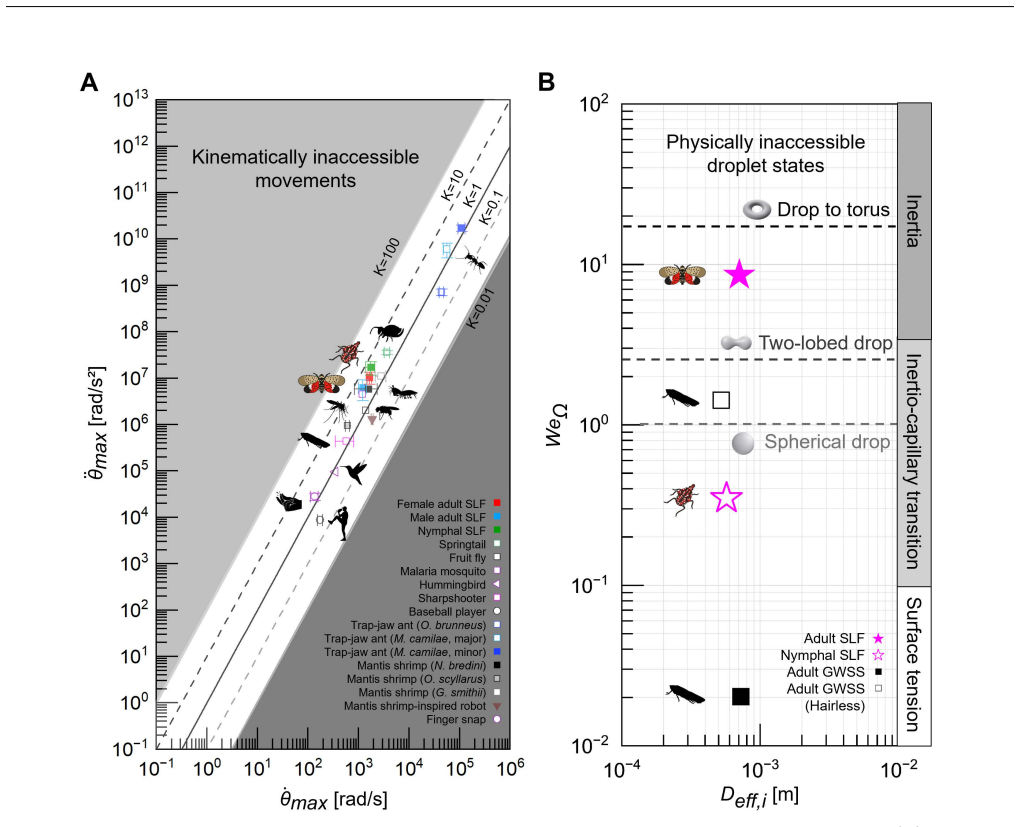
- Nymphal droplets remain surface-tension dominated after release, while adult droplets enter deformation- and spin-influenced regimes.
- The change in stylus-droplet coupling links life-stage biomechanics to honeydew placement.
- This suggests bioinspired strategies for droplet ejection, antifouling, and self-cleaning surfaces.
Where Pith is reading between the lines
- Other phloem-feeding insects may use similar ontogenetic switches to solve capillary ejection problems.
- The elastic basal region in adults could be a target for modeling optimal energy transfer in catapult mechanisms.
- Disrupting the switch might provide a strategy for controlling the invasive lanternfly without broad pesticides.
Load-bearing premise
The reduced-order modeling and Weber-Bond scaling based on measured honeydew properties correctly capture the dominant forces and post-release regimes without significant contributions from unmodeled effects such as viscoelasticity or three-dimensional flow at the contact line.
What would settle it
Direct observation that nymphal droplets detach without the predicted Laplace pressure difference from stylus curvature asymmetry, or that adult release does not produce deformation-influenced droplet regimes.
Figures


read the original abstract
Plant sap-feeding insects must dispose of excess fluid, yet at millimeter scales droplet release is constrained by capillary adhesion and contact-line pinning. How phloem-feeding insects solve this puzzle, particularly as the excretory apparatus changes in size and form from nymph to adult, has remained unclear. Combining micro-CT, high-speed imaging, measurements of honeydew properties, and reduced-order modeling, we show that the spotted lanternfly (Lycorma delicatula) uses distinct release mechanics across ontogeny. Nymphs release honeydew with an anal stylus that acts as a capillary rectifier, imposing a curvature asymmetry that biases the attached droplet toward detachment through a Laplace-pressure difference. Adults use a longer stylus associated with an elastic basal region, maintain stylus-droplet contact through a finite compression phase, and release droplets with greater translational and rotational momentum. In both stages, stylus rotation is ultrafast, with peak angular accelerations of order $10^7$ rad/s$^{-2}$ and release unfolding on millisecond timescales, yet droplet ejection speed remains below stylus tip speed. Weber-Bond scaling based on measured honeydew properties places both stages at $We_d<1$ and $Bo_d<1$ at the outlet, but distinguishes their post-release states: nymphal droplets remain surface-tension dominated, whereas adult droplets enter deformation- and spin-influenced regimes. Development therefore maintains waste clearance across ontogeny under the same outlet-scale capillary constraint by changing how stylus motion is coupled to the droplet at release, linking life-stage biomechanics to honeydew placement in this invasive phloem feeder and suggesting bioinspired strategies for droplet ejection, antifouling, and self-cleaning surfaces.
Editorial analysis
A structured set of objections, weighed in public.
Referee Report
Summary. The manuscript describes a developmental switch in honeydew ejection mechanics in the spotted lanternfly Lycorma delicatula. Nymphs utilize an anal stylus acting as a capillary rectifier through curvature asymmetry to promote detachment via Laplace pressure differences. Adults employ a longer stylus with an elastic basal region, involving a compression phase and release with translational and rotational momentum. Both stages feature ultrafast stylus rotation on millisecond timescales, with ejection speeds below tip speeds. Weber-Bond scaling using measured honeydew properties shows We_d < 1 and Bo_d < 1 at the outlet for both, but differentiates post-release regimes: surface-tension dominated for nymphs versus deformation- and spin-influenced for adults. The study combines micro-CT, high-speed imaging, property measurements, and modeling to link these mechanics to waste clearance across ontogeny.
Significance. This study offers valuable insights into how phloem-feeding insects adapt their excretory systems to physical constraints during development, with relevance to invasive species management and bioinspired engineering for droplet control and self-cleaning surfaces. The use of direct experimental techniques like high-speed imaging and property measurements provides strong empirical grounding for the observations. If the scaling analysis holds without significant unmodeled effects, it presents a clear example of functional continuity through mechanistic change.
major comments (2)
- [Abstract (Weber-Bond scaling)] The post-release regime distinction between nymphs and adults is central to the developmental switch claim, yet the reduced-order modeling assumes Newtonian honeydew without addressing potential viscoelastic contributions. If relaxation times are comparable to the millisecond release timescale, the effective Bond number during adult compression could increase, potentially eliminating the claimed regime difference.
- [Methods and modeling] Details on the full methods, including error bars on property measurements, model validation against imaging data, and sensitivity analysis for the scaling parameters, are not provided in the manuscript, making it difficult to assess the robustness of the We_d and Bo_d calculations.
minor comments (1)
- [Abstract] The notation for We_d and Bo_d should be defined explicitly upon first use, and the specific measured values of viscosity and surface tension should be reported.
Simulated Author's Rebuttal
We thank the referee for their constructive comments, which help strengthen the manuscript. We address each major point below and have revised the text and supplementary material accordingly.
read point-by-point responses
-
Referee: [Abstract (Weber-Bond scaling)] The post-release regime distinction between nymphs and adults is central to the developmental switch claim, yet the reduced-order modeling assumes Newtonian honeydew without addressing potential viscoelastic contributions. If relaxation times are comparable to the millisecond release timescale, the effective Bond number during adult compression could increase, potentially eliminating the claimed regime difference.
Authors: We agree that viscoelasticity merits explicit discussion. Our rheometry data (cone-plate, 0.1–100 s⁻¹) showed Newtonian response with no detectable yield stress or shear thinning for the measured honeydew samples. High-speed imaging of the release events also shows no delayed recoil or filament formation that would indicate significant elastic recovery on the millisecond scale. In the revised manuscript we have added a dedicated paragraph in the Discussion that (i) reports the measured relaxation-time upper bound (<0.5 ms) inferred from the absence of such signatures and (ii) shows that even if a modest elastic modulus were present, the resulting correction to Bo_d remains <0.2 and does not alter the reported regime separation. We therefore retain the developmental-switch interpretation while acknowledging the modeling assumption. revision: partial
-
Referee: [Methods and modeling] Details on the full methods, including error bars on property measurements, model validation against imaging data, and sensitivity analysis for the scaling parameters, are not provided in the manuscript, making it difficult to assess the robustness of the We_d and Bo_d calculations.
Authors: We accept this criticism. The revised Methods section now includes: (a) error bars (mean ± s.d., n = 5 biological replicates) for viscosity, surface tension, and density; (b) direct overlay of reduced-order model trajectories against tracked droplet centroids from high-speed videos for both nymphal and adult releases; and (c) a sensitivity table showing that the We_d < 1 and Bo_d < 1 classifications remain unchanged when each input parameter is varied by ±25 %. These additions are also summarized in a new supplementary figure. revision: yes
Circularity Check
No significant circularity; claims rest on direct measurements and standard scaling
full rationale
The paper's derivation chain begins with empirical inputs from micro-CT imaging, high-speed video, and direct measurements of honeydew viscosity, surface tension, and density. These feed into standard dimensionless Weber-Bond scaling (We_d and Bo_d) to classify post-release regimes. No equation reduces to a fitted parameter by construction, no self-citation supplies a uniqueness theorem or ansatz, and the developmental-switch claim follows from observed differences in stylus geometry and motion rather than tautological redefinition. The analysis is self-contained against external benchmarks.
Axiom & Free-Parameter Ledger
axioms (2)
- standard math Laplace pressure difference arising from droplet curvature asymmetry drives net force toward detachment
- domain assumption Elastic basal region stores and releases energy during stylus compression and rotation
Lean theorems connected to this paper
-
IndisputableMonolith/Cost/FunctionalEquation.leanwashburn_uniqueness_aczel unclear?
unclearRelation between the paper passage and the cited Recognition theorem.
Weber-Bond scaling based on measured honeydew properties places both stages at We_d<1 and Bo_d<1 at the outlet, but distinguishes their post-release states: nymphal droplets remain surface-tension dominated, whereas adult droplets enter deformation- and spin-influenced regimes.
-
IndisputableMonolith/Foundation/RealityFromDistinction.leanreality_from_one_distinction unclear?
unclearRelation between the paper passage and the cited Recognition theorem.
Nymphs release honeydew with an anal stylus that acts as a capillary rectifier, imposing a curvature asymmetry that biases the attached droplet toward detachment through a Laplace-pressure difference. Adults use a longer stylus associated with an elastic basal region...
What do these tags mean?
- matches
- The paper's claim is directly supported by a theorem in the formal canon.
- supports
- The theorem supports part of the paper's argument, but the paper may add assumptions or extra steps.
- extends
- The paper goes beyond the formal theorem; the theorem is a base layer rather than the whole result.
- uses
- The paper appears to rely on the theorem as machinery.
- contradicts
- The paper's claim conflicts with a theorem or certificate in the canon.
- unclear
- Pith found a possible connection, but the passage is too broad, indirect, or ambiguous to say the theorem truly supports the claim.
Reference graph
Works this paper leans on
-
[1]
Phloem-sap feeding by animals: prob- lems and solutions
Angela E Douglas. “Phloem-sap feeding by animals: prob- lems and solutions”. In:Journal of Experimental Botany 57.4 (2006), pp. 747–754
work page 2006
-
[2]
A phloem-sap feeder mixes phloem and xylem sap to regulate osmotic potential
Julien Pompon et al. “A phloem-sap feeder mixes phloem and xylem sap to regulate osmotic potential”. In:Journal of Insect Physiology57.9 (2011), pp. 1317–1322
work page 2011
-
[3]
Droplet superpropulsion in an ener- getically constrained insect
Elio J Challita et al. “Droplet superpropulsion in an ener- getically constrained insect”. In:Nature Communications 14.860 (2023)
work page 2023
-
[5]
Unifying fluidic excretion across life from cicadas to elephants
Elio J Challita and Saad M Bhamla. “Unifying fluidic excretion across life from cicadas to elephants”. In:Pro- ceedings of the National Academy of Sciences121.13 (2024), e2317878121
work page 2024
-
[6]
Adhesive properties of Aphrophoridae spittlebug foam
Hannelore Hoch et al. “Adhesive properties of Aphrophoridae spittlebug foam”. In:Journal of the Royal Society Interface21.210 (2024), p. 20230521
work page 2024
-
[7]
Nathan Pike et al. “How aphids lose their marbles”. In: Proceedings of the Royal Society of London. Series B: Biological Sciences269.1497 (2002), pp. 1211–1215
work page 2002
-
[8]
Pierre Chantelot et al. “Drop trampoline”. In:Euro- physics Letters124.2 (2018), p. 24003
work page 2018
-
[10]
Optimal concentration for sugar transport in plants
Kaare H Jensen, Jessica A Savage, and N Michele Hol- brook. “Optimal concentration for sugar transport in plants”. In:Journal of the Royal Society Interface10.83 (2013), p. 20130055
work page 2013
-
[11]
Phytophages of Xylem and Phloem: a Comparison of Animal and Plant Sap-feeders
John A Raven. “Phytophages of Xylem and Phloem: a Comparison of Animal and Plant Sap-feeders”. In: Advances in Ecological Research13 (1983), pp. 135–234
work page 1983
-
[12]
Lycorma delicatula (Hemiptera: Fulgoridae): A New Invasive Pest in the United States
Surendra K Dara, Lawrence Barringer, and Steven P Arthurs. “Lycorma delicatula (Hemiptera: Fulgoridae): A New Invasive Pest in the United States”. In:Journal of Integrated Pest Management6.1 (2015), p. 20
work page 2015
-
[13]
Hajar Faal et al. “Volatiles from male honeydew excre- tions attract conspecific male spotted lanternflies, Ly- corma delicatula (Hemiptera: Fulgoridae)”. In:Frontiers in Insect Science2 (2022), p. 982965
work page 2022
-
[14]
Novel trophobiotic interactions in lantern bugs (Insecta: Auchenorrhyncha: Fulgoridae)
Piotr Naskrecki and Kenji Nishida. “Novel trophobiotic interactions in lantern bugs (Insecta: Auchenorrhyncha: Fulgoridae)”. In:Journal of Natural History41 (2007), pp. 37–40
work page 2007
-
[15]
Spotted Lanternflies Respond to Natural Pheromone Lures for Mate-Finding and Oviposition
Miriam F Cooperband and Kelly M Murman. “Spotted Lanternflies Respond to Natural Pheromone Lures for Mate-Finding and Oviposition”. In:Insects15.6 (2024), p. 447
work page 2024
-
[16]
Barukh B Rohde et al. “Evidence of Receptivity to Vi- broacoustic Stimuli in the Spotted Lanternfly Lycorma delicatula (Hemiptera: Fulgoridae)”. In:Journal of Eco- nomic Entomology115.6 (2022), pp. 2116–2120. 12/31
work page 2022
-
[17]
Malcolm Burrows, Stephen R. Shaw, and Gregory P Sutton. “Resilin and chitinous cuticle form a composite structure for energy storage in jumping by froghopper insects”. In:BMC Biology6.1 (2008), p. 41
work page 2008
-
[18]
Xu Chen and Aiping Liang. “The Unilateral Jumping Structures of the Spotted Lanternfly, Lycorma delicat- ula (Hemiptera: Fulgoridae): A Highly Functional and Integrated Unit”. In:Biomimetics10.7 (2025), p. 444
work page 2025
-
[19]
Directional takeoff, aerial righting, and adhesion landing of semiaquatic springtails
Victor M Ortega-Jimenez et al. “Directional takeoff, aerial righting, and adhesion landing of semiaquatic springtails”. In:Proceedings of the National Academy of Sciences119.46 (2022), e2211283119
work page 2022
-
[20]
Jumping Per- formance and Behavior of the Globular Springtail Dicyr- tomina minuta
Adrian A Smith and Jacob S Harrison. “Jumping Per- formance and Behavior of the Globular Springtail Dicyr- tomina minuta”. In:Integrative Organismal Biology6.1 (2024), obae029
work page 2024
-
[21]
Wouter G van Veen et al. “The unsteady aerodynamics of insect wings with rotational stroke accelerations, a sys- tematic numerical study”. In:Journal of Fluid Mechanics 936 (2022), A3
work page 2022
-
[22]
Flies Evade Looming Targets by Executing Rapid Visually Directed Banked Turns
Florian T Muijres et al. “Flies Evade Looming Targets by Executing Rapid Visually Directed Banked Turns”. In:Science344.6180 (2014), pp. 172–177
work page 2014
-
[23]
Florian T Muijres et al. “Escaping blood-fed malaria mosquitoes minimize tactile detection without compro- mising on take-off speed”. In:Journal of Experimental Biology220.20 (2017), pp. 3751–3762
work page 2017
-
[24]
How the humming- bird wing beat is tuned for efficient hovering
Rivers Ingersoll and David Lentink. “How the humming- bird wing beat is tuned for efficient hovering”. In:Journal of Experimental Biology221.20 (2018), jeb178228
work page 2018
-
[26]
IMU arrays: The biomechanics of baseball pitching
Eric Berkson et al. “IMU arrays: The biomechanics of baseball pitching”. In:The Orthopaedic Journal at Har- vard Medical School8 (2006), pp. 90–94
work page 2006
-
[27]
A physical model of mantis shrimp for exploring the dynamics of ultrafast systems
Emma Steinhardt et al. “A physical model of mantis shrimp for exploring the dynamics of ultrafast systems”. In:Proceedings of the National Academy of Sciences 118.3 (2021), e2026833118
work page 2021
-
[28]
Fredrick J Larabee, Adrian A Smith, and Andrew V Suarez. “Snap-jaw morphology is specialized for high- speed power amplification in the Dracula ant, Mystrium camillae”. In:Royal Society Open Science5.12 (2018), p. 181447
work page 2018
-
[31]
The stability of a rotating liquid drop
Subrahmanyan F.R.S. Chandrasekhar. “The stability of a rotating liquid drop”. In:Proceedings of the Royal Society of London. Series A286.1404 (1965), pp. 1–26
work page 1965
-
[32]
The Shape and Sta- bility of Rotating Liquid Drops
Robert A Brown and L.E Scriven. “The Shape and Sta- bility of Rotating Liquid Drops”. In:Proceedings of the Royal Society of London. A. Mathematical and Physical Sciences371.1746 (1980), pp. 331–357
work page 1980
-
[34]
Three-dimensional capillary ratchet- induced liquid directional steering
Shile Feng et al. “Three-dimensional capillary ratchet- induced liquid directional steering”. In:Science373.6561 (2021), pp. 1344–1348
work page 2021
-
[35]
Physical Limits and Design Principles for Plant and Fungal Movements
Jan M Skotheim and L. Mahadevan. “Physical Limits and Design Principles for Plant and Fungal Movements”. In:Science308.5726 (2005), pp. 1308–1310
work page 2005
-
[36]
Vamsi J Nalam et al. “Location, location, location: Feed- ing site affects aphid performance by altering access and quality of nutrients”. In:PLOS One16.2 (2021), e0245380
work page 2021
-
[37]
Plant–Aphid Interactions Under Elevated CO2: Some Cues from Aphid Feeding Behavior
Yucheng Sun, Huijuan Guo, and Feng Ge. “Plant–Aphid Interactions Under Elevated CO2: Some Cues from Aphid Feeding Behavior”. In:Frontiers in Plant Sci- ence7 (2016), p. 502
work page 2016
-
[38]
Grooming Behavior as a Mechanism of Insect Disease Defense
Marianna Zhukovskaya, Aya Yanagawa, and Brian T Forschler. “Grooming Behavior as a Mechanism of Insect Disease Defense”. In:Insects4.4 (2013), pp. 609–630
work page 2013
-
[39]
How phloem-feeding insects face the chal- lenge of phloem-located defenses
Torsten Will, Alexandra C U Furch, and Matthias R Zimmermann. “How phloem-feeding insects face the chal- lenge of phloem-located defenses”. In:Frontiers in Plant Science4 (2013), p. 336
work page 2013
-
[40]
Julie M Urban and Heather Leach. “Biology and Man- agement of the Spotted Lanternfly, Lycorma delicatula (Hemiptera: Fulgoridae), in the United States”. In:An- nual Review of Entomology68.1 (2023), pp. 151–167
work page 2023
-
[41]
Jacob S Harrison and SN Patek. “Developing elastic mechanisms: ultrafast motion and cavitation emerge at the millimeter scale in juvenile snapping shrimp”. In: Journal of Experimental Biology226.4 (2023), jeb244645
work page 2023
-
[42]
Honeydew manage- ment to promote biological control
Maite Fernandez de Bobadilla et al. “Honeydew manage- ment to promote biological control”. In:Current Opinion in Insect Science61 (2024), p. 101151
work page 2024
-
[43]
A F Emeljanov. “Evolutionary transformations of ab- dominal wax-plates in the larvae of the Fulgoroidea (Homoptera, Cicadina)”. In:Entomological Review89.9 (2009), pp. 1035–1054
work page 2009
-
[44]
USDA Animal and Plant Health Inspection Service
USDA APHIS.Spotted Lanternfly. USDA Animal and Plant Health Inspection Service. Last modified August 26, 2025. 2025.url: https://www.aphis.usda.gov/ plant-pests-diseases/slf
work page 2025
-
[45]
Human-mediated dispersal drives the spread of the spotted lanternfly (Lycorma delicatula)
Zachary S. Ladin et al. “Human-mediated dispersal drives the spread of the spotted lanternfly (Lycorma delicatula)”. In:Scientific Reports13 (2023), p. 1098. doi:10.1038/s41598-022-25989-3
-
[46]
Hajar Faal et al. “Volatiles from male honeydew excre- tions attract conspecific male spotted lanternflies, Ly- corma delicatula (Hemiptera: Fulgoridae)”. In:Frontiers in Insect Science2 (2022), p. 982965. 13/31 Supporting Information Materials and Methods Honeydew Preparation and Characterization.Fresh honeydew was collected beneath anAilanthustree in St...
work page 2022
-
[47]
Optimal Design of Permeable Fiber Network Structures for Fog Harvesting
Kyoo-Chul Park et al. “Optimal Design of Permeable Fiber Network Structures for Fog Harvesting”. In:Langmuir29.43 (2013), pp. 13269–13277
work page 2013
-
[48]
Superhydrophilic-superhydrophobic water harvester inspired by wetting property of cactus stem
Sang Joon Lee, Nami Ha, and Hyejeong Kim. “Superhydrophilic-superhydrophobic water harvester inspired by wetting property of cactus stem”. In:ACS Sustainable Chemistry & Engineering7.12 (2019), pp. 10561–10569
work page 2019
-
[49]
Phytophages of Xylem and Phloem: a Comparison of Animal and Plant Sap-feeders
John A Raven. “Phytophages of Xylem and Phloem: a Comparison of Animal and Plant Sap-feeders”. In:Advances in Ecological Research13 (1983), pp. 135–234. 30/31
work page 1983
-
[50]
Physical and chemical interactions between aphids
Torsten Will and Aart J E van Bel. “Physical and chemical interactions between aphids”. In:Journal of Experimental Botany57.4 (2006), pp. 729–737
work page 2006
-
[51]
Optimal concentration for sugar transport in plants
Kaare H Jensen, Jessica A Savage, and N Michele Holbrook. “Optimal concentration for sugar transport in plants”. In: Journal of the Royal Society Interface10.83 (2013), p. 20130055
work page 2013
-
[52]
The chemical composition of Ricinus phloem exudate
Shelagh M Hall and Darren A Baker. “The chemical composition of Ricinus phloem exudate”. In:Planta106.2 (1972), pp. 131–140
work page 1972
-
[53]
Droplet superpropulsion in an energetically constrained insect
Elio J Challita et al. “Droplet superpropulsion in an energetically constrained insect”. In:Nature Communications14.860 (2023)
work page 2023
-
[54]
Elisabeth A Bergman, Emma L Green, and Philip G D Matthews. “The cibarial pump of the xylem-feeding froghopper Philaenus spumarius produces negative pressures exceeding 1 MPa”. In:Proceedings of the Royal Society B288.1954 (2021), p. 20210731
work page 1954
-
[55]
Duration of urination does not change with body size
Patricia J Yang et al. “Duration of urination does not change with body size”. In:Proceedings of the National Academy of Sciences111.33 (2014), pp. 11932–11937
work page 2014
-
[56]
Pierre Chantelot et al. “Drop trampoline”. In:Europhysics Letters124.2 (2018), p. 24003
work page 2018
-
[57]
Surface Tension Transport of Prey by Feeding Shorebirds: The Capillary Ratchet
Manu Prakash, David Qu´ er´ e, and John W. M Bush. “Surface Tension Transport of Prey by Feeding Shorebirds: The Capillary Ratchet”. In:Science320.5878 (2008), pp. 931–934
work page 2008
-
[58]
Physical Limits and Design Principles for Plant and Fungal Movements
Jan M Skotheim and L. Mahadevan. “Physical Limits and Design Principles for Plant and Fungal Movements”. In: Science308.5726 (2005), pp. 1308–1310
work page 2005
-
[59]
Design and mechanical properties of insect cuticle
Julian F V Vincent and Ulrike G K Wegst. “Design and mechanical properties of insect cuticle”. In: 33.3 (2004), pp. 187–199
work page 2004
-
[60]
Gregory P Sutton et al. “Dual spring force couples yield multifunctionality and ultrafast, precision rotation in tiny biomechanical systems”. In:Journal of Experimental Biology225.14 (2022), jeb244077
work page 2022
-
[61]
Fredrick J Larabee, Adrian A Smith, and Andrew V Suarez. “Snap-jaw morphology is specialized for high-speed power amplification in the Dracula ant, Mystrium camillae”. In:Royal Society Open Science5.12 (2018), p. 181447
work page 2018
-
[62]
Directional takeoff, aerial righting, and adhesion landing of semiaquatic springtails
Victor M Ortega-Jimenez et al. “Directional takeoff, aerial righting, and adhesion landing of semiaquatic springtails”. In: Proceedings of the National Academy of Sciences119.46 (2022), e2211283119
work page 2022
-
[63]
Jumping Performance and Behavior of the Globular Springtail Dicyrtomina minuta
Adrian A Smith and Jacob S Harrison. “Jumping Performance and Behavior of the Globular Springtail Dicyrtomina minuta”. In:Integrative Organismal Biology6.1 (2024), obae029
work page 2024
-
[64]
A physical model of mantis shrimp for exploring the dynamics of ultrafast systems
Emma Steinhardt et al. “A physical model of mantis shrimp for exploring the dynamics of ultrafast systems”. In: Proceedings of the National Academy of Sciences118.3 (2021), e2026833118
work page 2021
-
[65]
Flies Evade Looming Targets by Executing Rapid Visually Directed Banked Turns
Florian T Muijres et al. “Flies Evade Looming Targets by Executing Rapid Visually Directed Banked Turns”. In:Science 344.6180 (2014), pp. 172–177
work page 2014
-
[66]
Wouter G van Veen et al. “The unsteady aerodynamics of insect wings with rotational stroke accelerations, a systematic numerical study”. In:Journal of Fluid Mechanics936 (2022), A3
work page 2022
-
[67]
Florian T Muijres et al. “Escaping blood-fed malaria mosquitoes minimize tactile detection without compromising on take-off speed”. In:Journal of Experimental Biology220.20 (2017), pp. 3751–3762
work page 2017
-
[68]
Elio J Challita, Pankaj Rohilla, and Saad M Bhamla. “Fluid Ejections in Nature”. In:Annual Reviews15 (2024), pp. 187–217
work page 2024
-
[69]
How the hummingbird wing beat is tuned for efficient hovering
Rivers Ingersoll and David Lentink. “How the hummingbird wing beat is tuned for efficient hovering”. In:Journal of Experimental Biology221.20 (2018), jeb178228
work page 2018
-
[70]
The ultrafast snap of a finger is mediated by skin friction
Raghav Acharya et al. “The ultrafast snap of a finger is mediated by skin friction”. In:Journal of the Royal Society Interface18.184 (2021), p. 20210672
work page 2021
-
[71]
The biomechanics of baseball pitching
Glenn S Fleisig. “The biomechanics of baseball pitching”. PhD thesis. The University of Alabama at Birmingham, 1994
work page 1994
-
[72]
IMU arrays: The biomechanics of baseball pitching
Eric Berkson et al. “IMU arrays: The biomechanics of baseball pitching”. In:The Orthopaedic Journal at Harvard Medical School8 (2006), pp. 90–94. 31/31
work page 2006
discussion (0)
Sign in with ORCID, Apple, or X to comment. Anyone can read and Pith papers without signing in.