Quantum-Secure Physical Unclonable Function enabled by Silicon Photonics Integrated Circuits
Pith reviewed 2026-06-30 20:02 UTC · model grok-4.3
The pith
Silicon nitride photonic mesh functions as a physical unclonable function when read with single-photon quantum states.
A machine-rendered reading of the paper's core claim, the machinery that carries it, and where it could break.
Core claim
The SiN integrated mesh implements a unitary transformation that serves as a PUF whose secret signature arises from uncontrollable waveguide variations during fabrication, and the quantum readout protocol that combines single-photon states with maximally mixed states allows secure authentication with equal error rates as low as 10^{-14} against adversaries possessing similarly fabricated devices.
What carries the argument
The programmable photonic Mach-Zehnder interferometer mesh that implements a unitary transformation, with its secret physical signature arising from uncontrollable fabrication variations in the waveguides.
If this is right
- The protocol supports high-security authentication applications that combine silicon photonics with quantum cryptographic guarantees.
- Authentication performance improves with larger numbers of detected events while remaining robust to a controlled number of corrected errors.
- The approach extends quantum readout strategies to integrated photonic PUFs that can be fabricated in standard CMOS-compatible processes.
- Security evaluation focuses on passive eavesdropping and similar-device adversaries, establishing quantitative bounds via Monte Carlo analysis.
Where Pith is reading between the lines
- The mesh could be scaled in size or combined with other photonic components to increase transformation complexity without changing the quantum readout method.
- Integration with existing silicon photonic quantum technologies might allow the same hardware to perform both PUF authentication and other quantum tasks.
- Testing against active quantum attacks that go beyond passive eavesdropping would be a natural next measurement to strengthen the security claim.
Load-bearing premise
The secret physical signature arises from uncontrollable waveguide variations during fabrication, and security holds against adversaries possessing devices fabricated under similar conditions.
What would settle it
A simulation or measurement in which an adversary equipped with a device fabricated under comparable conditions achieves a false acceptance rate substantially above the reported equal error rate of 10^{-14} would falsify the security assessment.
Figures
read the original abstract
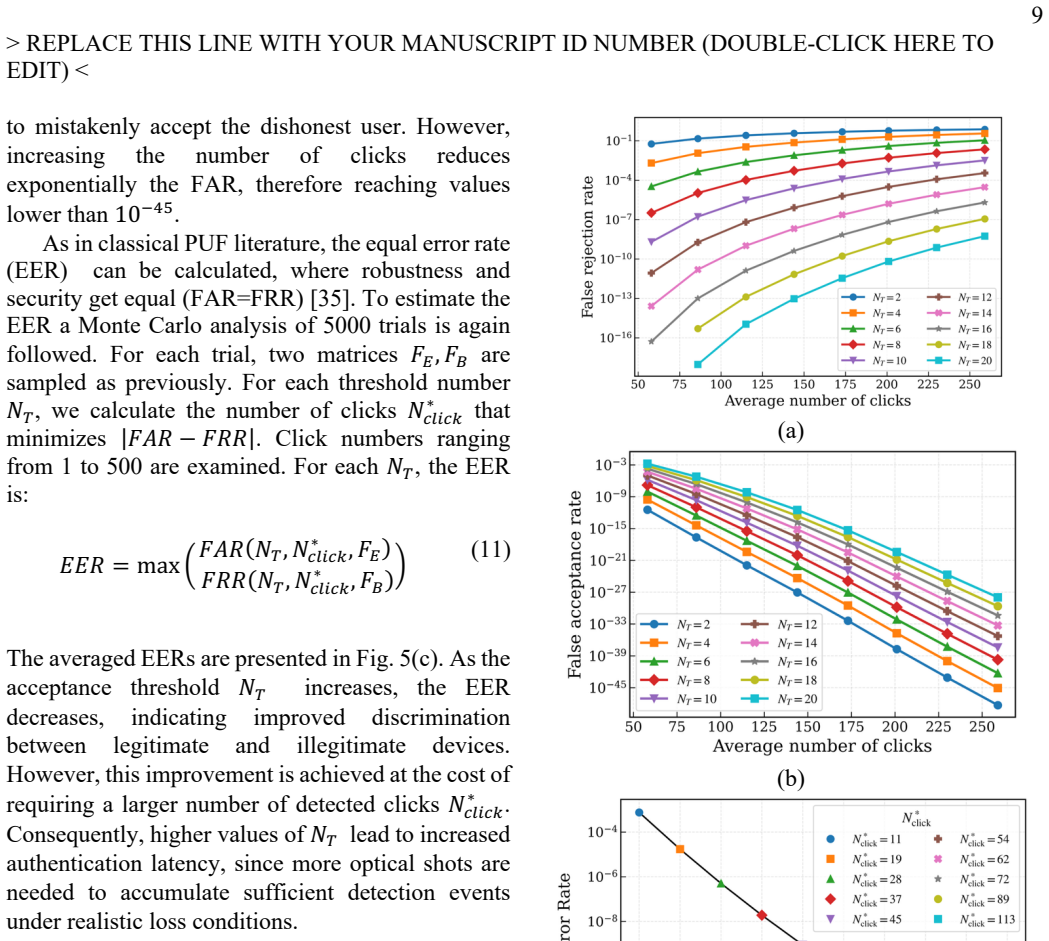
Physical Unclonable Functions (PUFs) are hardware security primitives whose inherent physical complexity can be exploited for secure authentication and cryptographic key generation. Silicon photonic devices, owing to their suitability for quantum and artificial intelligence applications alongside standard CMOS fabrication processes, constitute a highly promising substrate for integrated multifunctional PUFs. Despite the advanced security guarantees offered by quantum cryptographic protocols and the central role of silicon photonics in quantum technologies, quantum readout strategies based on single-photon states for photonic PUFs remain largely unexplored. In this work, we experimentally demonstrate a silicon nitride (SiN) programmable photonic Mach Zehnder interferometer mesh that implements a unitary transformation and operates as a PUF, whose secret physical signature arises from uncontrollable waveguide variations during fabrication. Using experimentally derived parameters from the SiN integrated mesh, we further introduce and numerically evaluate a quantum readout protocol that combines single-photon states with PUFs. Maximally mixed quantum states are employed to conceal the underlying unitary transformation from passive eavesdropping. Security against adversaries possessing devices fabricated under similar conditions is assessed, with authentication performance quantified through Monte Carlo analysis of the false acceptance and false rejection rates as a function of the number of detected events and corrected errors. The results indicate exceptional performance with equal error rates as low as 10 to the minus 14, highlighting the potential of quantum secure PUFs for high security authentication applications.
Editorial analysis
A structured set of objections, weighed in public.
Referee Report
Summary. The manuscript experimentally demonstrates a silicon nitride programmable photonic Mach-Zehnder interferometer mesh implementing a unitary transformation that functions as a PUF due to fabrication-induced waveguide variations. It then introduces a quantum readout protocol employing single-photon states and maximally mixed states to conceal the unitary from passive eavesdropping, with security against similar-process adversaries assessed and authentication performance quantified exclusively via Monte Carlo simulation of false-acceptance and false-rejection rates, yielding equal error rates as low as 10^{-14}.
Significance. If the Monte Carlo model faithfully incorporates all relevant quantum noise, loss, and eavesdropping channels, the work would indicate a viable route to quantum-secure high-performance authentication primitives on a CMOS-compatible silicon photonics platform; the classical mesh characterization supplies a concrete experimental foundation, though the headline performance numbers remain simulation-dependent.
major comments (3)
- [Abstract] Abstract: the headline claim of equal error rates as low as 10^{-14} is obtained solely from Monte Carlo simulation of the quantum protocol using experimentally derived parameters; no experimental single-photon readout, full quantum authentication, or raw data are presented, rendering the exceptional-performance assertion unverified and load-bearing for the central claim.
- [Monte Carlo analysis] Monte Carlo analysis (abstract and numerical evaluation section): the procedure lacks any description of the number of trials, explicit noise/loss models, eavesdropping channels, or derivation of the 10^{-14} figure, and reports no error bars or sensitivity analysis; this directly undermines reproducibility of the reported false-accept/reject rates.
- [Security assessment] Security assessment (abstract): the claim that security holds against adversaries possessing devices fabricated under similar conditions rests on the concealing power of the maximally mixed states; no quantitative bound on information leakage or concrete test against a same-process adversary is supplied, leaving the weakest assumption unaddressed.
minor comments (2)
- [Abstract] Abstract: explicitly state that the quantum protocol is evaluated numerically rather than demonstrated experimentally to prevent misreading the scope of the results.
- [Experimental section] The manuscript would benefit from a dedicated section or supplementary material containing the raw mesh transmission data, extracted unitary parameters, and full Monte Carlo code or pseudocode.
Simulated Author's Rebuttal
We thank the referee for the constructive and detailed comments. We address each major point below. Revisions will be made to clarify the scope of experimental versus numerical results, expand the Monte Carlo description, and strengthen the security discussion with additional quantitative analysis.
read point-by-point responses
-
Referee: [Abstract] Abstract: the headline claim of equal error rates as low as 10^{-14} is obtained solely from Monte Carlo simulation of the quantum protocol using experimentally derived parameters; no experimental single-photon readout, full quantum authentication, or raw data are presented, rendering the exceptional-performance assertion unverified and load-bearing for the central claim.
Authors: We agree that the abstract must explicitly distinguish the experimental classical characterization of the SiN MZI mesh (which supplies the unitary parameters) from the numerical Monte Carlo evaluation of the quantum protocol. The 10^{-14} figure is simulation-based. In revision we will rephrase the abstract to state that the PUF is experimentally demonstrated while the quantum readout performance is quantified numerically using those parameters, removing any implication of experimental quantum authentication. revision: yes
-
Referee: [Monte Carlo analysis] Monte Carlo analysis (abstract and numerical evaluation section): the procedure lacks any description of the number of trials, explicit noise/loss models, eavesdropping channels, or derivation of the 10^{-14} figure, and reports no error bars or sensitivity analysis; this directly undermines reproducibility of the reported false-accept/reject rates.
Authors: We accept that the current description is insufficient for reproducibility. The revised manuscript will add the number of Monte Carlo trials, explicit models for photon loss, detector noise, and the eavesdropping channel (including how maximally mixed states are prepared), the precise derivation of the equal-error-rate curves, and sensitivity plots with error bars obtained by varying key parameters within their experimental uncertainties. revision: yes
-
Referee: [Security assessment] Security assessment (abstract): the claim that security holds against adversaries possessing devices fabricated under similar conditions rests on the concealing power of the maximally mixed states; no quantitative bound on information leakage or concrete test against a same-process adversary is supplied, leaving the weakest assumption unaddressed.
Authors: The security argument is grounded in the information-theoretic hiding property of maximally mixed states. We will insert a new subsection deriving an upper bound on leaked information using the quantum relative entropy between the observed statistics and the maximally mixed case. A direct experimental confrontation with a same-process adversary would require a second independent fabrication run and is outside the present scope; we will note this limitation and identify it as future work while retaining the numerical assessment under the stated model. revision: partial
Circularity Check
No significant circularity detected
full rationale
The paper experimentally extracts unitary parameters from a fabricated SiN MZI mesh acting as a classical PUF and feeds those measured values into Monte Carlo simulations of a quantum authentication protocol. The reported EER values are simulation outputs, not quantities fitted to the target result or defined in terms of themselves. No self-citations, uniqueness theorems, or ansatzes are invoked in a load-bearing way that would reduce the central claims to the inputs by construction. The derivation chain remains independent of the reported performance numbers.
Axiom & Free-Parameter Ledger
axioms (1)
- domain assumption Maximally mixed quantum states conceal the underlying unitary transformation from passive eavesdropping
Reference graph
Works this paper leans on
-
[1]
Physical Unclonable Functions (PUF) for IoT Devices,
A. Al-Meer and S. Al-Kuwari, “Physical Unclonable Functions (PUF) for IoT Devices,” ACM Comput. Surv., vol. 55, no. 14s, p. 314:1-314:31, Apr. 2023, doi: 10.1145/3591464
-
[3]
S2RAM PUF: An Ultra-low Power Subthreshold SRAM PUF with Zero Bit Error Rate,
L. Ni and J. Zhang, “S2RAM PUF: An Ultra-low Power Subthreshold SRAM PUF with Zero Bit Error Rate,” in Proceedings of the 61st 12 > REPLACE THIS LINE WITH YOUR MANUSCRIPT ID NUMBER (DOUBLE-CLICK HERE TO EDIT) < ACM/IEEE Design Automation Conference, San Francisco CA USA: ACM, Jun. 2024, pp. 1–6. doi: 10.1145/3649329.3658246
-
[4]
J. Park et al., “Highly Reliable Physical Unclonable Functions using Memristor Crossbar with Tunneling Conduction,” in 2022 International Electron Devices Meeting (IEDM), Sep. 2022, p. 18.3.1-18.3.4. doi: 10.1109/IEDM45625.2022.10019539
-
[5]
Arbiter PUF—A Review of Design, Composition, and Security Aspects,
S. Hemavathy and V. S. K. Bhaaskaran, “Arbiter PUF—A Review of Design, Composition, and Security Aspects,” IEEE Access, vol. 11, pp. 33979–34004, 2023, doi: 10.1109/ACCESS.2023.3264016
-
[6]
Hardware assurance with silicon photonic physical unclonable functions,
M. A. Mahdian, E. Taheri, K. Rahbardar Mojaver, and M. Nikdast, “Hardware assurance with silicon photonic physical unclonable functions,” Sci Rep, vol. 14, no. 1, p. 25591, Oct. 2024, doi: 10.1038/s41598-024-72922-x
-
[8]
G. Sarantoglou, F. D. Ros, K. Sozos, A. Bogris, and C. Mesaritakis, “Reconfigurable Integrated Photonic Chips as Dual-Purpose Neuromorphic Accelerators and Physical Unclonable Functions,” Optics Letters, Jun. 2025, doi: 10.1364/OL.566148
-
[9]
Implementation of stable PUFs using gate oxide breakdown,
W.-C. Wang, Y. Yona, Y. Wu, S.-Y. Hung, S. Diggavi, and P. Gupta, “Implementation of stable PUFs using gate oxide breakdown,” in 2017 Asian Hardware Oriented Security and Trust Symposium (AsianHOST), IEEE, 2017, pp. 13–18
2017
-
[10]
Quantum crosstalk as a physically unclonable characteristic for quantum hardware verification,
C. Z. Chwa, L. A. Hsia, and L. D. Merkle, “Quantum crosstalk as a physically unclonable characteristic for quantum hardware verification,” in NAECON 2023-IEEE National Aerospace and Electronics Conference, IEEE, 2023, pp. 309–313
2023
-
[11]
Scaling and networking a modular photonic quantum computer,
H. Aghaee Rad et al., “Scaling and networking a modular photonic quantum computer,” Nature, vol. 638, no. 8052, pp. 912–919, Feb. 2025, doi: 10.1038/s41586-024-08406-9
-
[12]
Quantum readout of Physical Unclonable Functions,
B. Škorić, “Quantum readout of Physical Unclonable Functions,” Int. J. Quantum Inform., vol. 10, no. 01, p. 1250001, Feb. 2012, doi: 10.1142/S0219749912500013
-
[13]
Q. Li et al., “Quantum Physical Unclonable Function Based on Multidimensional Fingerprint Features of Single Photon Emitters in Random AlN Nanocrystals,” Advanced Functional Materials, vol. 35, no. 9, p. 2416216, 2025, doi: 10.1002/adfm.202416216
-
[14]
S. Roberts, X. Ji, J. Cardenas, M. Corato‐Zanarella, and M. Lipson, “Measurements and Modeling of Atomic‐Scale Sidewall Roughness and Losses in Integrated Photonic Devices,” Advanced Optical Materials, vol. 10, no. 18, p. 2102073, Sep. 2022, doi: 10.1002/adom.202102073
-
[15]
Pseudo-Random Generator based on a Photonic Neuromorphic Physical Unclonable Function,
D. Dermanis, P. Rizomiliotis, A. Bogris, and C. Mesaritakis, “Pseudo-Random Generator based on a Photonic Neuromorphic Physical Unclonable Function,” IEEE Journal of Quantum Electronics, pp. 1–1, 2024, doi: 10.1109/JQE.2024.3471951
-
[16]
C. Mesaritakis, P. Rizomiliotis, M. Akriotou, C. Chaintoutis, A. Fragkos, and D. Syvridis, “Photonic Pseudo-Random Number Generator for Internet-of-Things Authentication using a Waveguide based Physical Unclonable Function,” Jan. 31, 2020, arXiv: arXiv:2001.11794
-
[17]
Silicon photonic physical unclonable function,
B. C. Grubel et al., “Silicon photonic physical unclonable function,” Opt. Express, OE, vol. 25, no. 11, pp. 12710–12721, May 2017, doi: 10.1364/OE.25.012710
-
[18]
Progress on Chip-Based Spontaneous Four-Wave Mixing Quantum Light Sources,
H. Wang et al., “Progress on Chip-Based Spontaneous Four-Wave Mixing Quantum Light Sources,” Advanced Devices & Instrumentation, vol. 5, p. 0032, Jan. 2024, doi: 10.34133/adi.0032
-
[19]
J. Schneeloch et al., “Introduction to the absolute brightness and number statistics in spontaneous parametric down-conversion,” J. Opt., vol. 21, no. 4, p. 043501, Oct. 2019, doi: 10.1088/2040-8986/ab05a8
-
[20]
A Guideline on Pseudorandom Number Generation (PRNG) in the IoT,
P. Kietzmann, T. C. Schmidt, and M. Wählisch, “A Guideline on Pseudorandom Number Generation (PRNG) in the IoT,” ACM Comput. Surv., vol. 54, no. 6, pp. 1–38, Jul. 2022, doi: 10.1145/3453159
-
[21]
Physically Unclonable Functions: Concept and Constructions,
R. Maes, “Physically Unclonable Functions: Concept and Constructions,” in Physically Unclonable Functions, Berlin, Heidelberg: Springer Berlin Heidelberg, 2013, pp. 11–48. doi: 10.1007/978-3-642-41395-7_2
-
[22]
J. Carolan et al., “Universal linear optics,” Science, vol. 349, no. 6249, pp. 711–716, Aug. 2015, doi: 10.1126/science.aab3642
-
[23]
Enhancing quantum state tomography via resource-efficient attention-based neural networks,
A. M. Palmieri, “Enhancing quantum state tomography via resource-efficient attention-based neural networks,” Phys. Rev. Res., vol. 6, no. 3, 2024, doi: 10.1103/PhysRevResearch.6.033248
discussion (0)
Sign in with ORCID, Apple, or X to comment. Anyone can read and Pith papers without signing in.