Recognition: 2 theorem links
· Lean TheoremA Monte Carlo positronium decay source model with multiple annihilation channels in GATE
Pith reviewed 2026-05-15 02:52 UTC · model grok-4.3
The pith
A modular multi-channel positronium decay model has been implemented in GATE for Monte Carlo simulations.
A machine-rendered reading of the paper's core claim, the machinery that carries it, and where it could break.
Core claim
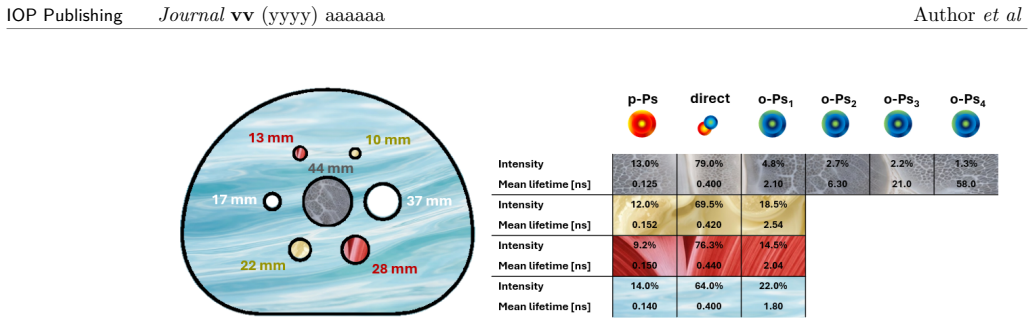
The model accurately samples from user-specified multi-component lifetime distributions and branching fractions while producing photon kinematics that match theoretical expectations for two- and three-photon annihilations, including cases with prompt photons, as shown through benchmarks and NEMA phantom simulations with a large field-of-view PET system.
What carries the argument
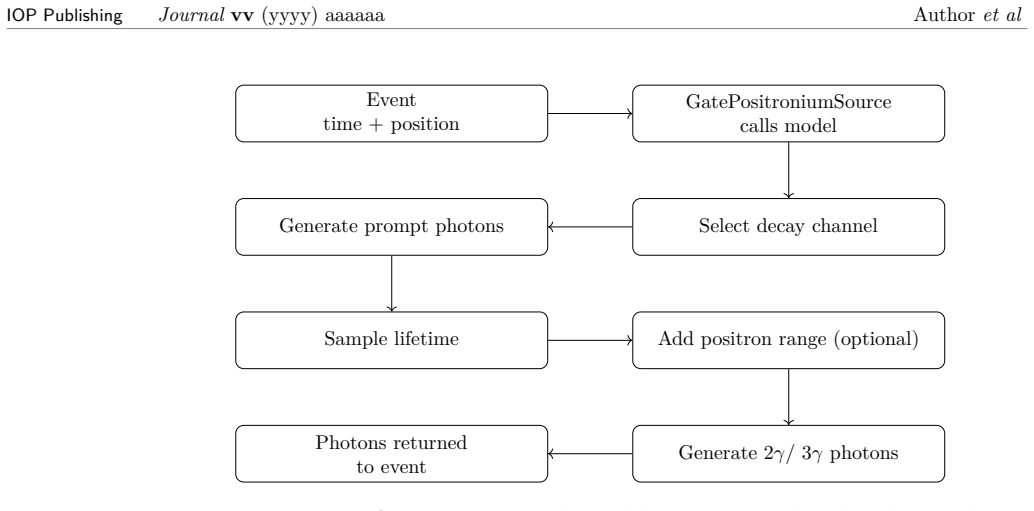
The modular Ps decay model allowing definition of arbitrary decay channels characterized by lifetime, branching fraction, annihilation multiplicity (2g/3g), and optional prompt photon emission.
If this is right
- Complex mixtures of decay channels with varying 3g-to-2g ratios are correctly modeled with observable signatures in temporal and energy distributions.
- The model enables generation of realistic positronium-sensitive datasets for medical imaging applications.
- Simulations of the NEMA IEC phantom demonstrate practical use with standard PET systems.
- Supports development and optimisation of positronium-based imaging like PLI and multi-photon PET.
Where Pith is reading between the lines
- This could facilitate testing of new detection algorithms for multi-photon PET by providing controlled simulation data.
- Applications might extend to material science studies where positronium lifetime is sensitive to the surrounding medium.
- Integration into standard GATE workflows allows seamless incorporation into existing simulation pipelines for tomography.
Load-bearing premise
The model assumes that the decay channels are independent and that standard Monte Carlo sampling of exponential lifetimes and photon kinematics is sufficient without additional medium-dependent effects or correlations.
What would settle it
If simulated lifetime spectra from a mixture of channels do not match the expected weighted sum of exponential distributions, or if the energy spectra of annihilation photons deviate from the theoretical shapes for 2-gamma and 3-gamma events.
Figures




read the original abstract
Positronium-based imaging requires realistic modelling of positronium (Ps) decay in matter. We introduce a modular Ps decay model implemented in GATE 9.4 and GATE 10, enabling the definition of an arbitrary number of decay channels characterised by lifetime, branching fraction, annihilation multiplicity (2g/3g), and optional prompt photon emission. The model is validated through analytical and numerical benchmarks, including lifetime distributions, branching fraction consistency, photon kinematics, and prompt photon emission. Its practical applicability is demonstrated using simulations of mixed annihilation scenarios and the NEMA IEC phantom with a large field-of-view PET system. The proposed model accurately reproduces input lifetime distributions as weighted sums of exponential components and correctly samples decay channel fractions. Simulated two- and three-photon annihilation kinematics are consistent with theoretical expectations. Complex mixtures of decay channels, including varying 3g-to-2g ratios and multi-component ortho-positronium lifetimes, are correctly modelled, with observable signatures reflected in both temporal and energy distributions. Phantom simulations demonstrate the capability to generate realistic positronium-sensitive datasets. This work provides the first general-purpose, multi-channel positronium decay model integrated into GATE, enabling realistic simulations of positronium behaviour in complex media. The model supports the development and optimisation of positronium-based imaging techniques, including PLI and multi-photon PET, and applies to medical imaging, industrial tomography, and fundamental physics studies. Its public availability and compatibility with standard GATE workflows make it a valuable tool for the broader research community.
Editorial analysis
A structured set of objections, weighed in public.
Referee Report
Summary. The manuscript introduces a modular Monte Carlo positronium decay source model implemented in GATE 9.4 and GATE 10. Users can define an arbitrary number of decay channels, each specified by lifetime, branching fraction, annihilation multiplicity (2γ or 3γ), and optional prompt photon emission. The model is validated against analytical lifetime distributions (as weighted sums of exponentials), branching fraction consistency, photon kinematics, and prompt photon emission. Practical applicability is shown through simulations of mixed annihilation scenarios and the NEMA IEC phantom with a large field-of-view PET system, where temporal and energy distributions reflect the input parameters.
Significance. If the implementation and sampling are correct as claimed, this provides the first general-purpose multi-channel positronium decay model integrated into the widely used GATE toolkit. It enables realistic simulations of positronium behavior in complex media, directly supporting development of positronium lifetime imaging (PLI) and multi-photon PET. The public availability, compatibility with standard workflows, and explicit validation against analytical expectations are notable strengths that lower the barrier for reproducible research in medical imaging, industrial tomography, and fundamental physics.
major comments (2)
- [§3] §3 (Model description): The central claim that the model correctly samples weighted exponential lifetime sums and branching fractions relies on the independence assumption and standard Monte Carlo procedures; however, the text does not quantify sampling accuracy (e.g., via Kolmogorov-Smirnov distances or maximum deviation from analytical CDFs) beyond visual agreement in the reported figures.
- [§4.3] §4.3 (Phantom simulations): The NEMA IEC phantom results demonstrate observable signatures in time and energy spectra for mixed 2γ/3γ and multi-lifetime scenarios, but the section does not report how the chosen branching fractions and lifetimes map to realistic tissue-dependent values or test sensitivity to small parameter perturbations.
minor comments (3)
- [Abstract] The abstract states compatibility with GATE 9.4 and 10; the methods section should explicitly list any version-specific code changes or required patches for reproducibility.
- Figure captions for the validation plots should include the exact input parameter sets (lifetimes, branching ratios, prompt energies) used to generate each curve.
- [§4] A short table summarizing the analytical benchmarks (target distributions, sampling method, and acceptance criteria) would improve clarity in the validation section.
Simulated Author's Rebuttal
We thank the referee for the positive assessment and constructive comments on our manuscript. We address each major comment below and have revised the manuscript accordingly where appropriate.
read point-by-point responses
-
Referee: [§3] §3 (Model description): The central claim that the model correctly samples weighted exponential lifetime sums and branching fractions relies on the independence assumption and standard Monte Carlo procedures; however, the text does not quantify sampling accuracy (e.g., via Kolmogorov-Smirnov distances or maximum deviation from analytical CDFs) beyond visual agreement in the reported figures.
Authors: We agree that quantitative metrics strengthen the validation claims. In the revised manuscript we have added Kolmogorov-Smirnov statistics and maximum absolute deviations between the sampled and analytical CDFs for all lifetime distributions shown in Section 3. These confirm agreement to within 0.8 % maximum deviation and KS p-values > 0.99, consistent with the visual matches already presented. revision: yes
-
Referee: [§4.3] §4.3 (Phantom simulations): The NEMA IEC phantom results demonstrate observable signatures in time and energy spectra for mixed 2γ/3γ and multi-lifetime scenarios, but the section does not report how the chosen branching fractions and lifetimes map to realistic tissue-dependent values or test sensitivity to small parameter perturbations.
Authors: The parameters were chosen as representative values drawn from the positronium lifetime literature for water and soft tissue. We have revised Section 4.3 to include explicit references to these literature values and a short table mapping the simulated lifetimes and branching fractions to typical tissue ranges. A full sensitivity study to small perturbations lies beyond the scope of an implementation-focused paper; the modular model is designed precisely so that users can perform such analyses themselves. We have added a clarifying sentence to this effect. revision: partial
Circularity Check
No significant circularity in implementation and validation
full rationale
The paper presents a software implementation of a user-parameterized Monte Carlo positronium decay model in GATE, with validation performed by direct comparison of sampled outputs (lifetime histograms, branching fractions, 2g/3g kinematics) against independent analytical expectations for weighted exponential sums and standard photon distributions. No equations derive new results from fitted parameters defined by the same data, no self-citations bear the load of uniqueness or ansatz choices, and the model explicitly treats decay channels as independent inputs rather than predicting them from internal structure. The work is therefore self-contained as an engineering contribution without reduction of outputs to its own inputs by construction.
Axiom & Free-Parameter Ledger
axioms (2)
- domain assumption Positronium lifetimes follow exponential distributions whose parameters are supplied by the user for each channel.
- domain assumption Photon emission directions and energies for 2g and 3g annihilations follow known kinematic distributions independent of the medium.
Lean theorems connected to this paper
-
IndisputableMonolith/Cost/FunctionalEquation.leanwashburn_uniqueness_aczel unclear?
unclearRelation between the paper passage and the cited Recognition theorem.
modular Ps decay model... arbitrary number of decay channels characterised by lifetime, branching fraction, annihilation multiplicity (2γ/3γ), and optional prompt photon emission... reproduces input lifetime distributions as weighted sums of exponential components
-
IndisputableMonolith/Foundation/RealityFromDistinction.leanreality_from_one_distinction unclear?
unclearRelation between the paper passage and the cited Recognition theorem.
validated through analytical and numerical benchmarks, including lifetime distributions, branching fraction consistency, photon kinematics
What do these tags mean?
- matches
- The paper's claim is directly supported by a theorem in the formal canon.
- supports
- The theorem supports part of the paper's argument, but the paper may add assumptions or extra steps.
- extends
- The paper goes beyond the formal theorem; the theorem is a base layer rather than the whole result.
- uses
- The paper appears to rely on the theorem as machinery.
- contradicts
- The paper's claim conflicts with a theorem or certificate in the canon.
- unclear
- Pith found a possible connection, but the passage is too broad, indirect, or ambiguous to say the theorem truly supports the claim.
Reference graph
Works this paper leans on
-
[1]
Adkins, G. S., Fell, R. N., and Sapirstein, J. (2002). Two-loop correction to the orthopositronium decay rate.Annals of Physics, 295(2):136–193
work page 2002
-
[2]
Adkins, G. S., McGovern, N. M., Fell, R. N., and Sapirstein, J. (2003). Two-loop corrections to the decay rate of parapositronium.Phys. Rev. A, 68:032512
work page 2003
-
[3]
M., Yamashita, T., Yarba, J., and Yoshida, H
Wright, D. M., Yamashita, T., Yarba, J., and Yoshida, H. (2016). Recent developments in geant4. Nuclear Instruments and Methods in Physics Research Section A: Accelerators, Spectrometers, Detectors and Associated Equipment, 835:186–225
work page 2016
-
[4]
Dulski, K. (2020). Pals avalanche — a new pal spectra analysis software.Acta Phys. Pol. A, 137(2):167–170
work page 2020
-
[5]
Y., Silarski, M., Skurzok, M andWiślicki, W., Zgardzińska, B., and P, M
Shopa, R. Y., Silarski, M., Skurzok, M andWiślicki, W., Zgardzińska, B., and P, M. (2018). Commissioning of the j-pet detector in view of the positron annihilation lifetime spectroscopy. Hyperfine Interact, 239(40):1
work page 2018
-
[6]
Fujimoto, M., Shimazoe, K., Sato, R., Hamdan, M., Uenomachi, M., Stephenson, L., Montgomery, A., Bordes, J., Watts, D., Caradonna, P., and Brown, J. (2025). Advancing pet through direct imaging of three-photon decay using pure positron emitters
work page 2025
-
[7]
Harpen, M. D. (2003). Positronium: Review of symmetry, conserved quantities and decay for the radiological physicist.Med. Phys., 31(1):57–61
work page 2003
-
[8]
Hourlier, A., Boisson, F., and Brasse, D. (2024). Experimental uses of positronium and potential for biological applications.IEEE Transactions on Radiation and Plasma Medical Sciences, 8(6):581–594
work page 2024
-
[9]
Y., Moskal, P., Stepien, E., and Qi, J
Huang, B., Li, T., Arino-Estrada, G., Dulski, K., Shopa, R. Y., Moskal, P., Stepien, E., and Qi, J. (2024). Split: Statistical positronium lifetime image reconstruction via time-thresholding.IEEE Trans Med Imaging, 43(6):2148–2158
work page 2024
- [10]
-
[11]
Huang, B., Wang, Z., Zeng, X., Goldan, A. H., and Qi, J. (2025). Fast high-resolution lifetime image reconstruction for positron lifetime tomography.Commun Phys, 8(1):181
work page 2025
-
[12]
Melot, F., Merheb, C., Pennacchio, E., Perez, J., Pietrzyk, U., Rannou, F. R., Rey, M., Schaart, D. R., Schmidtlein, C. R., Simon, L., Song, T. Y., Vieira, J.-M., Visvikis, D., Walle, R. V. D., Wieërs, E., and Morel, C. (2004). Gate: A simulation toolkit for pet and spect.Phys. Med. Biol., 49(19):4543–4561. Jasińska, B., Gorgol, M., Wiertel, M., Zaleski, ...
work page 2004
-
[13]
Rundel, O., Sharma, N., Silarski, M., Słomski, A., Strzelecki, A., Wieczorek, A., Wiślicki, W., Zgardzińska, B., Zieliński, M., and Moskal, P. (2016). Determination of the $3\gamma $ fraction from positron annihilation in mesoporous materials for symmetry violation experiment with j-pet scanner.Acta Phys. Pol. B, 47(2):453
work page 2016
-
[14]
Kacperski, K. and Spyrou, N. M. (2005). Performance of three-photon pet imaging: Monte carlo simulations.Physics in Medicine and Biology, 50(23):5679–5695
work page 2005
-
[15]
Kacperski, K., Spyrou, N. M., and Smith, F. A. (2004). Three-gamma annihilation imaging in positron emission tomography.IEEE Trans Med Imaging, 23(4):525–529
work page 2004
-
[16]
Tsoumpas, C., Zhang, J., Ziemons, K., and Sarrut, D. (2026). Gate 10 monte carlo particle transport simulation: Ii. architecture and innovations.Phys. Med. Biol., 71(1):015043. Laboratoire National Henri Becquerel (LNHB) (2026). Table of radionuclides / nuclear data tables. Accessed: 2026-04-24
work page 2026
-
[17]
M., Läppchen, T., Amon, M., Bregenzer, C., Conti, M., Cardoso, Â
Mercolli, L., Steinberger, W. M., Läppchen, T., Amon, M., Bregenzer, C., Conti, M., Cardoso, Â. R. F., Mingels, C., Moskal, P., Rathod, N., Sari, H., Stępień, E. Ł., Weidner, S., Rominger, A., Shi, K., and Seifert, R. (2026). In vivo voxel-wise positronium lifetime imaging of thyroid cancer using clinically routine i-124 pet/ct.EANM Innovation, 2:100017
work page 2026
-
[18]
M., Sari, H., Afshar-Oromieh, A., Caobelli, F., Conti, M., Felgosa Cardoso, Â
Mercolli, L., Steinberger, W. M., Sari, H., Afshar-Oromieh, A., Caobelli, F., Conti, M., Felgosa Cardoso, Â. R., Mingels, C., Moskal, P., Pyka, T., Rathod, N., Schepers, R., Stępień, E. Ł., Viscione, M., Rominger, A., Shi, K., and Seifert, R. (2024). In vivo positronium lifetime measurements with intravenous tracer administration and a long axial field-of...
work page 2024
-
[19]
T., Tanty, P., Wiślicki, W., Królicki, L., and Stępień, E
Silarski, M., Skurzok, M., Tayefi, F., Ardebili, K. T., Tanty, P., Wiślicki, W., Królicki, L., and Stępień, E. Ł. (2024). Positronium image of the human brain in vivo.Science Advances, 10(37):eadp2840
work page 2024
-
[20]
Y., Silarski, M., Skurzok, M., Stępień, E., Wiślicki, W., and Zgardzińska, B
Kozik, T., Kubicz, E., Mohammed, M., Niedźwiecki, S., Pałka, M., Pawlik-Niedźwiecka, M., Raczyński, L., Raj, J., Sharma, S., Shivani, Shopa, R. Y., Silarski, M., Skurzok, M., Stępień, E., Wiślicki, W., and Zgardzińska, B. (2019). Feasibility study of the positronium imaging with the j-pet tomograph.Phys. Med. Biol., 64(5):055017. NEMA (2018). Nema standar...
work page 2019
-
[21]
Ore, A. and Powell, J. L. (1949). Three-photon annihilation of an electron-positron pair.Phys. Rev., 75(11):1696–1699
work page 1949
-
[22]
Pevovar, S. C., Weber, M. H., and Lynn, K. G. (2007). Ratio of positron annihilation into three photons versus two.physica status solidi c, 4(10):3447–3450
work page 2007
-
[23]
Qi, J. and Huang, B. (2022). Positronium lifetime image reconstruction for tof pet.IEEE Trans Med Imaging, 41(10):2848–2855. Raczyński, L., Krzemień, W., Coussat, A., Bała, M., Hiesmayr, B. C., Klimaszewski, K., Obara, M., and Shopa, R. Y. (2026). Ortho-positronium three-photon decays: Physics constraints and a closed-form energy method for annihilation v...
work page 2022
-
[24]
Tsoumpas, C., Zhang, J., Ziemons, K., and Krah, N. (2026). Gate 10 monte carlo particle transport simulation: I. development and new features.Phys. Med. Biol., 71(1):015042
work page 2026
-
[25]
Papadimitroulas, P., Pommranz, C., Roncali, E., Rucinski, A., Winterhalter, C., and Maigne, L. (2022). The opengate ecosystem for monte carlo simulation in medical physics.Phys. Med. Biol., 67(18):184001
work page 2022
-
[26]
Visvikis, D., Ziemons, K., Zvolský, M., and Roncali, E. (2021). Advanced monte carlo simulations of emission tomography imaging systems with gate.Phys. Med. Biol., 66(10):10TR03. 21 IOP PublishingJournalvv(yyyy) aaaaaa Authoret al
work page 2021
-
[27]
Shibuya, K., Saito, H., Nishikido, F., Takahashi, M., and Yamaya, T. (2020). Oxygen sensing ability of positronium atom for tumor hypoxia imaging.Commun Phys, 3(1):173. Siemens Healthineers (2022).Biograph Vision PET/CT
work page 2020
-
[28]
Moskal, P., Stepien, E., Rominger, A., Shi, K., and Conti, M. (2024). Positronium lifetime validation measurements using a long-axial field-of-view positron emission tomography scanner. EJNMMI Physics, 11(1):76
work page 2024
-
[29]
Tashima, H., Takyu, S., Nishikido, F., Takahashi, M., and Yamaya, T. (2023). Modeling positronium lifetime distribution in geant4 monte carlo simulation. In2023 IEEE Nuclear Science Symposium, Medical Imaging Conference and International Symposium on Room-Temperature Semiconductor Detectors (NSS MIC RTSD), pages 1–1
work page 2023
-
[30]
Tashima, H. and Yamaya, T. (2024). Three-gamma imaging in nuclear medicine: A review.IEEE Trans. Radiat. Plasma Med. Sci., 8(8):853–866. 22 IOP PublishingJournalvv(yyyy) aaaaaa Authoret al A Supplementary material for section 5 (Results) (a) Lifetime: 2 ns (b) Lifetime: 40 ns (c) Lifetime: 100 ns Figure 11.Stacked histograms of energy deposition for the t...
work page 2024
discussion (0)
Sign in with ORCID, Apple, or X to comment. Anyone can read and Pith papers without signing in.