Recognition: no theorem link
Multi-Agentic Approach for History Matching of Oil Reservoirs
Pith reviewed 2026-05-15 02:59 UTC · model grok-4.3
The pith
PetroGraph deploys specialized LLM agents to automate history matching and reduce reservoir mismatch by 95 percent on SPE1, 69 percent on SPE9, and 13 percent on Norne.
A machine-rendered reading of the paper's core claim, the machinery that carries it, and where it could break.
Core claim
PetroGraph decomposes history matching into a set of cooperating agents that handle model review, planning, parameterization, optimization, simulation execution, and result summarization; when evaluated on the SPE1, SPE9, and Norne models it reduces mismatch by 95 percent, 69 percent, and 13 percent respectively under a weighted normalized root-mean-square-error objective.
What carries the argument
The multi-agent orchestration layer that couples LLM agents to validation routines for modified ECLIPSE input decks and an OPM Flow simulation backend.
If this is right
- Users can launch and steer history matching through natural language while keeping explicit oversight of chosen parameters and optimizer settings.
- The same agent structure supplies a reusable foundation for extending reservoir-model adaptation to new field data or simulator types.
- Automation of parameter selection and optimizer tuning reduces the manual configuration steps that currently limit practical deployment.
- Human-in-the-loop checkpoints remain available at key stages to preserve engineering control.
Where Pith is reading between the lines
- The framework could be tested on additional real-field models to determine whether the performance drop seen on Norne is typical of increasing geological complexity.
- Replacing the current OPM Flow backend with a higher-fidelity commercial simulator might improve the absolute mismatch reductions without changing the agent architecture.
- The approach may generalize to other inverse calibration tasks that involve large input decks and expensive forward simulations, such as groundwater or geothermal modeling.
Load-bearing premise
Large-language-model agents can consistently produce valid ECLIPSE decks and select physically admissible parameters without introducing systematic errors that the reported mismatch metrics would miss.
What would settle it
Run the generated input decks on an independent simulator and check whether any deck produces non-physical parameter values or simulator crashes that the weighted normalized root-mean-square-error score does not flag.
Figures






read the original abstract
History matching is a central inverse problem in reservoir engineering, where uncertain reservoir parameters must be calibrated against observations. Although automated history matching can reduce manual effort, practical deployment remains difficult because engineers must still configure heterogeneous workflows involving parameter selection, physically admissible bounds, optimizer choice, hyperparameter tuning, simulator execution, and diagnostic reporting. We propose PetroGraph, a multi-agent framework for intelligent reservoir history matching that decomposes this workflow into specialized agents for model review, experimental planning, parameterization, optimization, simulation, and summarization. The system combines large language model agents with domain-specific tools, retrieval-augmented access to simulator documentation, validation of modified ECLIPSE input decks, human-in-the-loop checkpoints, and an OPM Flow-based simulation backend. This design enables users to initiate and steer history matching through natural language while preserving explicit control over selected parameters and optimization settings. We evaluate PetroGraph on three reservoir models of increasing complexity: the synthetic SPE1 model, the faulted SPE9 benchmark, and the real-field Norne model. Using weighted normalized root mean square error as the objective, PetroGraph reduces the mismatch by 95% on SPE1, 69% on SPE9, and 13% on Norne. These results demonstrate that multi-agent orchestration can automate key decisions in history matching, lower the expertise barrier for operating complex simulation workflows, and provide a flexible foundation for extensible, domain-aware reservoir model adaptation.
Editorial analysis
A structured set of objections, weighed in public.
Referee Report
Summary. The paper proposes PetroGraph, a multi-agent LLM-based framework that decomposes reservoir history matching into specialized agents (model review, experimental planning, parameterization, optimization, simulation, summarization) augmented with RAG on simulator documentation, ECLIPSE deck validation, human-in-the-loop checkpoints, and an OPM Flow backend. On three benchmarks of increasing complexity (SPE1, SPE9, Norne), the system reports mismatch reductions of 95%, 69%, and 13% respectively under weighted normalized root mean square error, with the claim that natural-language steering can automate key workflow decisions while preserving user control over parameters and settings.
Significance. If the empirical reductions hold under more rigorous validation, the work shows that multi-agent orchestration with domain tools can lower the expertise barrier for operating complex reservoir simulators and offers an extensible template for other engineering inverse problems. The explicit handling of deck validity and human checkpoints is a practical strength that directly targets deployment risks in LLM-driven simulation workflows.
major comments (2)
- [Experimental evaluation] Experimental evaluation (abstract and results section): the reported mismatch reductions of 95% (SPE1), 69% (SPE9), and 13% (Norne) are given as single-point figures with no error bars, no repeated runs, and no ablation studies isolating the contribution of RAG, deck validation, or human checkpoints; this leaves the robustness of the central quantitative claims unquantified.
- [Methodology] Methodology section: insufficient detail is provided on post-hoc handling of agent-generated invalid decks or unphysical parameter selections, despite these being identified as core risks; without explicit metrics on failure rates or correction success, it is unclear whether the measured improvements reflect reliable automation or selective reporting.
minor comments (1)
- [Abstract] The abstract and results could more explicitly state the precise definition of the weighted NRMSE objective and the number of simulation runs underlying each percentage reduction.
Simulated Author's Rebuttal
We thank the referee for their constructive and detailed feedback, which highlights important aspects of experimental robustness and methodological transparency. We address each major comment below and indicate the planned revisions.
read point-by-point responses
-
Referee: [Experimental evaluation] Experimental evaluation (abstract and results section): the reported mismatch reductions of 95% (SPE1), 69% (SPE9), and 13% (Norne) are given as single-point figures with no error bars, no repeated runs, and no ablation studies isolating the contribution of RAG, deck validation, or human checkpoints; this leaves the robustness of the central quantitative claims unquantified.
Authors: We agree that presenting single-point results without error bars, repeated runs, or ablations limits the ability to assess robustness. The reported figures reflect single representative executions chosen to illustrate feasibility across benchmarks of increasing complexity, given the substantial computational cost of full-field simulations such as Norne. In the revised manuscript we will add a dedicated limitations subsection that explicitly discusses LLM stochasticity and the single-run nature of the experiments. We will also include ablation results isolating the contribution of RAG (by comparing runs with and without retrieval) and a brief analysis of human-checkpoint intervention frequency for the smaller SPE1 and SPE9 cases, where additional runs are computationally feasible. revision: partial
-
Referee: [Methodology] Methodology section: insufficient detail is provided on post-hoc handling of agent-generated invalid decks or unphysical parameter selections, despite these being identified as core risks; without explicit metrics on failure rates or correction success, it is unclear whether the measured improvements reflect reliable automation or selective reporting.
Authors: We acknowledge that the current methodology description does not sufficiently detail the post-hoc correction mechanisms or provide quantitative failure-rate metrics. The system relies on automated ECLIPSE deck validation combined with human-in-the-loop checkpoints to detect and correct invalid decks or unphysical parameter selections. In the revised version we will expand the methodology section with a new subsection that (i) describes the exact correction workflow (re-prompting of the parameterization agent, fallback to default bounds, or human override), (ii) reports the observed rates of invalid decks and unphysical selections across the three benchmarks, and (iii) quantifies the fraction of cases resolved automatically versus those requiring human intervention. This will make clear that the reported mismatch reductions incorporate the full safeguard pipeline rather than selective reporting. revision: yes
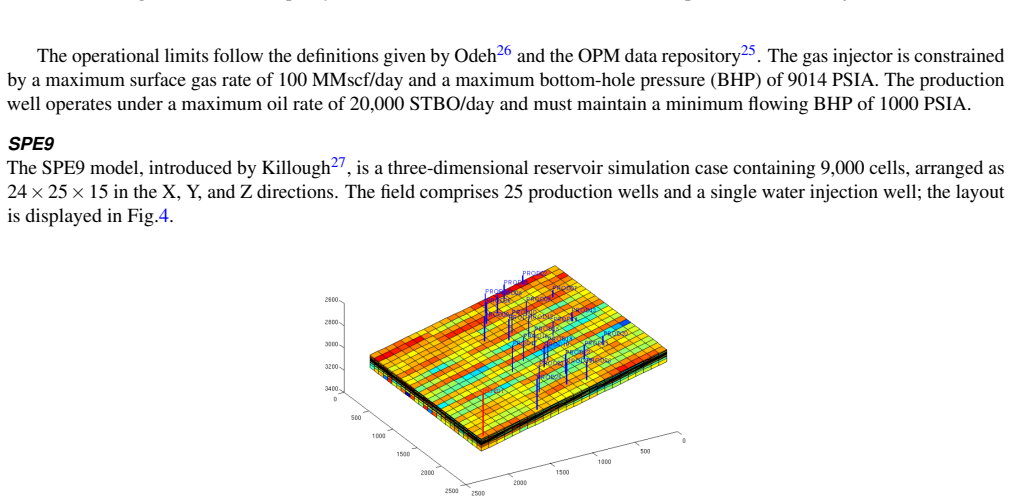
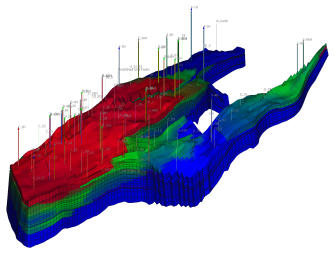
Circularity Check
No significant circularity identified
full rationale
The paper is an empirical systems paper that proposes a multi-agent LLM framework (PetroGraph) for history matching and reports measured mismatch reductions on fixed benchmark models (SPE1, SPE9, Norne) using weighted NRMSE. No derivation chain, first-principles equations, or predictions are presented that reduce to inputs by construction. The workflow description (agent decomposition, deck validation, RAG, human checkpoints) and results are presented as experimental outcomes rather than self-referential fits or renamed known results. No self-citation load-bearing steps or ansatz smuggling appear in the provided text.
Axiom & Free-Parameter Ledger
invented entities (1)
-
PetroGraph multi-agent framework
no independent evidence
Reference graph
Works this paper leans on
-
[1]
Samoil, S., Fare, C., Jordan, K. E. & Chen, Z. History matching reservoir models with many objective bayesian optimization. Appl. AI Lett.5, e99, DOI: https://doi.org/10.1002/ail2.99 (2024). https://onlinelibrary.wiley.com/doi/pdf/10.1002/ail2.99
-
[2]
Oliver, D. S. & Chen, Y . Recent progress on reservoir history matching: a review.Comput. Geosci.15, 185–221, DOI: 10.1007/s10596-010-9194-2 (2011)
-
[3]
Chai, Z., Nwachukwu, A., Zagayevskiy, Y ., Amini, S. & Madasu, S. An integrated closed-loop solution to assisted history matching and field optimization with machine learning techniques.J. Petroleum Sci. Eng.198, 108204, DOI: https://doi.org/10.1016/j.petrol.2020.108204 (2021). 4.Naji, S. Multi-agent systems: A review study.Ibn Al-Haitham J. for Pure Appl...
-
[4]
Jimenez-Romero, C., Yegenoglu, A. & Blum, C. Multi-agent systems powered by large language models: Applications in swarm intelligence.Front. Artif. Intell.8, DOI: 10.3389/frai.2025.1593017 (2025)
- [5]
-
[6]
arXiv preprint arXiv:2503.23315(2025)
Elrefaie, M.et al.Ai agents in engineering design: A multi-agent framework for aesthetic and aerodynamic car design. arXiv preprint arXiv:2503.23315(2025)
-
[7]
Du, C., Esser, S., Nousias, S. & Borrmann, A. Text2bim: Generating building models using a large language model-based multi-agent framework.arXiv preprint arXiv:2403.05615(2024)
- [8]
-
[9]
Lim, J., V ogel-Heuser, B. & Kovalenko, I. Large language model-enabled multi-agent manufacturing systems.arXiv preprint arXiv:2406.18939(2024)
-
[10]
Zhang, Y ., Wang, X., Li, Z.et al.An llm-powered multi-agent system for power grid control.arXiv preprint arXiv:2501.01541(2025)
work page internal anchor Pith review Pith/arXiv arXiv 2025
-
[11]
Gkournelos, C., Konstantinou, C. & Makris, S. An llm-based approach for enabling seamless human–robot collaboration in assembly.CIRP AnnalsDOI: 10.1016/j.cirp.2024.04.002 (2024)
-
[12]
Hao, Y . A multi-agent debate workflow for construction projects: A cross-stage decision framework.J Build Des Environ 3(2025). 15.Alada ˘g, H. & I¸ sık, Z. Multi agent system (mas) use in construction management literature (2019)
work page 2025
-
[13]
Accessed: 2025-10-15, 2501.01205
Mushtaq, A.et al.Harnessing multi-agent llms for complex engineering problem-solving: A framework for senior design projects (2025). Accessed: 2025-10-15, 2501.01205
-
[14]
Accessed: 2025-10-15, 2511.15752
Yan, H.et al.Build ai assistants using large language models and agents to enhance the engineering education of biomechanics (2025). Accessed: 2025-10-15, 2511.15752
-
[15]
Du, H., Thudumu, S., Nguyen, H., Vasa, R. & Mouzakis, K. A comprehensive survey on context-aware multi-agent systems: Techniques, applications, challenges and future directions (2024). Accessed: 2025-10-15, 2402.01968
-
[16]
Yue, L., Somasekharan, N., Zhang, T., Cao, Y . & Pan, S. Foam-agent 2.0: An end-to-end composable multi-agent framework for automating cfd simulation in openfoam (2025). 2509.18178. 20.Chen, Y ., Zhu, X., Zhou, H. & Ren, Z. Metaopenfoam: an llm-based multi-agent framework for cfd (2024). 2407.21320
-
[17]
Hou, S., Johnson, R., Makhija, R., Chen, L. & Ye, Y . Autofea: Enhancing ai copilot by integrating finite element analysis using large language models with graph neural networks.Proc. AAAI Conf. on Artif. Intell.39, 24078–24085, DOI: 10.1609/aaai.v39i22.34582 (2025). 22.Zhang, T., Liu, Z., Xin, Y . & Jiao, Y . Mooseagent: A llm based multi-agent framework...
-
[18]
opm-data: Datasets for testing opm simulator
OPM (Open Porous Media) Initiative. opm-data: Datasets for testing opm simulator. GitHub repository (2023). Includes the Norne field model case
work page 2023
-
[19]
Odeh, A. S. Comparison of solutions to a three-dimensional black-oil reservoir simulation problem (includes associated paper 9741 ).J. Petroleum Technol.33, 13–25, DOI: 10.2118/9723-PA (1981). https://onepetro.org/JPT/article-pdf/33/01/ 13/2229415/spe-9723-pa.pdf
-
[20]
SPE Reservoir Simulation Sym- posium ofSPE Reservoir Simulation Conference
Ninth SPE Comparative Solution Project: A Reexamination of Black-Oil Simulation, vol. SPE Reservoir Simulation Sym- posium ofSPE Reservoir Simulation Conference. DOI: 10.2118/29110-MS. https://onepetro.org/spersc/proceedings-pdf/ 95RSS/95RSS/SPE-29110-MS/3130251/spe-29110-ms.pdf
-
[21]
Chen, Y . & Oliver, D. S. History matching of the norne full-field model with an iterative ensemble smoother.SPE Reserv. Eval. & Eng.17, 244–256, DOI: 10.2118/164902-PA (2014). https://onepetro.org/REE/article-pdf/17/02/244/2127718/ spe-164902-pa.pdf. 29.Team, Q. Qwen3.5: Accelerating productivity with native multimodal agents (2026). 12/24 A Appendix: Gr...
-
[22]
DATA file consists of sections, sections have keywords
-
[23]
Use get description for sections and keywords to be more precise
-
[24]
In the end, when you are done, add reservoir description by tool ‘ add_reservoir_description‘. Planner Agent System Prompt System: You are a Petroleum Reservoir History Matching expert in PetroGraph, specializing in Design of Experiments (DoE). Your task is to design a DoE strategy for two agents: Parameterizer and Optimizer, based on the model descriptio...
-
[25]
Base estimator (e.g., Gaussian Process)
-
[26]
Number of initial points
-
[27]
Initial point generator (e.g., Sobol, Latin Hypercube, Random)
-
[28]
Acquisition function (e.g., EI, LCB, PI, gp_hedge)
-
[29]
- Maximum task dimension **< 40 ** (current dimension: {task_dimension})
Number of iterations **Constraints** 15/24 - If using **Sobol** initial point generator: - Number of initial points **must be a power of 2 ** (4, 8, 16, 32, ...). - Maximum task dimension **< 40 ** (current dimension: {task_dimension}). - If task_dimension > 40, **do not choose Sobol **. **Input from Planner Agent ** DoE (Design of Experiments) plan: {opt...
-
[30]
Call ‘set_bayesian_optimizer_config‘ with your chosen values
-
[31]
Briefly justify each choice (1-2 sentences per hyperparameter), referencing the DoE plan and constraints. Be concise but precise. Prioritize sampling efficiency and robustness for reservoir history matching. Summarizer Agent System Prompt Summarize this result of PetroGraph‘s History-Matching Agent into a short report. ## Casename: {case_name} ### Reservo...
-
[32]
Regional pressure behavior across 5 EQUIL regions
-
[33]
Gas injection efficiency and sweep
-
[34]
Water breakthrough timing
-
[35]
Fault transmissibility uncertainties 17/24
-
[36]
Well control changes throughout production history The reservoir description has been saved and is ready for the history-matching specialist to begin work. The model contains rich production history data suitable for comprehensive history matching exercises. Planner Parameterization Strategy •Fault Transmissibility Modifiers:Target flow barriers between r...
-
[37]
Fault transmissibility modifiers — DONE (58 parameters)
-
[38]
Permeability anisotropy ratios — DONE (21PERMZparameters) 3.Water-phase relative permeability endpoints— Need to add 4.Region-based pore volume multipliers— Need to add 19/24 Parameterizer Let me check if there’s a way to add region-based pore volume multipliers. I should look for MULTREGP or similar keywords, or check if we can useMULTIPLYin theEDITsecti...
-
[39]
target flow barriers between regions to correct water breakthrough timing
Fault Transmissibility Modifiers (58 parameters) All fault transmissibility multipliers in the MULTFLT keyword have been parameterized to control flow barriers between regions. This addresses the Planner’s recommendation to “target flow barriers between regions to correct water breakthrough timing.” Parameters include: •Major faults:FAULT_DE0, FAULT_DE1, ...
-
[40]
control vertical versus horizontal flow to manage water coning near producers
Permeability Anisotropy Ratios (21 parameters) Vertical permeability multipliers (PERMZ) for all 22 layers have been parameterized to control vertical vs horizontal flow. This addresses the Planner’s recommendation to “control vertical versus horizontal flow to manage water coning near producers.” Parameters include: •Garn formation:PERMZ_GARN1, PERMZ_GAR...
-
[41]
Add water relative permeability endpoint parameters?
-
[42]
Add region-based pore volume multipliers?
-
[43]
Proceed with the current parameterization? 21/24 User Yeap, lets optimize it! Optimizer Optimizer Configuration Based on the parameter dimension and user request, I have selected the following Design of Experiments (DoE) and Bayesian optimization hyperparameters: { "base_estimator": "GP", "n_initial_points": 32, "initial_point_generator": "lhs", "acq_func...
work page 2013
-
[44]
Executive Summary The PetroGraph History-Matching Agent successfully executed an automated history matching workflow for the Norne Benchmark Reservoir Model. By focusing on flow pathway uncertainties, the agent reduced the global mismatch metric (weighted NRMSE) by approximately13%, improving from an initial value of2.312to a best value of2.013. The optim...
-
[45]
•Grid:46×112×22 cells (113,344 active cells)
Model Overview •Reservoir:Full-field Norne Model (SPE ATW 2013). •Grid:46×112×22 cells (113,344 active cells). •Fluids:Black oil with compositional effects (DISGAS, V APOIL). •Geology:5 equilibration regions (Garn and Ile-Tilje formations) with complex faulting. •Wells:Multiple producers and gas injectors under historical controls (WCONHIST/WCONINJE)
work page 2013
-
[46]
Conse- quently, the strategy focused on dynamic flow mismatches rather than static volumetrics
History Matching Strategy Parameterization The Planner Agent identified that water production errors exceeded oil and gas errors by an order of magnitude. Conse- quently, the strategy focused on dynamic flow mismatches rather than static volumetrics. •Primary Parameters:Fault Transmissibility Modifiers (60+ parameters targeting flow barriers between regio...
-
[47]
Performance Metrics The objective function was the summed weighted Normalized Root Mean Square Error (wNRMSE) for well rates (WOPR, WWPR, WGPR, WWIR, WGIR). Metric Value Status Initial wNRMSE 2.3121 Baseline Best wNRMSE 2.0128Optimized Improvement∼12.98% Successful Reduction
-
[48]
Key Parameter Adjustments The Parameterizer Agent selected optimal values within defined bounds for over 70 parameters. Notable adjustments include: • Fault Transmissibility:Significant variations applied to major faults (e.g., FAULT_DE0 optimized to 32.34, FAULT_MEASTto 1.80) to correct water breakthrough timing. • Vertical Permeability:Zone-specific adj...
-
[49]
•Well Comparisons: –WBHP_compare.png(Bottom Hole Pressure)
Deliverables & Output All simulation results and diagnostic plots are stored in the following directory: /output/2026-04-07-14-11-13/ Generated Artifacts: •Best Case Folder:.../tasks/100 •Metric Evolution:metric_evolution.png(Convergence plot). •Well Comparisons: –WBHP_compare.png(Bottom Hole Pressure). –WOPR_compare.png(Oil Production Rate). –WGPR_compar...
work page 2026
-
[50]
Recommendations Based on the optimization results:
-
[51]
Validate Water Breakthrough:Review the WWPR matches specifically, as this was the primary driver for parameter selection
-
[52]
Fault Connectivity:The high sensitivity to fault multipliers suggests significant uncertainty in the static fault model; geological review of major fault seals is recommended
-
[53]
Consider refining parameter bounds around the current best values for a second optimization pass
Further Iteration:While improved, a wNRMSE of 2.01 suggests residual mismatch. Consider refining parameter bounds around the current best values for a second optimization pass. 24/24
discussion (0)
Sign in with ORCID, Apple, or X to comment. Anyone can read and Pith papers without signing in.