An Interpretable Latency Model for Speculative Decoding in LLM Serving
Pith reviewed 2026-06-30 21:21 UTC · model grok-4.3
The pith
A latency model decomposes speculative decoding costs into load-independent and load-dependent components to predict performance in varying server loads.
A machine-rendered reading of the paper's core claim, the machinery that carries it, and where it could break.
Core claim
The central discovery is a simple interpretable latency model for speculative decoding in LLM serving that infers effective batch size from request rate using Little's Law and decomposes per-request demand into load-independent and load-dependent components for prefill, drafting, and verification. This model accurately describes observed latency from vLLM measurements, explains the reduction in speedups as server load increases, and shows how draft length, acceptance rate, and verifier-drafter size affect latency, with extension to mixture of experts models where sparse activation changes costs across load regimes.
What carries the argument
The decomposition of per-request demand into load-independent and load-dependent components, combined with effective batch size inferred via Little's Law from request rate.
If this is right
- The model shows that speedups diminish as server load increases because of the growing influence of load-dependent components.
- Latency depends on draft length, acceptance rate, and the size difference between verifier and drafter models.
- The framework can guide configuration of speculative decoding in production serving systems.
- It extends to mixture of experts models by accounting for changes in effective service costs due to sparse expert activation.
Where Pith is reading between the lines
- Operators could use the model to dynamically tune draft model parameters based on measured request rates.
- The decomposition approach might help analyze other acceleration techniques like continuous batching under variable loads.
- Validation across more diverse hardware setups could strengthen the model's applicability.
Load-bearing premise
That the load-independent and load-dependent components of per-request demand stay stable enough to be useful across ranges of prefill and decode lengths, model sizes, and acceptance probabilities.
What would settle it
A set of latency measurements at high request rates where the predicted latency using the decomposed components deviates substantially from actual observed values for varying draft lengths.
Figures

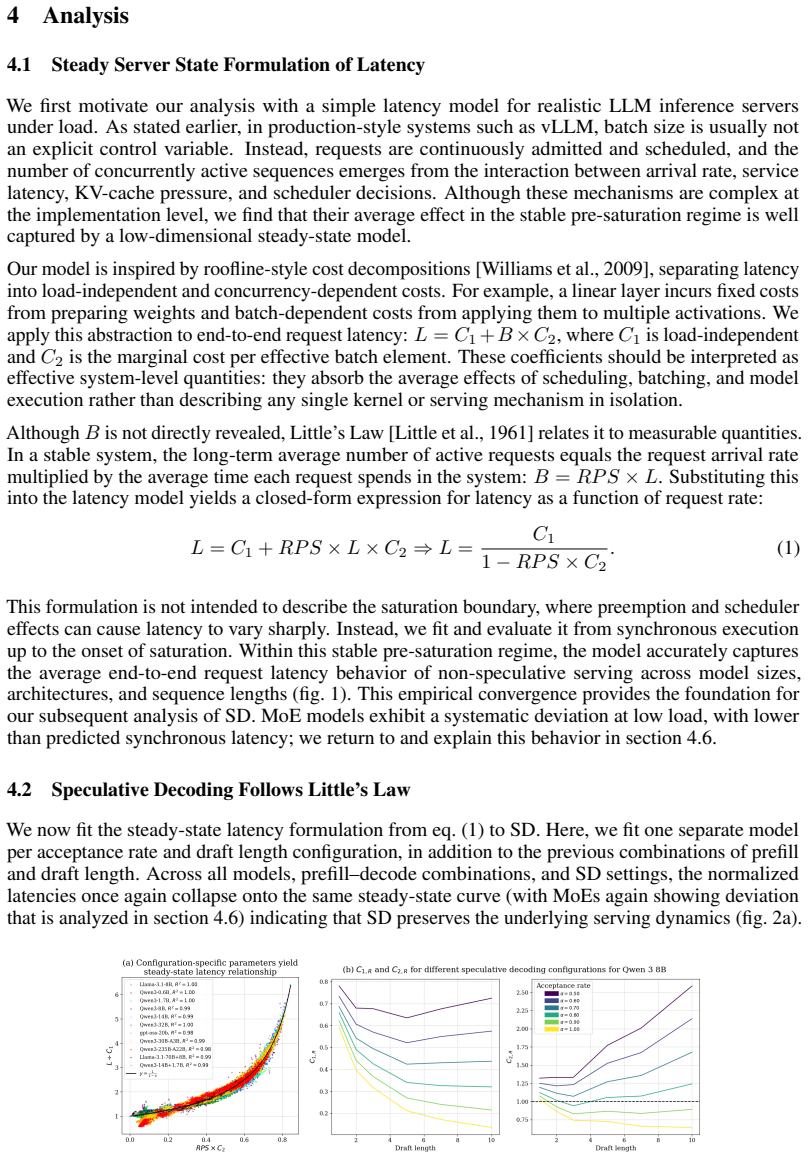
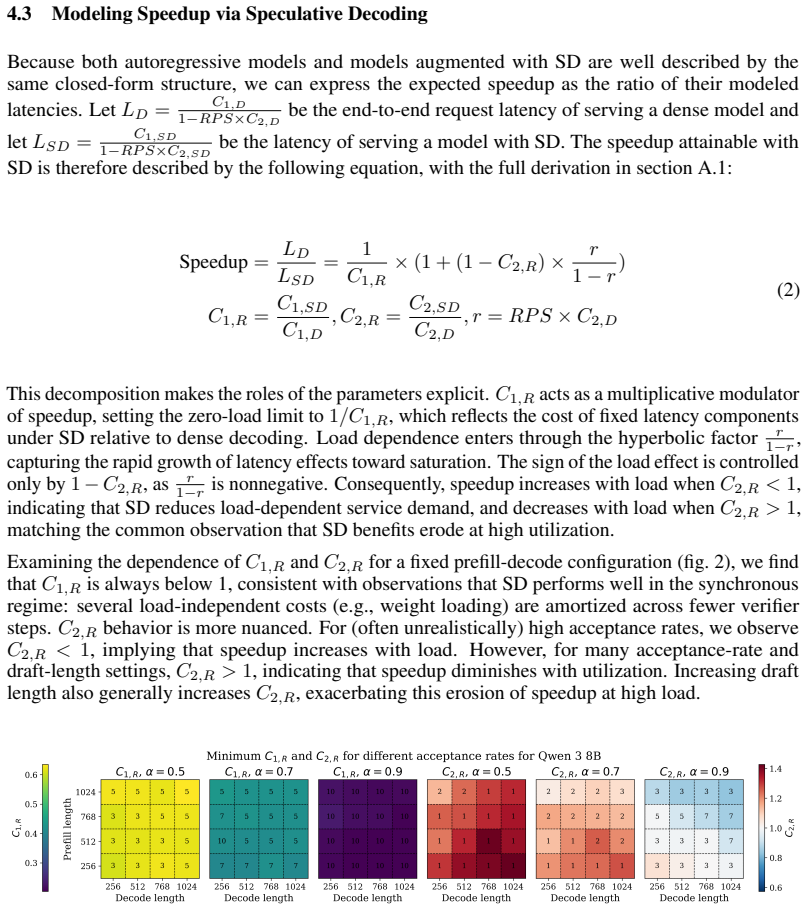


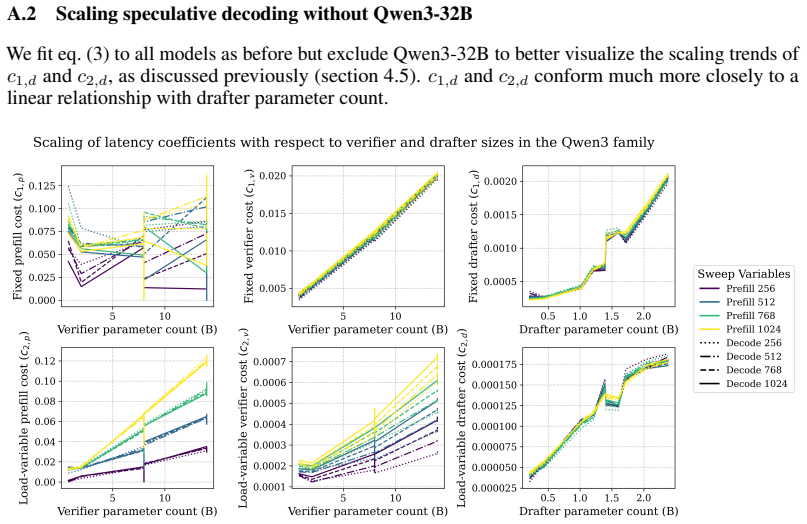


read the original abstract
Speculative decoding (SD) accelerates large language model (LLM) inference by using a smaller draft model to propose multiple tokens that are verified by a larger target model in parallel. While prior work demonstrates substantial speedups in isolated or fixed-batch settings, the behavior of SD in production serving systems remains poorly understood: request load varies over time, and effective batch size emerges from the serving system rather than being directly controlled or observed. In this work, we develop a simple and interpretable latency model for SD in LLM serving. We infer effective batch size from request rate using Little's Law and decompose per-request demand into load-independent and load-dependent components for prefill, drafting, and verification. We validate our model using extensive measurements from vLLM across verifier and drafter model sizes, prefill and decode lengths, request rates, draft lengths, and acceptance probabilities. The model accurately describes observed latency, explains why speedups often diminish as server load increases, and characterizes how draft length, acceptance rate, and verifier-drafter size shape latency across serving conditions, with implications for configuring SD in deployed systems. We further show how the framework extends to mixture of experts models, where sparse expert activation changes the effective service costs across load regimes. Together, our results provide a structured framework for understanding SD in real LLM serving systems.
Editorial analysis
A structured set of objections, weighed in public.
Referee Report
Summary. The paper develops an interpretable latency model for speculative decoding (SD) in LLM serving. It applies Little's Law to infer effective batch size from request rate and decomposes per-request demand into load-independent and load-dependent components for prefill, drafting, and verification phases. Extensive vLLM measurements across verifier/drafter sizes, prefill/decode lengths, request rates, draft lengths, and acceptance probabilities are used to show that the model accurately reproduces observed latencies, explains the erosion of SD speedups at higher loads, and characterizes the influence of draft length, acceptance rate, and model sizes, with an extension to mixture-of-experts models.
Significance. If the decomposition and predictions hold, the work supplies a practical, interpretable framework for configuring SD under variable production load, an area left open by prior isolated or fixed-batch studies. The broad empirical sweep and use of Little's Law as an external anchor are strengths; the MoE extension further increases relevance for modern serving stacks.
major comments (1)
- [Model derivation and validation] Model section (inferred from abstract and validation description): the load-dependent demand components are fitted from the same measurement sweeps used for validation. This makes the claim that the model 'accurately describes observed latency' partly tautological; a clearer statement of how the two-parameter fit is performed, whether any data are held out, and whether the components remain stable when load, hardware, or acceptance probability move outside the fitted range would be required to support the predictive use case.
minor comments (2)
- [Abstract and validation] Abstract and § on validation: the ranges of prefill/decode lengths, model sizes, and acceptance probabilities are described at a high level; explicit tables or figures listing the exact parameter grids would improve reproducibility.
- [Model] Notation: the distinction between 'demand' and 'latency' components should be defined once with symbols before the decomposition is applied.
Simulated Author's Rebuttal
We thank the referee for their constructive review and recommendation for minor revision. We address the single major comment below and will incorporate the requested clarifications.
read point-by-point responses
-
Referee: [Model derivation and validation] Model section (inferred from abstract and validation description): the load-dependent demand components are fitted from the same measurement sweeps used for validation. This makes the claim that the model 'accurately describes observed latency' partly tautological; a clearer statement of how the two-parameter fit is performed, whether any data are held out, and whether the components remain stable when load, hardware, or acceptance probability move outside the fitted range would be required to support the predictive use case.
Authors: We agree that the manuscript would benefit from greater transparency on this point. The load-dependent demand parameters are estimated from the same vLLM measurement sweeps. In the revision we will expand the model section to state explicitly that the two parameters per phase are obtained by least-squares minimization of the difference between predicted and measured per-request latency versus effective batch size (inferred via Little's Law) for each fixed configuration. No hold-out data were used; the fitting is performed independently per configuration to isolate the load-dependent component while the load-independent component is taken from low-load measurements. We will also add a paragraph noting that the fitted parameters remain consistent in magnitude across the wide range of verifier/drafter sizes, prefill/decode lengths, draft lengths, and acceptance probabilities tested, which provides evidence of stability within the measured regimes. For hardware or acceptance rates outside this range we will acknowledge that re-estimation may be required and that the current experiments do not constitute out-of-distribution validation. revision: yes
Circularity Check
No significant circularity identified
full rationale
The paper applies Little's Law (an external, standard result) to infer effective batch size from request rate, then introduces an empirical decomposition of per-request demand into load-independent and load-dependent terms for different phases. This decomposition is fitted to measurements and validated across wide experimental sweeps in vLLM. No quoted equations or steps reduce the model's predictions to the fitted inputs by construction, nor does any self-citation chain bear the central claim. The work is an empirical modeling effort whose validation is independent of the derivation itself.
Axiom & Free-Parameter Ledger
free parameters (2)
- load-independent demand components
- load-dependent demand components
axioms (1)
- standard math Little's Law relates average number of items in a system to arrival rate and average time in system.
Reference graph
Works this paper leans on
-
[1]
gpt-oss-120b & gpt-oss-20b Model Card
Sandhini Agarwal, Lama Ahmad, Jason Ai, Sam Altman, Andy Applebaum, Edwin Arbus, Rahul K Arora, Yu Bai, Bowen Baker, Haiming Bao, et al. gpt-oss-120b & gpt-oss-20b model card.arXiv preprint arXiv:2508.10925,
work page internal anchor Pith review Pith/arXiv arXiv
-
[2]
Zihao An, Huajun Bai, Ziqiong Liu, Dong Li, and Emad Barsoum. Pard: Accelerating llm inference with low-cost parallel draft model adaptation.arXiv preprint arXiv:2504.18583,
-
[3]
Medusa: Simple LLM Inference Acceleration Framework with Multiple Decoding Heads
Tianle Cai, Yuhong Li, Zhengyang Geng, Hongwu Peng, Jason D Lee, Deming Chen, and Tri Dao. Medusa: Simple llm inference acceleration framework with multiple decoding heads.arXiv preprint arXiv:2401.10774,
work page internal anchor Pith review Pith/arXiv arXiv
-
[4]
Accelerating Large Language Model Decoding with Speculative Sampling
Charlie Chen, Sebastian Borgeaud, Geoffrey Irving, Jean-Baptiste Lespiau, Laurent Sifre, and John Jumper. Accelerating large language model decoding with speculative sampling.arXiv preprint arXiv:2302.01318,
work page internal anchor Pith review Pith/arXiv arXiv
-
[5]
Yichao Fu, Peter Bailis, Ion Stoica, and Hao Zhang. Break the sequential dependency of llm inference using lookahead decoding.arXiv preprint arXiv:2402.02057,
-
[6]
Aaron Grattafiori, Abhimanyu Dubey, Abhinav Jauhri, Abhinav Pandey, Abhishek Kadian, Ahmad Al-Dahle, Aiesha Letman, Akhil Mathur, Alan Schelten, Alex Vaughan, et al. The llama 3 herd of models.arXiv preprint arXiv:2407.21783,
work page internal anchor Pith review Pith/arXiv arXiv
-
[7]
Haiyang Huang, Newsha Ardalani, Anna Sun, Liu Ke, Hsien-Hsin S Lee, Anjali Sridhar, Shruti Bhosale, Carole-Jean Wu, and Benjamin Lee. Towards moe deployment: Mitigating inefficiencies in mixture-of-expert (moe) inference.arXiv preprint arXiv:2303.06182,
-
[8]
EAGLE: Speculative Sampling Requires Rethinking Feature Uncertainty
Yuhui Li, Fangyun Wei, Chao Zhang, and Hongyang Zhang. Eagle: Speculative sampling requires rethinking feature uncertainty.arXiv preprint arXiv:2401.15077, 2024a. Yuhui Li, Fangyun Wei, Chao Zhang, and Hongyang Zhang. Eagle-2: Faster inference of language models with dynamic draft trees.arXiv preprint arXiv:2406.16858, 2024b. Yuhui Li, Fangyun Wei, Chao Z...
work page internal anchor Pith review Pith/arXiv arXiv
-
[9]
Xiaoxuan Liu, Jongseok Park, Langxiang Hu, Woosuk Kwon, Zhuohan Li, Chen Zhang, Kuntai Du, Xiangxi Mo, Kaichao You, Alvin Cheung, et al. Turbospec: Closed-loop speculation control system for optimizing llm serving goodput.arXiv preprint arXiv:2406.14066,
-
[10]
Jonathan Mamou, Oren Pereg, Daniel Korat, Moshe Berchansky, Nadav Timor, Moshe Wasserblat, and Roy Schwartz. Dynamic speculation lookahead accelerates speculative decoding of large language models.arXiv preprint arXiv:2405.04304,
-
[11]
doi:10.1038/s41592-019-0686-2 , eprint =
doi: 10.1038/s41592-019-0686-2. Samuel Williams, Andrew Waterman, and David Patterson. Roofline: an insightful visual performance model for multicore architectures.Communications of the ACM, 52(4):65–76,
-
[12]
An Yang, Anfeng Li, Baosong Yang, Beichen Zhang, Binyuan Hui, Bo Zheng, Bowen Yu, Chang Gao, Chengen Huang, Chenxu Lv, et al. Qwen3 technical report.arXiv preprint arXiv:2505.09388,
work page internal anchor Pith review Pith/arXiv arXiv
discussion (0)
Sign in with ORCID, Apple, or X to comment. Anyone can read and Pith papers without signing in.